
On October 15, 2026, a newly released EY analysis commissioned by Paycom put a specific price on an old back-office problem: $339 per payroll error. For finance leaders, that number changes the crypto payroll conversation. It is no longer only about paying global contractors in digital assets; it is about whether automated, crypto-native payment rails can remove the manual steps that make errors expensive.
Table of Contents
- A $339 Wake-Up Call for Payroll Operations
- Why Payroll Errors Persist and How Much They Really Cost
- Crypto Payroll: A Primer for Finance Leaders
- The Automation Advantage: Can Crypto Payroll Prevent Costly Mistakes?
- From Theory to Practice: Integrating Crypto Payroll with a Neo-Banking Platform
- What Finance Leaders Should Watch Next
- Key Takeaways
A $339 Wake-Up Call for Payroll Operations
On October 15, 2026, Paycom announced findings from an EY survey it commissioned, reported by Business Wire via Yahoo Finance. The updated analysis found the average cost to correct a payroll error is now $339, up nearly 20% from EY’s 2022 findings. Survey respondents also reported payroll errors occurring in 1 in 5 payrolls.
The EY payroll error survey adds a second, less visible number: for a 1,000-employee company, correcting the most time-consuming errors can take more than six months of staff time. Paycom’s founder and CEO, Chad Richison, put the operational goal bluntly: “The best payroll error is the one that never happens.” Paycom’s own automated payroll customers reduced time spent correcting errors by 85%, according to the release.
The short-term lesson is not that every payroll team should immediately switch to crypto. It is that payroll error costs are now high enough to justify evaluating infrastructure changes, not just better manual controls.
Why Payroll Errors Persist and How Much They Really Cost
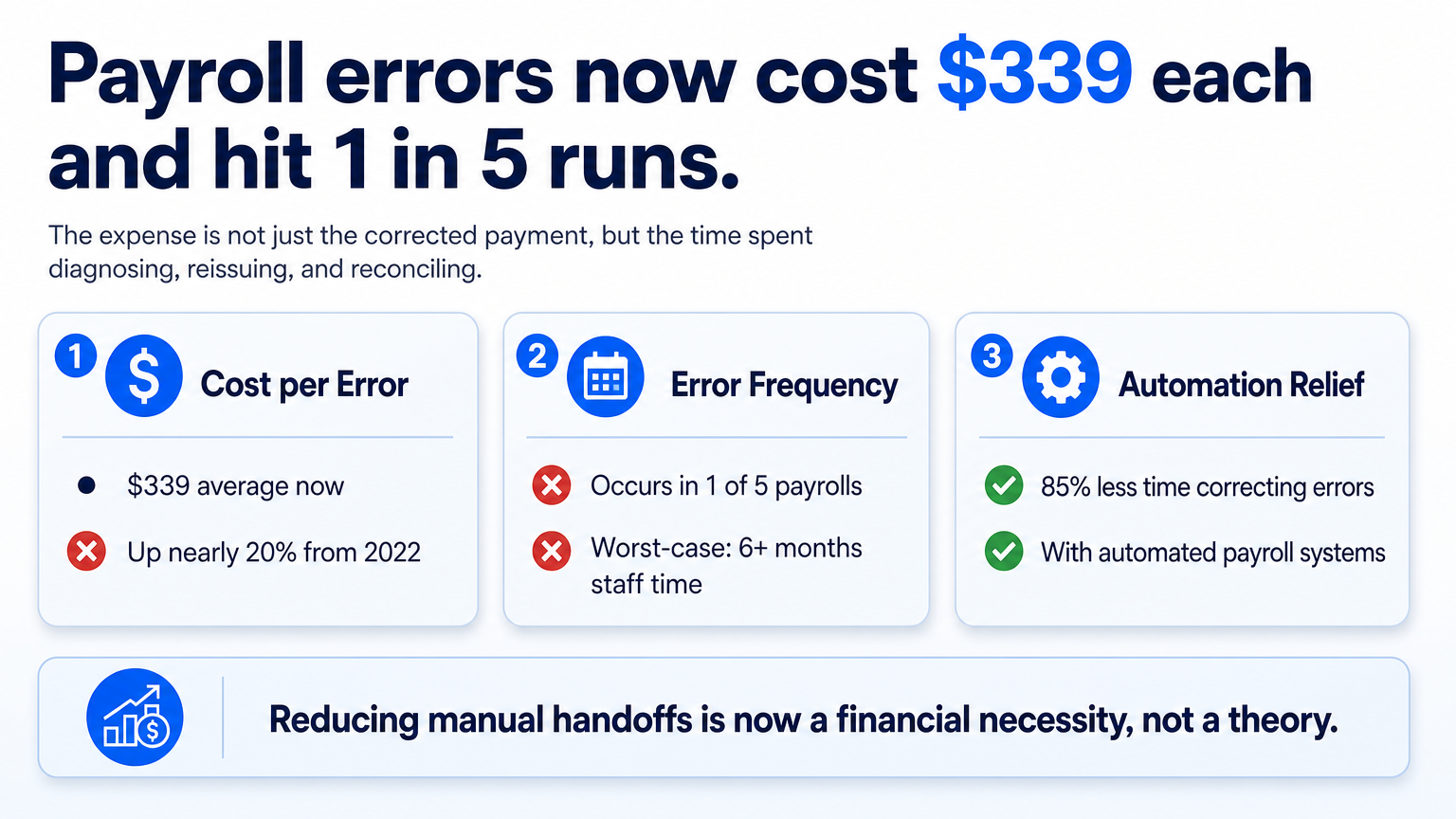
Payroll errors are rarely a single dramatic failure. They come from manual data entry, misapplied tax codes, stale bank details, off-cycle corrections, and currency conversion mistakes on cross-border payments. Paycom’s 2026 breakdown of the real cost of payroll errors reinforces the pattern: the expense is not just the corrected payment, but the time spent diagnosing, reissuing, and reconciling.
The newest data makes that cost concrete:
| Metric | Value | Source |
|---|---|---|
| Average cost per payroll error | $339 | EY/Paycom, Oct 15, 2026 |
| Increase from 2022 | nearly 20% | EY/Paycom |
| Payroll runs affected | 1 in 5 | EY/Paycom survey |
| Worst-case correction time | 6+ months staff time (1,000-employee org) | EY/Paycom |
| Time reduction with automated payroll | 85% | Paycom Beti composite |
For finance leaders, the implication is simple. If errors occur in one of every five payroll runs, and each error costs $339 to fix, the financial case for reducing manual handoffs is no longer theoretical.
Crypto Payroll: A Primer for Finance Leaders
What is crypto payroll?
Crypto payroll is the practice of paying employees or contractors in cryptocurrency, usually through a platform that handles calculation, tax withholding, and settlement. In most practical implementations, the payment asset is a stablecoin such as USDC, not bitcoin. That means the employee or contractor receives a token designed to hold a stable value, then either holds it or converts it to local fiat.
How Crypto Payroll Differs from Traditional Methods
Traditional payroll moves through an employer bank, a payroll processor, clearing networks, and employee bank accounts. Each handoff creates room for stale account data, failed ACH files, and delayed reconciliation.
Cross-border crypto payroll settles using wallet addresses on a blockchain. The transaction either executes or fails on-chain, and the record is visible immediately. Smart-contract-based payroll can also trigger recurring payments automatically when preset conditions are met, reducing the need for a payroll administrator to push every file manually. As of September 2026, Franklin Templeton launched a tokenized U.S. Government Money Market Fund on Solana, enabling institutional on-chain yield for cash equivalents used in payroll funding, according to a company announcement covered by The Block. That points toward a future where idle payroll float earns yield natively rather than sitting in a zero-interest operating account. Meanwhile, Bitwage reported in December 2025 that USDC payroll volume on its platform grew 3.5x year-over-year through Q3 2025, with over 45% of that volume flowing to Latin American and Southeast Asian contractors, per the company’s 2025 Annual Crypto Payroll Report.
Global payroll automation becomes more realistic when the settlement layer is programmable. That does not mean crypto payroll removes gross-to-net calculation, benefits logic, or local tax compliance. The difference is in the settlement and reconciliation layer: fewer manual bank files, fewer rejected transfers, and faster visibility into whether a payment landed.
Stablecoins as the Backbone of Practical Crypto Payroll
Volatility is the most common objection to crypto payroll. Stablecoin payroll addresses that objection directly by using assets engineered for price stability. USDC is a common settlement asset because it is designed to hold a 1:1 value with the U.S. dollar and is supported across many payroll and treasury tools, as Toku’s 2026 stablecoin payroll software guide outlines.
Regulatory treatment remains uneven. France’s proposed 31% tax treatment for stablecoins, detailed in Stablecoin Regulation: France’s 31% Tax Plan Explained, shows how quickly local rules can reshape the economics of stablecoin payroll. That is not a reason to avoid the category; it is a reason to treat compliance as an operating requirement.
What are the key advantages of crypto payroll over traditional payroll?
The concrete crypto payroll benefits for finance teams are:
- Faster cross-border settlement with fewer intermediary banks.
- Lower fees in some corridors where wire and SWIFT charges dominate.
- A transparent, auditable ledger for each settlement.
- Programmable payment schedules through automated workflows.
- Cleaner contractor payouts for globally distributed teams and DAOs.
The trade-off is equally real. A domestic-only, single-currency payroll with low error rates may not justify the added compliance work. The strongest use case is global, multi-currency, contractor-heavy payroll or a team already holding stablecoins.
The Automation Advantage: Can Crypto Payroll Prevent Costly Mistakes?
How does crypto payroll reduce payroll errors?
Crypto payroll automation matters because it compresses the number of manual touchpoints. Wallet addresses are verified before funds move, smart contracts can enforce payment amounts and schedules, and the transaction record is generated automatically. Sablier’s guide for DAOs and startups makes a similar case: automated payment streams can handle recurring payroll without a CFO manually approving every transfer (Sablier).
But there is a warning that finance leaders should not ignore: if the gross amount, tax withholding, or wallet address is wrong at input, an automated crypto payment can be irreversible faster. The benefit is that verification can be built into the workflow. Pre-funded balances, allowlisted wallet addresses, and role-based approvals reduce the fat-fingered account numbers and duplicate manual entries that drive the $339 error cost.
Is crypto payroll safe and compliant?
The honest answer is that it depends on the provider and jurisdiction. Safety is a custody and operational issue: strong encryption, multi-factor authentication, and reputable digital asset custody matter. Compliance is a legal issue: employers still owe payroll taxes, withholding, and reporting. Many jurisdictions have guidance but not explicit, comprehensive crypto payroll laws.
The CFTC’s rulemaking is altering what qualifies as compliant payroll activity in certain circumstances, as covered in CFTC Rulemaking Reshapes Crypto Payroll – What to Know. Privacy features add another layer: payroll tools with stealth addresses or zone-based controls may change how employee salary data is handled.
One distinction finance teams should not gloss over: a nonbank crypto platform is not automatically a bank, and crypto held there is not automatically FDIC-insured. The platform may be a technology provider with banking services through partners. That distinction affects how funds are held, how employees perceive safety, and how a treasury team sets internal controls.
From Theory to Practice: Integrating Crypto Payroll with a Neo-Banking Platform

Why a Crypto-Native Business Account Matters
A common error point is not the payroll software itself, but the handoff between the funding account and the payroll system. A finance team that runs payroll in fiat, manually converts to stablecoins on an exchange, then sends funds to employee wallets has created three new failure points: wrong conversion timing, mismatched balances, and duplicate approvals.
A crypto-native business account removes part of that friction. The broader shift away from debanking makes a unified fiat-and-crypto account more relevant for crypto-native businesses, as explored in Debanking Drives Crypto Treasury Management Adoption.
OneSafe, for example, is a financial technology company—not a bank—that provides neo-banking services through banking partners and supports fiat accounts, USDC on/off-ramps, FX, and automated payment workflows in one interface. For a global team, that means payroll can be funded in USD, settled in USDC, and off-ramped to local fiat without moving between disconnected platforms. That is the operational link between neobank payroll and error reduction: fewer manual transfers means fewer failures to reconcile.
What to Look For in a Payroll Platform
Before choosing among crypto payroll platforms, finance leaders should check:
- Settlement rails: Does it support USDC or comparable stablecoins with low-cost or free crypto withdrawals?
- Fiat off-ramp: Can recipients convert to local currency, and at what FX cost?
- Automated workflows: Are recurring payments, role-based approvals, and accounting integrations native rather than bolt-on?
- Custody and security: Who holds the digital assets? Are MFA and institutional-grade custody mandatory?
- Compliance footprint: What KYB/KYC is required? Which jurisdictions are excluded?
- Error visibility: Does the platform provide real-time status and an audit trail for each payroll run?
Eco’s 2026 crypto payroll platform comparison is a useful starting point, but the account layer matters as much as the payroll software. A payroll tool that cannot natively settle with a crypto-friendly business account will force manual conversion and reintroduce the failure points finance leaders are trying to remove.
What Finance Leaders Should Watch Next
Three developments deserve attention after the $339 data point.
Regulatory detail, not headlines. Watch for jurisdiction-specific guidance on stablecoin payroll, especially after the CFTC’s rulemaking and evolving EU e-money token treatment. The compliance roadmap will determine whether stablecoin payroll becomes a mainstream option or stays a corridor-by-corridor decision.
Privacy-preserving payroll features. Salary visibility and data leakage are becoming differentiators in crypto payroll tools. Finance leaders will need to evaluate whether privacy features conflict with internal audit or local tax reporting, as covered in Crypto Payroll Privacy: What Tempo’s Zones Means for Your Company.
Broader stablecoin infrastructure. Large financial players are expanding stablecoin payment capabilities, a shift analyzed in JPMorgan’s Stablecoin Push Shakes Up Stablecoin Payments. That should improve fiat-to-stablecoin settlement cost and reliability, lowering one more source of payroll error costs.
Open questions remain: Will the $339 average persist into 2027? Will regulators standardize payroll tax treatment for stablecoins? And will enterprise payroll providers integrate crypto rails natively rather than through third-party wrappers?
Key Takeaways
- The average cost to correct a payroll error is now $339, up nearly 20% from 2022, with errors reported in 1 of 5 payrolls.
- Crypto payroll does not erase payroll error costs by itself; the value comes from automated settlement, address verification, and fewer manual bank files.
- Stablecoin payroll in USDC reduces volatility risk, but tax and regulatory treatment still varies by jurisdiction and continues to evolve.
- Finance leaders should evaluate the account layer—fiat accounts, crypto on/off-ramps, and automated workflows—alongside the payroll software itself.
- Use the $339 figure as a budgeting trigger: estimate error frequency in your payroll runs, then compare the cost of manual correction against integrated crypto payroll automation.
Ready to evaluate a fiat-and-crypto business account for multi-currency and stablecoin payroll? Open a OneSafe account.



