Table of Contents
- description: "Binance breach 2026 shows why secure crypto custody matters. Crypto banking news and lessons for startups and DAOs after the $6.3B theft."
- What Happened: The Binance $6.3 Billion Breach
- Why This Matters for Crypto Banking Users Now
- The Weak Links That Enabled the Theft
- What Secure Crypto Banking Looks Like in Practice
- Immediate Actions for Startups and DAOs
- What to Watch Next: Fallout and Open Questions
- Key Takeaways
description: "Binance breach 2026 shows why secure crypto custody matters. Crypto banking news and lessons for startups and DAOs after the $6.3B theft."
Crypto Banking Lessons from the $6.3B Binance Heist
When the largest theft in history hits a major exchange, it’s not just a headline—it’s a stress test for every crypto banking platform and the businesses that depend on them. On October 30, 2026, Binance confirmed that a security incident had enabled unauthorized withdrawals of around $6.3 billion. As this crypto banking news unfolds, the breach offers a forensic wake‑up call for founders, treasury managers, and DAO operators, forcing a hard question: could your crypto banking infrastructure withstand a similar attack?
What Happened: The Binance $6.3 Billion Breach
Timeline and Scale of the Attack
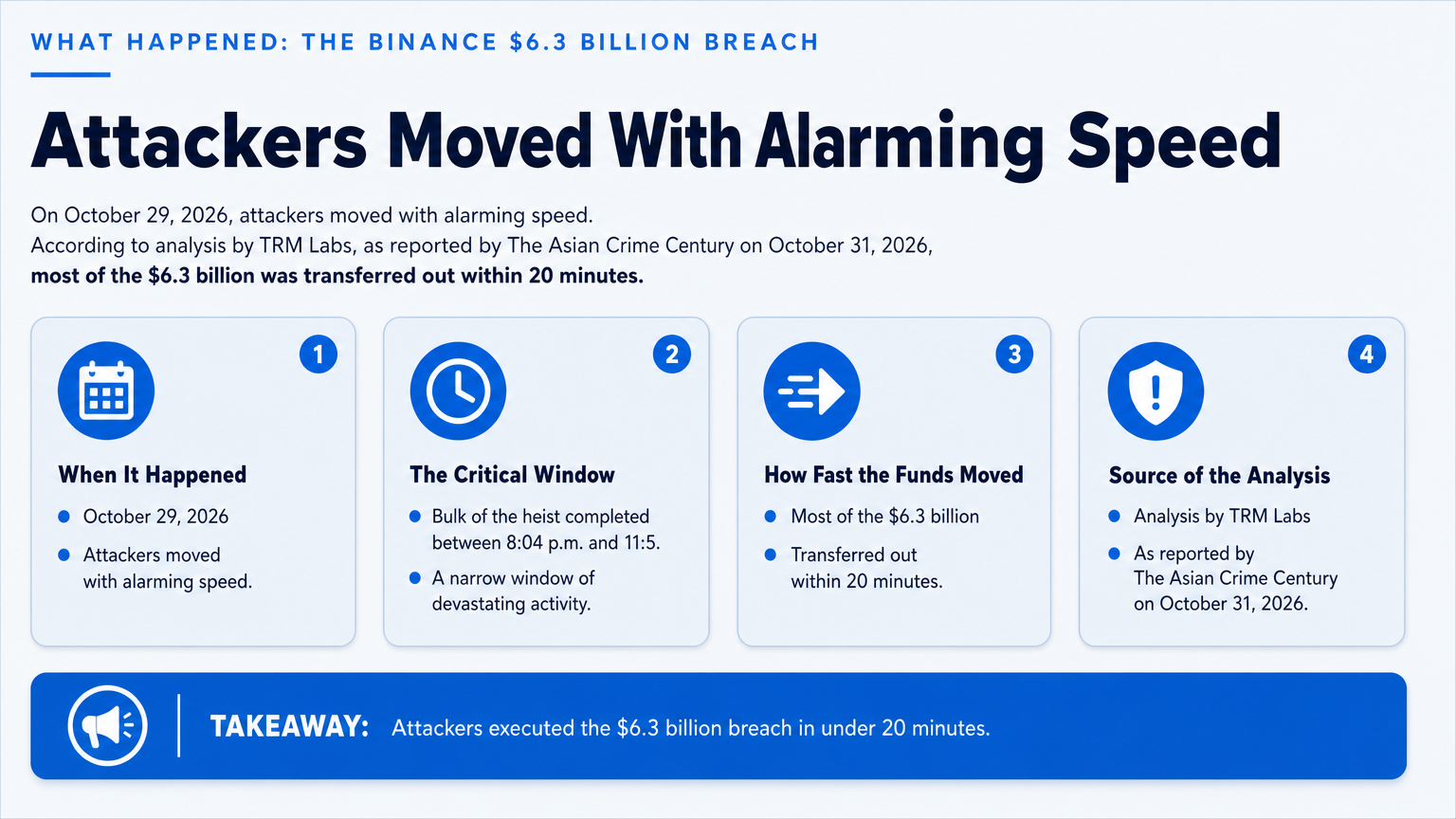
On October 29, 2026, attackers moved with alarming speed. According to analysis by TRM Labs, as reported by The Asian Crime Century on October 31, 2026, most of the $6.3 billion was transferred out within 20 minutes—the bulk of the heist completed between 8:04 p.m. and 11:56 p.m. UTC. The exploit leveraged a compromised engineer’s laptop plus “additional points of breach” to access Binance’s internal withdrawal systems. Bitquery reported on October 30, 2026 that $2.7 billion was frozen by Tether, Circle, Arbitrum, and four smaller issuers, but $729 million was swapped into other cryptocurrencies, and $3.2 billion remains in wallets controlled by the perpetrators. Elliptic stated that this is the largest theft of any kind in history, surpassing all previous crypto hacks combined.
Who Was Behind It?
Elliptic linked the laundering network to the Democratic People’s Republic of Korea (North Korea), as reported by The Asian Crime Century on October 31, 2026. The criminals used a Chinese-language underground banking system that serves online fraud compounds in Southeast Asia—a well‑documented channel for North Korea crypto theft operations. The attribution is consistent with a pattern of state‑sponsored thefts targeting crypto platforms to fund the regime’s activities.
Why This Matters for Crypto Banking Users Now
Impact on Trust in Centralized Platforms
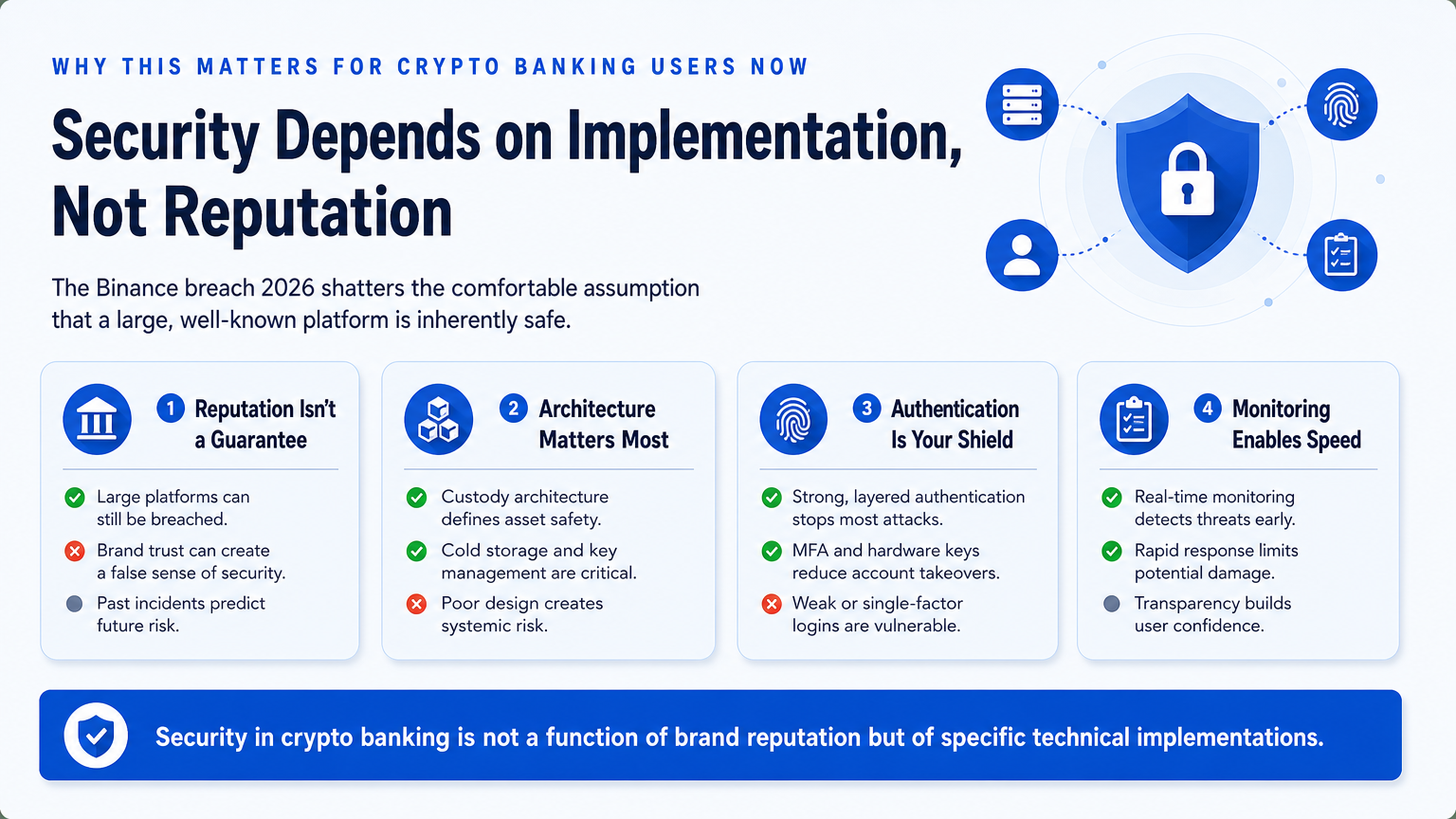
The Binance breach 2026 shatters the comfortable assumption that a large, well‑known platform is inherently safe. Security in crypto banking is not a function of brand reputation but of specific technical implementations—the custody architecture, authentication layers, and transaction‑monitoring rules that either stop an insider attack or let $6.3 billion walk out in 20 minutes. For startups and DAOs that route payroll, vendor payments, and treasury holdings through a crypto banking platform, the lesson is immediate: you are only as protected as the weakest link in your partner’s infrastructure.
Regulatory and Operational Consequences
This incident will accelerate regulatory scrutiny on custody practices and anti‑money laundering controls across the crypto banking sector. The Stablecoin Regulation in 2026: SEC Shift and Business Impact already highlighted how U.S. agencies are tightening oversight; now, lawmakers will likely demand that platforms demonstrate robust safeguards, including real‑time transaction velocity checks and mandatory multi‑party controls. The Crypto Treasury Management Shifts After Ripple Charter may accelerate as businesses migrate to qualified custodians with verifiable security postures.
The Weak Links That Enabled the Theft
Compromised Engineer’s Laptop and Insider Risks
The attack was not a sophisticated smart‑contract exploit; it was an old‑fashioned endpoint compromise. A single engineer’s laptop gave attackers the keys to move $6.3 billion. This points to a failure in privileged access management—the engineer likely had broad, unfettered credentials and no hardware‑backed authentication that could have stopped use of a stolen session. In secure crypto custody environments, all administrative access requires phishing‑resistant MFA (such as FIDO2 hardware keys) and just‑in‑time approvals that grant access only when needed.
Lack of Transaction Speed Bumps
The speed of the theft—most funds gone in 20 minutes—reveals an absence of velocity controls. A well‑designed crypto banking system would have triggered automatic freezes or manual approval thresholds for unusually large, rapid outflows. “Speed bumps” like multi‑signature requirements for transactions above a certain value, cooldown periods for address whitelisting, and real‑time anomaly detection are now table stakes for any platform handling institutional volumes.
What Secure Crypto Banking Looks Like in Practice
Are all crypto banking platforms equally vulnerable?
No. Vulnerability is not a binary, brand‑based trait; it depends on how a platform implements custody, authentication, and monitoring. A platform that relies on a single hot wallet with broad administrator access is far more exposed than one using multi‑party computation (MPC) and hardware security modules (HSMs) that distribute signing keys and enforce transaction policies. Elliptic’s attribution of the Binance heist to North Korea underscores that sophisticated adversaries will probe every weak seam. Businesses must treat their crypto banking partner’s security architecture as a variable they can audit, not a promise they must trust.
What security features prevent insider attacks?
Preventing an insider‑enabled heist requires a layered defense, not a single silver bullet. The critical features include:
- Multi‑Party Computation (MPC) and Hardware Security Modules (HSMs) such as those used by Fireblocks custody. These split private keys into shares, never reconstructing the full key in one place, so no single compromised device can authorize a transfer. The FS‑ISAC confirms that combining MPC with strong authentication is foundational for protecting digital assets (Crypto: What We Need to Protect).
- Mandatory Multi‑Factor Authentication (MFA) that goes beyond SMS or email codes—FIDO2 security keys resist phishing and session theft. OneSafe, for example, enforces MFA for every user upon signup and integrates digital asset custody via Fireblocks.
- Role‑based access controls that grant the minimum necessary permissions. An engineer does not need the ability to initiate a $1 billion withdrawal; that privilege should require multiple approvals from different roles.
- Transaction monitoring and velocity limits that automatically block or delay transfers exceeding size or frequency thresholds, especially when assets are moved to unfamiliar addresses. Mastercard’s Crypto Secure illustrates how real‑time risk assessments can catch anomalous patterns (Crypto Secure: Protect Digital Assets and Crypto Payments), a capability every crypto bank for startups should emulate.
How to choose a safe crypto banking partner for your business?
Due diligence must go beyond glossy security pages. Request a technical walkthrough of the platform’s custody model, key‑management protocols, and incident‑response plan. Specifically, verify:
| Security Dimension | What to Ask | Why It Matters |
|---|---|---|
| Custody infrastructure | Is digital asset custody provided by a qualified custodian like Fireblocks? How are keys generated, stored, and used? | Eliminates single‑point compromise; MPC wallets can enforce policy controls that prevent mass exfiltration. |
| Authentication & access | Is phishing‑resistant MFA mandatory for all users? Can you enforce hardware keys? | Stops credential theft from turning into unauthorized transfers. |
| Transaction controls | Are there configurable velocity limits, multi‑signature rules, and address whitelisting with time‑delay? | Adds friction that would have stalled the Binance theft before $6.3B moved. |
| Segregation of funds | Are customer assets held separately from operational funds? Can you see on‑chain proof? | Protects against commingling and makes recovery possible in a breach. |
| Compliance and monitoring | Does the platform integrate chain analytics (e.g., Elliptic, Chainalysis) and screen for sanctioned entities? | Crucial for deterring North Korea‑linked laundering and meeting AML requirements under upcoming regulations. |
For example, a business crypto account with a platform like OneSafe—which uses Fireblocks for custody and mandates MFA—directly addresses many of the architectural weaknesses exploited in the Binance breach. Similarly, Ripple Charter Reshapes Crypto Treasury Management shows that qualified custody is becoming a regulatory baseline; businesses should demand it now, not later.
Immediate Actions for Startups and DAOs
What can startups learn from the Binance hack?
Startups often prioritize speed and convenience in banking relationships, but the Binance breach proves that security gaps can wipe out years of runway in minutes. Actionable steps:
- Audit your current crypto banking platform. Demand evidence of MPC or HSM custody, mandatory MFA, and transaction velocity controls. If the provider cannot supply a SOC 2 Type II report or equivalent, consider migrating.
- Enforce internal access policies. Even if the platform has strong controls, your own team’s practices matter. Require hardware security keys for all finance‑related accounts. Never share administrative credentials.
- Set up withdrawal limits at the partner level. Many crypto banking platforms allow businesses to impose per‑transaction or daily caps that require multiple approvals to bypass.
- Separate operational from reserve funds. Keep the bulk of treasury assets in a time‑locked, multi‑sig wallet that is not connected to the day‑to‑day payment infrastructure. Only what’s needed for near‑term obligations should sit in hot accounts.
Finally, to keep stakeholders and customers informed about the security measures you’re adopting, consider using a service like Joyrise: your blog, written and published every day—it plans, writes and publishes illustrated SEO articles to your Webflow blog every day. Read your first article before you pay.
How should DAOs secure their crypto treasury?
DAOs face unique challenges because governance is often distributed across token holders, yet a treasury is managed by a small set of signers. The Binance insider angle makes it clear: a single compromised contributor can drain the treasury if controls are not programmatic and transparent. Best practices for DAO banking:
- Implement multi‑sig for all treasury movements. Use a Gnosis Safe or similar with a threshold that requires multiple independent signers from different entities. This mitigates the single‑point‑of‑failure risk that doomed Binance.
- Use a crypto banking platform that supports DAO‑native permissions. OneSafe offers customizable roles and permissions along with segregated accounts and automated payment workflows—so that even if one key person’s device is compromised, the attacker cannot unilaterally initiate a transfer.
- Enforce on‑chain transparency. The treasury should be visible on‑chain, and every significant outflow should be accompanied by a governance proposal. This not only deters rogue actions but also simplifies auditing.
- Leverage speed bumps. Route all transactions through a platform that imposes time‑delays for new addresses and requires secondary approval for amounts above a DAO‑defined threshold.
- Integrate with real‑time monitoring. Services that alert on suspicious patterns (e.g., large, unusual outflows to unknown addresses) can give the DAO a chance to intervene before funds are gone, much like the $2.7 billion that Tether and Circle froze.
The Crypto Payroll After Ripple’s OCC Charter: Analysis also underscores how regulatory clarity on stablecoins can give DAOs more predictable on‑ramp/off‑ramp paths, so long as the banking partner’s security holds.
What to Watch Next: Fallout and Open Questions
Will North Korea's Involvement Trigger New Sanctions on Crypto?
Given the direct attribution to North Korean cyber‑crime infrastructure, the U.S. Treasury’s Office of Foreign Assets Control (OFAC) is almost certain to designate additional addresses, and possibly expand sanctions on platforms that fail to screen for North Korea‑linked laundering. This could accelerate the demand for crypto banking security features such as automated sanctions screening and real‑time wallet labeling—making them a prerequisite, not a differentiator. The Stablecoin Regulation After the SEC’s Crypto Shift: What Businesses Must Know indicates that compliance frameworks are already tightening; the Binance incident will only add fuel.
Are Other Exchanges and Banking Platforms at Risk?
Any platform that centralizes custody without the layered controls described above is at risk. The stolen $3.2 billion remains in perpetrator‑controlled wallets, and the infrastructure used to launder it—Chinese underground banking networks—is operational. Businesses should assume that threat actors are already probing other exchanges and crypto banking platforms for similar chinks in privileged access and transaction monitoring. The market will likely bifurcate into platforms that can demonstrate MPC‑based custody, MFA, and velocity limits, and those that cannot—with capital flowing toward the former.
Key Takeaways
- The $6.3 billion Binance breach, executed in under 20 minutes via a compromised engineer’s laptop, proves that brand reputation is not a substitute for verifiable security architecture.
- Startups and DAOs must demand that their crypto banking platform uses MPC or HSM custody, phishing‑resistant MFA, transaction velocity controls, and segregated accounts.
- DAOs need programmatic multi‑sig, on‑chain transparency, and role‑based permissions to eliminate single‑point‑of‑failure risks, mirroring the controls OneSafe integrates with Fireblocks.
- North Korea’s involvement will likely trigger new sanctions and tighter AML requirements, making sanctions‑screening a non‑negotiable feature of any business crypto account.
- Assess your banking partner now by auditing custody, access controls, and incident response—don’t wait for the next headline.
Ready to move your treasury to a crypto banking platform built with MPC custody, mandatory MFA, and DAO‑native controls? Open a OneSafe account and bring your fiat and crypto finances under one secure roof.