On October 31, 2026, Binance disclosed a $6.3 billion hack—the largest in crypto history—and simultaneously announced it had covered 90% of the loss from its own treasury. Co-CEO Richard Teng assured users they would bear no financial hit. For businesses using crypto banking for payroll, vendor payments, and cross-border treasury, the breach raises a deeper question: Where exactly were those assets held, and what stood between them and an attacker?
The answer is different when you bank on an exchange versus on a purpose-built crypto banking platform. This piece breaks down what just happened, why the distinction matters right now, and the concrete steps every business should take to protect its fiat and digital funds.
Table of Contents
- What happened during the Binance hack on October 31, 2026, and how was it handled?
- How does this incident affect businesses that use crypto banking services?
- What security measures should a business look for when choosing a crypto banking platform?
- How does OneSafe protect business assets from similar threats?
- What immediate steps can a business take to improve the security of its crypto and fiat funds?
- What regulatory or insurance changes might follow this hack?
- Key Takeaways
What happened during the Binance hack on October 31, 2026, and how was it handled?
The October 31 attack—one of crypto’s largest thefts
On October 31, Binance reported an attacker drained $6.3 billion in digital assets. No technical details were disclosed—whether private-key compromise, insider exploit, or bridge vulnerability—but the scale became the largest crypto theft on record.[^1] The figure moves the threat from “state-sponsored” to “systemic.”
Company absorbs loss: 90% replenished, users protected
Binance’s response was a rare corporate backstop. “We’ve now replenished 90% of the stolen assets, and we’re committed to covering the remaining 10%,” Teng posted on X.[^1] The company used treasury funds to buy replacement tokens (the remaining 10% are less-liquid tokens). Markets dipped then steadied when users learned they would not lose money.
For retail users, the coverage brought relief. For businesses, it signaled the need to scrutinize their crypto banking relationships.
How does this incident affect businesses that use crypto banking services?
Exchange accounts vs. crypto banking platforms—where your funds truly sit
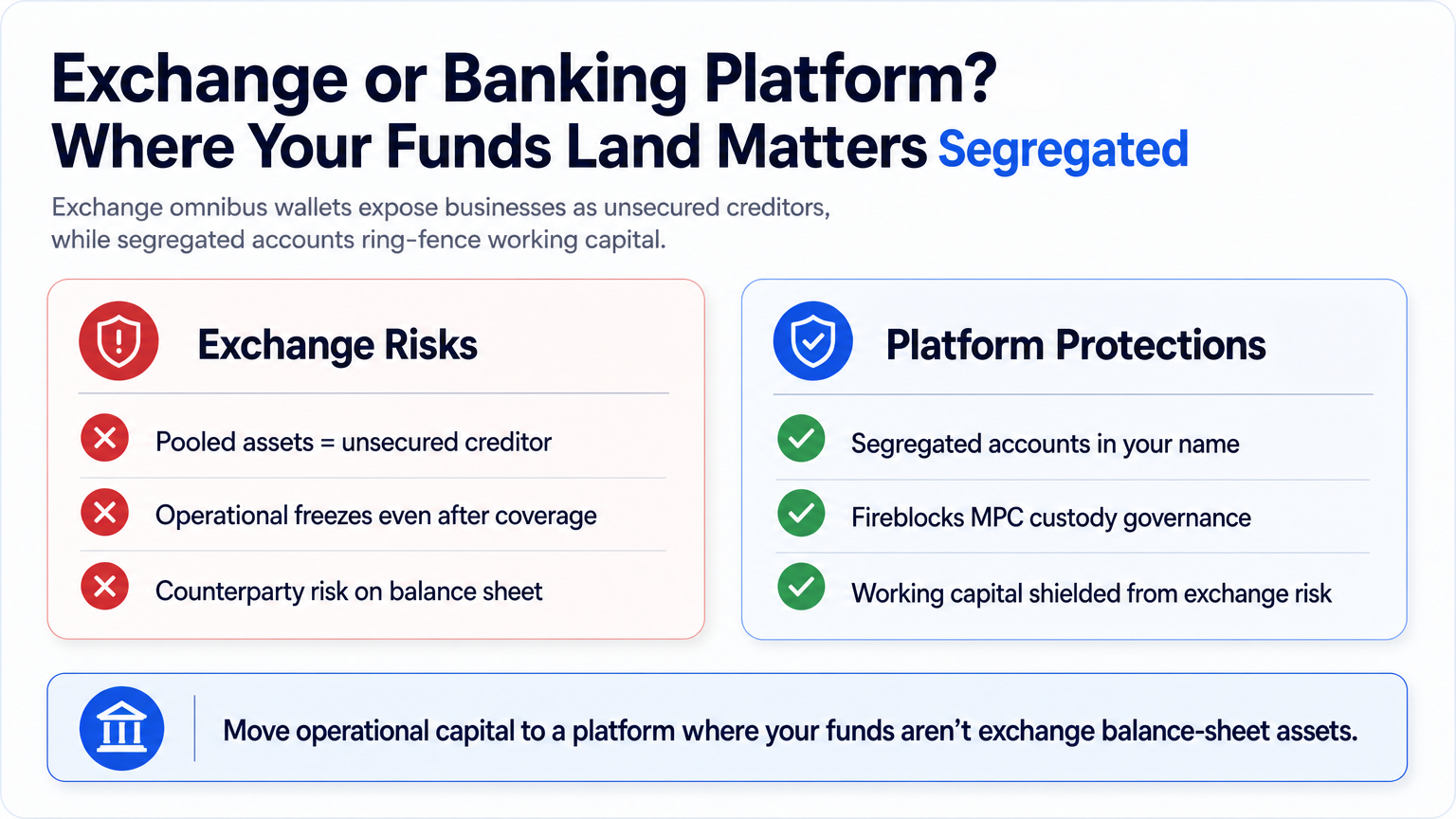
On a centralized exchange, business assets sit in omnibus wallets, making the company an unsecured creditor. If the exchange faces a loss, liquidity freezes and counterparty risk spikes—even if the exchange later covers the funds. A crypto banking platform with segregated accounts, by contrast, ring-fences client assets from its own balance sheet, typically via trust or institutional custody (e.g., Fireblocks). The Binance hack turns this distinction into a dollars-and-cents calculation.
Operational risk: when an exchange’s balance sheet backs your working capital
For startups and DAOs running payroll and supplier payments on exchanges, even a breach that is eventually covered can freeze operations for hours or days. Investigations trigger fund-freezes and withdrawal delays. Tying working capital exclusively to one exchange means your liquidity hinges on that entity’s balance sheet—exactly the risk that modern crypto payroll solutions already force businesses to address, especially when timing is everything.
What security measures should a business look for when choosing a crypto banking platform?
Custody done right: why Fireblocks and institutional-grade vaults matter
Mature custody moves private keys off the application layer. Fireblocks uses MPC and HSMs so no single person or machine can sign alone. Institutional vaults add governance—spending policies, time-locks, quorum approvals—turning a private key into a business process. FS-ISAC notes that security starts with key management, not perimeter defense.[^2] When evaluating a crypto banking platform, ask if custody is MPC-based, air-gapped, or still a hot-wallet model with keys online.
Segregated accounts and insurance—how to verify real protection
Segregated accounts hold funds in your business’s name, off the platform’s balance sheet. Traditional banks offer pass-through FDIC insurance on fiat deposits (OneSafe is a technology company; banking services come from partner banks). For crypto, demand crime insurance that covers client digital asset theft, not just the platform’s own treasury. Check the policy’s scope, sub-limits, and insurer. If a provider can’t answer clearly, you’re self-insuring. The Binance lesson: who carries the liability?
Access controls and compliance: multi-factor authentication beyond the basics
Every platform offers MFA. A business-grade crypto banking platform adds hardware-token MFA, whitelisted withdrawal addresses, role-based limits, and multi-approval thresholds. For DAOs, granular permissions prevent a single signer from draining a multi-sig. Fraud tools like Mastercard’s Crypto Secure now apply network-level threat intelligence to flag suspicious wallets before a payment completes.[^3]
How does OneSafe protect business assets from similar threats?
Fireblocks-integrated custody with segregated global accounts
OneSafe is a financial technology company, not a bank. Its architecture segregates client assets from its own, with digital assets custodied through Fireblocks (MPC governance, no keys on OneSafe servers). Multi-currency accounts support USD, EUR, CAD, and stablecoins via partner banking rails. Client funds sit in accounts opened in the business’s own name, not pooled with corporate cash. For startups and DAOs moving millions in payroll, this prevents an operational disruption at the platform from automatically locking up working capital.
Mandatory MFA, encryption, and a compliance-first design
MFA is mandatory at signup. Encryption covers data at rest and in transit. Full KYB verification (formation documents, government ID, EIN for U.S. entities) reduces the risk of the platform becoming a vector for illicit funds, which can cause account freezes for innocent counterparties.
What immediate steps can a business take to improve the security of its crypto and fiat funds?
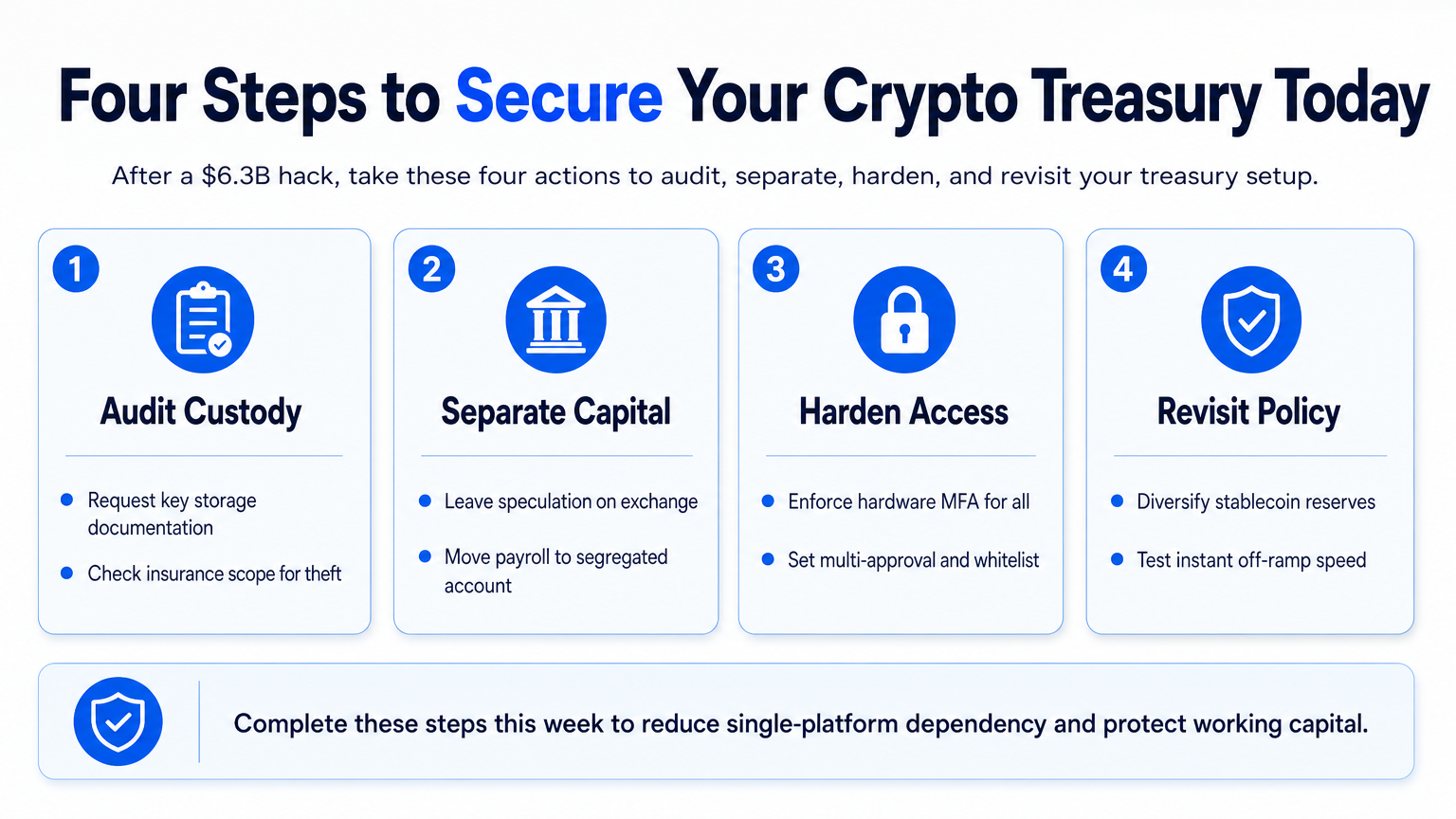
The Binance recovery was fast, but the window of uncertainty should prompt a cold review of your treasury setup. Here are four actions you can complete this week.
Audit your current provider’s custody and insurance arrangements
Request a written explanation of key generation, storage, and access. Ask for the insurance policy’s coverage letter and check if it covers client digital asset theft. Most exchanges use omnibus structures; know your legal standing in bankruptcy or a breach.
Separate trading and operational capital across multiple venues
Keep speculative trading on an exchange. Move payroll, bill-pay, and stablecoin reserves to a crypto-friendly banking platform with segregated accounts. This way, an exchange hack doesn’t freeze payroll, and a banking platform outage doesn’t lock up trades.
Harden internal access controls and transaction approvals
Enforce MFA for all users, drop SMS-based 2FA, and adopt hardware tokens or authenticator apps. Require multiple signers for wire and crypto withdrawals above a threshold. Whitelist withdrawal addresses and lock the whitelist behind a time delay.
Revisit your treasury policy for stablecoin and fiat reserves
After a $6.3B shock, treasury composition matters. Evaluate stablecoin vs. fiat balances and maintain an instant crypto-to-fiat off-ramp. Diversify across segregated bank accounts and multiple stablecoin issuers to reduce single-platform dependency. The post-Ripple OCC charter shift already urged qualified custodians; the Binance hack makes it urgent.
Immediate-action checklist:
| Action | Key Question | Immediate Step |
|---|---|---|
| Audit custody & insurance | Where are private keys stored, and are my assets insured? | Request a custody architecture doc and the insurance policy’s scope for digital asset theft. |
| Separate trading & operational capital | Is my working capital exposed to exchange risk? | Open a dedicated business crypto account for payroll, vendor payments, and treasury reserves. |
| Harden access controls | Who can authorize large transactions? | Enforce MFA for all users, set multi-approval rules, and whitelist withdrawal addresses. |
| Revisit treasury policy | How much is in stablecoins vs. fiat, and can I convert instantly? | Review stablecoin holdings, test off-ramp speed, and diversify across banking partners and issuers. |
What regulatory or insurance changes might follow this hack?
Potential for faster FDIC guidance on bank-crypto partnerships
The scale of the Binance loss will accelerate FDIC and OCC conversations. The Ripple bank charter showed regulators are willing to grant limited-purpose trust charters to firms meeting capital and custody standards. Now, mandating segregated customer accounts for any platform holding digital assets is moving from best practice to regulatory priority. Stablecoin rules already require 1:1 reserve backing; similar principles will bleed into broader crypto banking requirements.
Will mandatory insurance minimums become the new baseline?
Today, crypto platforms aren't required to insure digital assets at SIPC or FDIC levels. A $6.3B shock could change that, pushing for mandatory crime insurance as a percentage of client assets under custody. Surviving crypto banking providers will need institutional-grade underwriting, permanently raising the security bar.
Key Takeaways
- The $6.3B hack, though covered by Binance, exposed the gap between exchange omnibus wallets and segregated crypto banking accounts.
- Treat exchanges as trading venues, not treasury hubs. Move operational capital to a platform with Fireblocks custody and accounts in your own name.
- Act now: audit custody, separate funds, enforce hardware MFA, and diversify stablecoin and fiat reserves.
- Expect accelerated FDIC/OCC guidance and mandatory digital-asset insurance minimums that will reshape viable providers.
- A compliance-first crypto banking platform with mandatory MFA, segregated accounts, and institutional custody offers protection exchange accounts can’t match.
To keep your audience current on crypto banking developments, a service like Joyrise—which plans, writes and publishes illustrated SEO articles to your Webflow blog every day—can handle the content engine.
For a crypto banking platform built with institutional-grade custody and compliance from day one, open an account with OneSafe.
[^1]: “Binance Covers 90% of $6.3B Hack Losses, Assures User Protection,” Global Banking & Finance Review, October 31, 2026. https://www.globalbankingandfinance.com/binance-replenishes-90-assets-stolen-security-incident
[^2]: “Crypto: What We Need to Protect,” FS-ISAC, accessed November 1, 2026. https://www.fsisac.com/insights/crypto-what-we-need-to-protect
[^3]: “Crypto Secure: Protect Digital Assets and Crypto Payments,” Mastercard, accessed November 1, 2026. https://www.mastercard.com/global/en/business/cybersecurity-fraud-prevention/crypto-secure.html