Table of Contents
- What just happened
- The overlooked risk in crypto payroll
- What the Seattle case changes for founders and finance leads
- Recommended actions for teams running crypto payroll
- Open questions and what to watch next
- Key Takeaways
What just happened
A decade of missing payroll taxes
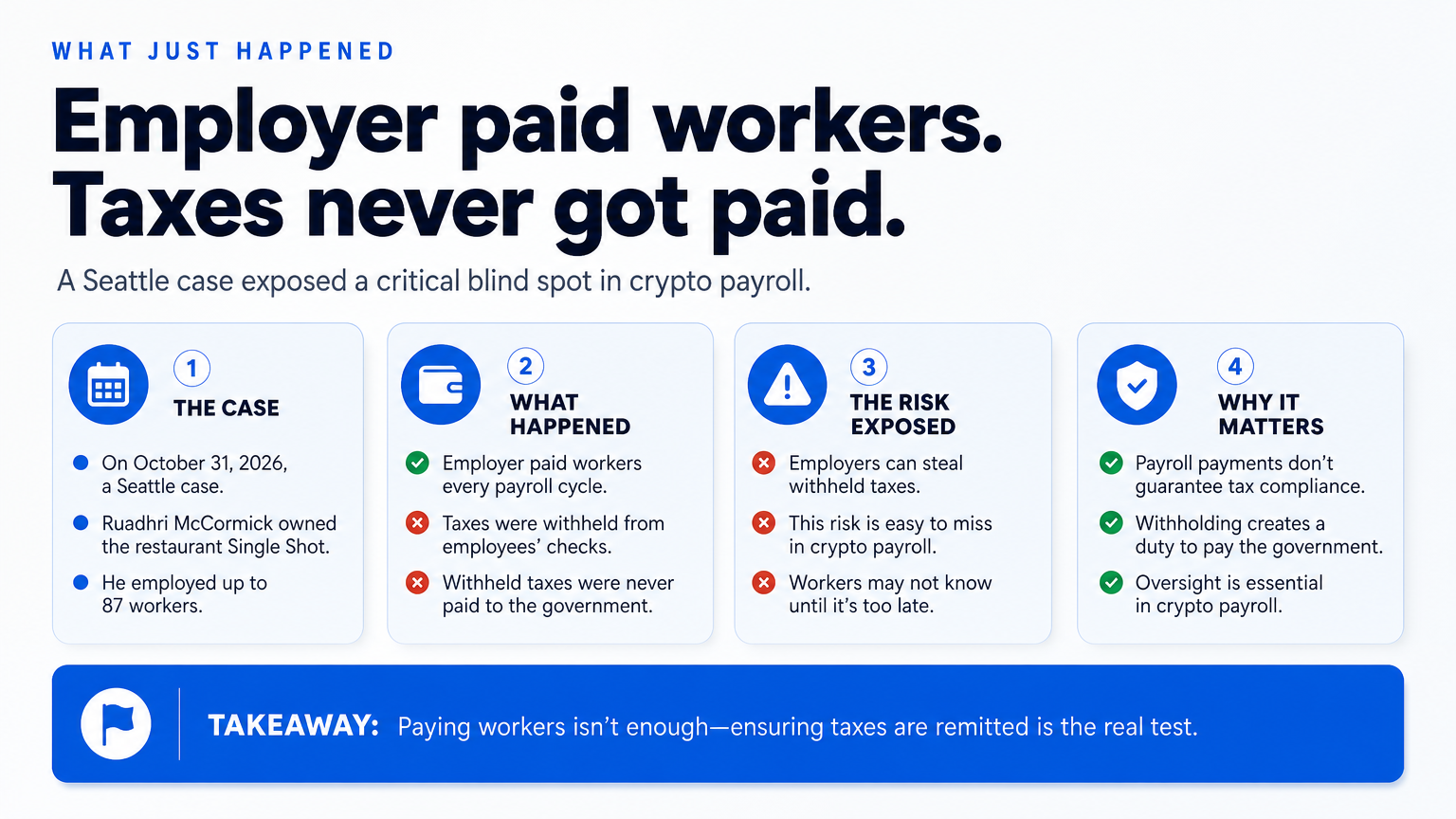
On October 31, 2026, a Seattle case exposed what may be the most overlooked danger in crypto payroll: an employer can pay workers every cycle and still steal the taxes withheld from their checks. Ruadhri McCormick, owner of the restaurant Single Shot, employed up to 87 workers between 2014 and 2024. He collected payroll taxes from their wages—Social Security, Medicare, and income tax withholdings—and simply never sent them to the IRS. Over ten years, he failed to remit $1,027,362 in payroll taxes, according to the Department of Justice case reported by Yahoo Finance and Moneywise on October 31, 2026. Instead, he spent the withheld funds on gambling, travel, and a home remodel.
The case involved traditional fiat wages, not crypto. That is exactly why it matters for crypto payroll. A founder running payroll in USDC or Bitcoin still owes the same withholding, deposit, and filing duties McCormick ignored. Paying wages in crypto does not change the legal obligation to remit payroll taxes—it only changes the settlement rail. The core mechanics of what crypto payroll is remain a tax function first, a payment method second.
The Social Security cost to workers
When an employer withholds taxes but never files them, the government records zero earnings for those workers during those quarters. Social Security retirement benefits are calculated from a worker's highest 35 years of reported earnings. Gaps created by non-remittance can permanently reduce monthly retirement checks. As the Yahoo Finance report detailed on October 31, 2026, workers whose employers do not report payroll taxes can permanently lose Social Security retirement credits, but there is a process to fix their records—filing Form SSA-7008 with the Social Security Administration and providing W-2s, pay stubs, or written statements. The burden falls entirely on the employee, years after the damage was done.
How a $1M case reached the news on October 31, 2026
McCormick pleaded guilty to willful failure to pay over employment taxes. Sentencing is pending. The case became public because the dollar figure crossed seven figures and the fraud spanned a decade, affecting nearly 90 workers. It serves as a sharp reminder that payroll tax compliance is not a paperwork formality—it is a trust function where the employer holds worker money and must forward it to tax authorities.
The overlooked risk in crypto payroll
Paying in crypto doesn't replace tax-withholding duties
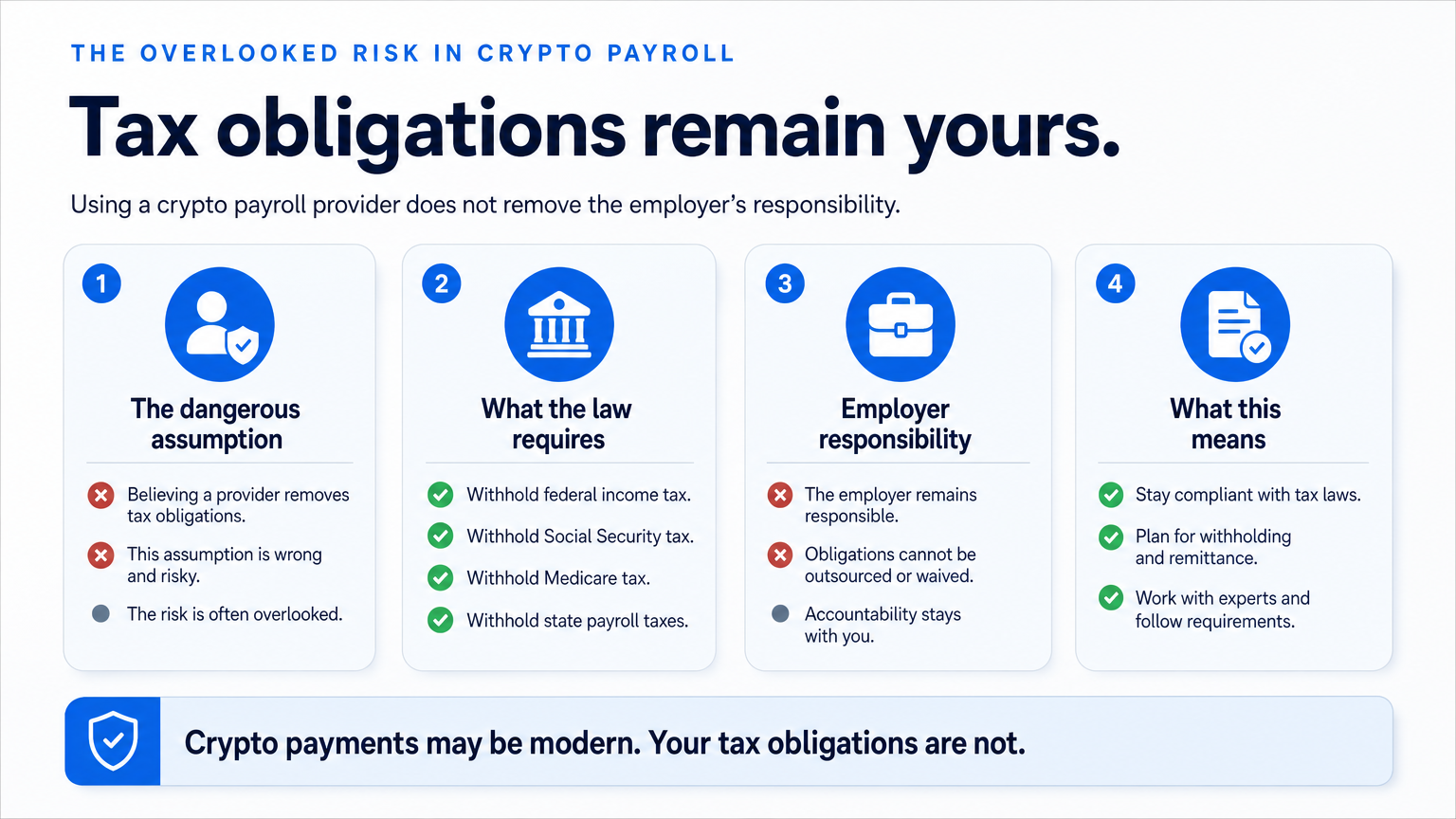
The single most dangerous assumption in crypto payroll is that using a crypto payroll provider eliminates the employer's tax obligations. It does not. The employer remains responsible for withholding federal income tax, Social Security tax, Medicare tax, and state payroll taxes; depositing them on schedule; and filing quarterly and annual returns. A platform that converts fiat to USDC and sends it to an employee wallet has not necessarily filed Form 941 or deposited the trust fund taxes. The Seattle case shows that the failure mode is not "workers didn't get paid"—they did. The failure mode is "taxes were withheld but pocketed."
Crypto payroll is a payment method layered on top of a tax compliance function. Confusing the two creates exactly the exposure McCormick exploited.
Where stablecoins solve one problem but can hide another
Stablecoin payroll has clear appeal. USDC or USDT payouts avoid the intraday price swings that make Bitcoin payroll impractical for salary. Cross-border teams settle in minutes rather than days. Global stablecoin payouts solve a genuine settlement problem.
But that very seamlessness can hide the tax remittance step. A finance lead at a startup sees the stablecoin arrive in the employee's wallet and assumes the job is complete. Meanwhile, the payroll tax deposit deadline—typically the next business day for semi-weekly depositors—passes without a filing. The IRS does not care that the wage portion reached the worker in crypto. It cares that the withheld taxes never arrived.
The distinction is structural: paying wages in crypto is a payment operation. Remitting payroll taxes is a separate compliance workflow. When a team adopts a crypto-native payroll stack, the second step often falls into a gap between the payroll provider and the company's own finance function.
Why founders treat crypto payroll as a payment tool, not a compliance function
Most founders at Web3 startups and DAOs come from product or engineering backgrounds. They evaluate payroll providers the way they evaluate SaaS tools: does it integrate, does it automate, is it fast? Cryptocurrency payroll services market themselves on these dimensions—instant settlement, no correspondent banks, worker sovereignty. Tax compliance gets a bullet point, not a workflow.
The provider landscape reflects this tension. Some emphasize that they never touch client funds and that the employer controls the fiat-to-crypto conversion timing, leaving tax responsibility squarely with the employer. Others warn more directly about the legal and tax disadvantages of paying wages in crypto. But neither category typically surfaces a receipt proving that withheld taxes were deposited with the IRS on a given date. The employer signs off on a payroll run and the provider disburses. What happens between disbursement and tax deposit is often invisible to both the worker and the company's own operations team. This gap becomes especially acute for teams posting on platforms that list jobs paying in crypto, where workers joining may not realize they must independently verify their Social Security contributions.
What the Seattle case changes for founders and finance leads
The liability gap: who answers when taxes go unpaid
The employer. Always the employer. If a crypto payroll platform fails to remit taxes, the IRS pursues the employer, not the software vendor. McCormick's case did not involve a third-party payroll provider at all—he simply didn't file. But the liability structure is identical: the employer is the withholding agent under 26 U.S. Code § 7501, and withheld taxes are held in trust for the United States. Willful failure to remit can trigger criminal prosecution and personal liability for responsible individuals, including founders and officers who sign tax returns.
For DAOs and unincorporated entities, the question of who is the responsible person becomes even murkier. If no individual signs the 941, the IRS may look through the structure to identify who controlled the finances.
What to verify before choosing any payroll provider
| Verification Point | What to Ask | Red Flag |
|---|---|---|
| Tax deposit receipt | Does the provider supply proof of federal/state tax deposits for each payroll run? | Provider says "we handle taxes" but provides no dated receipt or confirmation number |
| Filing responsibility | Who signs and files Form 941 and state equivalents—the provider or the employer? | The contract assigns filing to the employer but the platform offers no reminders or integration |
| Error liability | If the provider misclassifies a worker or miscalculates withholding, who pays the penalty and interest? | The terms disclaim all tax-related liability onto the employer with no audit trail |
| Crypto conversion timing | What USD value is used for W-2 reporting—the rate at payroll approval or the rate at disbursement? | The platform reports one value to the employer and another to the worker |
| KYC/AML scope | Does the provider verify worker identity and tax ID before the first payroll run? | Workers can receive payments without submitting a W-4 or equivalent |
The minimum operational controls for crypto-native teams
Teams adopting payroll in stablecoins need at least three controls that the Seattle restaurant lacked entirely:
Monthly tax deposit reconciliation. Compare the payroll register's withheld amounts against the IRS EFTPS confirmation and state deposit receipts. If the provider doesn't supply these, pull them directly from EFTPS. Missing one quarterly deposit can cascade into penalty exposure.
Segregated payroll tax account. Hold estimated payroll taxes in a dedicated fiat account, not the general operating account. This creates a cash discipline: the money for the IRS is walled off before anyone can spend it on a home remodel or a marketing campaign.
Quarterly 941 review against disbursement records. Someone inside the company—not the provider—reconciles the filed 941 to the total wages paid in each quarter. This catches misreporting before it compounds.
Recommended actions for teams running crypto payroll
Run payroll as a tax workflow, not just a payment
Crypto payroll is a tax compliance function with a crypto settlement layer, not the reverse. The payroll run should produce three outputs every cycle: (1) the net wage to the worker in the chosen asset; (2) the employer's deposit confirmation for the withheld taxes; and (3) a line-level report mapping each worker's gross-to-net breakdown. If a provider delivers (1) but cannot produce (2) within two business days, the employer must execute the deposit directly through EFTPS.
Verify remittance receipts every cycle
Do not assume the provider handled it. Log into EFTPS after every payroll run and confirm the deposit posted. For state taxes, check the state's equivalent portal. This takes under five minutes but is the single control that would have flagged McCormick's decade of nonpayment within the first quarter.
Keep fiat-side payroll controls even when salaries settle in crypto
The wage can settle on-chain. The tax obligations remain fiat. That means maintaining a US bank account for tax deposits, filing the same 94x forms every employer files, and issuing W-2s that report wages in USD at the fair market value on the payment date. Stablecoins do not change any of this. The IRS's position, consistent through multiple revenue rulings, is that cryptocurrency received as wages is taxable compensation at its USD equivalent—and the withholding obligation is on the employer, calculated in dollars.
What workers can do to protect their Social Security credit
Workers paid in crypto face an additional verification burden. Because the pay stub may come from a payroll provider rather than a traditional employer portal, the worker must:
- Request a pay stub for every pay period showing gross wages, withholdings, and the USD conversion rate used.
- Check their Social Security Statement annually at ssa.gov. If earnings for a taxed period show $0, the employer likely withheld but did not remit.
- File Form SSA-7008 immediately with any W-2, pay stubs, bank statements, or written employer confirmations to correct the record, as the Yahoo Finance report detailed on October 31, 2026. Workers whose employers do not report payroll taxes can permanently lose Social Security retirement credits, but this process exists to fix their records.
- Keep independent proof of work and payment—employment contracts, on-chain transaction hashes with timestamps, and any correspondence confirming salary terms. The SSA can use these to reconstruct missing quarters.
Open questions and what to watch next
Will crypto payroll platforms build tax remittance proofs?
Currently, few crypto payroll providers offer an automated, verifiable proof that tax deposits were made. Some integrate with third-party tax filing services; most leave filing to the employer. As the Seattle case circulates through startup legal and finance circles, the market pressure for a "tax deposit receipt" feature will grow. Whether platforms build it natively or integrate with a licensed payroll tax processor remains an open product question.
How regulators may treat employer liability in mixed fiat/crypto payroll
The McCormick case used pure fiat payroll, making the tax violation straightforward. In a mixed environment where some compensation is denominated in tokens—including governance tokens, airdrops, or token option grants—the withholding calculation gets complex. The IRS has issued guidance on cryptocurrency as wages (Notice 2014-21) but has not yet tested a case where an employer paid base salary in stablecoins and bonus tokens with no fiat withholding. Expect enforcement attention to intensify on valuation methodology and under-withholding penalties.
What the Seattle sentencing means for small business enforcement
McCormick awaits sentencing. The case signals that the Department of Justice pursues payroll tax fraud even at the single-location small business level when the amount is high and the conduct is willful over many years. Founders who treat payroll tax deposits as optional cash flow management—delaying a quarter here, skipping a deposit there—should read the case as a direct warning. The trust fund recovery penalty, which allows the IRS to assess 100% of the unpaid trust fund taxes against any responsible person, applies regardless of whether the company exists or has assets.
What is crypto payroll?
Crypto payroll is a compensation arrangement where an employer pays workers all or part of their wages in cryptocurrency—most commonly stablecoins like USDC or USDT—rather than in fiat currency through traditional bank transfers. The employer converts a fiat-denominated gross wage, withholds applicable taxes in fiat, and sends the net amount to the worker's wallet as crypto. Alternatively, some arrangements settle the gross amount in crypto and require the worker to handle their own tax payments as an independent contractor, though this model shifts classification risk onto the employer.
Is crypto payroll safe?
It depends on which risk is being evaluated. The settlement risk—will the worker receive the right amount of the right token—is well-handled by several major platforms. The tax risk—did the employer properly withhold and deposit payroll taxes—is entirely outside the payment rails and depends on the employer's own compliance practices. The Seattle case shows that wage payment can be flawless while tax remittance is fraudulent. For workers, safety means verifying tax deposits independently. For employers, safety means maintaining fiat-side payroll controls regardless of which crypto payroll provider processes the settlement.
What are the advantages of crypto payroll?
For employers: faster cross-border settlement—minutes versus days for SWIFT transfers; lower per-transaction fees compared to international wire fees; simplified payments to distributed teams without maintaining local bank accounts in every country; and the ability to attract talent that prefers compensation in digital assets.
For workers: near-instant receipt of wages; avoidance of correspondent bank delays and intermediary fees; direct custody of earnings without depending on a local bank's hours or policies; and for workers in jurisdictions with unstable currencies, stablecoins provide a more predictable store of value between pay periods.
What are the disadvantages of crypto payroll?
Tax complexity is the primary disadvantage. The employer must still calculate withholding in USD, deposit taxes in fiat, and file all traditional payroll returns. The cryptocurrency payroll services market has not yet standardized a tax remittance proof that puts the employer and worker on equal footing with traditional payroll. Workers face the burden of converting crypto to fiat for rent, bills, and other expenses that require traditional payment methods, incurring exchange fees. Price volatility—even with stablecoins—creates timing risk around the conversion rate used for W-2 reporting. And for both parties, the regulatory treatment of crypto wages continues to evolve, creating compliance uncertainty.
Is it legal to pay wages in crypto?
Yes, in most jurisdictions, provided the employer complies with all applicable wage and hour laws and tax withholding requirements. In the United States, the Fair Labor Standards Act requires that wages be paid in cash or negotiable instruments and that the worker receives at least the minimum wage in freely usable funds. The IRS treats cryptocurrency wages as taxable compensation reportable on Form W-2 at the fair market value on the payment date. State laws vary—some require employee consent for non-cash wage payments, and others impose specific wage payment method requirements. Employers should review state-specific rules with counsel before implementing cryptocurrency payroll services.
How is crypto taxed?
Crypto received as wages is subject to the same employment taxes as fiat wages: federal income tax withholding, Social Security tax (6.2% employee, 6.2% employer), Medicare tax (1.45% each), and applicable state and local payroll taxes. The employer must calculate withholding based on the fair market value of the crypto at the time of payment. The worker's W-2 reports the USD equivalent. Any subsequent gain or loss when the worker sells or exchanges the crypto is a separate capital gains event. Payroll tax compliance here is identical in structure to fiat payroll—the only difference is the settlement asset.
What happens if the crypto price changes after payroll is processed?
For the employer, the wage has been paid at the agreed USD value, and the payroll tax obligation is fixed at that moment. A subsequent price change in the crypto asset does not adjust the employer's withholding or reporting. For the worker, the crypto is income at its fair market value upon receipt. If the worker holds the crypto and it appreciates, the gain is taxable upon sale. If it depreciates, the loss may be realized upon sale, but the income recognized on the W-2 remains unchanged. Stablecoin payroll minimizes this variance, which is why most crypto payroll platforms default to stablecoin settlement.
Do crypto payroll platforms require KYC and AML checks?
Most do, but the scope varies significantly. Provider pages differ on whether KYC/AML is applied at the employer level only or extended to individual workers. Some platforms perform identity verification and OFAC screening on every payee; others rely on the employer to verify worker identity and tax documentation. Employers should confirm whether their chosen provider verifies each worker's W-4, Social Security Number, and right to work before the first payment.
How do companies account for crypto payroll in their books?
The wage expense is recorded at the USD fair market value of the cryptocurrency on the payment date, consistent with ASC 718 or IFRS 2 for share-based payments if applicable, or as standard compensation expense under ASC 340. The employer records the gross wage as a compensation expense, the withheld taxes as a liability until deposited, and the net crypto transfer as a reduction of the cash or digital asset balance. Any difference between the exchange rate at the time of withholding calculation and the rate at which the employer acquired the crypto for disbursement creates a realized gain or loss, which must be booked separately.
How can workers verify their employer actually remitted payroll taxes?
Three steps, in order: (1) Create an account at SSA.gov and review the Social Security Statement. If a year shows zero earnings despite employment, taxes were likely withheld but not remitted. (2) Request a wage and income transcript from the IRS using Form 4506-T, which shows the income and withholding the employer reported. (3) Compare both against every pay stub received. If the IRS transcript shows lower or no wages versus the pay stubs, contact the employer in writing and, if unresponsive, file Form SSA-7008 with the Social Security Administration attaching every available pay stub, employment contract, and bank or wallet statement confirming the payments. Workers whose employers do not report payroll taxes can permanently lose Social Security retirement credits, but this process exists to fix their records, as Yahoo Finance reported on October 31, 2026.
Key Takeaways
- Crypto payroll is a tax compliance workflow with a crypto settlement layer, not a payment tool that happens to involve taxes—confusing the two creates the same exposure the Seattle restaurant owner exploited over ten years.
- The employer, never the payroll provider, retains full legal liability for withholding, depositing, and filing payroll taxes, regardless of whether wages settle in USDC or USD.
- Verify tax deposit receipts every payroll cycle—log into EFTPS and confirm the IRS received the withheld funds; this single five-minute control catches non-remittance before it compounds.
- Workers paid in crypto should check their Social Security Statement annually and keep independent pay stubs and on-chain transaction records to correct missing quarters if the employer fails to file.
- DAOs and founder-led startups without in-house payroll staff need at least three controls: a segregated tax reserve account, monthly deposit reconciliation, and quarterly 941 review against disbursement records.
For teams who want to publish their own thought leadership on crypto payroll compliance, Joyrise plans, writes and publishes illustrated SEO articles to your Webflow blog every day—read your first article before you pay.
Ready to put this into practice? Get started with onesafe.io.