Meta description: Rain’s $1.1M card exploit exposed crypto banking’s shared-infrastructure risk. Learn how to protect working capital and separate custody.
On November 10, 2026, Crypto News reported that a $1.1 million exploit of Rain’s crypto debit card program in August 2026 bypassed private keys entirely, draining only the managed balances loaded onto the cards. MNEE App CEO Ron Tarter, quoted in the same report, noted that most crypto debit card brands control little beyond their app and design, depending on banking-as-a-service platforms, shared sponsor banks, and pooled processors. This event exposes a hidden vulnerability: crypto banking relies on shared payment infrastructure that can cascade failure across businesses and users.
Table of Contents
- Why shared infrastructure concentrates risk
- The typical crypto-banking stack—and where it breaks
- Three immediate implications
- Actions to reduce shared-infrastructure risk today
- What to watch next
- Sources
Why shared infrastructure concentrates risk
A single sponsor bank often underpins dozens of fintech brands. If its charter is suspended or the connecting middleware fails, every business relying on that bank can lose fiat access immediately—even if their wallets are on-chain. When identity verification, custody, card issuing, and bank connectivity are bundled into one middleware layer, a breach like Rain’s can freeze all working capital. Companies using business crypto accounts and crypto on-ramps for payroll and vendor payments face this systemic threat daily.
The typical crypto-banking stack—and where it breaks
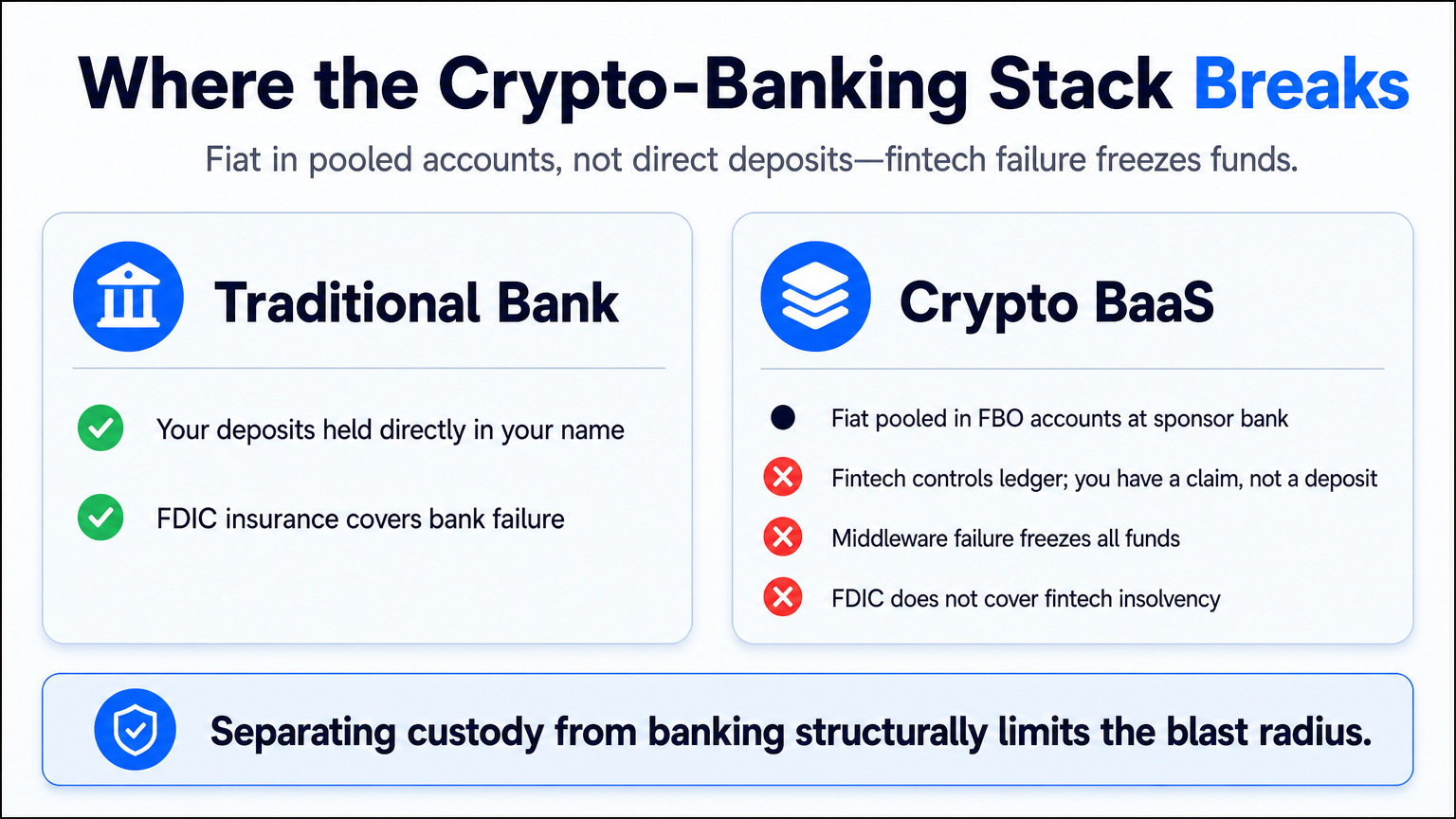 In a traditional bank, deposits are held directly in your name and insured. In most BaaS-powered crypto banking, fiat sits in pooled “for benefit of” (FBO) accounts at a sponsor bank; the fintech controls the ledger. If the fintech or its middleware fails, your fiat is a claim against the provider, not a direct deposit. FDIC insurance only covers bank failure, not fintech insolvency. All-in-one platforms that combine custody, card issuing, and fiat settlement amplify this risk. Platforms that structurally separate custody from banking—such as OneSafe, which secures on-chain assets with Fireblocks institutional MPC custody and holds fiat with direct bank partners—limit the blast radius. A card freeze won’t lock up treasury crypto or all fiat.
Three immediate implications
- Card failure locks working capital even when crypto is safe. Rain’s exploit froze card balances, preventing bill payments and payroll despite untouched wallets.
- Deposit insurance doesn’t protect against fintech collapse. The FDIC clarifies that pass-through insurance applies only at bank failure, not when the fintech intermediary fails. FBO pools rarely meet the strict requirements.
- Bundled custody and banking shrinks your liquidity horizon. If the same vendor manages your on-chain assets and the card program, a single failure can freeze both. Independent custody (e.g., non-custodial multi-sig or Fireblocks) keeps crypto liquid even when fiat rails break.
Actions to reduce shared-infrastructure risk today
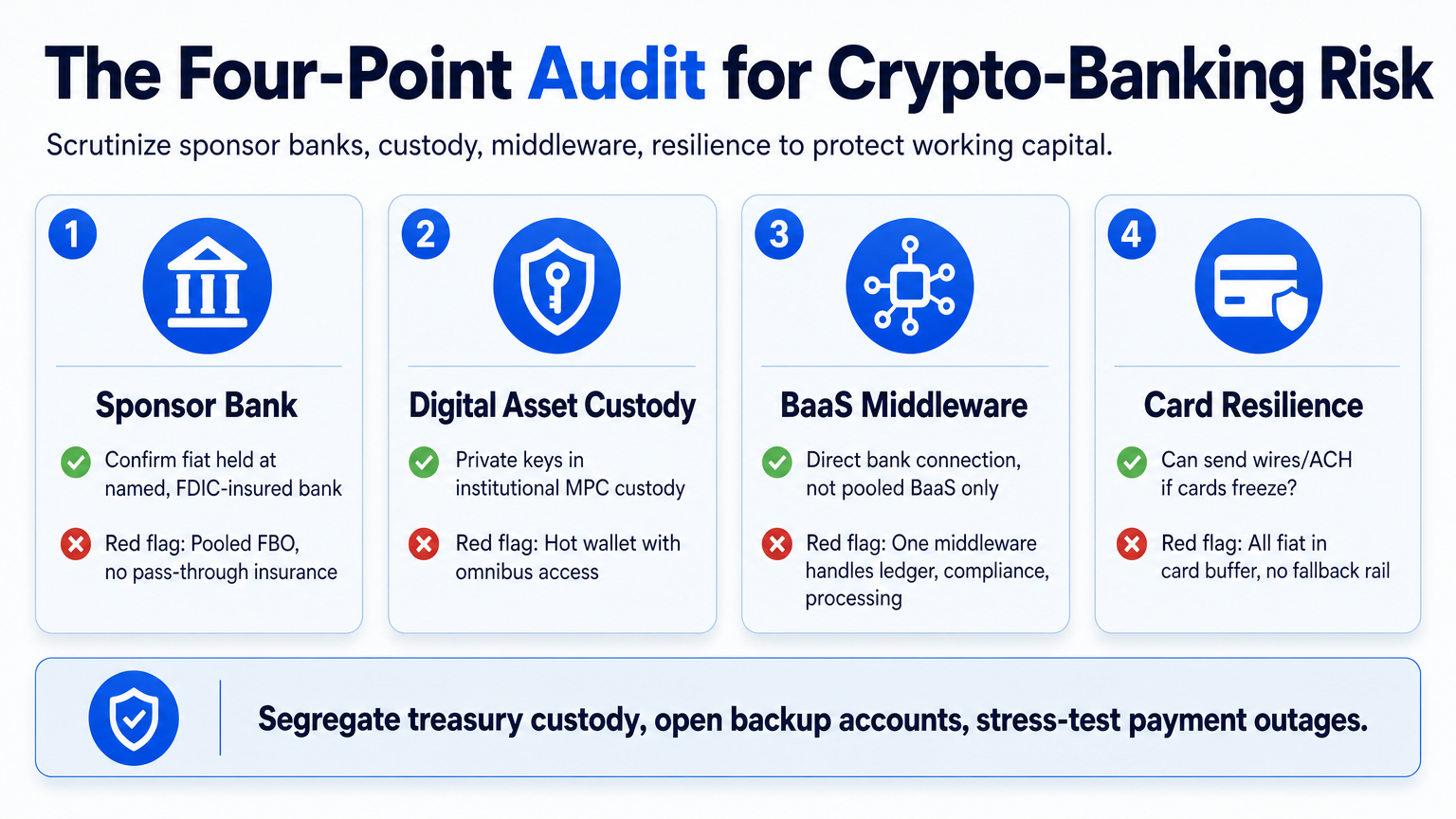
- Audit your provider: Demand written details on the sponsor bank, account type (direct or FBO pool), and BaaS middleware. Opaque answers are a red flag.
- Segregate custody: Move treasury-grade crypto to institutional MPC custody like Fireblocks, separate from the card-issuing layer.
- Verify redundancy: Ensure the platform has direct bank relationships, not just a single pooled BaaS spine. Query whether fallback payment rails exist.
- Test a freeze: Map all payables and simulate a 72-hour card outage. Record which payments would bounce and where you’d reroute.
| Audit Item | Key Question | Red Flag |
|---|---|---|
| Sponsor bank | Is fiat held at a named, FDIC-insured bank? Are accounts segregated? | FBO pool with no explicit pass-through insurance, single-bank exposure |
| Digital asset custody | Are private keys in institutional MPC custody, separate from the card layer? | Provider holds keys in hot wallet with omnibus access |
| BaaS middleware dependency | Is there a direct bank connection or only a pooled BaaS spine? | One middleware for ledger, compliance, and processing; no fallback |
| Card program resilience | If cards freeze, can you still send wires/ACH from the same fiat account? | All fiat moves through the card buffer; no alternative rail |
What to watch next
Regulators are tightening oversight of fintech-bank partnerships. Both the FDIC and FinCEN are pushing for clearer segregation of customer funds and independent attestations. Automated payment workflows—scheduled payroll, recurring bill payments—could become the next target, as the same middleware concentration affects those flows. Businesses should verify that automation layers are decoupled from the core ledger and manual fallbacks exist.
Key Takeaways
- A $1.1 million Rain card exploit proved that shared payment infrastructure can drain working capital without touching private keys.
- Hidden sponsor banks, BaaS middleware, and processors can freeze all fiat operations with a single failure.
- Deposit insurance only applies to bank failure; most crypto-banking fiat pools are not directly insured.
- Independent custody (e.g., Fireblocks) and segregated bank accounts structurally limit damage.
- Immediate steps include separating treasury custody, opening backup fiat accounts, demanding transparency, and running card-freeze scenarios.
For businesses that want to maintain daily, SEO-optimized content on crypto banking developments, Joyrise plans, writes, and publishes illustrated SEO articles to your Webflow blog every day. Read your first article before you pay.
To operate with a platform that structurally separates fiat banking from digital-asset custody and insulates working capital from middleware risk, open a OneSafe account today.
Sources