On November 10, 2026, the OCC granted Coinbase a national trust charter — a federal green light for cryptocurrency custody and payments that reshapes crypto banking for businesses and decentralized organizations. The charter doesn’t make Coinbase a bank, but brings a single regulatory framework to a sector long hampered by state-by-state licensing. For founders and finance leads running global operations across USD, EUR, USDC, and on-chain assets, the decision accelerates the maturation of fiat-plus-crypto infrastructure that non-bank platforms like OneSafe have been building.
Table of Contents
- What Just Happened
- Why This National Trust Charter Crypto Move Matters
- Trust Charter vs. Banking License: The Gap
- Concrete Implications for Businesses and DAOs
- Where Platforms Like OneSafe Fit
- Open Questions
- What does the Coinbase trust charter mean for crypto banking?
- How does a trust charter differ from a full banking license?
- Can non-bank platforms offer real crypto banking for businesses?
- What changes for DAOs and startups managing crypto and fiat?
- Is this the start of federal crypto banking regulation?
- Key Takeaways
What Just Happened
The OCC authorized a national trust bank charter for Coinbase, as first reported by Yahoo Finance on November 10. The charter permits fiduciary services, digital asset custody, and potentially expanded payment or stablecoin services — but not FDIC-insured deposits or commercial loans. Rick Schonberg, Coinbase’s trust CEO, called the federal preemption a boxing upgrade: “If you want to win an Olympic gold medal in boxing, you don’t get in the gym and spar with your mom.” Instead of 50 state licenses, Coinbase now operates under one OCC rulebook.
This is not the first such charter — Anchorage and Protego got them in 2021 — but Coinbase’s scale makes it a landmark. It signals that federal regulators will define a lane for compliant, nationwide crypto custody and payment infrastructure.
Why This National Trust Charter Crypto Move Matters
For years, “crypto banking” has been an ambiguous term. Some providers bundle demand deposit accounts with crypto wallets; others act as tech layers between banks and on-chain rails. The OCC trust charter creates a new category: a federally chartered, non-lending institution that can custody digital assets, settle stablecoin payments, and serve as the back-office plumbing for crypto-native businesses.
The immediate value is lower legal uncertainty. A national trust charter crypto framework gives the crypto custody business a clear, nationwide compliance standard — pushing the market toward more robust practices. Meanwhile, the FDIC’s 2025 clarification on crypto activities opened a path for insured banks to offer certain crypto services with notice. The trust charter links that permissioning directly to the OCC, creating a more coherent supervisory architecture.
The impact flows to Web3 startups and DAOs, where operations demand that ACH payments, USDC payroll, and multi-currency balances move seamlessly between fiat and crypto. The charter accelerates a world where those rails are federally supervised.
Trust Charter vs. Banking License: The Gap
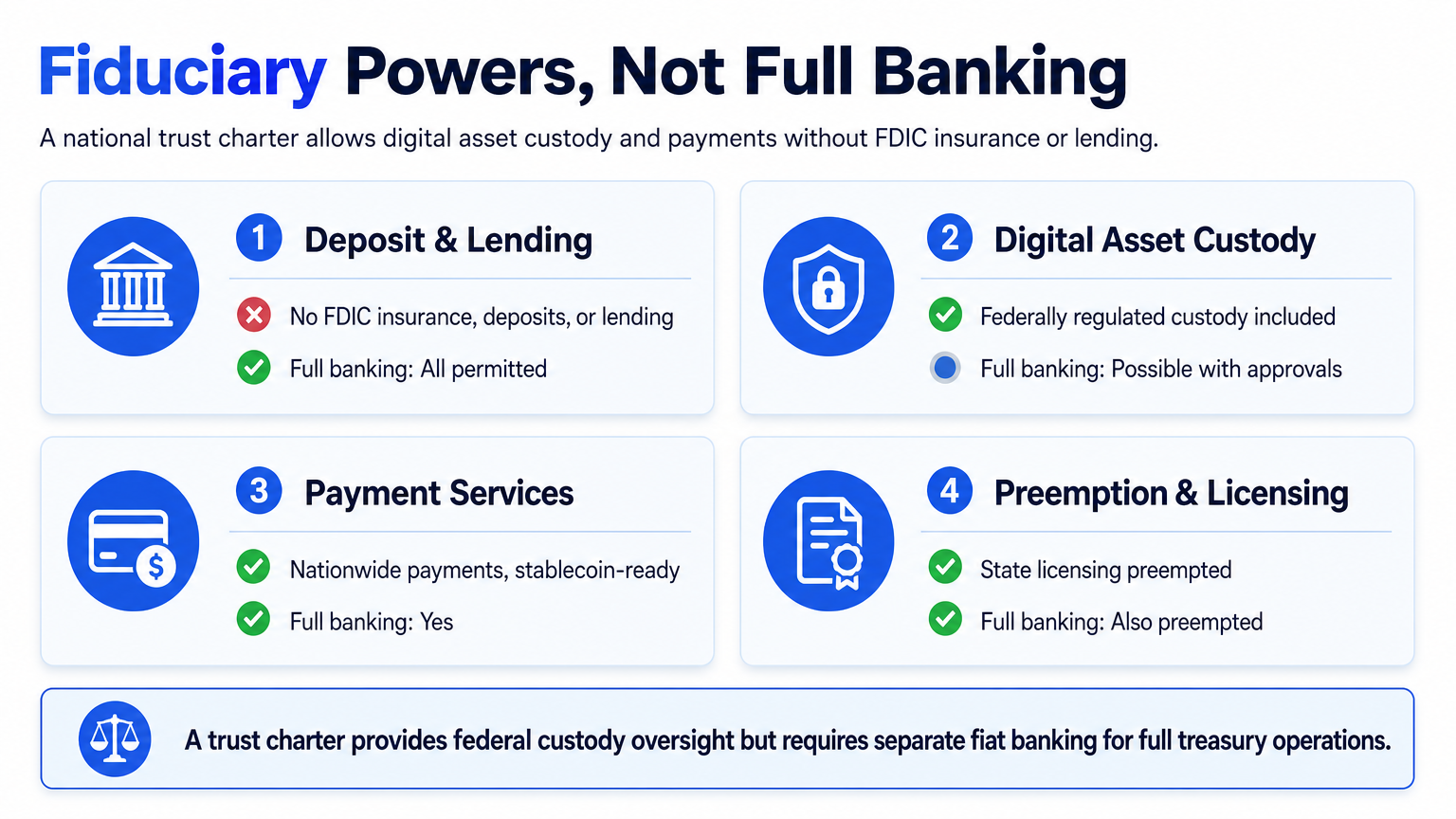
A national trust bank is not a commercial bank. It can provide fiduciary services, custody digital assets, offer payments and stablecoin services under federal preemption, and operate nationwide. It cannot accept FDIC-insured deposits or make loans. That makes a trust-chartered crypto bank a qualified custodian — not a place for your operating cash, but ideal for digital asset storage. For corporate treasuries, that means you still need a separate fiat banking relationship or a fiat and crypto platform that bridges both.
The charter’s preemption power also cuts compliance costs. One set of capital requirements, one audit standard, one AML exam cycle — and a single regulatory counterpart. This precedent could encourage the OCC to charter other fintechs that focus on custody, payments, and stablecoin infrastructure.
Concrete Implications for Businesses and DAOs
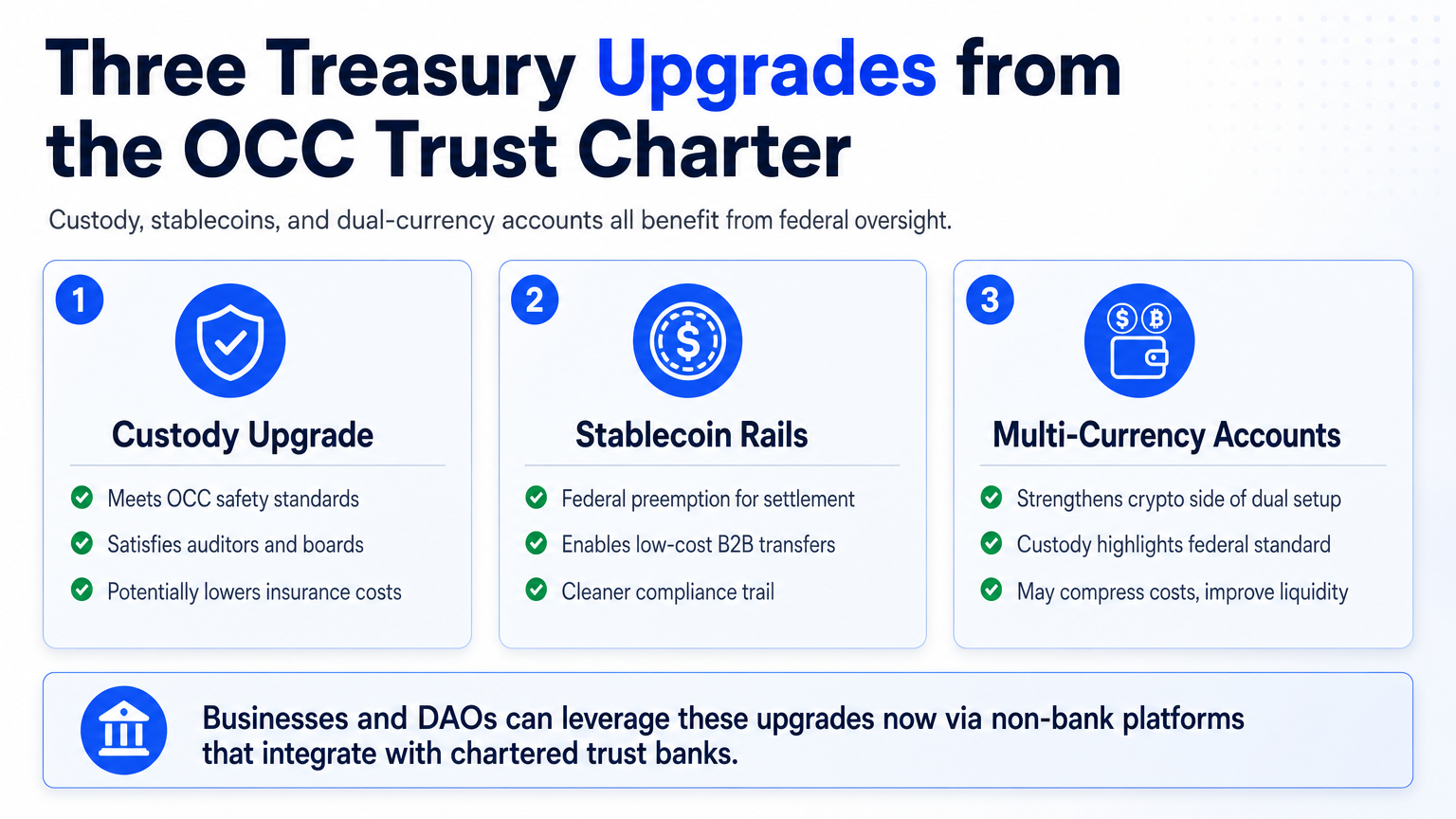
Custody upgrade. Under a national trust charter, custody must meet OCC safety and soundness requirements — capital backing, risk management, regular exams. For businesses and DAOs with significant on-chain treasuries, a federally regulated custodian can satisfy auditor and board demands, potentially lowering insurance costs. Non-bank platforms that partner with custodians like Fireblocks can now point to a federal standard that elevates the whole market.
Stablecoin rails with federal preemption. A trust charter could let Coinbase issue or settle stablecoins without 50 state money transmitter licenses. In 2025, PNC Bank’s USDC settlement pilot with Coinbase reshaped crypto treasury management thinking. If federal oversight extends to stablecoin payments, we could see rapid expansion of instant, low-cost B2B transfers that rival SWIFT. Non-bank on/off-ramps could plug into these federally supervised rails, delivering a cleaner compliance trail.
Multi-currency fiat-and-crypto accounts. A trust charter doesn’t provide demand deposit accounts. But it strengthens the crypto side of a dual-currency setup. Platforms that integrate fiat accounts (via chartered banking partners) with crypto wallets can now highlight that their custody layer meets a federal standard. This could compress costs, improve liquidity, and simplify audits.
Where Platforms Like OneSafe Fit
Neo-banking for Web3 before and after the charter
OneSafe is a financial technology company, not a bank. It offers businesses multi-currency fiat accounts through bank partners and crypto on/off-ramps with custody via Fireblocks. Over 1,000 businesses across 30+ countries have used it to process $800 million+ in volume — proving that the market doesn’t wait for a single charter to solve the fiat-plus-crypto problem.
This model of neo-banking for Web3 doesn’t disappear with the trust charter; it gains a higher-grade custody layer to integrate. Just as fintechs use chartered banks for FDIC-insured accounts, they could route digital asset custody through an OCC-regulated trust partner. OneSafe’s single-interface approach — fast onboarding, corporate cards, segregated global accounts, and automated crypto-to-fiat — already works for Web3 startups and DAOs. The OCC’s move lowers back-end complexity, making that bridging role even more valuable.
DAO treasury management with role-based controls
Decentralized organizations juggle multiple signers, on-chain wallets, stablecoin contributor payments, and the need for financial transparency without a traditional CFO. DAO treasury management requires operational tools that combine fiat and crypto oversight. OneSafe addresses this with customizable permissions, automated workflows, and a single dashboard. Its Fireblocks custody adds a security layer that aligns with the trust charter’s federal standard.
The charter could eventually standardize the compliance bar that DAO tooling providers must meet, unlocking larger enterprise relationships. A DAO might hold part of its treasury in a chartered trust bank while using a neo-banking interface for day-to-day payments, invoices, and FX — a model the charter makes more defensible.
Open Questions
- Will other major exchanges pursue national trust charters?
- Can the OCC expand a trust charter’s activities to stablecoin issuance without new legislation?
- How will state regulators react to aggressive preemption? Some may challenge it, as they did with fintech charters.
- Does the charter ease bank partnerships for crypto custody? A 2025 FDIC letter signaled openness, but no major bank has fully integrated custody yet.
- The stablecoin payments market is surging even as market cap growth stalls, hinting at real B2B usage. Trust charters could tip the balance to widespread commercial adoption.
- For DAOs and startups, the next indicator: will chartered trust banks offer direct business accounts that interact with neo-banking dashboards via APIs?
| Criteria | National Trust Charter | Full Banking License |
|---|---|---|
| FDIC insurance | No | Yes |
| Demand deposits | No | Yes |
| Commercial lending | No | Yes |
| Digital asset custody | Yes, federally regulated | Possible, with approvals |
| Payment services | Yes, including stablecoin rails | Yes |
| State licensing | Preempted by federal charter | Preempted for national banks |
| Typical user | Custodians, payment providers, fiduciaries | Retail & business banking |
What does the Coinbase trust charter mean for crypto banking?
It means the OCC now sanctions a federal path for crypto custody and payments without full banking powers. For the crypto banking sector, it decouples asset safety from deposit insurance and opens a faster route to nationwide services without navigating 50 state regimes.
How does a trust charter differ from a full banking license?
A trust charter allows fiduciary activities — holding and managing assets for others, including digital assets — but excludes FDIC-insured deposits and commercial lending. A full banking license permits taking deposits and making loans, along with solvency regulation and deposit insurance obligations.
Can non-bank platforms offer real crypto banking for businesses?
Yes. Platforms like OneSafe partner with chartered banks for fiat accounts and with custodians like Fireblocks for digital assets. They don’t hold deposits themselves, but they aggregate banking, payments, FX, and crypto on/off-ramps into a single interface — making them operationally “crypto banking” platforms.
What changes for DAOs and startups managing crypto and fiat?
The trust charter raises the compliance bar for custody, giving DAOs and startups more confidence when selecting a custodian. It also signals that federal regulators are building a cohesive framework, which could simplify licensing for DAO tooling. In the near term, non-bank platforms that layer secure custody and role-based controls on top of bank accounts remain the most practical solution.
Is this the start of federal crypto banking regulation?
It’s a milestone, not the start. The OCC issued trust charters to crypto firms as early as 2021. But the Coinbase approval, after years of friction, could accelerate a broader framework. The rescinded FinCEN reporting rule in 2026 further suggests a more coordinated approach. The trust charter may be one piece of a larger architecture that eventually includes stablecoin legislation and clearer payment system access rules.
Key Takeaways
- Coinbase’s OCC trust charter creates a federal standard for digital asset custody and payments, preempting state-by-state regulation, but doesn’t permit FDIC-insured deposits or commercial lending.
- Businesses and DAOs get a more predictable, regulated custodian option, but still need a fiat banking relationship or a neo-banking platform for day-to-day treasury operations.
- Non-bank platforms like OneSafe already bridge fiat and crypto through bank partners and Fireblocks custody — the trust charter strengthens, rather than replaces, this operational layer.
- Immediate action for founders: audit current custody arrangements, ask whether they meet future federal standards, and ensure your fiat-and-crypto platform can integrate with OCC-chartered trust banks.
For Web3 founders who need to keep their community informed, a service like Joyrise can plan, write, and publish illustrated SEO articles to your blog every day. Stay ahead as the regulatory landscape evolves.
Start managing your fiat and crypto operations in a single, secure place — open an account with OneSafe today.