On October 29, 2026, crypto payroll shifts from a niche experiment to an operational default. Data from a DBS and EY survey of 422 finance leaders across 11 markets shows that 88% of large enterprises now run live deployments or pilots of tokenized cash. Finance and payroll teams must now map a payroll rail that’s fast, reconcilable, and compliant.
Table of Contents
- What Just Happened: Tokenized Cash Becomes an Operational Default
- Why This Changes Crypto Payroll Now
- The Background You Need to Follow the Shift
- What to Do This Quarter: An Operational Response
- The Cost Model Most Crypto Payroll Content Skips
- What to Watch Next
- Key Takeaways
What Just Happened: Tokenized Cash Becomes an Operational Default
The DBS and EY Data Behind the Shift
On October 28, 2026, DBS and EY reported that 88% of 422 surveyed enterprises had live tokenized cash deployments or pilots across 11 markets—a tipping point detailed in OneSafe’s coverage. Tokenized cash is no longer a sandbox concept but an infrastructure layer.
Why Payroll Is the Next Rail to Move
Treasury teams holding tokenized dollars seek natural spending outlets. Payroll is a predictable, recurring outflow that avoids cross-border friction when moved onto the same rail. A company can distribute USDC from its on-chain treasury, bypassing correspondent banks and conversion delays, once legal and tax scaffolding is established.
Why This Changes Crypto Payroll Now
From Optional Perk to Treasury Rail Decision
Before this data, crypto wages were a niche perk. With 88% enterprise adoption, crypto payroll becomes a treasury rail decision. Regulatory approvals like Ripple’s bank charter make stablecoin rails institutionally viable (see our analysis).
What 88% Adoption Means for Smaller Teams and DAOs
Enterprise adoption lowers the barrier for SMEs and DAOs. Platforms like OneSafe provide the same custody and API access, enabling DAO payroll with role-based controls rather than jury-rigged multisigs.
The Background You Need to Follow the Shift
How does crypto payroll actually work?
Crypto payroll typically involves a company funding a wallet with USDC, which the provider distributes to employee wallet addresses on payday. Employees may hold the stablecoin or auto-convert to fiat. Providers like Bitwage and Crossmint handle wallet collection, batching, and reporting. It’s a standard push payment settling on-chain in minutes.
Is it legal to pay employees in crypto?
Most developed markets permit crypto wages if standard tax and employment obligations are met. The U.S. Department of Labor allows any medium of exchange as long as minimum wage is satisfied in fiat-equivalent value and taxes are withheld. In the EU, MiCA provides a stablecoin framework, with local labor laws adding requirements. Payments must be fiat-denominated, and employees must consent.
Can US employees receive payroll in crypto?
Yes. The IRS taxes crypto wages as property, so the fair market value at payment is subject to income, Social Security, and Medicare withholding. Employers report the USD value on Form W-2 and remit taxes in USD. Crypto payroll software calculates the fiat-equivalent net pay and transfers the crypto amount, with the employer bearing the conversion and reporting burden.
How do stablecoins reduce risk in crypto payroll?
Stablecoins peg to fiat, eliminating Bitcoin’s intraday swings, making them the default for payroll. A 1,000 USDC payment can be redeemed for roughly $1,000 if the peg holds. Risks remain tied to issuer reserves and redemption mechanisms. For a full trade-off analysis, see our post on hidden costs.
What happens if the crypto price changes after payroll is processed?
The transaction is complete at payment. If the peg breaks later or the employee converts to a volatile asset that falls, the loss is the employee’s. Employment contracts specify the wage in fiat, and the crypto amount is calculated at the moment of transfer. The employer’s obligations are settled.
Do crypto payroll platforms require KYC and AML checks?
Yes. Crypto payroll providers implement KYC/AML as money service businesses or VASPs. You’ll provide business documents and owner identification, and employees may need identity verification for fiat cash-outs. A platform without this exposes your company to legal risk.
How do companies account for crypto payroll in their books?
Stablecoin payroll is accounted like fiat: record the gross salary expense at the USD-equivalent value on the payment date and normal tax liabilities. If paying from a treasury wallet, debit Compensation Expense and credit Digital Asset. Any small FX difference between accrual and payment is typically negligible for well-collateralized stablecoins.
Can small businesses use crypto payroll software?
Tokenized cash infrastructure makes crypto payroll software accessible to SMBs, with free accounts and pay-as-you-go fees. OneSafe’s free tier, for example, offers 0.25% FX rates and free USDC transfers, giving a 10-person startup enterprise-grade capability after completing KYB onboarding.
Are stablecoins risk-free?
No. Stablecoins have issuer, custody, and regulatory risk. Institutional tokenized cash (as in the DBS/EY survey) differs from retail stablecoins like USDT. Finance teams must assess the specific instrument, as we covered in Stablecoin Payments Just Got a SEPA On-Ramp. Low volatility does not mean risk-free.
How does tax reporting work for crypto payroll?
Crypto wages are reported on Form W-2 (or equivalent) using the USD value at payment. Payroll taxes must be remitted in fiat, so the provider must split net pay (crypto) and tax withholdings (fiat) seamlessly. A full crypto-to-fiat integration handles this split automatically.
What to Do This Quarter: An Operational Response
Map the Payroll Cash Conversion Cycle
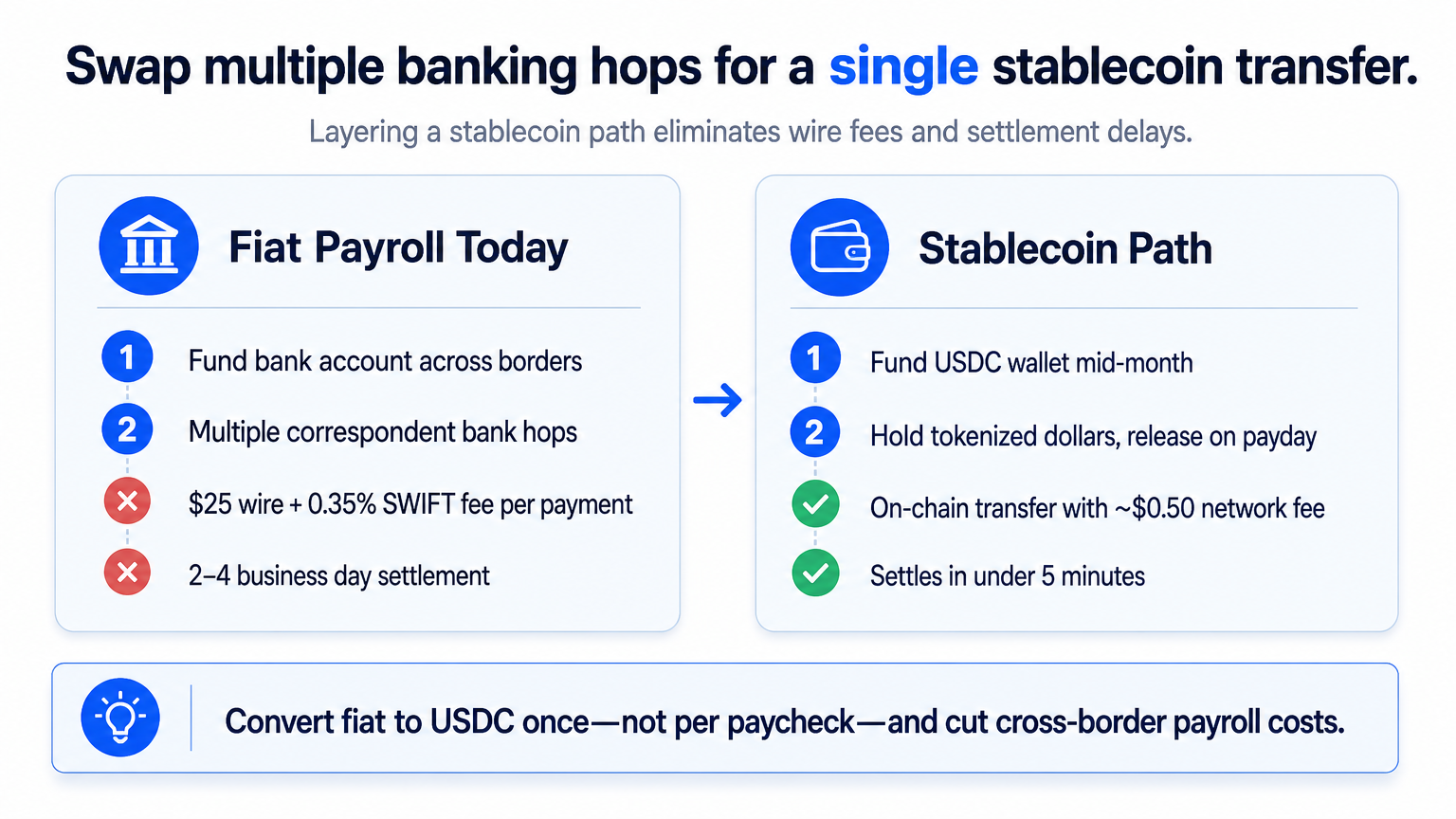
Diagram your current fiat payroll flow: where cash sits, when it converts, and the number of banking hops. Layer on a stablecoin path: fund a USDC wallet mid-month, hold tokenized dollars, and release on payday. You eliminate the $25 wire and 0.35% SWIFT fee per cross-border payment. Convert fiat to USDC once, not per paycheck.
Run a Stablecoin Pilot with One Approved Pay Group
Run a 90-day pilot with a small team using USDC. Denominate salary in USD, pay the net after tax in stablecoin, and deposit taxes in fiat. Reconciliation should match the on-chain hash to your payroll journal in minutes.
Build Role-Based Controls and Custody Around Payouts
Use role-based controls: separate proposers, approvers, and auditors. OneSafe’s platform supports customizable permissions and Fireblocks custody, enabling a controller to approve while an operations lead initiates, with full audit logs. This replaces the risky single-key model.
The Cost Model Most Crypto Payroll Content Skips
Fiat vs Stablecoin Rail Math
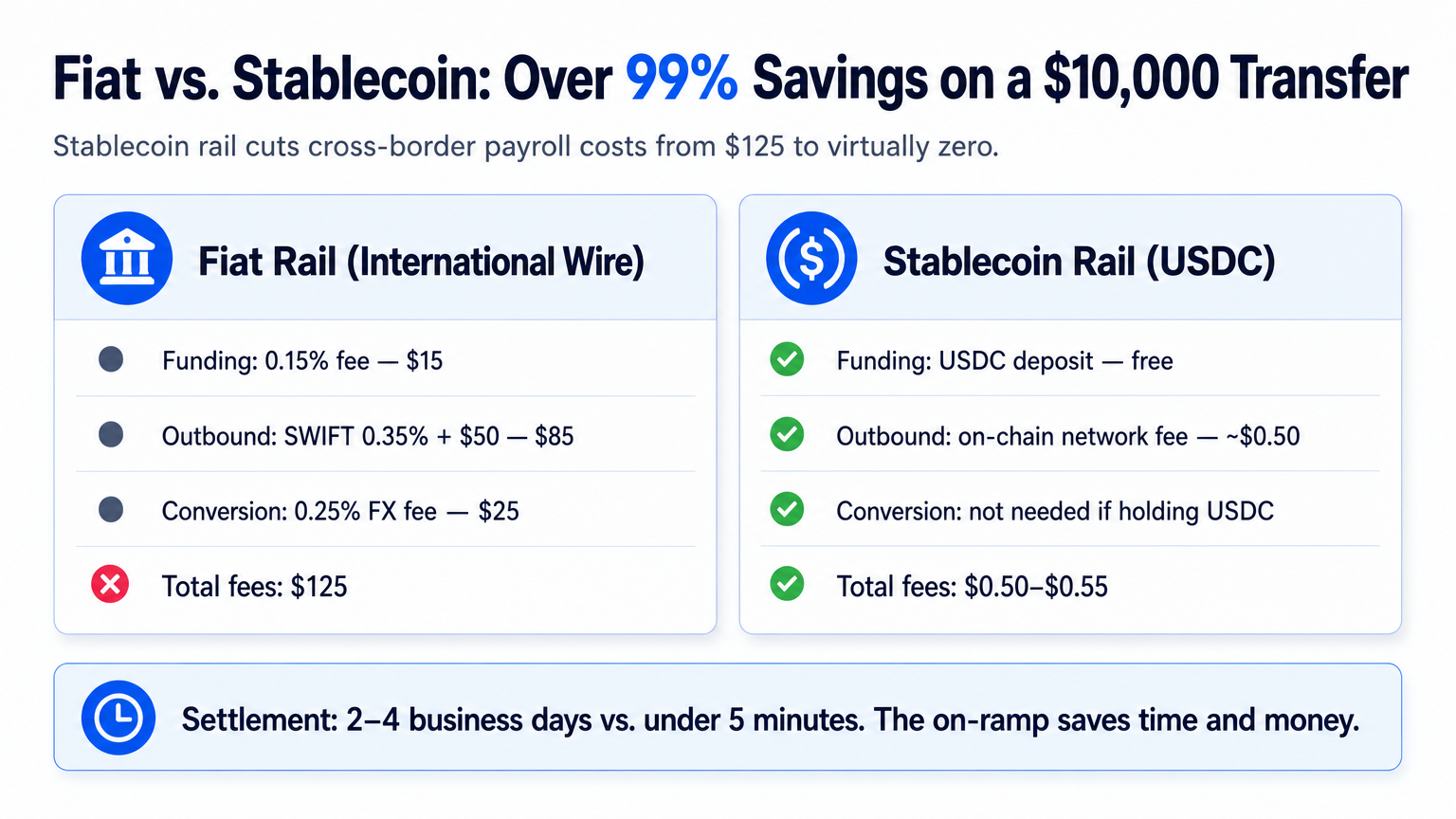
Here’s a side-by-side for paying a $10,000 equivalent to a European contractor via OneSafe’s pricing:
| Cost Component | Fiat Rail (International Wire) | Stablecoin Rail (USDC) |
|---|---|---|
| Funding cost | Fiat deposit: 0.15% ($15) | USDC deposit: free |
| Outbound transfer | SWIFT wire: 0.35% + $50 ($85) | USDC on-chain transfer: network fee ~$0.50 |
| Currency conversion | 0.25% FX fee if USD→EUR ($25) | Not needed if contractor holds USDC; if they convert off-platform, no fee |
| Total fees (on $10,000) | $125 | $0.50–$0.55 |
| Settlement time | 2–4 business days | < 5 minutes |
Stablecoin payroll cuts transfer costs by over 99% in this scenario, assuming the contractor can use USDC. If they need fiat, exit fees apply but usually beat bank retail rates.
Fee Timing, FX Exposure, and Treasury Buffering
The hidden cost is the USDC buffer. Fiat payroll funding can sit in an interest-bearing sweep; stablecoin buffers earn no yield. Keep a float of two payroll cycles plus 5%, and top up frequently. Automated treasury rules handle timing, making the buffer function like a prefunded card.
What to Watch Next
Open Questions Payroll Teams Should Track
- Will tax authorities accept stablecoin tax deposits directly? Currently, fiat is required. If the IRS or HMRC change, the loop closes.
- How will SEPA Instant and FedNow integrate with stablecoins? The SEPA on-ramp suggests interoperability could allow instant euro-stablecoin pushes into traditional systems.
- Will MiCA reserve requirements go global? Payroll could be disrupted if a widely-used stablecoin fails a U.S. audit but stays legal elsewhere—multinationals must monitor.
Signals That Tokenized Payroll Is Ready for Your Full Team
Infrastructure is mature when: (a) ERP systems offer native crypto payroll modules, (b) auditors verify on-chain proofs at no extra cost, and (c) benefits providers accept stablecoin contributions seamlessly. Meanwhile, content teams can document the migration using Joyrise, which publishes daily illustrated SEO articles to your Webflow blog.
Key Takeaways
- 88% enterprise tokenized cash adoption makes stablecoin payroll a treasury-standard decision.
- Stablecoins cut cross-border costs but carry issuer, custody, and redemption risks that need mitigation.
- Role-based controls prevent single-point failures; platforms with permissions and combined custody are critical for DAOs.
- Run a pilot, map your conversion cycle, and compare real fees using your own data.
- Taxes are still remitted in fiat; your provider must split net pay and tax seamlessly.
Start mapping your stablecoin payroll rail on a platform built for global businesses and DAOs—open a OneSafe account today.