Table of Contents
- What just happened: Polygon adds privacy to stablecoin payments
- Why it matters now for founders and finance leads
- The background: payment stablecoins, public ledgers, and the trust trade-off
- Implications and recommended actions
- What to watch next and open questions
- Key Takeaways
What just happened: Polygon adds privacy to stablecoin payments
What exactly did Polygon announce on October 28, 2026?
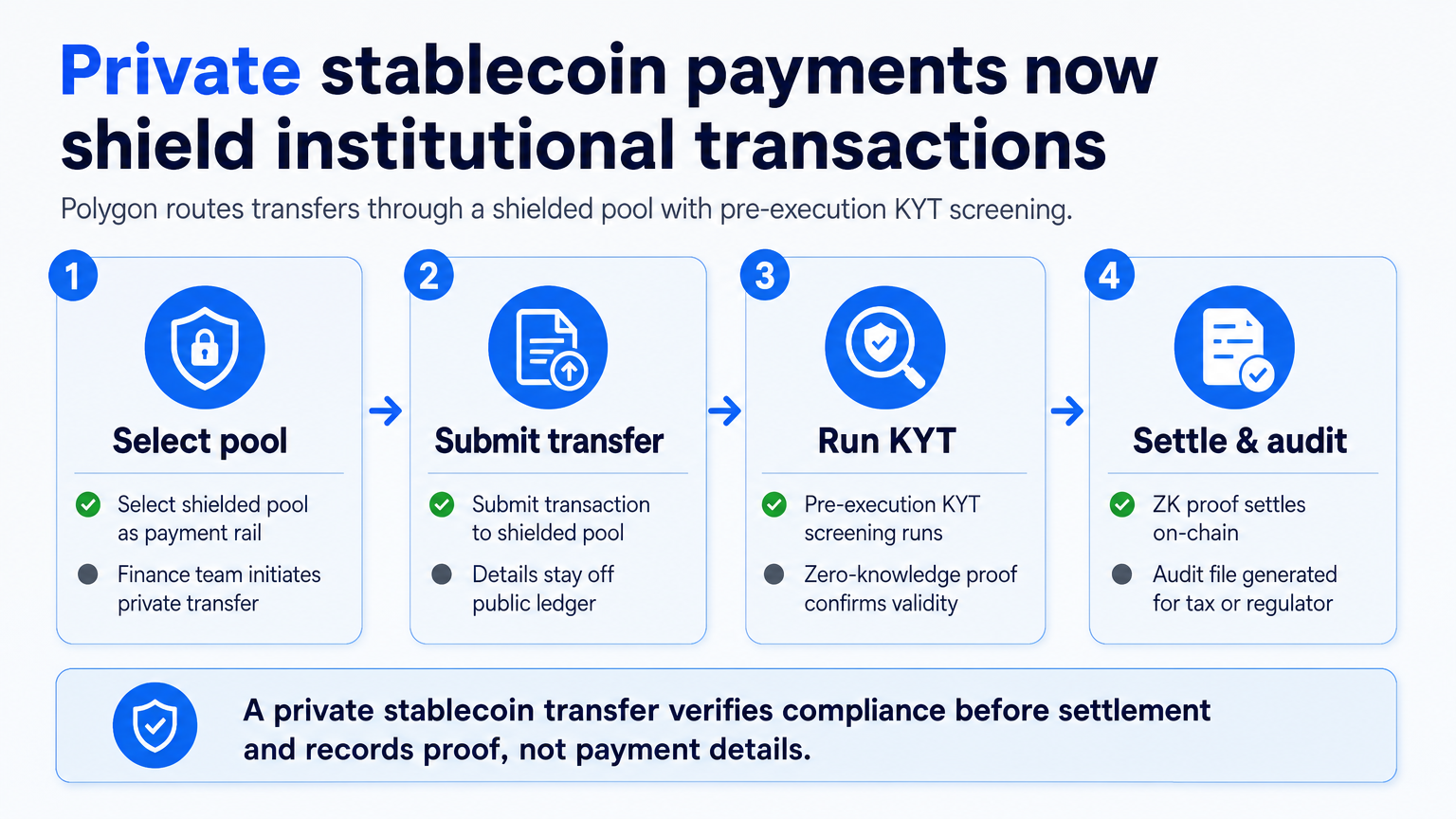
On October 28, 2026, Ethereum scaling network Polygon launched a private payments feature for stablecoin transactions, directly targeting the institutional confidentiality gap that has kept significant treasury volume off public blockchains, according to a CoinMarketCap report. The feature routes stablecoin payments through a shielded pool integrated with privacy protocol Hinkal, using zero-knowledge proofs to verify transactions without exposing the underlying data to network participants.
A finance team initiating a private transfer now has a clear workflow: select the shielded pool as the payment rail, submit the transaction, and let the system run Know Your Transaction (KYT) screening before execution. The zero-knowledge proof confirms validity—the sender has the funds, the amount is correct, the recipient is eligible—without revealing sender identity, recipient address, or transaction amount on the public ledger. After settlement, the user can generate an audit file for tax or regulatory submission.
Polygon community lead Smokey framed the move on X as addressing operational privacy, not regulatory evasion: “Not ‘hide from regulators’ privacy. Operational privacy.” The company stated explicitly that confidentiality has been the primary gap preventing institutions from moving significant stablecoin volume on-chain.
What does private stablecoin payments mean when blockchains are supposed to be public?
Standard stablecoin transfers on public ledgers leave every detail visible forever: the sending address, the receiving address, the exact amount, and the timestamp. For a business paying a supplier, that means competitors, counterparties, and data scrapers can reconstruct payment flows, negotiate leverage, and map treasury relationships. Polygon’s private pool replaces that public broadcast with cryptographic proof that the transaction was valid—without handing the world a permanent record of who paid whom and how much.
This is not a mixer. It is a shielded execution environment where the compliance check happens before the ledger update, and the proof of compliance is what gets recorded, not the raw transaction data. The distinction matters for institutional risk committees that have rejected public stablecoin rails specifically because they cannot control who sees their payment activity.
Why it matters now for founders and finance leads
The institutional confidentiality gap
Banks and treasury teams operate on rails where settlement is confidential by default. A SWIFT message between correspondent banks is not posted to a global bulletin board. Corporate treasurers moving seven-figure supplier payments do not expect those amounts to appear on a public dashboard indexed by Google. That expectation has been the structural barrier to institutional stablecoin adoption, not transaction speed or cost.
Polygon’s move addresses this directly. A manufacturer paying a component supplier in USDC can now do so without broadcasting the payment relationship and the contract value to every blockchain analytics firm and competitor with a block explorer. The operational security implications extend beyond competitive intelligence: revealing treasury wallet addresses and payment patterns creates attack vectors for social engineering, invoice fraud, and wallet-targeted exploits.
How can private stablecoin transfers remain compliant with KYC, KYT, and audit requirements?
The architecture separates two functions that public-chain transparency conflates: compliance verification and public disclosure. KYT screening runs on every transaction before it enters the shielded pool. The zero-knowledge proof confirms that screening passed. An audit file exists that a regulated entity can hand to an examiner or tax authority. What does not exist is a permanent public record of the transaction details.
This mirrors how traditional bank confidentiality works. A bank knows its customer, monitors transactions, and files suspicious activity reports—but does not post customer account activity on a public website. Polygon’s design brings that norm to on-chain settlement without sacrificing the cryptographic guarantees that make blockchains useful.
The background: payment stablecoins, public ledgers, and the trust trade-off
What payment stablecoins are at a glance
Payment stablecoins are tokens designed to hold a stable value—typically pegged to a fiat currency like the US dollar—and function as a settlement instrument. USDC is the dominant example for institutional use, issued by regulated entities with attestations backing the reserves. Unlike volatile crypto assets, payment stablecoins are built for transfer, not speculation. They settle on-chain in seconds to minutes, cost fractions of a cent to low dollars per transaction, and can move across borders without correspondent banking delays.
The IMF has noted that stablecoins can improve cross-border payment speed and reduce costs, while McKinsey frames them as a component of next-generation payment infrastructure. These are precisely the use cases that benefit most from the private payment layer Polygon now provides: cross-border stablecoin payments where both speed and confidentiality matter.
Why public transparency has limited larger treasury movements
The transparency that makes public stablecoins auditable also makes them operationally exposed. A publicly visible ledger means counterparties can reverse-engineer a company’s supplier network, competitors can estimate revenue run rates from incoming flows, and attackers can identify high-value wallets. For a CFO, the question becomes: why move treasury operations to a rail that creates new information asymmetry risks I don’t face on existing rails?
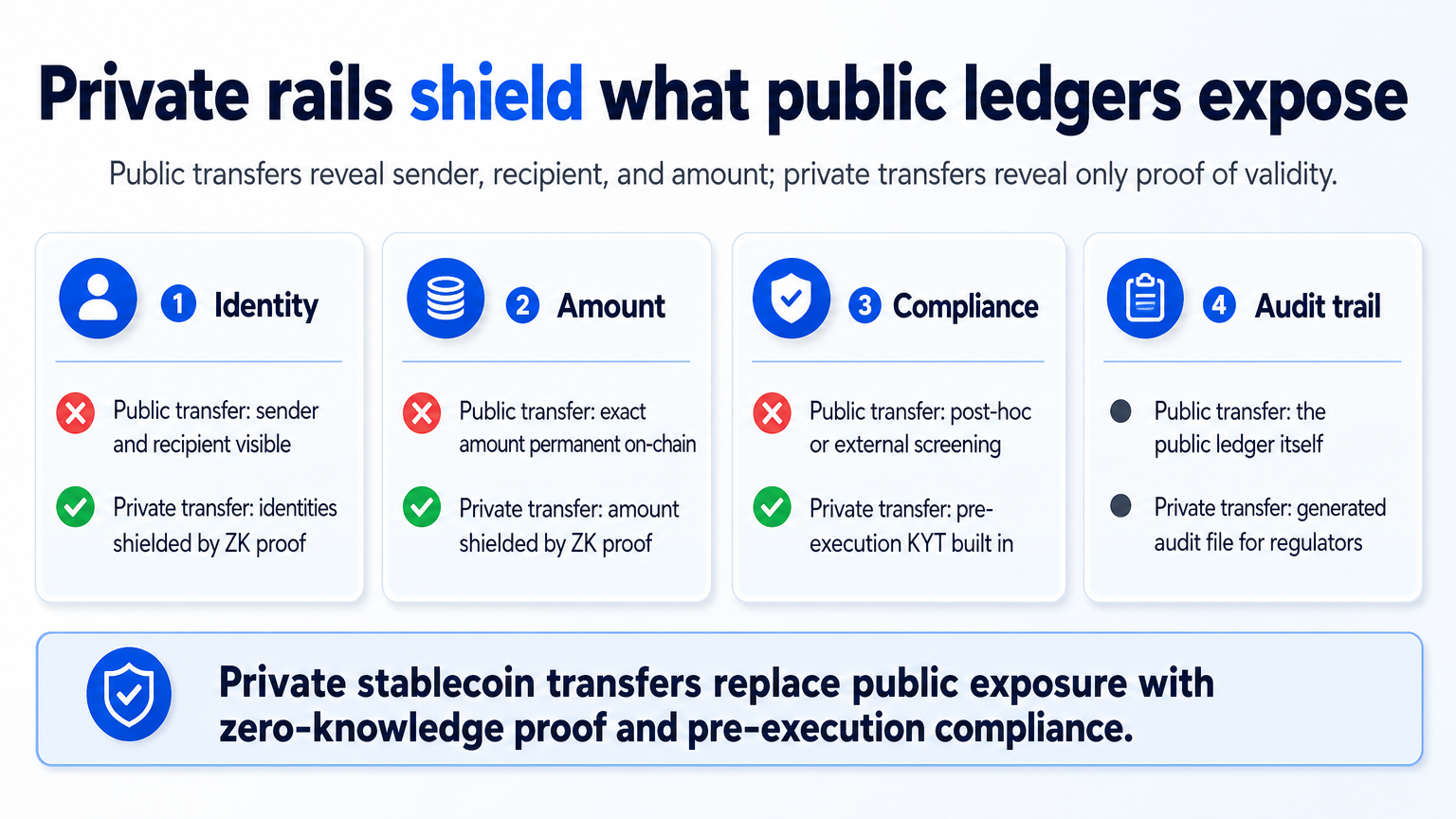
| Feature | Public Stablecoin Transfer | Private Stablecoin Transfer (Polygon/Hinkal) |
|---|---|---|
| Sender identity visible | Yes, via address analysis | No, shielded by ZK proof |
| Recipient address visible | Yes, permanently on-chain | No, shielded by ZK proof |
| Transaction amount visible | Yes, exact amount public | No, shielded by ZK proof |
| Compliance screening | Post-hoc or external | Pre-execution KYT built in |
| Audit trail for regulators | Public ledger itself | Generated audit file |
| Settlement finality | On-chain confirmation | On-chain ZK proof confirmation |
| Counterparty risk from visibility | High | Minimal |
Implications and recommended actions
Should finance leaders route institutional stablecoin payments through a private pool now or wait?
Finance teams need a decision filter, not a blanket policy. The following framework separates transactions that stay on public rails from those that should move to a private pool once the infrastructure matures:
Route through a private pool when:
- The payment amount is large enough that competitors could derive meaningful intelligence
- The counterparty relationship is commercially sensitive (new supplier, acquisition target, strategic partner)
- The recipient address would create a mappable link between previously unconnected business entities
- The payment is recurring and would establish a visible pattern over time
Keep on public rails when:
- The payment is small and routing complexity isn’t justified
- Public visibility is desired (e.g., grant disbursements where transparency is a feature)
- The counterparty cannot yet receive through private pools
- Audit requirements demand full public traceability and the audit-file model isn’t yet accepted by the relevant regulator
For most institutional payments that are material and non-public, waiting for regulatory clarity is prudent, but building internal readiness now is practical. Infrastructure is live; liquidity and counterparty networks will follow.
Auditability requirements to insist on
The Polygon/Hinkal feature generates audit files, but finance leaders should not assume these satisfy every jurisdiction’s requirements. Before routing any material volume, insist on:
- Confirmation that the audit file format is compatible with your accounting system and ERP
- A documented chain of custody for audit files that would survive a regulatory exam
- Clear understanding of what the auditor or examiner sees versus what stays shielded
- A tested process for responding to a specific transaction inquiry without breaking privacy for all other transactions
Documentation from projects like Neti-Soft’s confidential stablecoin implementation suggests the model is technically sound, but regulatory acceptance is still emerging.
What does OneSafe provide today for businesses moving between fiat and stablecoins, and what does it not provide?
OneSafe does not provide private stablecoin payment pools today. What it does provide is the fiat/crypto infrastructure that private settlement rails will connect to: USDC on-ramp and off-ramp functionality with free crypto deposits and withdrawals, multi-currency accounts in USD, Euro, and CAD, and a unified platform for managing both fiat and cryptocurrency transactions.
For a business that routes a supplier payment through a private stablecoin pool, the flow still needs to land somewhere—either the recipient off-ramps to fiat, or holds USDC and pays their own vendors from it. OneSafe’s stack covers the fiat side: convert stablecoins to fiat at a 0.25% FX fee (or prevailing FX rate), send domestic and international wires, issue corporate cards, and manage crypto treasury management operations from a single interface.
The total cost picture includes public stablecoin gas costs, private pool fees (still unannounced), and adjacent fiat costs like 0.15% for fiat deposits/withdrawals, $25 domestic wires, $50 plus 0.35% for SWIFT. OneSafe provides that fiat on/off ramp and treasury management layer but does not operate or offer a private stablecoin payment pool itself.
What to watch next and open questions
Adoption signals and regulatory response
The immediate question is uptake. Infrastructure without liquidity is theoretical. Watch for:
- The first named institutional user announcing volume through the private pool
- Third-party custody and wallet providers integrating the shielded pool into existing interfaces
- Stablecoin issuers—particularly Circle for USDC—issuing guidance on private pool compatibility with their reserve and redemption frameworks
On the regulatory side, the key moment will be the first public statement from a US or EU regulator acknowledging private stablecoin pools as compliant infrastructure. Without that, treasury teams at regulated entities will remain sidelined. The architecture’s “privacy from the market, not from regulators” positioning is designed to invite that acknowledgment, but it has not yet arrived.
Questions finance leaders should ask before adding a private rail
Who runs the KYT screening and what is their regulatory status? If the provider lacks standing with your primary regulator, the privacy is worthless for your use case.
What happens if the zero-knowledge prover has a vulnerability? Implementations have had bugs; a flaw could retroactively expose historical transaction data.
Are audit files per-transaction or batch, and who holds decryption keys? If decryption requires third-party cooperation, you’ve exchanged public visibility for dependency risk.
Does the private pool fragment stablecoin liquidity? If USDC in the shielded pool isn’t fungible with public USDC without a withdrawal step, you accept liquidity fragmentation.
What are counterparty requirements? Your payment only works if the recipient can receive through a compatible shielded pool. Network effects are not yet built.
For teams that need to keep their own stakeholders informed with daily, illustrated analysis of these payment infrastructure shifts, Joyrise plans, writes and publishes SEO articles to your Webflow blog every day—read your first article before you pay.
Polygon’s launch is not the end of the private stablecoin story. It is the beginning of an infrastructure layer that, if it gains adoption, will separate the settlement function of blockchains from the surveillance function that public ledgers have imposed by default. For CFOs and finance leads, stablecoin payments are now a question of routing policy, not just acceptance—and the decision framework matters more than the technology.
Key Takeaways
- Polygon’s October 28, 2026 launch of private stablecoin payments addresses the confidentiality gap that blocked institutional volume, using zero-knowledge proofs with pre-execution KYT screening.
- Route commercially sensitive, large, or pattern-creating stablecoin payments through private pools; keep small or transparency-desired transactions on public rails.
- Private transfers require a new auditability workflow: insist on compatible audit files, documented chain of custody, and tested regulatory response processes before routing material volume.
- OneSafe provides the fiat/crypto infrastructure (free USDC deposits/withdrawals, 0.15% fiat fees, multi-currency accounts) but does not operate a private stablecoin payment pool.
- Critical open questions: regulatory acknowledgment, counterparty compatibility, and whether audit files satisfy examiners in your operating jurisdictions.
Start building your fiat and crypto treasury operations on a platform that keeps pace with infrastructure shifts—open a OneSafe account today.