

Stablecoin payments settle fast, but as of October 29, 2026, the relevant question is no longer speed—it is what happens after the on-chain transfer. A report published October 28, 2026 by BeInCrypto warns that hidden conversion and cash-out costs can eat into savings. For founders and finance leads running cross-border payroll, contractor payouts, or DAO contributor payments, the full-loop cost drives the decision more than the quoted USDC settlement transfer fee. Stablecoin payment fees look small at the chain level, but they can grow at off-ramp and conversion points.
Table of Contents
- What just happened: the hidden-cost warning
- Why this matters now for founders and finance leads
- Background: how stablecoin payments reached this point
- Implications and recommended actions
- What to watch next and open questions
- Key Takeaways
What just happened: the hidden-cost warning
On October 28, 2026, BeInCrypto reported that stablecoin payments promise speed and low fees, but hidden conversion and cash-out costs can eat into savings. The report does not dispute settlement speed. It shifts the cost problem one step after the on-chain transfer: the conversion back to fiat and the cash-out rail.
The October 2026 report found a mismatch between the quoted cost of a stablecoin transfer and the realized cost of closing the payment loop. The visible on-chain leg may be cheap or free, but the effective stablecoin payment fees appear later, in conversion and cash-out steps that are not always disclosed in the same table as the transfer fee.
Fact: The October 28, 2026 BeInCrypto report says hidden conversion and cash-out costs can erode stablecoin savings.
Analysis: The right unit of comparison is not the on-chain transfer fee. It is the full-loop cost: USDC settlement plus stablecoin off-ramp costs plus conversion spread plus any wire, SWIFT, or card FX fees. The hidden stablecoin costs live in the handoff from crypto to fiat, not in the stablecoin itself.
Why this matters now for founders and finance leads
Analysts have catalogued hidden stablecoin costs that routinely sit outside the quoted transfer fee. The main ones:
- Stablecoin conversion costs: the spread or percentage charged when USDC becomes USD, EUR, CAD, or another local currency.
- Stablecoin cash-out fees: fiat withdrawal charges, wire fees, and SWIFT fees on the off-ramp.
- Card FX marks: corporate card foreign exchange fees, which can price at 3% or more and wipe out low-margin savings.
- Reconciliation and refund friction: stablecoin rails do not always behave like card rails on disputes. Finance teams should review stablecoin payment refund risk before extending payment terms.
- Float and liquidity: pre-funding multiple currencies or batching off-ramps can tie up working capital.
None of these is always large. In aggregate, they can turn a near-free transfer into a meaningful percentage of the invoice.
Cross-border payroll, contractor, and vendor payouts
Cross-border stablecoin payments look attractive for contractor and vendor payouts because USDC settlement can arrive in minutes instead of days. But payroll rarely ends in a wallet. Employees need local fiat for rent and taxes; vendors need bank credits. The payer’s real cost is set by the final off-ramp.
As crypto payroll moves into mainstream payroll infrastructure, the Dayforce-Deloitte alliance coverage is a useful signal for finance leads: payroll is not staying separate from stablecoin rails, so fee transparency has to be managed inside payroll operations. At the same time, new local bank and wallet payout rails shorten the last mile but introduce off-ramp partners whose fees must be tracked separately.
How do stablecoin off-ramp and FX fees affect cross-border payroll?
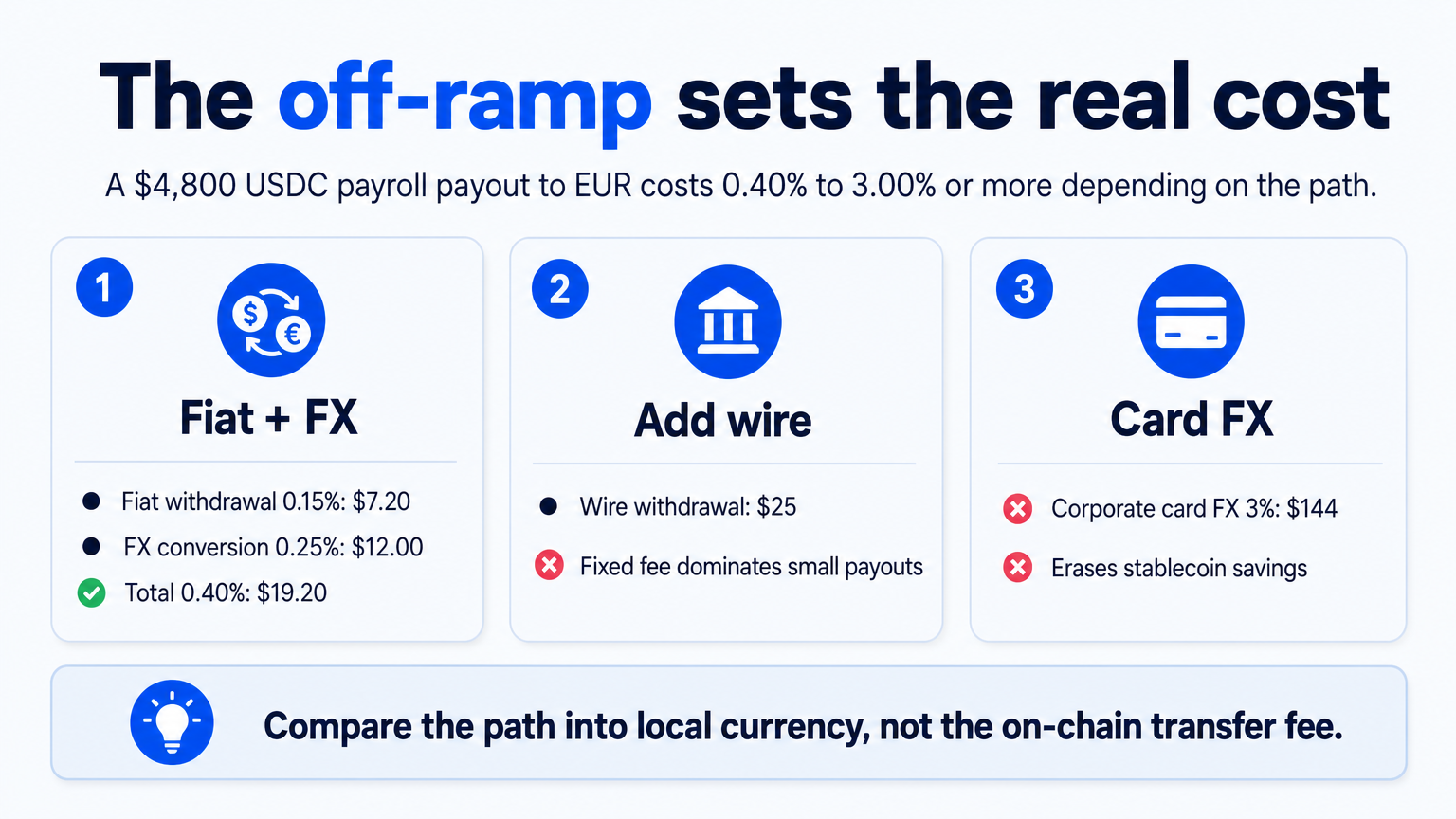
Suppose a US-based startup or DAO pays a contractor the equivalent of $4,800 in USDC, and the contractor off-ramps to EUR. Using a published crypto-friendly business baseline as of October 2026:
- USDC withdrawal: free at the baseline.
- Fiat withdrawal at 0.15%: $7.20.
- Wire withdrawal: $25 more if the contractor needs a bank rail.
- FX conversion at 0.25%: $12.00.
- Corporate card FX at 3%: $144.00.
That changes the math quickly. The on-chain leg can be free, but the after-transfer cost is 0.40% to 3.00% or more depending on which off-ramp and FX path the recipient uses. For payroll, the practical number is not the transfer fee; it is the cost of arriving in local payroll currency.
DAO treasuries and token-denominated contributor payouts
DAOs that pay contributors in USDC usually still have fiat obligations: taxes, legal fees, SaaS subscriptions, and local salary costs. The more often a contributor or sub-DAO converts to fiat, the more stablecoin cash-out fees compound. Effective DAO treasury management treats off-ramp and FX as first-class line items, not rounding errors.
A DAO making 50 small monthly payments may look cheap on-chain but pay flat cash-out fees per payout. At $25 per wire withdrawal, that matters far more on a $200 contributor payment than on a $20,000 vendor invoice.
Background: how stablecoin payments reached this point
Stablecoin payments gained adoption because they settle faster than many cross-border bank rails and avoid much of the correspondent-bank delay. USDC settlement on blockchains is often near-instant, which makes stablecoins appealing for time-sensitive treasury and contractor payments. A recent case study of Stablecoin Payments: 1TCH’s Fiat-to-USDC Move reflects that direction: businesses are moving fiat workflows into USDC to gain settlement speed.
The consensus is accurate on settlement time. It is less reliable on total cost.
Most ranking pages already explain what stablecoin payments are, how the payment flow works, settlement APIs, billing, refunds and disputes, and pending stablecoin policy. They cover speed, merchant acceptance, and developer infrastructure. What they skip is full-loop cost accounting: conversion spreads, cash-out fees, wire fees, and card FX marks after the stablecoin leaves the wallet.
Provider and issuer pages generally frame stablecoin payments as faster and cheaper than legacy rails. A Bitwave comparison of stablecoin versus traditional transactions covers part of that argument. But the October 28, 2026 BeInCrypto report says hidden conversion and cash-out costs can eat into savings.
Both can be true. The on-chain transfer cost is low. The effective cost depends on whether and how often the business converts to fiat, which provider handles the conversion, and whether off-ramp, wire, and card FX fees are disclosed.
The decision rule is not “stablecoins are cheaper.” It is: stablecoin payments are cheaper than wire transfers when at least one side stays in crypto, or when bank wire FX spreads plus fixed wire fees exceed the full stablecoin loop cost; they often are not cheaper for low-value, high-frequency fiat-to-fiat payouts that hit minimum cash-out or card FX fees.
Implications and recommended actions
Price the full loop, not just the quoted stablecoin transfer fee
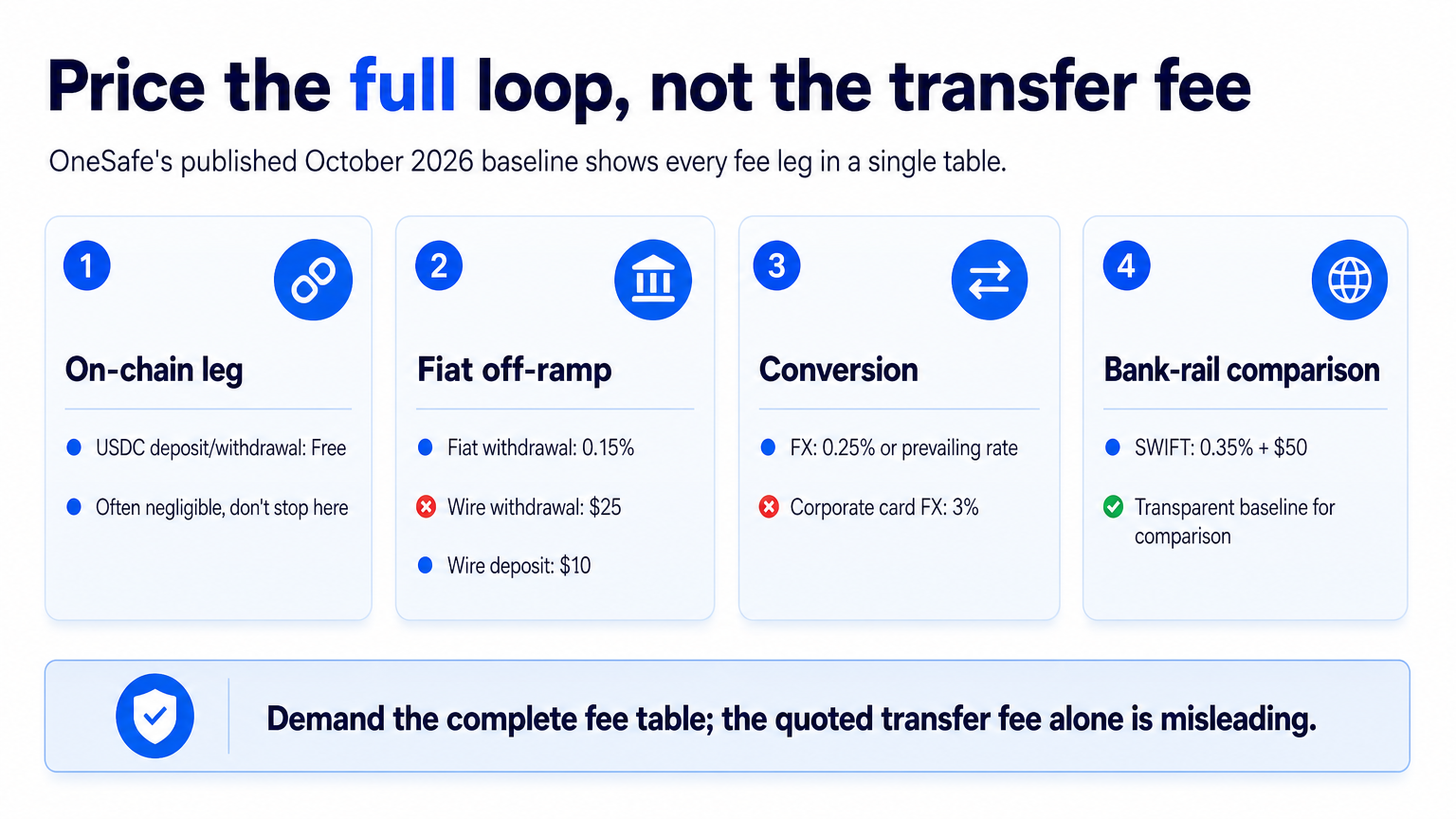
The table below uses OneSafe’s published fee schedule as a concrete baseline because it itemizes crypto and fiat legs in one table. That is the format finance teams should demand from any provider.
| Payment loop leg | Published fee baseline, October 2026 | Why it matters for comparison |
|---|---|---|
| USDC deposit/withdrawal | Free | The on-chain leg may be negligible; do not stop here |
| Fiat deposit/withdrawal | 0.15% | Adds a direct off-ramp cost |
| Wire withdrawal | $25 | Fixed fee can dominate small payouts |
| Wire deposit | $10 | Smaller, but part of the loop |
| FX conversion | 0.25% or prevailing FX rate | Conversion spread may not be quoted as a separate line |
| Corporate card FX | 3% | High-volume card spend can erase stablecoin savings |
| SWIFT deposit/withdrawal | 0.35% + $50 | The full bank-rail alternative is visible, so compare it |
These are not universal market rates. They are a published baseline that shows what transparent stablecoin pricing should look like.
How much do stablecoin cash-out and conversion fees cost?
At the transparent end, the baseline above shows fiat withdrawal at 0.15%, wire withdrawal at $25, and SWIFT at 0.35% plus $50. Stablecoin conversion costs typically land between 0.25% and 3% depending on whether the conversion happens through FX or a corporate card. CryptoSlate’s coverage of an $80 stablecoin fee gap shows that even similar-sounding stablecoin services can price cash-out very differently.
Compare fee tables line by line, including conversion and off-ramp
Do not compare “transaction fee” in isolation. Request the full fee table: stablecoin deposits and withdrawals, fiat deposits and withdrawals, wire and SWIFT fees, FX spreads, card FX, ACH, minimum balances, and monthly fees. If a provider will not disclose the full table, treat that as a cost risk.
Use multi-currency and crypto-native accounts to cut conversion hops
Every conversion hop adds spread. A crypto-friendly business banking account that holds USD, EUR, or CAD alongside USDC can reduce the need to convert twice—for example, USDC to USD, then USD to EUR. Multi-currency accounts let a finance team off-ramp once and pay local vendors in local currency. Fewer hops usually means lower stablecoin conversion costs and less operational friction.
What should finance teams compare before choosing stablecoin payment rails?
Finance teams should compare the full loop line by line:
- On-chain USDC deposit and withdrawal fees.
- Fiat withdrawal percentage and any minimums.
- Wire, SWIFT, and ACH outbound fixed fees.
- FX conversion rate and separate FX fee.
- Corporate card FX fee.
- Network gas costs and who pays them.
- Monthly fees and minimum balance requirements.
- Refund, dispute, and reversal behavior.
- Whether the provider supports multi-currency accounts to reduce conversion hops.
- Whether the recipient can stay in stablecoin or must off-ramp to fiat.
That checklist is the procurement framework. It works for payroll, vendor payouts, and DAO contributor payments alike.
Set a “use stablecoins / don’t use stablecoins” threshold for each payout type
Create a per-payout rule instead of a blanket policy. Use stablecoin payments / don’t use stablecoin payments thresholds could look like this:
- Use stablecoins for high-value cross-border invoices where bank wire fees plus FX spread exceed the stablecoin loop cost, or where the recipient already holds USDC and does not need fiat.
- Do not use stablecoins for sub-$250 frequent payouts where fixed wire fees, minimum off-ramp fees, or 3% card FX exceed the cost of a simple fiat alternative.
- Re-evaluate quarterly because fee tables and off-ramp partnerships change.
This turns a vague “stablecoins are cheap” assumption into a repeatable, testable operating rule.
What to watch next and open questions
The pressure is building. The October 28, 2026 BeInCrypto warning plus more granular processor fee comparisons may push providers to disclose conversion, off-ramp, and card FX fees rather than quoting only the on-chain leg. For finance teams that want a daily published feed on this topic, Joyrise plans, writes and publishes illustrated SEO articles to your Webflow blog every day—you can read your first article before you pay. Still, the final judgment requires verifying fee tables directly.
Open questions for operators
- Will stablecoin cash-out fees compress as off-ramp competition increases?
- Will DAO contributors begin negotiating gross-up payments for conversion costs?
- Will multi-currency accounts and integrated crypto-fiat rails make the full loop cheaper by removing conversion hops?
- How will pending stablecoin regulation affect fiat on-ramps and off-ramps, especially for DAOs and cross-border treasury operations?
The speed story is settled. The cost story is now the part that determines whether stablecoin payments make sense for a specific payout.
Key Takeaways
- Stablecoin payments settle fast, but the October 28, 2026 report shows hidden conversion and cash-out costs can erode savings.
- The right comparison is full-loop cost: USDC settlement plus stablecoin cash-out fees, FX, wire, SWIFT, and card FX.
- Stablecoins are not automatically cheaper than wires; they win mainly when one side stays in crypto or when bank wire costs and FX spreads exceed the full stablecoin loop.
- Finance teams should compare providers line by line, including conversion and off-ramp fees, and set a use/don’t-use threshold for each payout type.
- Multi-currency accounts and fewer conversion hops reduce effective cost for payroll, vendor, and DAO contributor payouts.
If you want to apply this framework to your own payouts, open a fiat-and-crypto account today.



