
Table of Contents
- What just happened: Bitcoin-backed lending enters the treasury mainstream
- Why this matters now for crypto treasury management
- The background a newcomer needs to follow the story
- What changes in practice for startups and DAOs
- Recommended actions for finance leads
- What to watch next and open questions
- Key Takeaways
What just happened: Bitcoin-backed lending enters the treasury mainstream
The dated development
On October 23, 2026, Silicon Valley Bank / First Citizens Innovation published a report that marks a structural shift in crypto treasury management: Bitcoin-backed lending has matured into a collateralized, transparent institutional market. The numbers make the case plainly.
Total crypto-backed lending reached $67 billion, up 49% year over year. Ledn, a digital asset lending platform, closed a $188 million asset-backed security (ABS) — the first Bitcoin-collateralized deal to earn an investment-grade rating from a Nationally Recognized Statistical Ratings Organization. Several major US banks have begun offering Bitcoin-backed credit lines. Lending rates sit at 7.5%-16% APR, above comparable traditional products, but a growing pipeline of institutional capital suggests spreads could compress.
This is not the 2022 market. The collapses of BlockFi, Celsius, and Genesis were failures of undercollateralized, opaque rehypothecation. The 2026 version is a collateralized lending model where the asset — Bitcoin — is posted, segregated, and tracked. The risk has shifted from platform solvency to collateral management.
The two details treasury teams should circle
Two mechanics in the report deserve careful attention from anyone running crypto treasury operations:
Conservative loan-to-value ratios. The report emphasizes LTVs that transfer risk from lending platforms to the collateral itself. This means margin calls trigger sooner, and treasury managers must model what happens if BTC draws down 30% in a week — entirely possible in a volatile asset class.
Lightning Network infrastructure for collateral operations. The report positions Lightning as a rail for faster margin calls, collateral posting, and liquidations. In traditional securities lending, a margin call might give a borrower T+2 to post additional collateral. In a Lightning-enabled Bitcoin lending framework, that window could shrink to minutes or seconds. Lightning Network collateral mechanics reduce counterparty exposure but introduce operational latency questions that no current ranking page on crypto treasury management addresses.
Why this matters now for crypto treasury management

From 2022 undercollateralized opacity to 2026 collateralized, rated debt
The 2022 lending market failed because platforms lent depositor assets without adequate collateral and without transparency. A treasury that parked corporate funds with Celsius lost them — no recovery, no rating, no segregation.
The 2026 market offers a different failure mode: collateralized debt can still trigger margin calls and forced liquidation, but the loss is bounded. The asset is posted and tracked. Investment-grade ratings mean a third party has examined the structure and the collateral pool.
Critically, the trust requirement has not disappeared — it has relocated. The trust now sits with the custodian who holds the collateral and the liquidation engine that executes when an LTV breaches a threshold. A treasury team must understand that chain of trust before adding Bitcoin-backed credit lines to its toolkit.
A new liquidity layer for BTC-heavy treasuries — but not a cheap one
For startups and DAOs that hold significant BTC reserves, Bitcoin-backed lending creates a liquidity option that does not require selling the underlying asset. This matters when a treasury has fiat obligations — payroll, vendor invoices, tax payments — but believes BTC will appreciate over the holding period.
The cost is the constraint. At 7.5%-16% APR, Bitcoin-backed credit is not a working-capital facility. It is a contingency tool, not a payroll line. A treasury that borrows at 12% to cover monthly opex is burning capital faster than most startups can sustain. Finance leads should model this as bridge liquidity — a line opened, documented, and held in reserve for scenarios where selling BTC would trigger unacceptable tax consequences or break a strategic asset allocation policy.
For founders and finance leads, credit lines are now a possible add-on
The October 23 report validates what many treasury managers suspected: institutional crypto lending has arrived. But custody, conversion, and payment operations still come first. A credit line is a bolt-on, not the core. Before any borrowing arrangement, a treasury needs independent custody, a documented segregation of duties, and a fiat conversion workflow that does not depend on the lending platform holding the keys.
OneSafe provides the base layer here — a unified platform where fiat and crypto accounts coexist under one interface, with crypto-to-fiat conversion and payment rails built in rather than patched together across exchanges and bank portals. That operational foundation is what makes a credit line usable, not dangerous.
The background a newcomer needs to follow the story
What a crypto treasury is and how it differs from traditional cash management
A crypto treasury is the corporate function that manages digital asset holdings alongside fiat under a single policy framework covering custody, liquidity, risk controls, and reporting. Companies like MicroStrategy have made Bitcoin treasury holdings central to their identity; public company Bitcoin treasury data shows the scale. For a broader view, Schwab’s overview of Bitcoin treasury companies explains the strategies.
Unlike traditional treasury management (banking hours, T+2 settlement), crypto treasury operates 24/7 with on-chain settlement and custody based on key management, not bank statements. Volatility is continuous, rebalancing between assets and fiat obligations is a constant function.
The base operational stack
Before any credit arrangement or yield strategy, the operational stack needs three layers:
- Secure custody: independent key management through a qualified custodian. OneSafe's integration with Fireblocks provides this, with MFA enforced on signup.
- Multi-currency accounts: fiat accounts in the currencies the business actually operates in — USD, EUR, CAD — alongside crypto accounts on the same platform.
- Reliable on/off-ramps: the ability to convert crypto to fiat and move fiat to payroll and vendor accounts without manual exchange trading.
Without this stack, a treasury cannot safely add borrowing. With it, a credit line becomes a manageable liquidity option.
What changes in practice for startups and DAOs
The conversion-first workflow that keeps treasury solvent
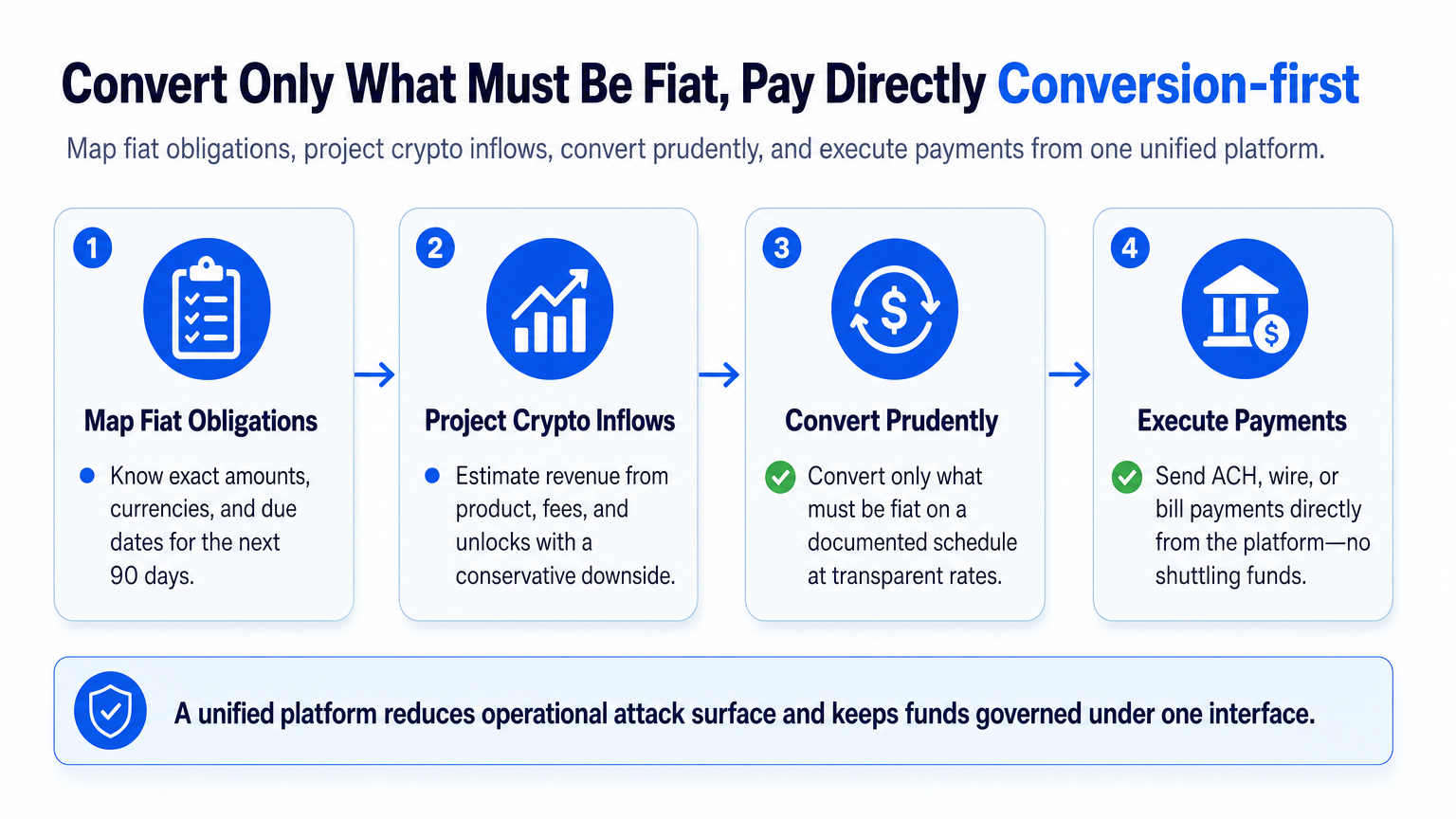
Most crypto-native businesses face a core operational challenge: revenue arrives in crypto (BTC, ETH, stablecoins), but obligations — payroll, rent, SaaS subscriptions, taxes — are denominated in fiat. The treasury workflow that keeps these businesses solvent is crypto-to-fiat conversion executed on a schedule and under policy, not in panic when bills come due.
The workflow looks like this:
- Map all fiat obligations over the next 90 days — know the exact amounts, currencies, and due dates.
- Project crypto inflows from product revenue, protocol fees, or token unlocks — with a conservative downside estimate.
- Convert only what must be fiat — no more, no less — on a documented schedule using a platform that prices the conversion transparently.
- Execute payments directly from the platform — no shuttling funds from an exchange to a separate bank account.
This workflow is what a unified neo-banking platform like OneSafe makes operationally feasible: stablecoin treasury holdings can be converted to fiat at known costs (0.25% or the prevailing FX rate, with free USDC on/off-ramp) and then paid out via ACH, wire, or bill payment — all within one interface.
DAO treasury controls
DAOs bring a specific governance requirement to treasury management: no single individual should control the funds. Role-based permissions are not a nice-to-have; they are a governance and security layer.
OneSafe's platform supports customizable roles and permissions, allowing a DAO to separate the authority to initiate a payment from the authority to approve it. Automated payment workflows can enforce multisig-style governance on fiat operations, mirroring the on-chain governance that DAO members already trust. This matters because a DAO that manages treasury votes on-chain but then lets a single signer move fiat through a bank portal has created a governance gap that no amount of smart-contract elegance can close.
Fee and rail benchmarks current guides skip
Every ranking page on crypto treasury management talks about "infrastructure" in the abstract. None publishes the actual costs. Here is what treasury rails cost on a platform that publishes its pricing — not as a sales pitch, but as a benchmark for treasury managers comparing options:
| Transaction Type | Cost |
|---|---|
| Fiat deposit / withdrawal | 0.15% |
| Wire withdrawal | $25 |
| Wire deposit | $10 |
| SWIFT deposit / withdrawal | 0.35% + $50 |
| FX conversion | 0.25% or prevailing FX rate |
| Corporate card FX | 3% |
| USDC on/off-ramp | Free |
For a treasury that converts $100,000 of stablecoins to USD and wires it to a payroll provider, the all-in cost on these rails is approximately 0.40% ($250 FX fee + $25 wire). That real number — not an enterprise custodian's negotiated rate sheet — is what a startup or DAO treasury should use when modeling operational costs.
Where collateralized lending actually fits
The October 23, 2026 report makes Bitcoin-backed lending look institutionally credible. But the placement rule is non-negotiable: collateralized borrowing is only safe when custody is independent and collateral is segregated.
If the lending platform holds the private keys that control the collateral, the treasury has recreated the 2022 risk structure — a single counterparty with control over the assets. If custody sits with a qualified, independent provider — and the collateral is merely pledged, not transferred — the treasury retains separation between its asset security and its credit relationship.
Never let a lending platform become the treasury system itself. The treasury system is custody, multi-currency accounts, conversion rails, and payment execution. The credit line is a contract that references the collateral held elsewhere.
Recommended actions for finance leads
Set borrowing and collateral policy before it becomes urgent
The worst time to write a collateral policy is during a liquidity crunch. Finance leads should define these parameters now, even if no borrowing is planned:
- LTV ceiling: the maximum loan-to-value ratio the treasury will accept, expressed as a percentage (e.g., 40% LTV, not 60%).
- Segregated custody duties: the person who can pledge collateral must be different from the person who controls the custodial account — or governed by a multisig or role-based approval workflow.
- Collateral movement authority: documented, limited, and logged — with a defined set of authorized counterparties.
A simple framework: define the maximum BTC exposure you would borrow against, model what a 30% BTC drawdown does to your LTV at 40% and 50% ceilings, and set the ceiling below the level that would trigger a margin call within your liquidity runway.
Map fiat obligations first, convert only what must be fiat
This is the core treasury cadence, and it runs before any borrowing decision. Automate it:
- Integrate accounting data so obligations are visible in real time.
- Set conversion triggers that are policy-driven, not panic-driven — e.g., "convert to fiat when a payment is due within 7 days and the treasury holds sufficient crypto."
- Execute payments directly from the platform that holds the converted fiat, avoiding the latency and cost of transferring between an exchange and a bank.
Platforms that combine these functions — crypto custody, fiat accounts, conversion, and payment execution — reduce the operational attack surface. Every additional platform and transfer is another point where funds sit in transit, ungoverned.
Keep custody independent and reporting tight
This rule applies regardless of whether the treasury uses a credit line: do not let a lending platform hold the private keys that control collateral. Use qualified custodians with audited security infrastructure. OneSafe's Fireblocks integration provides one such custody layer. The lending arrangement should reference the collateral location, not control it.
Reporting should produce a single view of all positions — fiat, crypto, and any pledged collateral — updated at a frequency that matches the 24/7 nature of the assets. A treasury manager who updates a spreadsheet once a week is several market cycles behind.
What to watch next and open questions
Lightning Network in lending operations
The SVB / First Citizens report flags Lightning Network as infrastructure for faster margin calls and liquidations. This is a genuine operational shift. Faster liquidations reduce the window where a lender is undercollateralized, which reduces systemic risk. But they create a new question for treasury managers: how fast is too fast?
If a margin call executes in seconds over Lightning, a treasury team that operates during business hours may not have time to post additional collateral manually. Automated collateral management — policy-driven bots that monitor LTV and post from a reserve — may become an operational requirement, not a sophistication play. This has compliance, governance, and technical implications that no current crypto treasury management software fully addresses.
Credit spread compression
The report notes a "growing pipeline of institutional capital" that could push credit spreads lower. If Bitcoin-backed lending rates compress from 7.5%-16% toward 4%-8%, the product shifts from contingency tool to plausible working-capital facility. Treasury managers should watch for new entrants — particularly bank-led programs — and model what rate thresholds would change their borrowing calculus.
Open questions
- Regulatory treatment of crypto-collateralized ABS. Ledn's $188 million deal earned an investment-grade rating, but regulatory frameworks for securities backed by digital assets are still forming. The stablecoin regulation landscape shows how policy can reshape treasury options overnight.
- Accounting for borrowed crypto. When a treasury borrows against BTC, how should the liability and the pledged collateral be reported? Standards are inconsistent across jurisdictions.
- Access for smaller treasuries. The $67 billion market described in the October 23 report is institutional. Whether a startup with $2 million in BTC can access these rails at reasonable terms remains an open, underreported question. Current evidence suggests the market is concentrated among larger borrowers.
Key Takeaways
- Bitcoin-backed lending hit $67 billion (up 49% YoY) as of October 2026, with investment-grade ABS and bank participation signaling institutional maturity — but 7.5%-16% APR means it is a contingency tool, not cheap working capital.
- Custody must stay independent from lending: the base treasury stack — secure custody, multi-currency accounts, and crypto-to-fiat conversion rails — comes first, and no lending platform should hold the private keys that control collateral.
- Lightning Network collateral operations will accelerate margin calls and liquidations, creating a new operational requirement for automated LTV monitoring that current treasury tools do not yet address.
- DAO treasury management requires role-based permissions and automated payment workflows to close the governance gap between on-chain voting and fiat execution.
- Conversion-first, borrow-second: map fiat obligations, convert only what must be fiat on transparently priced rails, and automate payments from a unified platform before considering any credit line.
Start building your crypto treasury foundation — with multi-currency accounts, transparent FX, and secure custody on a single platform — at OneSafe.



