Crypto Treasury Management After Surveillance Rule Withdrawal
On October 5, 2026, the U.S. Treasury’s Financial Crimes Enforcement Network (FinCEN) withdrew two long‑contested surveillance proposals, as first reported by CoinGape. The rules would have imposed detailed reporting on unhosted wallets and mixers. For anyone running a crypto treasury management strategy, the FinCEN surveillance rules withdrawal removes a near‑term mandate but shifts the compliance burden to internal controls. Here’s what changed, what didn’t, and the concrete steps treasury teams should take now.
Table of Contents
- What Just Happened?
- Why This Matters for Crypto Treasury Management
- The Operational Playbook: Adjusting Your Treasury Approach
- What This Means for DAOs and Web3 Treasuries
- What to Watch Next
- What does the U.S. Treasury's withdrawal of proposed surveillance rules mean for my crypto treasury?
- How should I adjust my treasury management policies after this regulatory change?
- Are crypto mixers and unhosted wallets now safe to use for business treasuries?
- What does secure crypto treasury management look like without these proposed rules?
- How can DAOs keep their treasuries compliant and secure in this evolving landscape?
- What tools are available to help manage a crypto treasury that meets both regulatory and operational needs?
- Key Takeaways
- Sources
What Just Happened?
FinCEN Drops Two Proposed Surveillance Rules
On October 5, 2026, FinCEN withdrew its notices of proposed rulemaking that had been pending since late 2020. The two targeted rules covered:
- Unhosted wallet reporting: Banks and MSBs would have had to collect counterparty names, addresses, and transaction details for crypto transfers involving non‑custodial wallets.
- Mixer surveillance: Any transaction involving a crypto mixer would have required special reporting, treating all mixer exposure as high‑risk.
The proposals faced massive industry pushback for being technically unworkable. FinCEN confirmed the withdrawal via a brief Federal Register entry, and noted the rules no longer reflected current enforcement priorities.
What the Rules Would Have Required
The unhosted wallet rule would have kicked in for transactions aggregating over $10,000 in 24 hours, or $3,000 if a wallet was deemed high‑risk. The mixer rule would have mandated reporting within 15 days of any mixer interaction, regardless of amount. For corporate treasuries, this meant constant surveillance of every counterparty address and the risk of banking de‑risking.
A Shift in Regulatory Tone
The withdrawal follows a broader softening of aggressive crypto surveillance postures since 2025, as Treasury prioritizes stablecoin legislation and clear exchange regulation. FinCEN pulled the rules because they no longer aligned with current priorities, though they also faced legal uncertainty.
Why This Matters for Crypto Treasury Management
Immediate Relief for Compliance Teams
Treasury managers no longer face the costly prospect of per‑transaction reporting for unhosted wallet interactions. Budgets earmarked for compliance headcount and blockchain analytics can be redirected. However, existing BSA/AML requirements still apply, and every business treasury must still demonstrate reasonable risk processes to maintain banking relationships.
Strategic Implications: Privacy, Mixers, and Unhosted Wallets
The absence of mandatory crypto wallet regulations does not make mixers safe. FinCEN’s existing interpretive guidance flags mixers as high‑risk, and FATF pressure keeps them under scrutiny. A treasury that touches a mixer could still have funds frozen by a downstream exchange. Unhosted wallets remain a legitimate tool for multi-sig wallets and cold storage when governed by internal policy and documented controls, never anonymity.
Corporate holdings data from BitcoinTreasuries.net shows how public and private firms manage billions using a mix of custodians and self‑custody. The withdrawal removes a federal push toward fully hosted models, but disciplined recordkeeping is still essential.
The Operational Playbook: Adjusting Your Treasury Approach
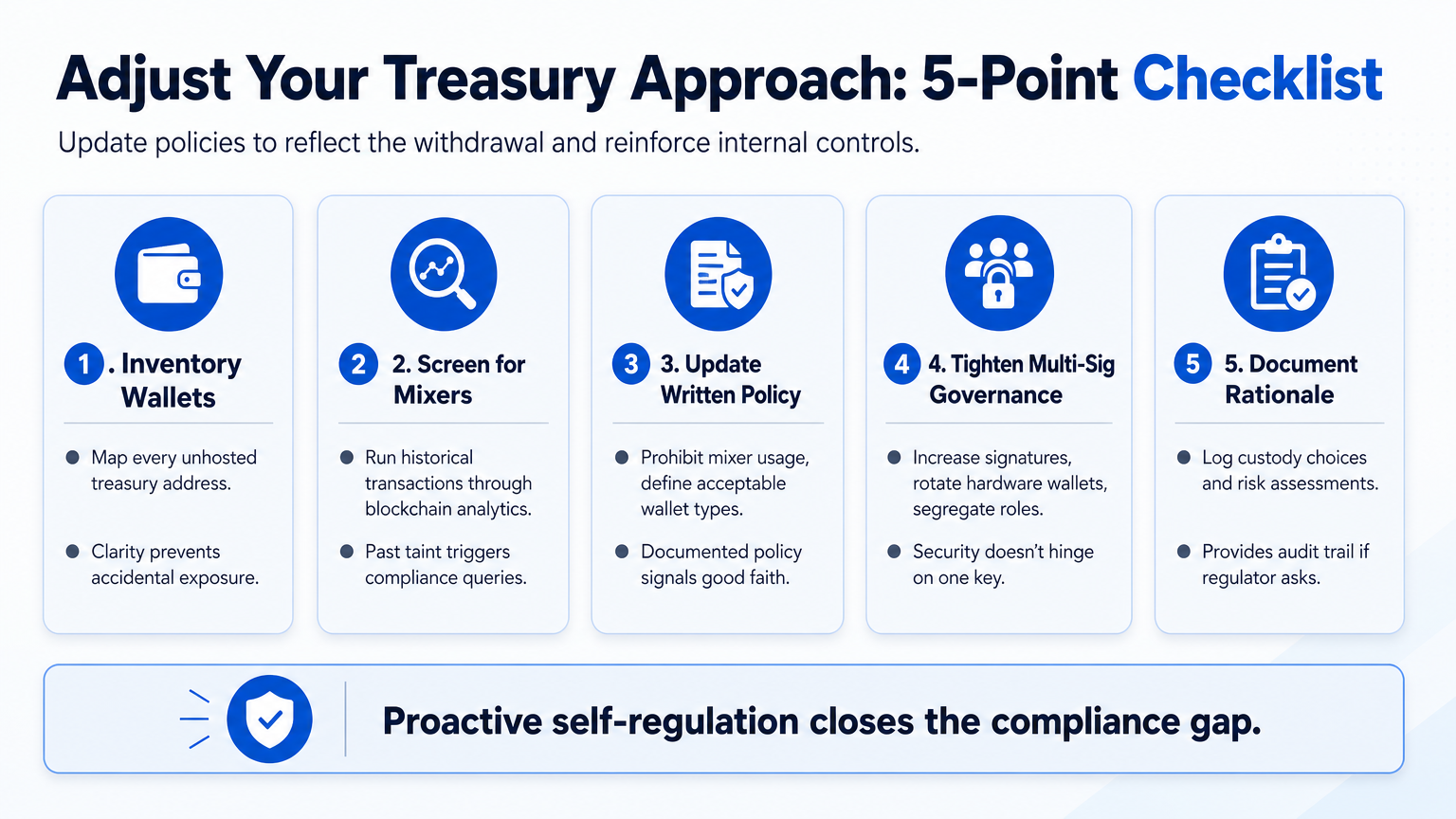
Reassess Wallet and Mixer Policies
Update your internal playbook with this five‑point checklist:
| Step | Action | Rationale |
|---|---|---|
| 1. Inventory wallets | Map every unhosted address used for treasury ops, including multi‑sig signer addresses. | Clarity prevents accidental exposure. |
| 2. Screen for mixer exposure | Run historical transactions through a blockchain analytics tool to identify indirect mixer touchpoints. | Even past taint can trigger compliance queries. |
| 3. Update written policy | Prohibit mixer usage for treasury funds and define acceptable wallet types. | A documented policy signals good faith to regulators and banks. |
| 4. Tighten multi‑sig governance | Increase required signatures for large transfers, rotate hardware wallets, and segregate approval roles. | Security doesn’t hinge on a single compromised key. |
| 5. Document decision rationale | Maintain a log explaining custody choices and risk assessments. | Provides an audit trail if a regulator asks. |
Strengthen Internal Controls Without Regulatory Overreach
Without the prescriptive rules, the onus is on teams to self‑regulate—exactly the kind of crypto risk management that traditional treasury best practices demand. A robust cryptocurrency treasury framework should include segregation of duties, regular independent wallet audits, threshold‑based approvals enforced by multi-sig wallets, and real‑time monitoring integrated with your general ledger. These steps mirror the controls Citi’s treasury considerations recommend, now applied to chain‑native assets.
Leverage Institutional Crypto Custody
Institutional crypto custody solutions like Fireblocks use MPC wallets that eliminate private key exposure and embed policy‑based workflows. For teams without dedicated security personnel, integrating a qualified custodian or custody‑tech platform reduces operational risk while preserving control.
What This Means for DAOs and Web3 Treasuries
DAOs depend heavily on multi-sig wallets (e.g., Safe) where signers often operate from unhosted personal addresses. Had the surveillance rules taken effect, every transaction could have required identifying each signer’s counterparty wallet—a near‑impossible task. The withdrawal removes that pressure, allowing Web3 treasury operations to continue with less fear of non‑compliance.
But DAOs still fall under state money‑transmission laws and BSA expectations. Proactive DAOs are mapping contributors’ wallets and implementing role‑based controls, leveraging the smart‑contract layer to enforce permissions. Platforms like OneSafe bridge fiat and crypto natively, letting a DAO hold USD and digital assets, manage multi‑sig authorization, and settle payments in crypto or fiat—all on Fireblocks infrastructure—while providing a single dashboard for crypto compliance.
What to Watch Next
Potential Congressional or State-Level Actions
The withdrawn rules could resurface as legislation, such as the SARs‑for‑Crypto Act. State regulators like NYDFS also retain broad authority to impose surveillance requirements. Any treasury active in the U.S. must monitor both levels.
Global Regulatory Trends
While the U.S. dials back, the EU’s MiCA framework is implementing strict reporting for crypto‑asset service providers, as detailed in our MiCA compliance review. A multinational treasury needs a flexible, policy‑driven stack that can adapt to fragmented rules.
What does the U.S. Treasury's withdrawal of proposed surveillance rules mean for my crypto treasury?
It means the imminent threat of heavy‑handed reporting on unhosted wallets and mixers has passed. Your cryptocurrency treasury no longer faces a near‑term requirement to collect counterparty identity data for every non‑custodial wallet transaction above $10,000 or file special reports on mixer exposure. Underlying AML laws remain, so you still must treat mixer‑touched funds as high‑risk and maintain good‑faith BSA records.
How should I adjust my treasury management policies after this regulatory change?
Update policies to reflect the withdrawal while reinforcing internal controls:
- Remove procedures drafted solely for the withdrawn rules, but retain enhanced documentation for wallet inventory and mixer screening.
- Add a policy statement prohibiting mixer use for treasury operations.
- Review banking agreements to ensure unhosted wallet usage for multi‑sig does not violate terms—many banks remain wary.
- Strengthen multi‑sig governance by increasing required signatures and rotating devices regularly.
The checklist from the Operational Playbook covers the key execution steps.
Are crypto mixers and unhosted wallets now safe to use for business treasuries?
Mixers are still not safe. FinCEN’s standing guidance and financial institution flags persist; a single mixer‑touched transaction can freeze your account. Unhosted wallets are safe when managed with rigorous controls—document who controls keys, how approvals work, and never treat them as anonymous tools. They remain a standard component of multi‑sig cold storage.
What does secure crypto treasury management look like without these proposed rules?
Secure crypto treasury management now hinges on proactive self‑regulation: use institutional‑grade custody or MPC wallets with policy engines, enforce multi‑sig quorums for material transfers, run ongoing blockchain analytics, maintain audit trails linking every transaction to a business purpose, and integrate fiat and crypto operations via a platform that reconciles both ledgers. This closes the gap that often hides errors or fraud.
How can DAOs keep their treasuries compliant and secure in this evolving landscape?
DAOs should anchor compliance in transparent, role‑based governance:
- Deploy a multi‑sig wallet (e.g., Safe) with vetted, identifiable signers.
- Set spending limits with supermajority approval for large transactions.
- Use an operational grants committee and execute payments only through approved wallets.
- Leverage a platform offering crypto‑fiat banking for DAOs to bridge on‑chain and off‑chain rails without unvetted intermediaries.
- Publish quarterly treasury reports detailing holdings, movements, and compliance measures.
This satisfies community transparency and demonstrates good faith to regulators.
What tools are available to help manage a crypto treasury that meets both regulatory and operational needs?
- Custody: Fireblocks, Copper, BitGo (institutional crypto custody with MPC wallets). For smaller teams, Gnosis Safe with hardware‑wallet signers.
- Analytics: Chainalysis, Elliptic, TRM Labs for wallet screening and monitoring.
- Fiat integration: OneSafe provides a unified neo‑banking interface to hold fiat and crypto, convert between them, issue corporate cards, and automate payments—all with assets secured on Fireblocks. See our guide to crypto business bank accounts.
- Multi‑sig front‑ends: Safe and Coinshift offer treasury dashboards with role‑based approval.
- Accounting: Subledger tools like Cryptio and Integral reconcile on‑chain activity with financial reporting.
Key Takeaways
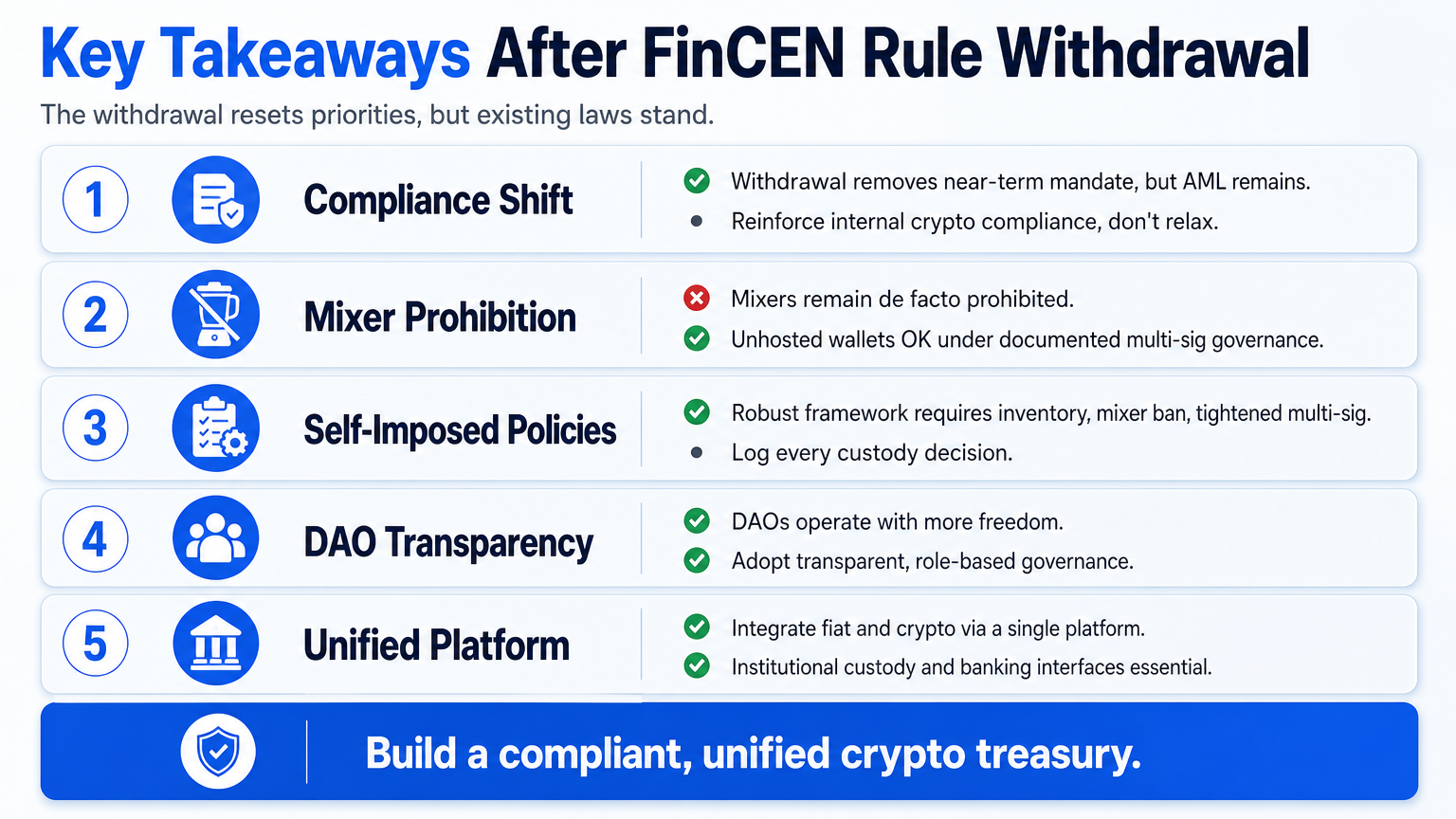
- The FinCEN withdrawal on October 5, 2026, removes a near‑term reporting mandate, but existing AML laws are unchanged. Treat this as a call to reinforce internal crypto compliance, not relax.
- Mixers remain de‑facto prohibited for business treasuries; unhosted wallets are acceptable only under documented multi‑sig governance.
- A robust crypto treasury management framework now relies on self‑imposed policies—inventory wallets, prohibit mixers, tighten multi‑sig, and log every custody decision.
- DAOs and Web3 treasuries can operate with more freedom but must adopt transparent, role‑based governance to satisfy community and regulatory expectations.
- Integrating fiat and crypto operations through a single platform reduces complexity; institutional crypto custody and crypto‑friendly banking interfaces are essential to stay ahead.
Start building your compliant, unified crypto treasury today—explore how OneSafe streamlines fiat and digital asset operations for global businesses.
Sources