Stablecoin regulation in 2026 reached a new inflection point on October 5, 2026, when the Observer Research Foundation (ORF) published The Dollar Outside the Banking System, a stark analysis arguing that stablecoins have created a parallel dollar ecosystem operating beyond traditional financial intermediaries. That same dynamic is now colliding with a wave of rulemaking in the United States and abroad—making stablecoin business compliance an urgent priority—that aims to pull stablecoin flows firmly back inside the regulatory perimeter. For businesses that rely on stablecoins for payments, treasury, or DeFi operations, the months ahead will determine whether dollar-denominated digital value remains a lightly constrained utility or becomes a heavily re‑intermediated banking product.
Table of Contents
- The Dollar Outside Banking and the Regulatory Response
- Why Businesses Must Act Now
- A Quick Primer on Stablecoins and Their Regulation
- What This Means for Your Business
- Choosing a Platform for Stablecoin Operational Compliance
- What to Watch Next
- Key Takeaways
The Dollar Outside Banking and the Regulatory Response
The ORF piece, published on October 5, frames stablecoins as a structural shift: dollar-pegged tokens now circulate in on‑chain wallets and smart contracts, bypassing banks entirely. It argues that this “dollar outside banking system stablecoin” circulation erodes the state’s traditional gatekeeping over the dollar’s reach, raising questions of monetary sovereignty. Yet this stablecoin news October 2026 is already being overtaken: regulators are moving to re‑intermediate those very flows.
On one side, the ORF article describes a permissionless global dollar rail. On the other, the GENIUS Act and the Federal Reserve’s proposed rules from September 24, 2026 seek to pull stablecoin issuance inside a bank‑style regulatory framework. The GENIUS Act’s public comment period and the Fed’s proposal make clear that regulation is effectively re‑intermediating stablecoin flows. When a dollar‑pegged stablecoin can only be issued by a state-chartered entity with reserves at the Fed, the institutional plumbing is dragged back into the banking perimeter. In practice, stablecoins are becoming a regulated extension of the dollar, not an autonomous parallel system.
Key Stablecoin Regulatory Milestones, 2026
| Date | Development | Immediate implication |
|---|---|---|
| Mar 2, 2026 | Federal Register publishes Proposed Rule to implement the GENIUS Act (Proposed Rule) | Formal rulemaking begins; public comment window opens |
| Sep 24, 2026 | Treasury proposes rules defining stablecoin issuance and reserve requirements (Treasury proposes rules) | Issuers face requirement to hold reserves at Fed banks |
| Oct 5, 2026 | ORF publishes The Dollar Outside the Banking System | Policy voices spotlight the systemic dimension |
| Ongoing | EU MiCA stablecoin provisions in effect | Euro‑denominated stablecoins face strict licensing and reserve rules |
Why Businesses Must Act Now
Businesses that use stablecoins for settlement or liquidity face an imminent reset. A 2026 analysis of global stablecoin laws (Stablecoin Regulation: US Federal and State Rules) notes that major jurisdictions now demand robust KYC/AML controls, sufficient reserves, and licensing for any entity intermediating stablecoin transactions. A startup routing USDC to freelancers globally via unregulated wallets and offshore exchanges will soon find that path blocked.
The shift from guidance to hard rule is accelerating. The U.S. Treasury released a Notice of Proposed Rulemaking under the GENIUS Act, and the Federal Reserve proposed rules that would make non‑compliant stablecoin activity a federal violation. The era of optional compliance is over.
A Quick Primer on Stablecoins and Their Regulation

Stablecoins are tokens engineered to maintain a steady value against a reference asset, typically the U.S. dollar. The dominant fiat-backed stablecoin rules require issuers to hold dollar reserves at a 1:1 ratio, minting and burning tokens as users deposit or redeem fiat. Businesses use them for cross‑border payments, treasury, on‑chain trading, and payroll—24/7 settlement and low cost make them ideal for DAOs and global teams. Risks include de‑pegging, opaque reserves, and systemic contagion—exactly what the evolving stablecoin regulatory framework 2026 targets.
In the U.S., state money transmitter laws already apply, but the GENIUS Act proposes a dedicated federal charter with capital standards and examinations. The Fed’s September reserve proposal would require issuers to hold reserves in Fed‑supervised accounts, effectively turning stablecoin issuance into narrow banking. Abroad, the EU’s MiCA requires authorization, high‑quality reserves, and direct redemption at par; the UK and Singapore have similar frameworks, while the FSB pushes harmonization. This means businesses must navigate multiple overlapping rulebooks under crypto regulation for businesses 2026.
What This Means for Your Business
If your business issues, redeems, or facilitates stablecoins—even indirectly—you increasingly need a license (money transmitter or a federal charter) and a compliant AML program. The line between “user” and “intermediary” is blurring; holding large stablecoin treasury that you regularly convert to fiat may trigger reporting.
DAO stablecoin compliance is especially fraught. Without a centralized legal entity, a DAO can’t easily hold a money transmitter license or pass KYB checks. Regulators expect any “person” facilitating stablecoin transactions to comply, forcing DAOs to adopt legal wrappers (e.g., Cayman Islands, Wyoming) or rely on compliant platform partners. Operating as an unregistered money services business risks enforcement, frozen accounts, and loss of banking access.
Choosing a Platform for Stablecoin Operational Compliance
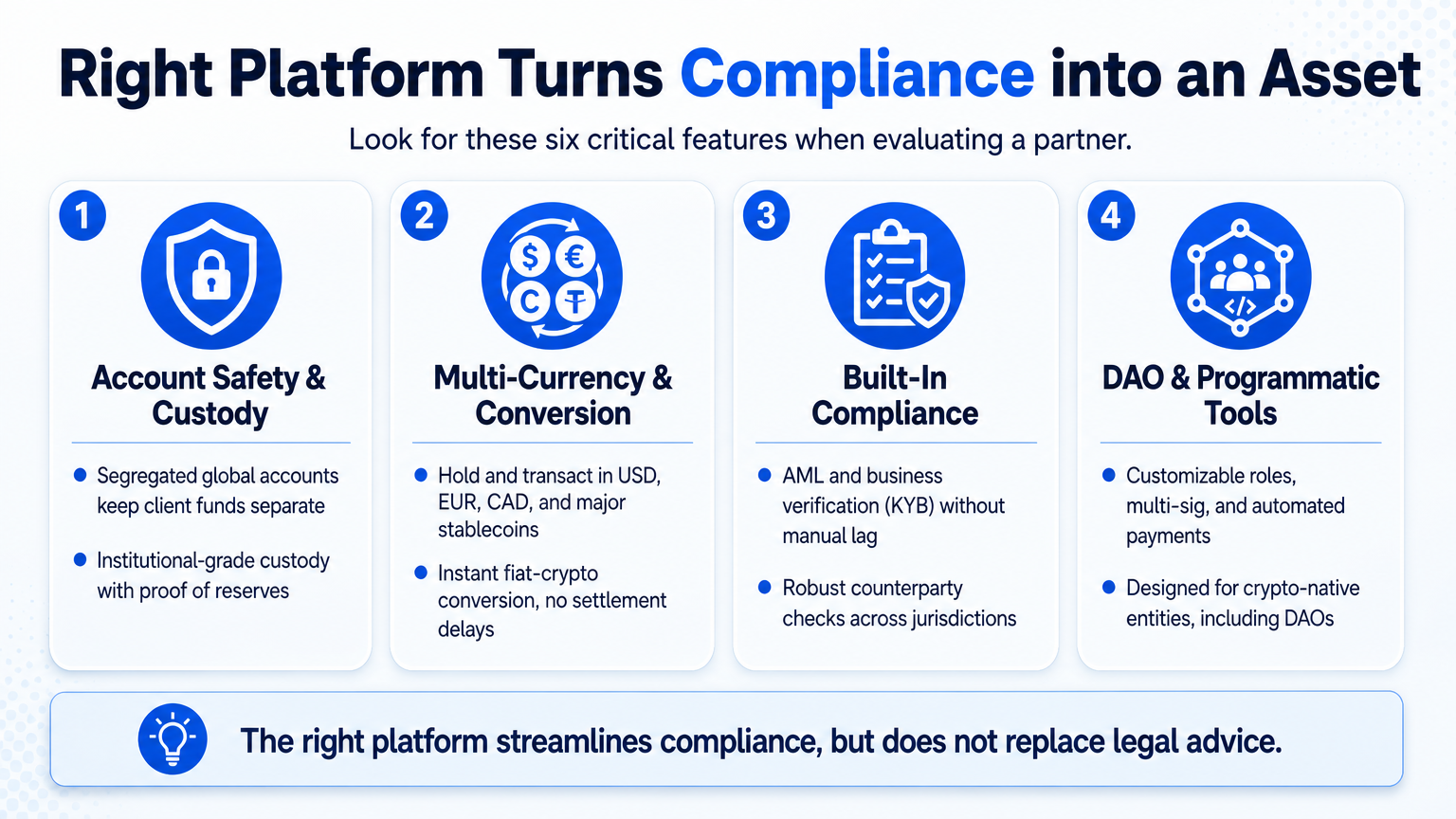
When evaluating a partner that handles fiat and stablecoin rails, look for these stablecoin operational compliance features:
- Segregated global accounts to keep funds separate from platform capital.
- Transparent custody—institutional-grade security like Fireblocks, with proof of reserves.
- Multi‑currency rails holding USD, EUR, CAD, and major stablecoins.
- Built‑in AML/KYB for counterparty verification without manual delays.
- DAO‑specific tools: customizable roles, multi‑sig, automated payment flows.
- Instant fiat‑crypto conversion to avoid multi‑day settlement.
Compliance-Ready Platform Checklist
- Accounts in fiat currencies and stablecoins you use
- Digital asset custody by a recognized third-party custodian (e.g., Fireblocks)
- Robust business verification (KYB) compliant with your jurisdictions
- Programmatic payment flows and spending limits for team or smart contracts
- Designed for crypto‑native entities, including DAOs
- Transparent fee structures for deposits, wires, and crypto conversions
OneSafe, for example, provides segregated multi‑currency accounts, Fireblocks custody, and instant crypto‑to‑fiat conversions, with KYB onboarding for businesses and DAOs in under a week. (Disclosure: OneSafe is a financial technology company, not a bank; banking services are provided by its partners.)
No platform replaces legal advice, but the right one streamlines operations: automating compliance, consolidating monitoring, and providing auditable records.
What to Watch Next
The GENIUS Act NPRM is in comment phase, with final rules expected in 2026. Its outcome will determine if issuers get a lighter federal charter or face full banking regulation. The Fed’s reserve proposal could independently impose bank‑like conditions. Expect high‑profile enforcement against unregistered intermediaries, and international coordination via FATF and the BIS. Even established frameworks are being tightened, as shown by ESMA’s recent additional MiCA demands and the ongoing MiCA review linked to DeFi compliance realities.
A critical open question: can a stablecoin remain permissionless if its issuer must conduct sanctions screening, KYC, and reserve audits? Current proposals suggest permissioned controls at the issuer level, while tokens still move on open networks. The result may be a bifurcated market: fully compliant, institution-grade stablecoins for business, and a shrinking gray market losing fiat access.
Key Takeaways
- Stablecoin regulation in 2026 is dismantling the “dollar outside banking” thesis by imposing bank‑style requirements, re‑intermediating flows.
- Map your stablecoin exposure immediately to determine if you are a passive user or a potential money transmitter.
- For DAOs, compliance is existential: without a wrapper or compliant partner, enforcement risk grows.
- A compliance‑ready platform like OneSafe turns compliance into an operational asset with segregated accounts and built‑in AML/KYB, but does not replace legal advice.
- Watch the GENIUS Act final rule and Fed reserve proposal—they will define the cost and accessibility of stablecoin commerce.
Sign up for OneSafe to explore a platform built for businesses managing fiat and stablecoins under a compliance‑first architecture.