On October 26, 2026, the Office of the Comptroller of the Currency (OCC) publicly invited community banks to build payment stablecoin capabilities — a move that resets the near-term trajectory of crypto banking for startups, DAOs, and global businesses. The agency’s statement, reported by PYMNTS on October 26, came days after the OCC finalized rules implementing the GENIUS Act, the federal law that establishes a licensing framework for payment stablecoin issuers. For finance leads who have relied on fintech platforms because traditional banks wouldn’t touch stablecoins, the message is simple: the banking sector is being recruited into the rails, not left out of them.
Table of Contents
- What Just Happened: OCC Opens the Door for Bank-Issued Stablecoins
- Why This Changes Crypto Banking for Global Businesses
- The Background: Crypto Banking’s Regulatory Tug-of-War
- What You Should Do Now: 3 Moves for Your Treasury
- What to Watch Next: The Stablecoin Banking Infrastructure Race
- What is crypto banking and how does it differ from a traditional bank account?
- What does the OCC’s new stablecoin push mean for my business?
- How do I choose a crypto banking platform that can handle both fiat and digital assets?
- Is bank-issued stablecoin banking safe for my startup’s treasury?
- How can my DAO use stablecoins for global payments without exposing itself to regulatory risk?
- Will community bank stablecoins reduce the fees I pay for on/off-ramp conversions?
- Key Takeaways
What Just Happened: OCC Opens the Door for Bank-Issued Stablecoins
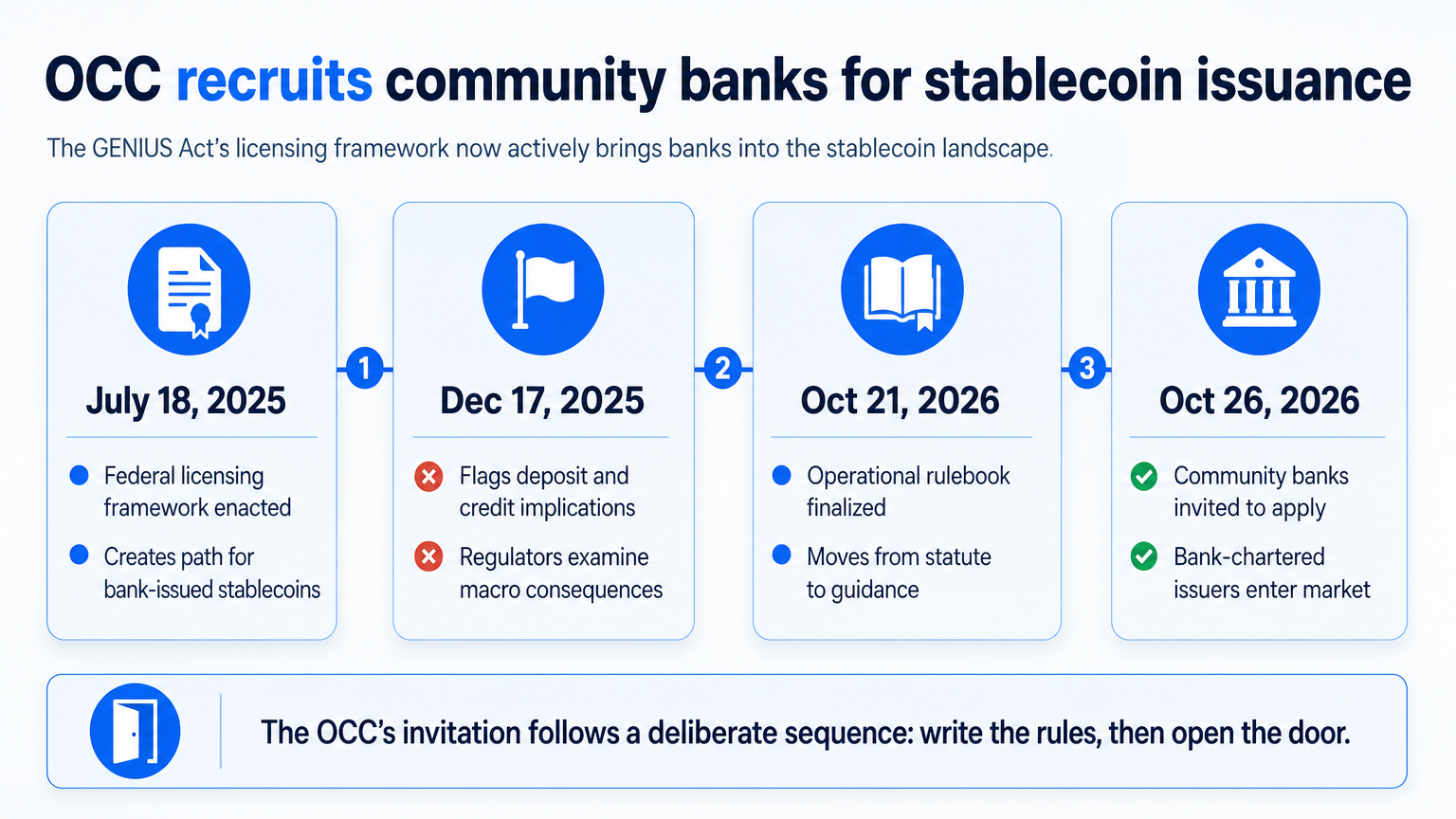
The OCC said it “wants community banks to help shape the future of payments,” according to a Monday, October 26, 2026 post on X cited by PYMNTS. The regulator encouraged interested community banks to apply to become — or to have a subsidiary become — a permitted payment stablecoin issuer. The word to anchor on is intentionality: this is an invitation, not a mandate. No bank must issue a stablecoin; the OCC is recruiting willing institutions into a regulated channel.
This accelerates a change already underway, as Crypto Banking Shift: OCC Pushes Stablecoins for Community Banks details.
The GENIUS Act Implementation
The statute behind the move is the GENIUS Act, enacted July 18, 2025, which creates a licensing and regulatory framework for payment stablecoin issuers. PYMNTS reported on October 21, 2026 that the OCC had finalized rules governing stablecoins, and the October 26 encouragement followed within days. The sequencing matters: the agency wrote the rulebook first, then opened the door.
A Shift in Tone from Regulators
For most of the last three years, federal banking regulators talked about crypto in terms of risk containment. The OCC’s October 26 message inverts that posture. But the shift is less a reversal than a maturity: the GENIUS Act supplies the statutory footing that earlier permissive guidance lacked, and the OCC is now using it. The underlying safety-and-soundness requirements have not disappeared; they have simply moved into a formal licensing lane.
| Development | Date / status | Why it matters |
|---|---|---|
| OCC encourages community banks to seek payment stablecoin issuer status | October 26, 2026 (PYMNTS) | Adds bank-chartered issuers to a stablecoin market long dominated by fintechs |
| GENIUS Act enacted | July 18, 2025 (per PYMNTS) | Federal licensing framework for payment stablecoin issuers |
| OCC final implementing rule reported | October 21, 2026 (PYMNTS) | Moves the framework from statute to operational guidance |
| Federal Reserve staff note on banks and stablecoins | December 17, 2025 | Flags possible implications for bank deposits and credit intermediation |
Why This Changes Crypto Banking for Global Businesses
From Fintech-Only to Bank-Backed Stablecoins
Until now, global business banking with stablecoins largely ran through non-bank issuers. Community bank participation would change the counterparty mix: an issuer chartered as a bank, with reserve custody and capital requirements, offers a different risk profile than an unlicensed fintech issuer. Some large banks are already testing the waters — U.S. Bank, for example, has launched its own USBDC stablecoin. The OCC’s new posture extends that option down the asset-size ladder.
For a closer look at the GENIUS Act compliance mechanics, read OCC Stablecoin Move Rewrites Crypto Banking Rules.
Implications for DAOs and Web3 Startups
For a DAO treasury or Web3 startup, a bank-issued stablecoin can mean a settlement asset with clearer reserve backing and a named, regulated issuer — useful when explaining counterparty risk to token holders or tax authorities. But DAO banking has operational needs community banks are not built for: multi-signature approvals, on-chain treasury visibility, and fast fiat-crypto conversion. That is why the likely end state is hybrid: the stablecoin may become bank-issued, while the crypto banking platform layer continues to handle crypto-native workflows.
The Background: Crypto Banking’s Regulatory Tug-of-War
The FDIC’s Cautious Approach
The Federal Deposit Insurance Corporation (FDIC) has historically been the most process-heavy of the federal banking agencies on crypto exposure, requiring banks to notify and await review before engaging in certain activities. A Federal Reserve staff note published December 17, 2025 examined the possible implications of stablecoin adoption for bank deposits and credit — evidence that regulators were still working through the macro consequences even as the OCC now pushes toward adoption. Stablecoin Regulation: What the OCC’s Latest Move Means details that split-screen tension.
Here is the adjudication: the FDIC’s caution and the OCC’s encouragement are not contradictory under the GENIUS Act. The statute gives both agencies a framework to enforce safety and soundness for issuers. The OCC has chosen to operationalize it by recruiting community banks; the FDIC retains its role on deposit insurance and resolution. The caution didn’t vanish — it got a licensing process.
The Rise of Neo-Banking Platforms
Neo-banking platforms grew precisely because crypto businesses were often de-risked out of traditional banks. These fintech platforms pair partner-bank fiat accounts with crypto rails, giving startups multi-currency accounts, wires, cards, and on/off-ramps in one interface. Crypto Banking: Why Banks and Startups Must Coexist makes the case that coexistence — not displacement — is the durable structure. The OCC’s move supports that read: banks may issue the stablecoins, but integrated fiat and crypto management will still require the fintech layer.
What You Should Do Now: 3 Moves for Your Treasury
Reassess Your Banking Partnerships
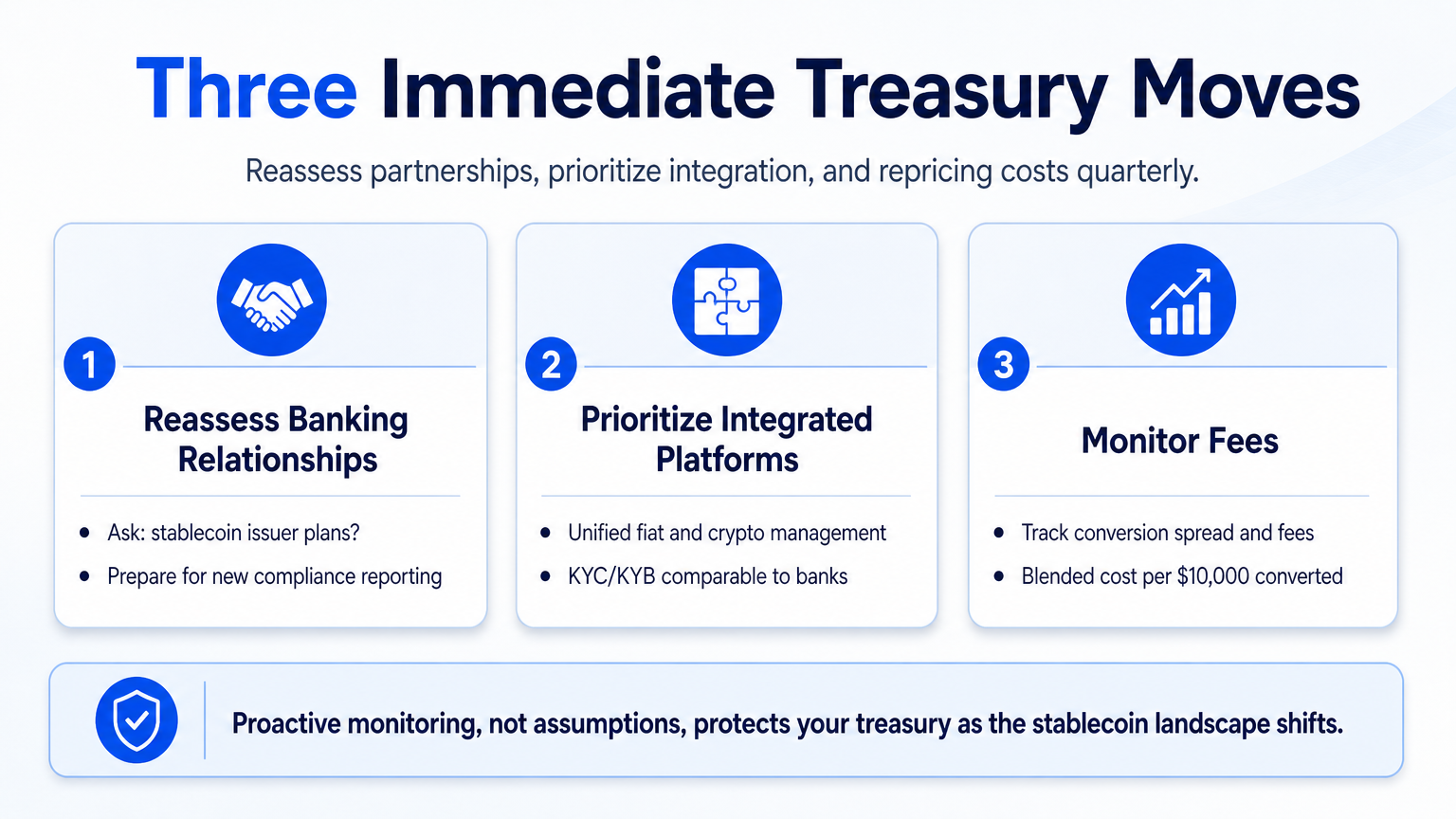
Ask your current bank two questions: does it plan to seek stablecoin issuer status, and what happens to your account if it does? A bank that becomes an issuer may offer direct on-ramp to its own stablecoin, but it may also impose new compliance reporting on crypto-adjacent customers. Do not assume your existing relationship survives this shift unchanged.
Prioritize Integrated Fiat-Crypto Platforms
If community banks become issuers, the scarce resource is no longer “a bank that tolerates crypto” — it’s a platform that manages both worlds without friction. OneSafe, a financial technology company that provides neo-banking services for global businesses, startups, and DAOs, is one example of the category: banking services are delivered through partners, while treasury operations — fiat and crypto management, wires, cards, and crypto-to-fiat conversion — sit in a single interface. KYC and KYB standards remain comparable to a bank’s; the integration is what differs.
Monitor Fees and Compliance Mandates
New issuers change the pricing picture. Watch three numbers in any stablecoin banking relationship: the conversion spread, the fiat withdrawal fee, and the wire/SWIFT fee. Today those vary widely across platforms. More issuers could compress spreads through competition — but banks also carry reserve and compliance costs, so compression is not guaranteed. Track your blended cost per $10,000 converted, not just the headline spread.
What to Watch Next: The Stablecoin Banking Infrastructure Race
Will Community Banks Build or Partner?
The OCC’s invitation forces a build-vs-buy decision on community banks. Building issuer capability in-house is expensive: reserve management, blockchain custody, and redemption infrastructure are not core community-bank competencies. The more plausible near-term path is partnership — banks providing the charter and reserves, fintechs providing the technology. Expect announcements that look like collaborations rather than solo launches.
Open Questions for Global Operations
For businesses operating across borders, the US posture is only one part of the puzzle. Canada’s parallel consultation, tracked in Canada’s Stablecoin Regulation Draft: Business Implications, shows jurisdictions moving at different speeds. For finance teams that maintain a Webflow blog, Joyrise — which plans, writes, and publishes illustrated SEO articles every day — can automate routine updates, though no summary replaces reading the primary order.
Three open questions will determine how this plays out: how fast banks move from interest to application; whether the first community bank stablecoin licenses skew large, regional, or community; and whether the reserve-asset standards expected under the GENIUS Act make bank-issued stablecoins genuinely interchangeable with existing issuers for global payments.
What is crypto banking and how does it differ from a traditional bank account?
A traditional bank account is a deposit account at a chartered institution. A crypto banking platform, by contrast, combines deposit-style fiat services with digital asset functionality — stablecoin custody, on-ramp and off-ramp conversions, crypto payments — often through a fintech that relies on partner banks for the underlying fiat settlement. NerdWallet’s crypto banking explainer walks through the basic mechanics. The distinction that matters for startups: a crypto banking platform is a technology layer, not a bank charter; the relevant question is who holds the underlying license for each asset class.
What does the OCC’s new stablecoin push mean for my business?
In the short run, it adds a new category of counterparty: a community bank that could become a stablecoin issuer. That gives you more options for where your stablecoin balances sit and who redeems them. In the medium run, it raises the floor on stablecoin transparency, because GENIUS Act issuers will operate under a formal licensing framework carrying safety-and-soundness expectations. The specific OCC stablecoin regulation that follows will set the compliance terms you inherit through whichever platform you use.
How do I choose a crypto banking platform that can handle both fiat and digital assets?
Use a short checklist. A viable platform must offer: (1) multi-currency fiat accounts, (2) domestic and international rails — ACH, wires, and where relevant SWIFT, (3) crypto on/off-ramps with disclosed fees, (4) asset custody through a recognized custodian, and (5) mandatory multi-factor authentication. OneSafe, for example, combines USD, Euro, and CAD multi-currency accounts with crypto-to-fiat conversions, digital asset custody via Fireblocks, and MFA enabled at signup. Ask for the fee schedule in writing before onboarding, and test a small conversion to verify settlement time.
Is bank-issued stablecoin banking safe for my startup’s treasury?
The honest answer is nuanced. A bank-issued stablecoin carries the issuer’s bank charter obligations, including safety-and-soundness supervision. That is a real improvement over unregulated issuers. But a stablecoin is not the same as an insured bank deposit — stablecoin value depends on the redemption terms and the quality of reserve assets, not on FDIC insurance. Treat bank-issued stablecoins as a different risk profile, not a risk-free upgrade, and size your treasury exposure accordingly.
How can my DAO use stablecoins for global payments without exposing itself to regulatory risk?
Anchor the DAO’s stablecoin payments to regulated issuers, maintain transaction-level records for sanction screening, and enforce execution through multi-signature controls with clearly assigned roles. A DAO banking platform that supports customizable roles and permissions helps prevent unauthorized outflows while preserving the collective governance that defines a DAO. Avoid routing payments through OFAC-sanctioned jurisdictions — that is a hard stop, not a compliance nicety.
Will community bank stablecoins reduce the fees I pay for on/off-ramp conversions?
Potentially, but not automatically. More issuers competing for the same payment flow tends to compress conversion spreads. Banking issuers, however, carry reserve maintenance and compliance overhead that can keep fees structurally higher than a lean fintech issuer. The correct stance is to treat fee reduction as a possibility to monitor, not a certainty to budget on — and to reprice your conversion stack quarterly while the market digests the OCC’s invitation.
Key Takeaways
- The OCC’s October 26, 2026 invitation to community banks is a recruitment, not a mandate: banks may apply to become payment stablecoin issuers under the GENIUS Act framework, but none are required to.
- A bank-issued stablecoin changes your counterparty risk profile but is not a substitute for an insured deposit — treat it as a regulated asset with its own redemption terms.
- The realistic end state is hybrid: community banks may issue the stablecoins, while crypto banking platforms keep handling DAO-native workflows, fiat-crypto conversion, and global payments rails.
- Finance leads should reread their banking relationships now, stress-test platform custody and compliance features, and reprice on/off-ramp costs quarterly as new issuers enter.
- Watch whether community banks build issuer infrastructure in-house or partner with fintechs — the build-or-partner choice will determine how fast the shift reaches startups.
If your treasury needs a unified home for fiat and digital assets while the issuer landscape shifts, sign up for OneSafe to evaluate the platform firsthand.