On October 26, 2026, at the Swell 2026 conference, a Ripple Treasury senior vice president unveiled an “Always-On AI Treasury,” telling the audience that large corporations’ working capital will no longer sit idle during banks’ non-working hours. The announcement matters for startups, DAOs, and mid-market finance teams because it forces a sharper question about crypto treasury management: what should you change this week, before the enterprise product narrative becomes a buying decision?
Table of Contents
- What Just Happened: The Always-On AI Treasury Announcement
- Why It Matters Now for Startups, DAOs, and Global Businesses
- Background a Newcomer Needs
- Direct Answers to the Most Common Questions
- The Split: Always-On Yield vs. Always-Safe Controls
- Concrete Implications and Recommended Actions
- What to Watch Next
- Key Takeaways
What Just Happened: The Always-On AI Treasury Announcement
The October 26, 2026 announcement
According to Cryptonews.net on October 26, 2026, Ripple’s Treasury SVP unveiled an “Always-On AI Treasury” framework at Swell 2026. The core claim reported is that working capital currently trapped by bank-hours cutoffs can be put to work continuously. That is a liquidity-and-utilization pitch, not a detailed product disclosure.
For readers tracking the arc, OneSafe’s companion analysis of Ripple Adds AI to Crypto Treasury Management: What It Means covers the baseline mechanics without assuming enterprise staffing.
What the source confirms—and what's still open
The source confirms an always-on ambition, not a product. The October 26 report does not specify:
- Which assets or stablecoins are involved
- Whether returns come from lending, staking, or money-market protocols
- Custody model, redemption terms, or settlement rails
- Regulatory approvals or geographic availability
- Yield rate, fees, or loss-absorbing guarantees
- Whether AI executes transactions or only recommends them
For a small finance team, the difference between “AI proposes” and “AI executes” is the difference between a workflow tool and a governance problem.
Why It Matters Now for Startups, DAOs, and Global Businesses
The end of bank-hours cash drag—in principle
Most mid-market and crypto-native businesses still hold operating cash in accounts governed by wire cutoffs, ACH batches, and weekend settlement gaps. An always-on treasury, if it works as described, could reduce the idle balance buffer that teams keep for these gaps. But “could” does not confirm safety, redeemability, or sufficient yield to justify moving operating funds out of a bank.
The awareness-to-action gap is the real risk
The bigger near-term risk is that teams hear “always-on AI treasury” and conclude that a product will solve a process problem. Most small businesses do not yet have a single view of their fiat and stablecoin balances, approval permissions, or daily cutoff exposure. Automating a broken process does not create treasury control; it accelerates it. This is a workflow problem, not just a yield problem.
Background a Newcomer Needs
What crypto treasury management is
Crypto treasury management is the set of policies and tools for custody, liquidity, risk, compliance, and accounting of digital assets as part of operating treasury. Bitwave’s overview describes it as more than holding crypto on a balance sheet: it includes reconciliation, spend controls, tax reporting, and counterparty oversight.
Three ways it differs from traditional treasury
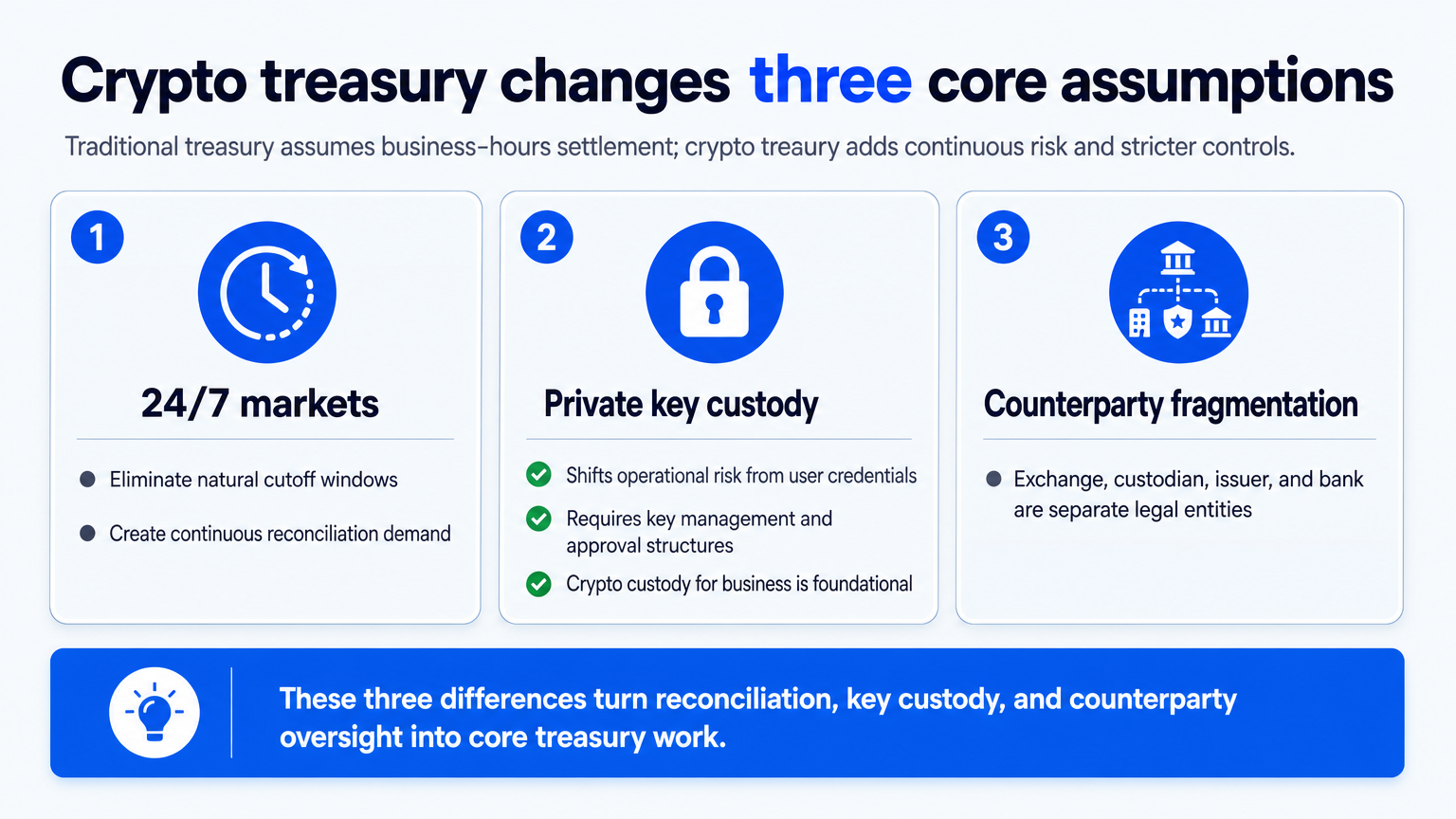
Traditional treasury assumes business-hours settlement, bank deposit guarantees, and centralized account controls. Crypto treasury differs in three ways:
- 24/7 markets eliminate natural cutoff windows and create continuous reconciliation demand.
- Private key custody shifts operational risk from user credentials to key management and approval structures — making crypto custody for business a foundational requirement, not an afterthought.
- Counterparty fragmentation means an exchange, a custodian, a stablecoin issuer, and a bank are often different legal entities.
The custody-liquidity-policy triangle
Secure crypto treasury operations balance three constraints. Custody determines who controls keys or authorizes moves. Liquidity determines how quickly assets become usable fiat or payables. Policy determines who may approve, how much, and under what conditions. A product that optimizes one leg without the other two is not a treasury solution.
Where a unified fiat-crypto account changes the picture
Much of the operational drag comes from running fiat banking and crypto custody as separate stacks. A single operating interface with multi-currency balances, USDC on/off-ramp, bill pay, corporate cards, and role-based permissions removes manual sweeps and the weekly cash-consolidation exercise. That is the prerequisite for always-on liquidity — and it’s a core crypto treasury best practice before chasing yield.
Direct Answers to the Most Common Questions
What is crypto treasury management?
It is the policy-and-tools layer for holding, moving, reconciling, and reporting digital assets alongside operating fiat. It includes custody, liquidity planning, risk limits, compliance, and accounting.
How is treasury management for crypto different?
The difference is continuous settlement risk, key-based custody, and variable counterparty quality. Traditional treasury relies on bank-hours finality and deposit insurance; crypto treasury requires more frequent reconciliation and stronger authorization gates. Stablecoin treasury management adds the layer of reserve attestations and issuer viability to that equation.
Does the future of treasury management require support for crypto assets?
For businesses with crypto revenue, stablecoin payables, or global 24/7 operations, yes. CNBC’s December 2, 2025 explainer on digital asset treasuries shows how balance-sheet crypto exposure has become a distinct corporate strategy. For purely domestic businesses with no crypto flows, support may remain optional—but stablecoin rails are entering the regulatory mainstream.
What does secure crypto treasury management look like?
Secure management means segregation of duties, multi-signature or MPC custody, cold-storage separation for long-term holdings, automated reconciliation, and human sign-off before any sweep or investment. No single person should be able to move operating funds without a second eyes-on approval.
What is digital asset treasury management?
Digital asset treasury management is the broader umbrella covering crypto assets, tokenized securities, and other digitally native instruments. Amina’s corporate treasury guide treats it as treasury infrastructure for organizations holding more than just traditional currencies.
How do 24/7 returns work?
In principle, around-the-clock returns require a counterparty or protocol paying for asset use outside traditional bank hours. The October 26 source does not confirm what mechanism Ripple’s always-on treasury would use. For an operator, the practical question is “who is the counterparty, what are the redemption terms, and can I exit to cash by my payroll date?”
How is this different from using a separate crypto exchange?
A separate exchange solves trading and conversion. It does not solve bill pay, payroll, multi-currency balances, corporate cards, or permissioned approvals for a finance team. A unified fiat-crypto operating account reduces the manual interfaces, but it still requires policy.
Do I need crypto expertise to use always-on treasury features?
You do not need to manage keys yourself if the platform uses a qualified custodian and role-based controls. You do need to understand approvals, redemption timing, and what happens if the service pauses withdrawals. “Crypto expertise” should mean policy literacy, not private-key custody.
What stablecoins are involved?
The October 26 report does not name specific stablecoins. In practice, U.S. dollar-backed stablecoins—especially USDC—are the default bridge for business treasury because they carry less price volatility and integrate with fiat on/off-ramps. Always confirm per product which issuers, reserve disclosures, and jurisdictions are involved.
The Split: Always-On Yield vs. Always-Safe Controls
One camp treats 24/7 yield as the breakthrough; the other treats custody and policy as the real bottleneck. Stripe’s crypto treasury explainer reflects the practical framing that the hardest problems are custody, accounting, and counterparty risk—not finding a yield source.
Always-on liquidity is the near-term win; always-on yield is optional. Operating cash should remain in highly liquid, low-counterparty-risk vehicles. Yield-bearing products—however automated—should be quarantined from payroll, vendor payables, and emergency reserves until redemption and custody terms are explicit. AI can propose moves, but every treasury transition should still require human approval and a durable audit trail.
Concrete Implications and Recommended Actions
Separate always-on liquidity from always-on yield
Run two distinct tracks. The first makes fiat and stablecoin balances visible, sweepable, and permissioned around the clock. The second is optional return-seeking capital that your business could lose access to for days or longer. Do not connect the two until you understand exit times.
Questions to ask before adopting any 24/7 treasury product
- Who is the legal custodian, and what happens if it becomes insolvent?
- Which stablecoins and assets are supported, and who issues them?
- What are the redemption windows during normal and stressed markets?
- Are transactions executed automatically or only proposed?
- What roles, approval limits, and audit logs exist?
- Is the platform a bank, a money transmitter, or a technology provider?
Regulatory context changes quickly; OCC Stablecoin Move Reshapes Crypto Banking for Startups is useful background before signing a new product.
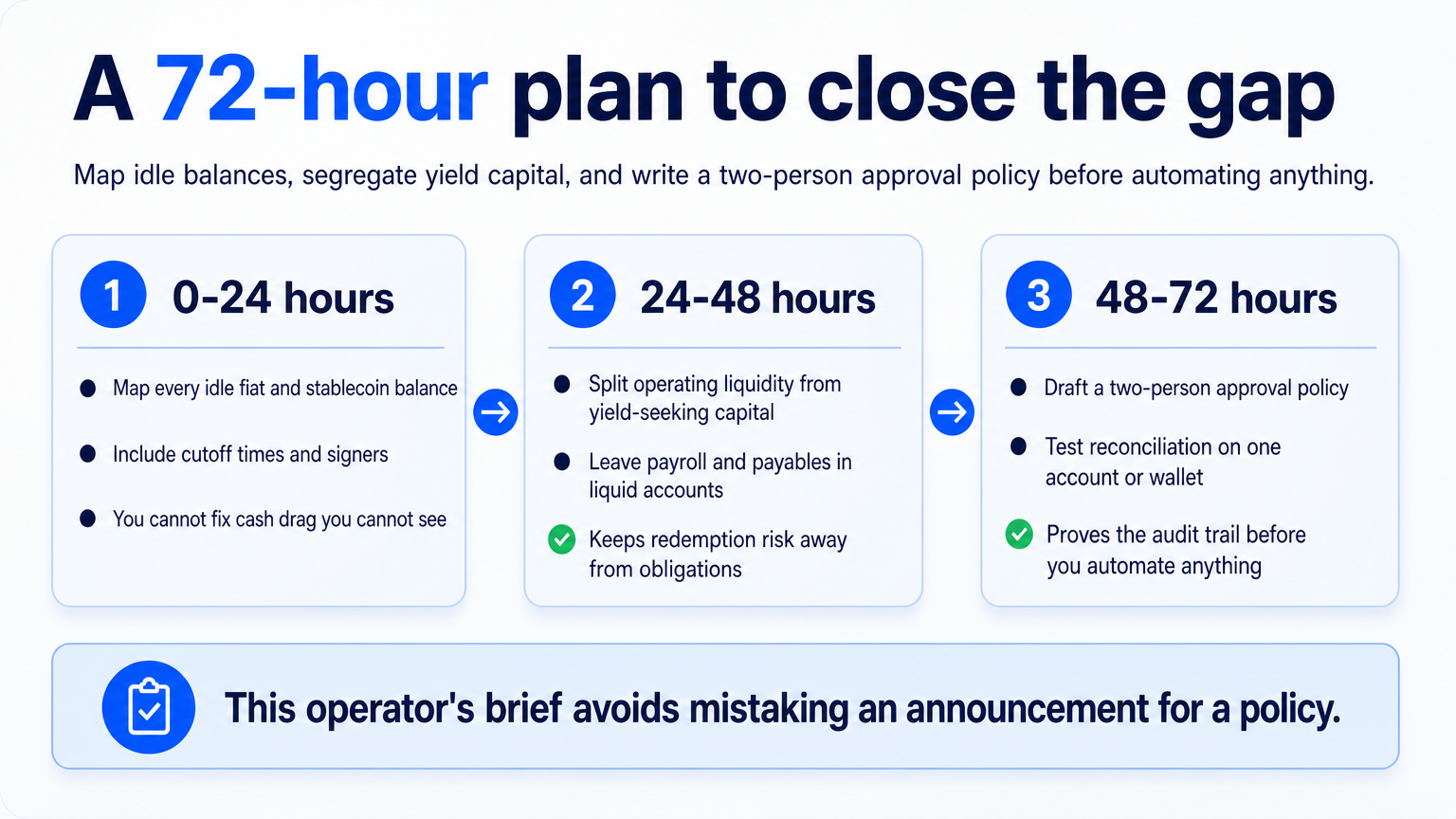
A 72-hour action plan
| Timeframe | Action | Why it matters |
|---|---|---|
| 0–24 hours | Map every idle fiat and stablecoin balance, including cutoff times and signers. | You cannot fix cash drag you cannot see. |
| 24–48 hours | Split operating liquidity from yield-seeking capital; leave payroll and payables in liquid accounts. | Keeps redemption risk away from obligations. |
| 48–72 hours | Draft a two-person approval policy and test reconciliation on one account or one DAO wallet. | Proves the audit trail before you automate anything. |
This is the missing operator’s brief: no enterprise treasury staff required, but enough structure to avoid mistaking an announcement for a policy.
What to do if you're running a DAO
DAO treasury management demands more than a multi-sig wallet. DAOs need customizable roles and permissions, segregated treasury accounts, and automated payment workflows that leave a full audit trail. OneSafe, a financial technology company rather than a bank, offers documented DAO controls including role-based permissions, Fireblocks custody, and USDC on/off-ramp. That addresses the liquidity leg, not yield. For why coexistence matters more than replacement, see Crypto Banking: Why Banks and Startups Must Coexist.
What to Watch Next
Stablecoin and asset support disclosures
If Ripple’s always-on treasury includes a stablecoin, the next disclosure should name it. Compare that against cross-border rules, including Canada’s stablecoin rules, because support disclosures determine where the product is usable.
Regulatory and audit treatment of AI-driven treasury
Auditors will ask how an AI-proposed transfer is approved, logged, and reversed. The OCC’s stablecoin moves are already rewriting expectations for how banks and technology providers handle digital assets. Watch whether any always-on treasury vendor publishes its audit trail and custodian arrangement.
Proof of adoption outside enterprise
The announcement is aimed at large corporations. The real test for mid-market and DAO use is whether Ripple or its partners disclose small-business onboarding, minimum balances, and non-enterprise controls. Until then, treat the enterprise demo as a direction, not a product you can buy.
If you want to keep an internal daily note without writing it yourself, Joyrise plans, writes and publishes illustrated SEO articles to your Webflow blog every day—read your first article before you pay—though it’s not a substitute for treasury review.
Key Takeaways
- The October 26, 2026 Ripple announcement is an always-on ambition, not a confirmed product with disclosed assets, custody, or redemption terms.
- Treat always-on liquidity as the immediate win and always-on yield as optional capital with separate risk controls.
- Your 72-hour job is to map idle balances, segregate yield capital from operating cash, and write a two-person approval policy.
- DAO and mid-market teams need role-based permissions, audit trails, and a unified fiat-crypto account before they can safely use any 24/7 treasury feature—adopting these crypto treasury best practices closes the awareness-to-action gap.
- Watch for stablecoin, custodian, and audit disclosures before adopting any always-on treasury product.
If you want to reduce the operational drag in your fiat-crypto treasury, open an account with OneSafe to bring multi-currency balances, USDC on/off-ramp, corporate cards, and DAO role controls into one place.