You just signed the first serious treasury contract, or maybe the revenue from a few customers finally started landing in crypto instead of promises. Now the same question shows up in a board call, a Slack thread, and your own head, who can move these assets, how do you prove control, and what happens if one person disappears with a laptop or one vendor goes sideways. Digital asset protection stops being a technical topic the moment real money, payroll, and counterparties depend on it.
For startups, DAOs, and international SMEs, the risk isn't only theft. It's stalled approvals, failed recovery, vendor exposure, and the operational mess that follows a bad transfer process. That's why protection has to be designed as a business system, not a wallet setting.
Table of Contents
- External threats are usually noisy, but not always obvious
- Internal risk is usually about access, not malice
- Counterparty risk sits outside your own perimeter
- Self-custody gives control, and demands discipline
- Exchange custody is convenient, but it concentrates dependency
- Institutional custody fits teams with real workflows
- Start with identity, because most failures begin there
- HSMs and MPC solve different parts of the same problem
- Monitoring only works if someone acts on the signal
- A payment run should have a path, not a habit
- Least privilege should be visible in daily work
- The goal is to make the safe path the easiest path
- Insurance can soften loss, but it doesn't replace control
- Recovery needs to be procedural, not emotional
Why Digital Asset Protection Is a Business Imperative
The first treasury decision usually arrives at the worst possible time. Cash is moving, a contractor needs payment, a market opportunity is open, and suddenly the founder is deciding whether one person should hold the key, whether the finance lead should sign alone, or whether the team needs a more formal custody setup before the next transfer goes out.
That decision matters because the market around custody is scaling fast. Global demand for digital asset custody is projected to grow from USD 68.48 billion in 2024 to USD 462.8 billion by 2033, a 23.65% CAGR, which is a more than 6.7x increase across the forecast window (Business Research Insights). That kind of growth signals something bigger than a tooling trend. It means enterprises are treating custody as infrastructure, not as a sidecar to trading.
Protection is a treasury function, not a wallet feature
A treasury team doesn't just ask, “Is the wallet safe?” It asks who can move assets, how quickly a payment can be reversed or recovered, what happens if a signer is unavailable, and whether the controls still work when the company adds vendors, new geographies, or a second finance operator. Those are business continuity questions.
Practical rule: If a control can't survive a team change, a vendor change, or a bad Monday, it isn't a control yet.
Digital asset protection is strongest when technology, process, and policy reinforce one another. Encryption and custody tools help, but they don't fix a sloppy approval chain. A good policy helps, but it doesn't stop a compromised account if there's no technical backstop. The objective is to reduce the chance that one mistake, one insider, or one compromised machine can move everything.
For a founder, the right question isn't “What's the safest wallet?” It's “What system lets us keep operating if the first line of defense fails?” That mindset is what turns protection into a business capability.
One practical primer on why ransomware pressure often turns into crypto extortion is this guide on ransomware attacks and cryptocurrency extortion, because treasury security and recovery planning are often two sides of the same problem.
Understanding Your Digital Asset Threat Model
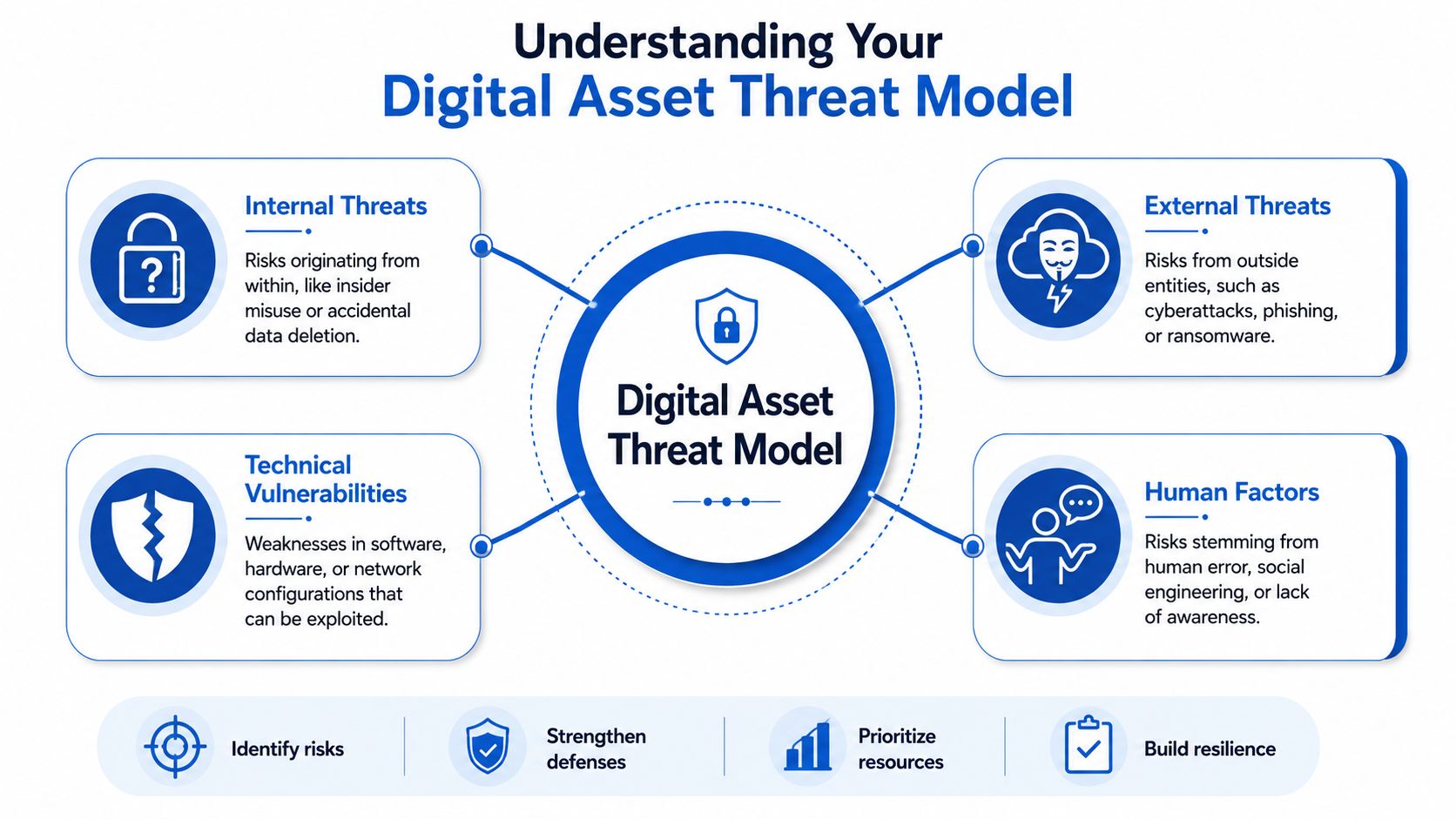
Organizations often begin with the wrong question. They ask which product to buy before they've mapped who can fail, where the assets can leak, and how a compromise would spread through the business. A useful threat model separates the problem into three buckets, external, internal, and counterparty.
External threats are usually noisy, but not always obvious
External risk includes phishing, wallet-draining scams, credential theft, exchange compromise, and attack chains that start with a compromised email inbox or cloud account. The common mistake is assuming these attacks only target large firms. In practice, smaller teams are often easier to probe because their permissions are looser and their monitoring is thinner.
A founder should ask three questions. Which accounts are exposed to the internet? Which approvals can be tricked through urgency or impersonation? Which transaction paths would still work if an attacker got into one admin inbox? If you can't answer those quickly, the external attack surface is already too broad.
Internal risk is usually about access, not malice
Internal threats include a disgruntled employee, an overstretched finance operator, or a contractor who has more access than they need. Human error often looks mundane until it becomes expensive, such as sending funds to the wrong address, approving a transfer too quickly, or restoring a backup in the wrong environment. For web3 teams, this is especially important because treasury tasks can blur together with product ops and community work.
A compromise rarely starts as a “security incident.” It often starts as a rushed exception that never got tightened back up.
Process prevails over assumption. If a junior operator can initiate a transfer but not approve it, or a contractor can prepare a payout but not sign it, the team has already reduced blast radius. Without those boundaries, every trusted person becomes a single point of failure.
Counterparty risk sits outside your own perimeter
Your controls won't matter if a vendor, platform, or bridge partner has weak safeguards. That includes exchanges, payroll providers, infrastructure vendors, custodians, and legal or accounting partners who touch sensitive workflows. Counterparty risk is why treasury design has to include due diligence, not just internal control.
A practical framework for assessing that external and vendor exposure is the Accelerate IT Services Inc. guide on threat risk assessment, which is useful when you need to turn a vague concern into a documented review. It helps teams think in terms of likelihood, impact, and control coverage instead of gut feel.
For startups and SMEs, the right map is simple. Ask who can initiate, who can approve, who can recover, and who can interfere. If one vendor or one employee sits in too many of those roles, the threat model is already telling you where to tighten up.
Choosing Your Custody Foundation
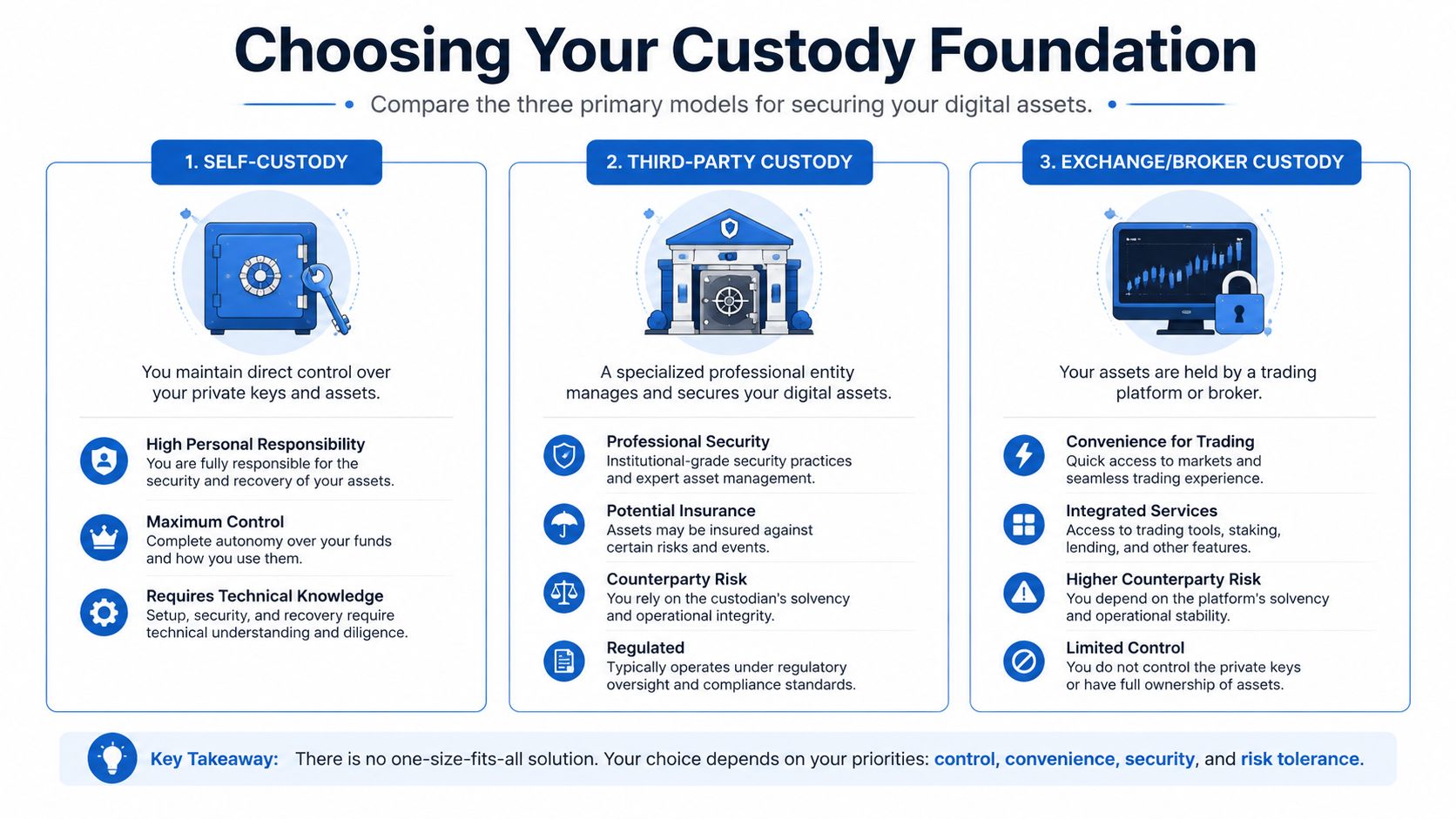
Custody is the foundation layer because every later control depends on it. If asset control is weak, better monitoring just tells you about the problem after it has already spread. If the custody model is too rigid, the business starts working around it, and shadow processes become the primary security risk.
Self-custody gives control, and demands discipline
Self-custody means the team controls the private keys directly. That offers maximum control, but it also puts recovery, backup, signer coordination, and device security on your shoulders. For a technical founder with a tiny treasury, that can be workable.
The trade-off is operational. The more people need to touch the funds, the more coordination overhead appears. Once payroll, vendor payments, or treasury rebalancing enters the picture, the simplicity of self-custody starts to erode unless the team has unusually strong security hygiene.
If you're deciding whether to stay there, this overview of self-custody wallet benefits and risks is a helpful reality check because the upside is control, but the hidden cost is process burden.
Exchange custody is convenient, but it concentrates dependency
Exchange or broker custody is attractive because it's familiar and fast for trading. It works best when the main job is liquidity access, not treasury governance. The downside is obvious once the company depends on that provider for access, execution, or settlement timing.
As market infrastructure matures, custody is concentrating around specialized providers. One forecast identifies Coinbase at about 18% market share and BitGo at about 14% among top providers, while also noting a stablecoin market cap of USD 300 billion in September (Fortune Business Insights). That concentration is a sign that businesses are reaching for more specialized infrastructure as balances get too meaningful for casual handling.
Institutional custody fits teams with real workflows
Institutional-grade custody, including models built around MPC, is designed for teams that need shared access without shared exposure. Instead of one private key sitting in one place, control is distributed so that no single person or device can unilaterally move funds. That matters for finance teams, DAOs, and SMEs with distributed signers.
OneSafe is one example of a platform that combines crypto and fiat operations with built-in controls, but it should be evaluated the same way you would evaluate any other treasury stack, by looking at who can initiate, who can approve, and how recovery works. The point is not the logo. The point is whether the custody model matches the company's operational reality.
Implementing Essential Technical Security Controls
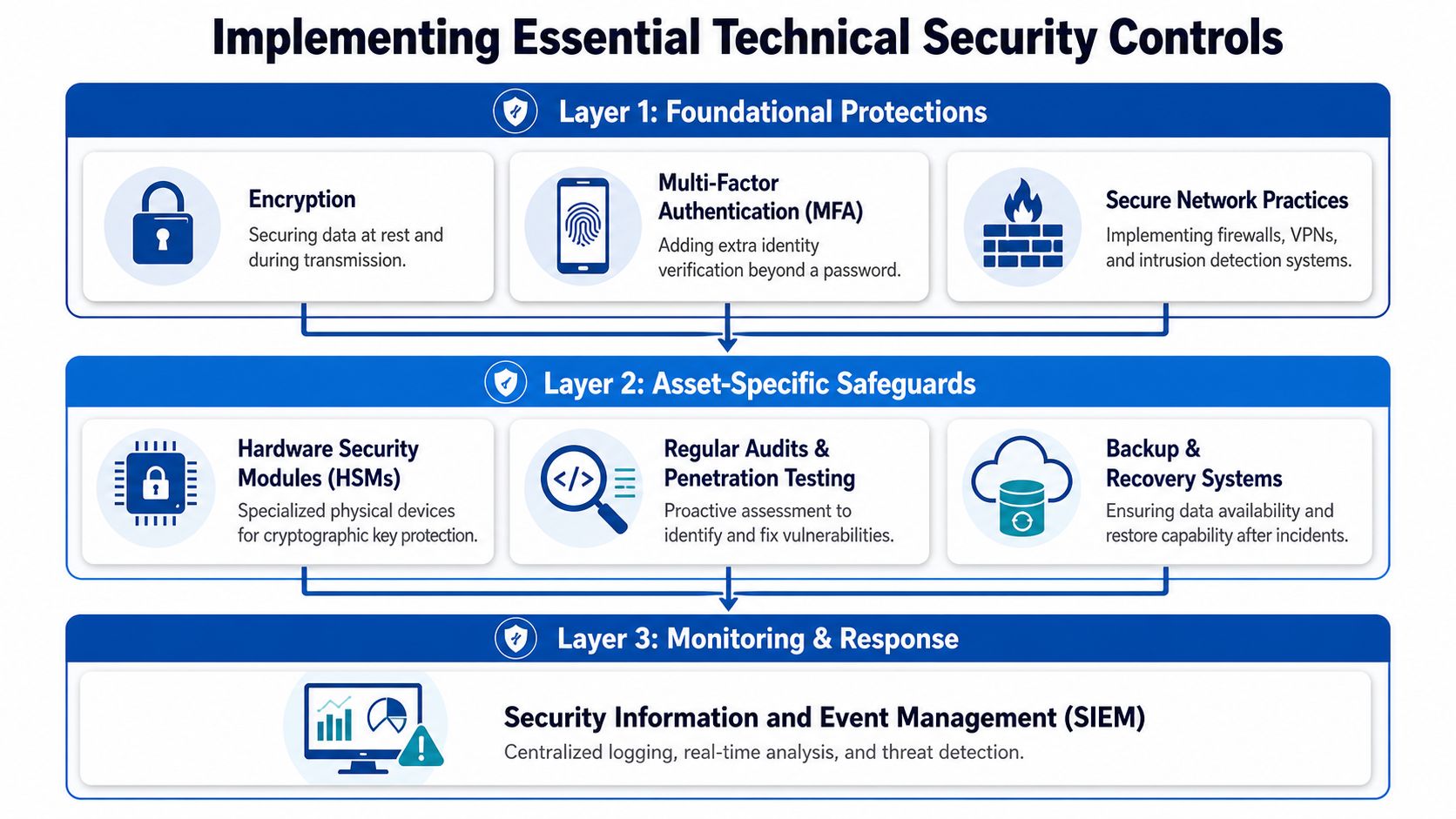
A strong custody foundation still fails if the technical controls around it are weak. The most common mistake is treating authentication, key storage, and monitoring as separate purchases rather than as one control chain. In practice, these layers only work when they reinforce the same security objective, which is preventing unauthorized movement of assets.
Start with identity, because most failures begin there
Multi-Factor Authentication (MFA) should be mandatory on every admin account, every custodian interface, every exchange login, and every email system tied to treasury. Passwords alone don't hold up once phishing, password reuse, or device theft enters the picture. MFA doesn't make a team invulnerable, but it forces attackers to do more than guess or steal one credential.
Encryption matters too, because backups, logs, and sensitive records should stay protected both at rest and in transit. If a vendor dump or endpoint breach exposes stored keys or recovery data, encryption limits how much damage the attacker can do with what they find.
A separate layer is network practice. Segmented admin access, VPN use where appropriate, and monitoring for suspicious authentication patterns keep treasury access from blending into ordinary office traffic. That separation is boring on paper and useful in real life.
HSMs and MPC solve different parts of the same problem
A Hardware Security Module (HSM) keeps cryptographic material inside a hardened device instead of leaving it floating around in general-purpose systems. For teams handling significant balances, that's valuable because key material needs a place that resists extraction and misuse.
The Federal Reserve notes that secure multi-party computation (MPC), fully homomorphic encryption (FHE), and zero-knowledge proofs (ZKPs) are emerging technologies that can support confidentiality while preserving auditability (Federal Reserve). In plain terms, these approaches let systems verify or process sensitive information without exposing the full data set in one place. That shifts the security model away from one vault and toward cryptographic minimization.
Operational insight: If one database or one operator can reconstruct the whole asset record, the design still has a concentration problem.
Monitoring only works if someone acts on the signal
Logging, alerting, and audit trails are not a replacement for strong access control. They are the proof layer that shows when the control failed, when someone tried to bypass it, and whether the team reacted in time. Without that visibility, a treasury stack can look safe right up until it isn't.
For businesses that need to combine custody with payment operations, the better pattern is layered defense. Use MFA and encryption as table stakes, add HSM or MPC protection for key material, and keep logging active across every place where a transfer or approval can happen. That combination is what turns technical security from a checkbox into an operating system for treasury risk.
Building Resilient Operational Workflows
A secure system can still be broken by bad process. That's why the operational layer matters so much for DAOs, crypto-native startups, and international SMEs, where the same person might handle vendor onboarding, treasury prep, and payment approvals if no one has formally separated duties. The biggest failures usually come from workflow design, not from advanced code exploits.
A payment run should have a path, not a habit
A good treasury workflow starts before money moves. One person prepares the payment, another reviews it, and a separate signer authorizes it according to pre-set rules. That split matters because it keeps urgency from collapsing the control stack.
Bermuda's Digital Asset Business Code of Practice requires that backup seed phrases be split into at least two parts, kept separately from the primary key, and protected with encryption equal to or better than the primary key. It also recommends FIPS 140-2 certified HSMs for critical seed and key storage, and an M-of-N multisignature control with at least three signatories where feasible (Bermuda Monetary Authority). The operational lesson is simple, process separation is a control, not just a compliance preference.
Least privilege should be visible in daily work
Role-based access control only works if the roles are narrow enough to matter. Finance can prep payments, operations can verify vendors, and leadership can approve exceptions, but nobody should casually inherit all three. If that sounds restrictive, it's because convenience and control are always in tension.
That tension is exactly why operational controls have to be embedded in the workflow. A platform that handles both fiat and crypto can be useful when it ties permissions, approvals, and spend rules directly to the transaction path. That way, the team doesn't rely on memory or informal checks, which are the first things to fail during a rush.
For teams that also need to protect filings, code, and IP-heavy work, Kons Law's guide on protecting your firm's intellectual assets is a useful reminder that treasury security and asset protection often overlap in the same operating calendar.
The goal is to make the safe path the easiest path
A resilient workflow reduces the temptation to create side channels. If a contractor payment requires three chats, a spreadsheet, and an offline approval, people will eventually route around the process. If the secure path is the shortest path, compliance becomes habitual.
That's where an integrated platform can help, but only if it enforces the right separation of duties. The business should be able to see who prepared a transfer, who approved it, and which policy allowed it. If that audit trail is clear, the team has a fighting chance to investigate, recover, and continue operating after a problem.
Navigating Regulatory, Insurance, and Recovery Planning
The worst time to think about recovery is after the breach. By then, every minute is expensive, stakeholder trust is already under pressure, and the team is arguing over who should talk to customers, counterparties, and legal counsel first. A mature digital asset protection program assumes that something will go wrong and prepares for the response in advance.
The practical threat model here is operational. Institutional guidance increasingly emphasizes zero-trust architecture, least-privilege access, segmentation, logging, and third-party risk management, because employee access, vendor exposure, and flawed approval chains are often more realistic than a pure wallet theft scenario (CBH). For DAOs and global SMEs, that's the core issue. Shared access and distributed work create more failure modes than a single offline key ever did.
Insurance can soften loss, but it doesn't replace control
Digital asset insurance can help with some categories of loss, but it's not a substitute for good custody design, and it rarely solves every failure mode. Its primary value is that it forces a business to define what it considers insurable, what it can prove, and which controls it must maintain to stay eligible. That alone improves discipline.
An incident response plan should list the first calls, the immediate containment steps, the evidence to preserve, and the transfer or freeze actions to attempt. It should also define who communicates externally, because silence creates confusion and duplicated mistakes. If the team has to invent the response under pressure, it's already behind.
Recovery needs to be procedural, not emotional
Recovery planning should cover lost signers, compromised devices, vendor outages, chain issues, and asset recovery across platforms. It should also document when to stop transacting and escalate. Teams often want to “keep the business moving” during an incident, but unstructured activity can widen the blast radius.
The OneSafe asset recovery guide for DeFi and multichain scenarios is relevant here because it reflects the practical reality that recovery often spans more than one wallet, one chain, or one counterparty. That kind of complexity is exactly why an incident plan needs roles, thresholds, and communications already written down.
If your recovery plan can't be followed by someone who wasn't in the original setup meeting, it isn't ready.
Jurisdiction also matters. Different markets treat custody, controls, and reporting differently, so the team should know which regulator, banking partner, or legal framework governs each part of the workflow. The point isn't to become a compliance department overnight. It's to avoid finding out, during a crisis, that the recovery path was never allowed.
Unifying Your Digital Asset Protection Strategy
The strongest security programs don't feel like a pile of tools. They feel like one operating model. A sane custody foundation, layered technical controls, and disciplined workflows all point to the same outcome, reducing the number of people, devices, and vendors that can turn a mistake into a treasury event.
For web3 startups, DAOs, and international SMEs, the most useful lens is business continuity. Can the team still pay vendors, move assets, and prove approvals after a signer leaves, a vendor fails, or a transfer gets questioned? If the answer is uncertain, the stack is still fragmented.
A unified platform can help when it ties fiat and crypto activity to the same control plane, but the platform is only the implementation layer. The strategy still has to come first. That means deciding who can act, how keys are protected, how approvals are separated, and how recovery works before volume and complexity make the gaps harder to close.
The right end state is simple to describe. The finance team knows the rules, the technical team knows the exposure, and leadership can see the trade-offs without chasing five systems. That's what mature digital asset protection looks like, not perfect security, but controlled risk that the business can operate through.
If you're setting up or tightening your treasury controls now, review your custody model, approval flow, and recovery plan together, not as separate projects. Then compare that design with how your team moves money today, and use OneSafe as one option to evaluate a unified workflow for fiat and crypto operations under a single control framework.