Meta Description: No, you don’t need an LLC to open a business bank account. Sole proprietorships, partnerships, and DAOs can all qualify. Learn what you really need.
Do I Need an LLC to Start a Business Banking Account?
The question “Do I need an LLC to start a business banking account?” is asked by founders everywhere. The short answer is no. A sole proprietorship qualifies, you can use your Social Security number, and the paperwork is often simpler. But that answer barely scratches the surface for a founder in 2026 who runs a global startup, manages a DAO treasury, or pays contractors in stablecoins. The real question isn’t “LLC or no LLC”—it’s whether your banking partner fits the way you actually move money. Below, we walk through exactly what every structure requires, where traditional banks still fall short, and how modern platforms are closing those gaps for crypto-native and cross-border teams.
Table of Contents
- The Short Answer: No, You Don’t Need an LLC
- What You Actually Need to Open a Business Bank Account
- Can Non-US Residents Open a US Business Bank Account?
- How Crypto-Friendly Business Accounts Work
- Traditional Banks vs. Neobanks: Which Onboarding Is Actually Faster?
- October 2026: Free Checking and Embedded Payroll Are Everywhere—But Is That Enough?
- FAQs
- Key Takeaways
The Short Answer: No, You Don’t Need an LLC
Legally, a business bank account is available to any legitimate business structure recognized in the jurisdiction. Sole proprietors, partnerships, corporations, and even unincorporated associations can apply. Many founders believe an LLC is a prerequisite only because traditional banks build onboarding checklists around standard entity types, and an LLC with an EIN is often the smoothest path. However, the LLC itself is a choice about liability and tax treatment, not a banking requirement. You can open business bank account without LLC just as easily if you have the right supporting documents. Where things get complicated—and where this article spends its real time—is when your business doesn’t look like a conventional LLC, especially for DAOs, non‑U.S. founders, and teams mixing fiat and crypto flows.
What You Actually Need to Open a Business Bank Account
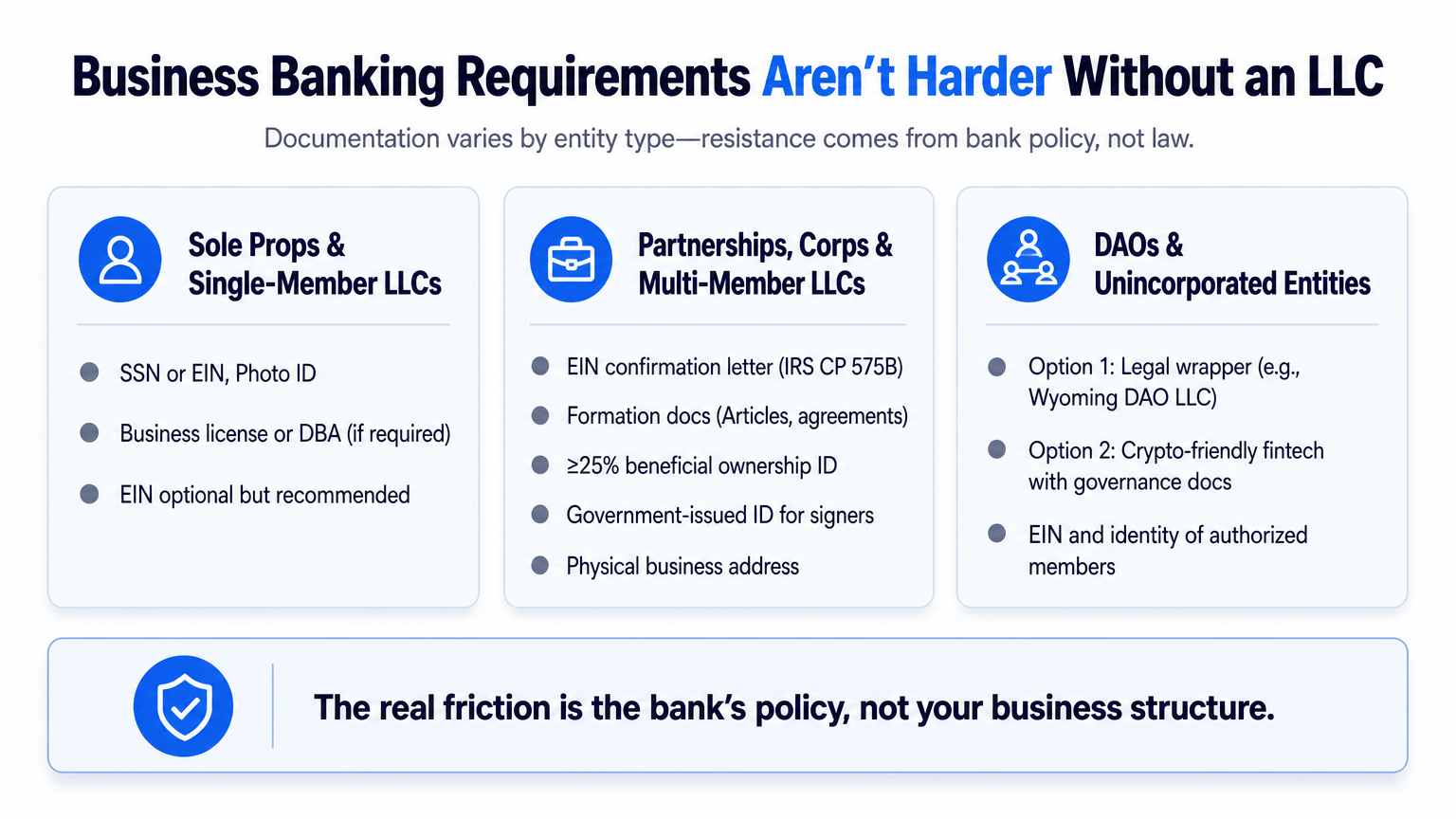
Every provider verifies two things: that your business exists legally and that you are authorized to act for it. Exact requirements vary.
For Sole Proprietors and Single-Member LLCs
A sole proprietor often opens an account with a Social Security number, photo ID, and, where local law requires it, a business license or DBA registration. Some banks ask for an EIN even for sole props (Bank of America lists it as a standard requirement). Obtaining an EIN takes minutes from the IRS and keeps your SSN off payment forms. A single-member LLC adds one document: the Articles of Organization. The main point: business banking requirements for a sole proprietor are not materially harder than for an LLC—resistance comes from a bank’s internal policy, not from law.
For Partnerships, Corporations, and Multi-Member LLCs
You’ll typically need:
- EIN confirmation letter (IRS CP 575B)
- Formation documents (Articles, partnership agreement, or operating agreement)
- Ownership identification for anyone with ≥25% beneficial ownership
- Government-issued ID for signers
- A physical business address (not a P.O. box, for many traditional banks)
Wells Fargo’s business deposit account requirements follow this model. The biggest hurdle for fast-growing startups is that multi-member entities often trigger deep beneficial-ownership reviews, adding days to onboarding—unless you’re using a neobank with digital-first KYB.
A Quick Note on DAOs and Unincorporated Entities
A Decentralized Autonomous Organization does not automatically have a recognized legal form. Traditional banks don’t have a “DAO” checkbox. To open a business account, a DAO usually takes one of two paths:
- Form a legal wrapper – incorporate as a Wyoming DAO LLC, a Cayman foundation, or a Swiss association. With that entity, you get an EIN and formation documents a bank can process. This adds legal cost and a governance layer that may clash with full decentralization.
- Use a crypto-compatible fintech partner – a growing set of platforms can onboard a DAO using multi‑sig wallet addresses, operational agreements, and the identity of authorized members—without a separate corporate entity. For example, a platform built for Web3 teams might accept on-chain governance documentation alongside standard KYC for core contributors.
This second route is what makes DAO banking practical at scale. It’s a compliance framework that reads what a DAO actually is. If your treasury straddles fiat payroll and on-chain grants, you need a partner that understands both.
Can Non-US Residents Open a US Business Bank Account?
Yes, but the path depends on whether you use a traditional U.S. bank or a global-first financial platform.
Most U.S. banks ask for a physical presence—a U.S. business address, an ITIN or SSN, and often an in-person visit. For a founder in Lagos or Lisbon running a Delaware LLC, that friction is real. Global-first fintechs have removed the physical presence requirement by building KYB around digital identity and international document formats. With a Delaware LLC, an EIN, and a passport, a non-U.S. resident can often open a multi-currency US business account within a week, entirely online. This is the global business account category reshaping cross-border commerce.
How Crypto-Friendly Business Accounts Work
A business bank account that sends wires is table stakes. For Web3 startups, the real question is whether you can hold USDC, pay a vendor in ETH, and convert to USD without a separate exchange. Crypto business accounts built on modern infrastructure merge fiat and digital assets into a single treasury interface.
Instead of routing payroll through a bank and then moving funds to a wallet, a unified platform lets you keep a USD balance for payroll and a USDC balance for contractor payments, with instant conversion between them. You pay a contributor in stablecoins on Thursday, settle a supplier invoice in euros on Friday, and never off-ramp more than you need. This reduces treasury risk when managing runway across volatile assets.
OneSafe exemplifies this design: the platform supports ACH, domestic and international wires, bill payments, and instant crypto-to-fiat conversions—all within the same set of business accounts.
What Compliance Still Requires (KYC/KYB) No legitimate platform lets you skip identity verification. A crypto-friendly account is not an anonymous account. You still provide entity documents, EIN, and personal ID for every controller. The difference is that a crypto-native fintech’s compliance engine is built for on-chain transaction monitoring, wallet screening, and non-traditional entity structures like DAOs. That design choice is what makes onboarding for a Web3 startup feasible without a 12-week “compliance review” that ends in refusal.
Traditional Banks vs. Neobanks: Which Onboarding Is Actually Faster?
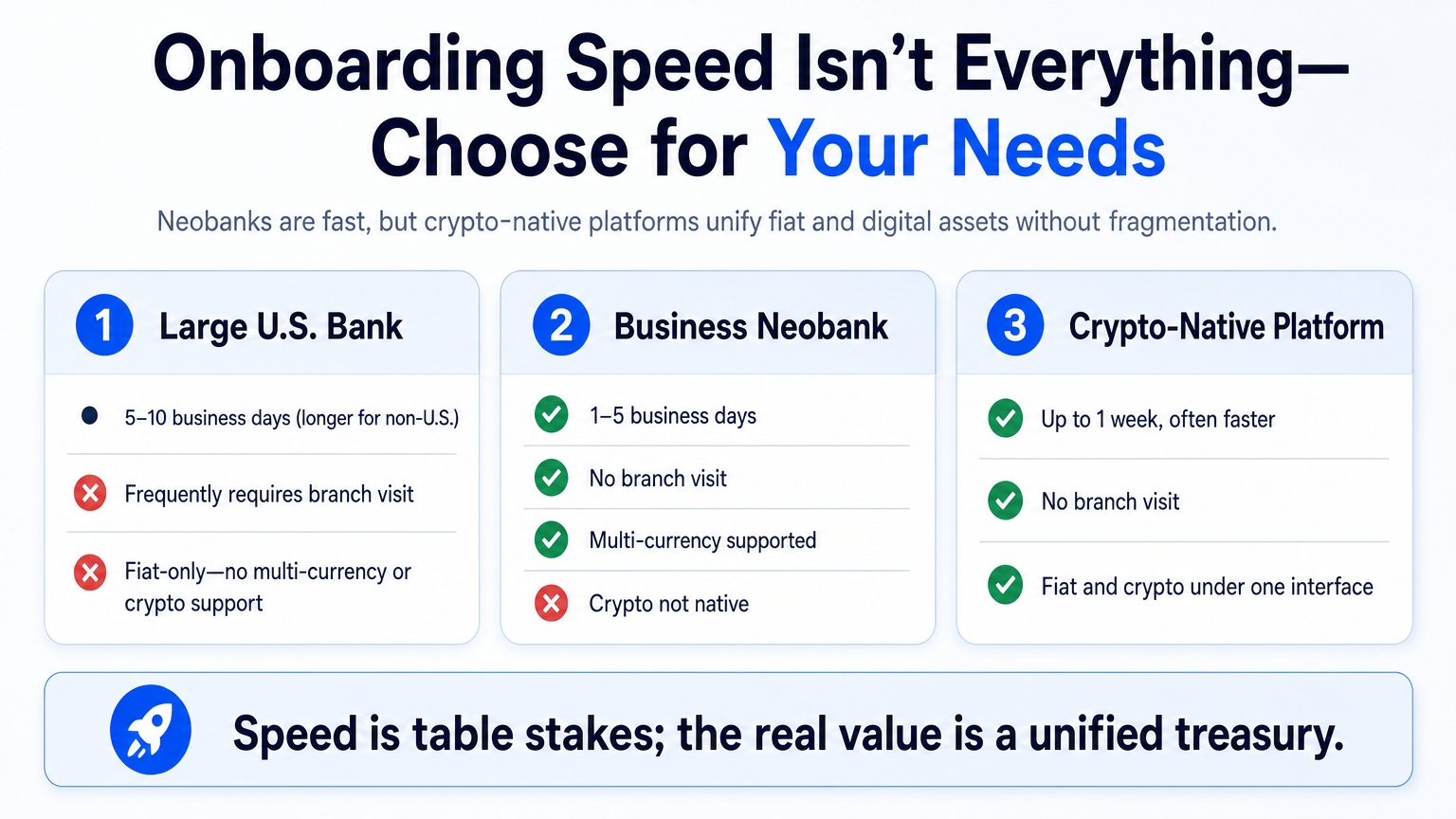
| Platform Type | Typical Onboarding Time | Requires Branch Visit? | Supports Multi-Currency & Crypto |
|---|---|---|---|
| Large U.S. bank (e.g., Chase, Wells Fargo) | 5–10 business days (longer for non-U.S. residents) | Frequently | Rarely—fiat-only |
| Business neobank (e.g., Mercury, Wise Business) | 1–5 business days | No | Multi-currency supported; crypto usually not native |
| Crypto-native global platform (e.g., OneSafe) | Up to 1 week, often faster | No | Yes—fiat and crypto under one interface |
The neobank tier has made onboarding faster, as Forbes noted in its 2026 list of best business checking accounts, rewarding low friction and digital workflows. But speed alone isn’t the game. If you later need to add a crypto off-ramp or pay an overseas team in local currency, a pure-play neobank that doesn’t support those rails forces you back to a fragmented stack.
October 2026: Free Checking and Embedded Payroll Are Everywhere—But Is That Enough?
CNBC’s October 2026 roundup of the best free business checking accounts underscores that free checking with no minimum balance is now a standard offer from fintechs and even some traditional banks. Chase for Business just expanded its integrated Chase Payroll feature (powered by Gusto), and as Business Wire reported on October 7, 2026, 89% of small business owners value managing payroll and banking in one place.
But for global startups, crypto-native teams, and DAOs, free checking and payroll alone leave massive gaps. You still can’t hold USDC in your Chase account, settle a vendor invoice in euros from the same dashboard where you custody on-chain assets, or open that account without a strong U.S. footprint. In 2026, evaluate a business account by its treasury capability, not its fee schedule. The right partner gives you those rails now.
FAQs
How can a DAO open a business bank account?
DAOs generally either form a recognized legal wrapper (like a Wyoming DAO LLC) to get standard formation documents and an EIN, or they work with a neo-banking platform that supports on-chain entity structures. The latter accepts multi-sig governance documentation alongside KYC for key members. For a step-by-step breakdown, see Banking for Web3 Companies: The Definitive Guide.
What’s the fastest way to open a business bank account online?
A digital-first neobank or crypto-compatible platform typically completes onboarding in minutes to a few business days, depending on entity complexity. Simple sole proprietorship applications can be approved same-day. Multi-member entities may take up to a week. The fastest experience is usually a platform that designs its KYB flow for remote, document-upload verification. For more on approvals, read Is It Hard to Get Approved for a Business Bank Account?
Key Takeaways
- An LLC is not a banking prerequisite. You can open a business account as a sole proprietor, partnership, or DAO if you meet the platform’s verification requirements.
- The real friction is structural, not legal. Traditional banks struggle with non-U.S. residents, crypto income, and unincorporated entities. Choose a fintech partner built for your business model.
- Unified fiat-crypto capability is now table stakes for Web3 startups. A business account that holds both USD and USDC and converts instantly cuts treasury complexity in half.
- Global teams should prioritize multi-currency rails over “free checking” headlines. The best account for a borderless business eliminates the need for a separate FX provider or crypto off-ramp.
- Onboarding timelines are no longer a moat. Most modern platforms can onboard you within a week, but the quality of that onboarding—whether it understands DAO governance or accepts non-U.S. documents—determines long-term usability.
For a platform that handles fiat and crypto treasury, multi-currency payments, and DAO-native governance in one place, see how OneSafe works for global businesses.