Banking for Web3 Accounts: The 2026 Definitive Guide
Banking for web3 accounts is no longer about finding a bank that won’t close you. In Q4 2026, the landscape has shifted to native infrastructure—stablecoins settle on Solana in seconds, DOJ seizures rewrite counterparty risk, and DAOs need role-based custody, not a shared login. This guide gives you a practical framework to evaluate, open, and operate a genuine Web3 banking relationship.
Table of Contents
- What Is Banking for Web3 Accounts?
- The Three Layers of a Web3 Banking Stack
- How to Choose a Web3 Banking Partner
- What documentation do I need to open a Web3 business account?
- Myths, Mistakes, and Hard Lessons from Q4 2026
- What Comes Next: Stablecoin Networks and Programmable Payments
- Key Takeaways
What Is Banking for Web3 Accounts?
A true Web3 banking partner lets you hold, move, and settle both fiat and digital assets on the same platform, with direct on-chain interaction and institutional-grade custody. It’s not a bank that merely tolerates crypto flows; it’s a provider—licensed digital bank, fintech with partner banks, or hybrid—that treats stablecoins and crypto as first-class currencies. Web3 banking is the service layer connecting a legal entity to both fiat rails and blockchain networks, so you can receive USD wires and programmatic USDC payouts from one dashboard. This is the core of a web3 financial stack.
Traditional banks still decline Web3 businesses because legacy compliance systems can’t monitor blockchain transactions. What changed in 2026 is that fintech platforms with partner banks and purpose-built digital asset infrastructure—like OneSafe—now absorb that burden, onboarding verified businesses in under a week with multi-currency accounts, ACH, and Fireblocks-secured custody.
The Three Layers of a Web3 Banking Stack
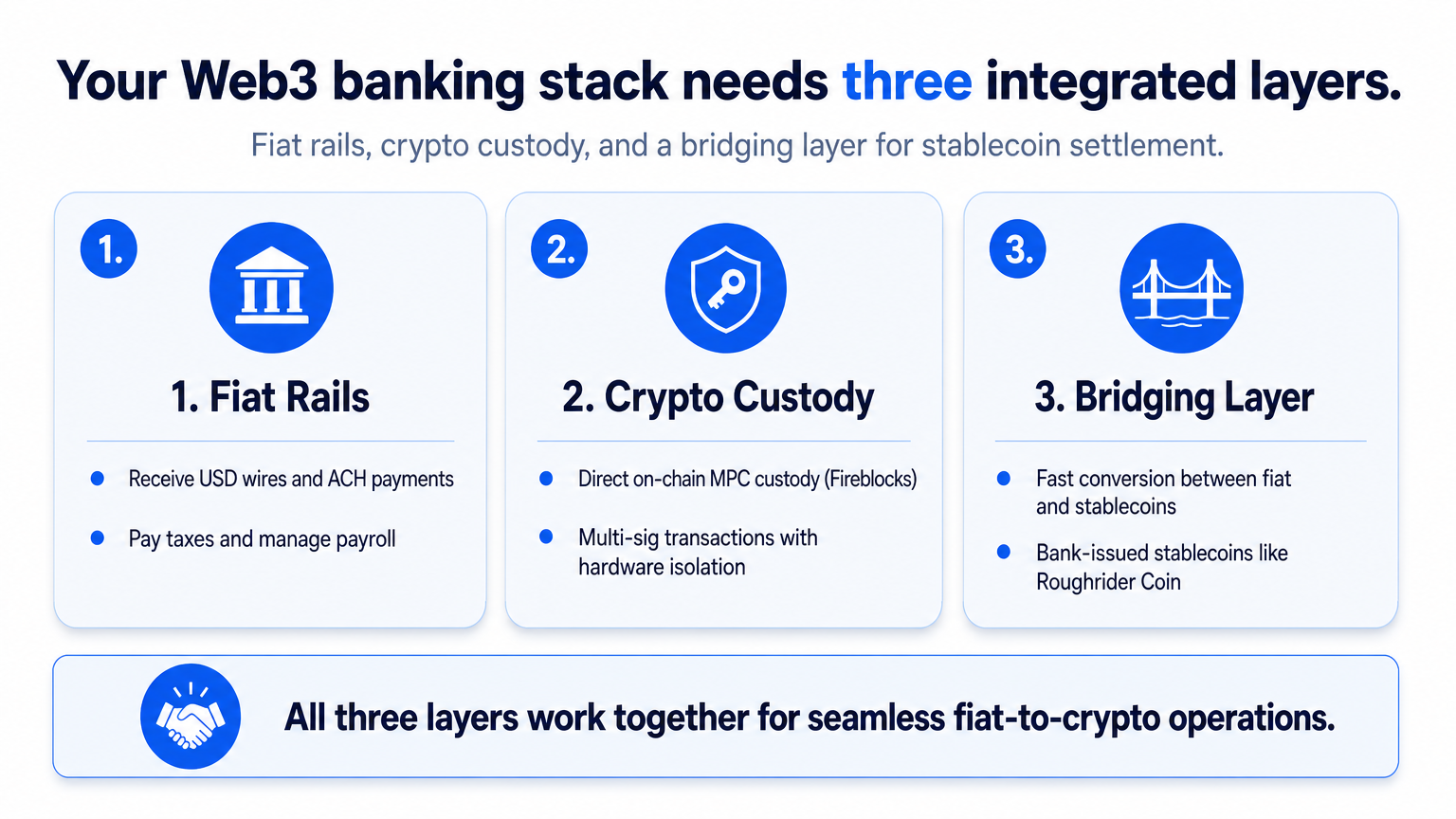
- Fiat rails and multi-currency accounts – IBAN or ACH routing to receive client payments, pay taxes, and manage payroll, designed to interoperate with crypto rails.
- Crypto custody and on-chain interaction – Direct on-chain custody via institutional MPC (like Fireblocks) so your organization signs transactions with multi-sig and sees on-chain balances alongside fiat.
- The bridging layer: on/off-ramps and stablecoin settlement – Fast, cheap conversion between fiat and stablecoins embedded in your workflow. The live deployment of Bank of North Dakota’s Roughrider Coin on Fiserv’s platform in October 2026 shows where this is headed: a bank-issued stablecoin on Solana, secured by Fireblocks, used for interbank settlement.
How to Choose a Web3 Banking Partner
What should I look for in a crypto business bank account?
Four non-negotiables: direct on-chain custody (not an exchange wallet), segregated fiat accounts in your business’s name, role-based permissions with multi-approval workflows, and transparent pricing without hidden FX markups. If a provider can’t confirm your USDC sits in segregated, insolvency-remote custody, it’s not a crypto business bank account—it’s a marketing page.
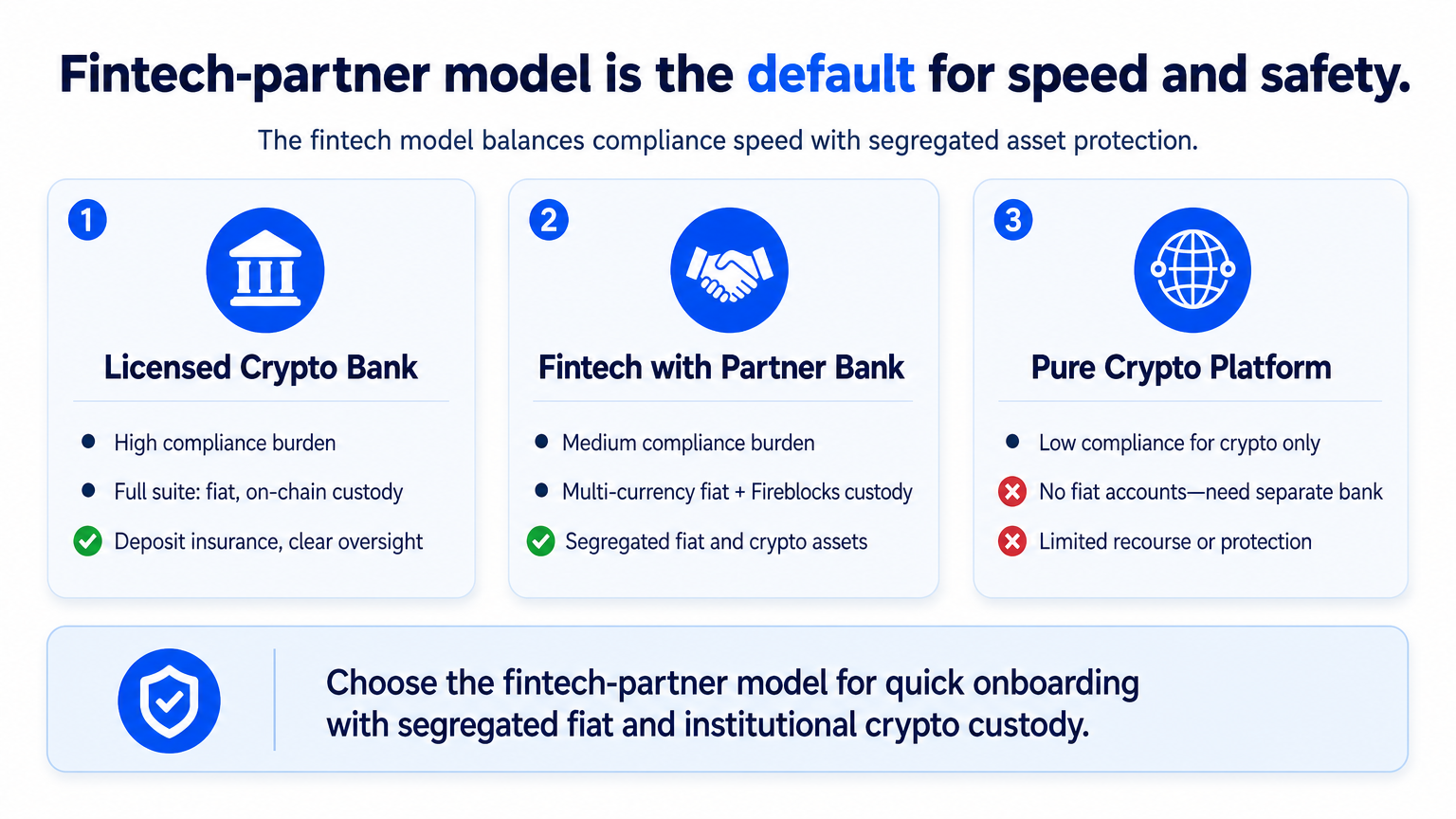
Licensed Crypto Bank vs. Fintech-Partner Model vs. Pure Crypto Platform
| Model | Compliance Burden | Custody & Asset Coverage | Recourse & Protection | Best For |
|---|---|---|---|---|
| Licensed crypto bank | High; you’re a direct bank customer | Full suite: fiat, on-chain custody, stablecoin issuance | Deposit insurance, clear oversight | Large protocols, enterprises |
| Fintech with partner bank (e.g., OneSafe) | Medium; KYB via platform, fiat at partner banks | Multi-currency fiat + institutional crypto custody (Fireblocks) | Fiat pass-through, segregated crypto | Startups, DAOs, mid-sized Web3 companies |
| Pure crypto platform | Low for crypto, but you need separate bank for fiat | Crypto only | None to limited | Crypto-native projects rarely touching fiat |
The fintech-partner model is the default because it balances speed with safety. The DOJ seizure of $84.2 million from accounts tied to Tether and EQIBank on September 25, 2026 (reported by The Paypers) underlined why: your exposure includes your provider’s partner bank and its other clients. With the fintech model, your fiat accounts are typically segregated.
Is it truly crypto-friendly without on-chain custody?
No. A true bank account for cryptocurrency must give you direct on-chain custody: you generate deposit addresses, view balances on block explorers, and sign transactions from your own multi-sig. Without that, you have a brokerage, not a crypto account.
Security: Why Fireblocks and Multi-Sig Matter
At scale, security means institutional MPC custody like Fireblocks, where the private key never exists in one place. Fireblocks’ infrastructure, used by OneSafe and North Dakota for Roughrider Coin, replaces single-key risk with a policy engine: transactions require multiple approvers, hardware isolation, and automated risk checks. For DAOs, this is the only custody model that can enforce on-chain governance votes for asset movement.
DAO banking: Role Permissions, Segregated Wallets, Voting
DAO banking requires a legal wrapper (like a Wyoming DAO LLC or Cayman Foundation). The platform must support custom roles (Viewer, Initiator, Approver), multi-sig thresholds on-chain, and ideally trigger payments from on-chain votes. Segregated wallets per working group prevent co-mingling. OneSafe supports these natively, so a grant committee can initiate a USDC payment that the treasury multi-sig approves without exposing other balances.
Fee Structures and Hidden Costs
Ask for: monthly fee, ACH/wire fees, crypto deposit/withdrawal fees, FX markup, and card fees. OneSafe charges 0.15% on fiat deposits, $25 wire withdrawals, 0.25% FX, and free USDC transfers. Many providers hide a 1–2% FX spread—on a $50,000 EUR-to-USD conversion, that’s $125 vs. $750. Startups should prioritize platforms that display the exact conversion rate upfront.
What documentation do I need to open a Web3 business account?
To open a Web3 business account, have ready: formation documents, government-issued photo ID for all beneficial owners, an EIN (for US companies), proof of business address, and a description of business activities with expected volumes. A DAO also needs its legal wrapper’s registration and directors’ identities. Platforms like OneSafe complete KYB digitally; for most non-sanctioned jurisdictions, you can start in under 10 minutes and receive full access within a week. This is the essence of neo-banking for startups—fully digital onboarding without printing forms.
Myths, Mistakes, and Hard Lessons from Q4 2026
‘Crypto-friendly banks are FDIC insured’ is false: FDIC insurance only covers fiat deposits at the partner bank, not crypto assets. Crypto custody protection comes from segregation, MPC, and custodian insurance—always verify where each asset sits.
Ignoring governance can freeze a treasury: a 3-of-5 multisig with signers using the same device is one phishing attack away from disaster. Use separated signing paths and a recovery procedure that doesn’t rely on one person.
The DOJ seizure fallacy: after the Tether/EQIBank seizure, many businesses realized they had no insight into their provider’s partner bank. Your counterparty risk includes the entire client base of that bank. Ask for the partner bank’s name and check its recent regulatory actions. For a crypto on-ramp for business, choose a provider with multiple partner banks and maintain a small fiat reserve outside crypto-exposed accounts.
What Comes Next: Stablecoin Networks and Programmable Payments
Roughrider Coin’s launch signals a future where the bank account is a programmable stablecoin wallet. Stablecoin banking collapses settlement from T+2 to immediate finality, eliminates FX exposure during float, and enables programmable payments—like an invoice that pays itself when an oracle confirms delivery. As public chains and bank-issued stablecoins converge, a Web3 banking platform becomes the policy layer managing access and compliance.
Key Takeaways
- Banking for web3 accounts means direct on-chain custody, not a tolerant fiat account. A crypto business bank account must hold digital assets in segregated institutional custody.
- The fintech-partner model (e.g., OneSafe) balances speed, security, and cost for most startups and DAOs. Verify where fiat sits and that crypto custody uses Fireblocks or equivalent.
- The DOJ’s Tether/EQIBank seizure revealed your biggest operational risk is your provider’s partner bank. Demand transparency, multi-bank capability, and a disaster plan.
- Stablecoin networks like Roughrider Coin are turning the bank account into a programmable token. Start building treasury operations around on-chain settlement now.
- For DAOs, banking requires a legal wrapper, role-based permissions, and governance-aware multi-sig. Without these, you’re a spreadsheet and a shared seed phrase away from disaster.
Ready to set up a true Web3 banking stack? Sign up for OneSafe and onboard your business in under 10 minutes. For deeper context, read our Banking for Web3 Companies: The Definitive Guide, and see Business Banking for Crypto Companies for an alternative comparison.