Crypto Treasury Management Shifts as Treasury Drops Rule
Two U.S. regulatory moves on October 5, 2026, directly recast crypto treasury management. FinCEN withdrew its self-custody wallet reporting proposal, while the CFTC proposed its first digital asset market rules—Regulation CTX and CAM. Bitcoin held above $85,000 on the news (Stocktwits), signaling net-positive for adoption. Below, what changed, why it matters, and how to adapt.
Table of Contents
- What Just Happened: Treasury Withdraws Wallet Rule, CFTC Proposes New Framework
- Why This Shift Matters for Crypto Treasury Management
- The Current State of Crypto Treasury Management
- How the Regulatory Reset Affects Your Treasury Operations
- Recommended Actions for Startups and DAOs
- What to Watch Next
- Your Crypto Treasury Management Questions Answered
- Key Takeaways
What Just Happened: Treasury Withdraws Wallet Rule, CFTC Proposes New Framework
The self-custody reporting plan is dead
On October 5, 2026, FinCEN withdrew its December 2020 proposal to require reporting of crypto transactions over $10,000 involving self-custodied wallets (Stocktwits). The rule would have made sizable transfers to hardware wallets or DAO multisigs reportable, creating operational friction. Its removal removes a cloud over DAO and startup treasuries that move funds between custodial and self-custodied environments. Self-custody alone no longer signals a disclosure trigger.
CFTC steps up with Regulation CTX and CAM
The same day, the CFTC proposed Regulation CTX (clearing and trading of digital asset derivatives) and Regulation CAM (core principles for crypto asset markets) (Stocktwits). These rules will require capital, custody, reporting, and governance standards for covered entities—potentially capturing exchanges, custodians, and prime brokers that treasury teams depend on. Even if your organization isn’t directly registered, your service providers will be, changing due diligence and contract terms.
Why This Shift Matters for Crypto Treasury Management

A clearer path for self-custody
Without the reporting rule, treasury managers can move assets between cold storage, multisig wallets, and hot wallets without automatic Bank Secrecy Act filings. This is especially meaningful for DAOs with frequent on-chain transfers and startups using self-custody as a hedge.
New compliance obligations on the horizon
The CFTC proposals bring new obligations: asset segregation, recordkeeping, and independent custody verification. Even if you aren’t directly regulated, your trading venues and custodians will be, requiring updated due diligence. The SEC’s October 2026 custody rule proposal (SEC) adds another layer, potentially permitting self-custody under strict safekeeping conditions.
The market’s immediate reaction
Bitcoin’s resilience above $85,000 signals reduced uncertainty, making crypto more attractive for corporate balance sheets. Treasury managers who hesitated because of the reporting rule’s ambiguity now have one fewer barrier.
| Development | Effective Date | Direct Treasury Impact |
|---|---|---|
| FinCEN self-custody wallet rule withdrawn | October 5, 2026 | No mandatory $10k transaction reporting for unhosted wallets; self-custody simplifies treasury flows |
| CFTC proposes Regulation CTX & CAM | October 5, 2026 (proposed) | New compliance obligations for trading venues/custodians; due diligence requirements evolve |
| Bitcoin holds above $85,000 | October 5, 2026 | Positive signal for corporate crypto holdings and treasury allocation decisions |
The Current State of Crypto Treasury Management
Crypto treasuries operate 24/7 with instant settlement, unlike fiat. They require real-time visibility into positions, a custody layer (multisig, MPC), liquidity management (stablecoins, DeFi, fiat ramps), and reporting tools that track on-chain activity. Today’s adopters range from DAOs and startups to traditional corporates testing bitcoin allocations. Tools like Bitwave, Request Finance, and platforms that unify fiat and crypto management address the fragmentation many teams face.
How the Regulatory Reset Affects Your Treasury Operations
Self-custody relieved, but not risk-free
Self-custody is no longer a reportable tripwire, but the underlying risks—key compromise, phishing—remain. DAO treasuries can disburse without fear of automatic filings. The onus is entirely on the organization to implement robust key management, access controls, and incident response plans.
Preparing for CFTC compliance
Review your service providers’ new terms, insurance, and segregation policies if they fall under Regulation CTX or CAM. The SEC’s custody proposal adds that investment advisers managing crypto for others may soon be permitted to self-custody, but only under stringent standards. Prepare for updated custody agreements and audit requirements.
Redrawing the line between fiat and crypto reporting
The FinCEN withdrawal doesn’t eliminate Bank Secrecy Act obligations—transactions over $10,000 that flow through financial institutions still trigger reports. However, a direct peer-to-peer transfer from a company’s self-custodied wallet to a vendor’s wallet isn’t automatically swept in. Treasury teams can design workflows where fiat-crypto integration happens through regulated on-ramps, while purely on-chain movements remain internal. A neo-banking platform that bridges both worlds can simplify separation with a single dashboard for fiat, crypto, and compliance alerts.
Recommended Actions for Startups and DAOs
Re-evaluate your custody model
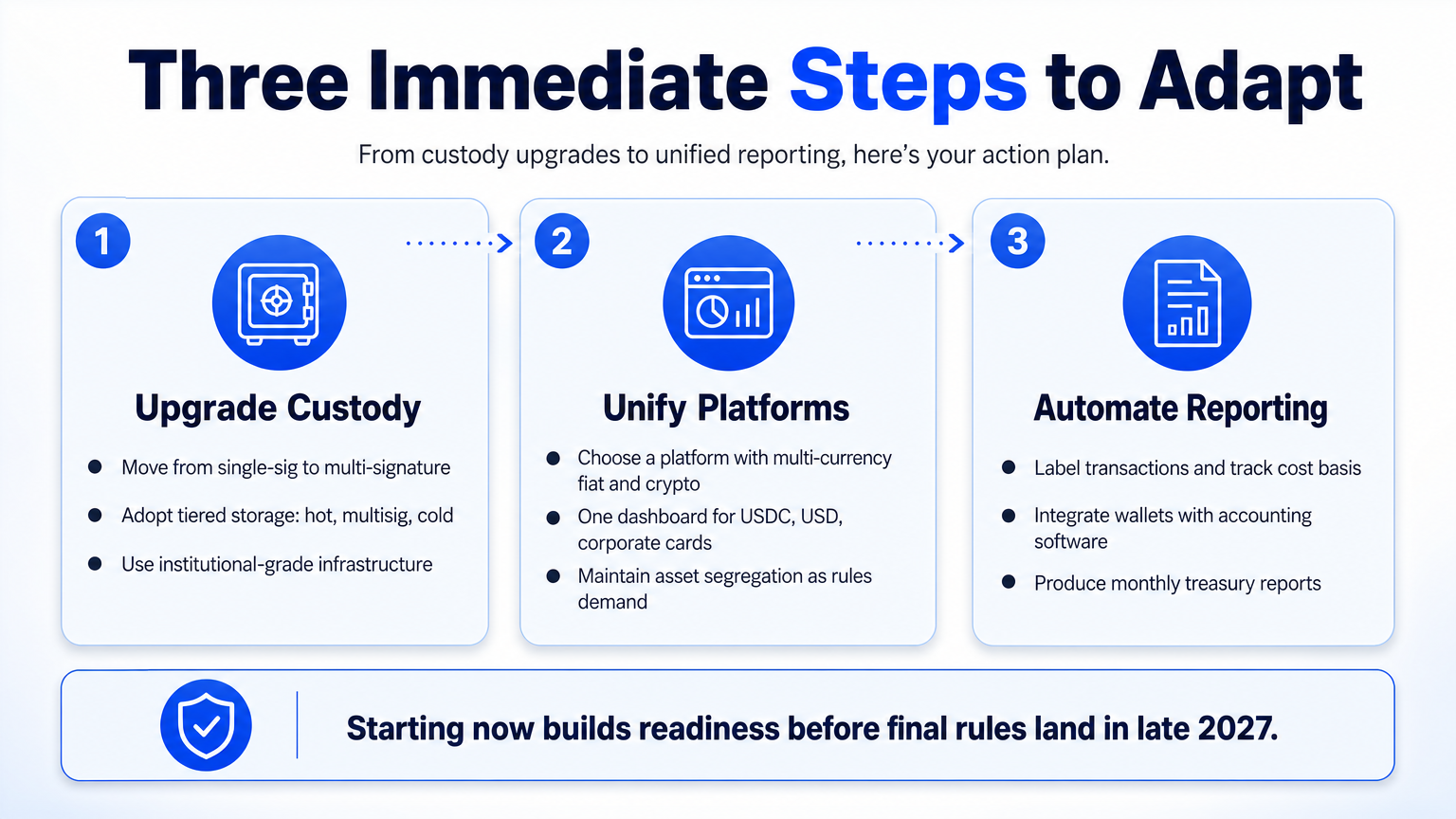
Upgrade from single-signature hot wallets. For DAOs, adopt multi-signature governance with key holders distributed across trusted contributors, using institutional-grade infrastructure like Fireblocks. For startups, use a tiered model: small working capital in a hot wallet, operational reserves in a multisig, long-term holdings in deep cold storage. Make self-custody safe, not just legal.
Consolidate fiat and crypto management
A unified platform that provides multi-currency fiat accounts, corporate cards, and crypto on/off-ramps secured by Fireblocks—like OneSafe—enables you to pay a vendor in USDC, settle payroll in USD, and see a single cash position while maintaining asset segregation as new rules demand.
Upgrade your compliance and reporting stack
Automate transaction labeling, cost-basis tracking, and audit trails now. Integrate wallet infrastructure with accounting software and produce monthly treasury reports that delineate fiat and crypto holdings. Early preparation reduces transition costs when final rules drop.
What to Watch Next
The CFTC proposals face a comment period; industry groups may contest definitions, and any substantial revision could delay implementation into 2028 or beyond. Monitor the CFTC’s open meeting schedule. The SEC’s custody proposal may finalize by mid-2027. The IRS could issue more detailed basis-tracking guidance, and international frameworks (Financial Stability Board) could create cross-border complexity. Treasury managers should treat late 2027 as the earliest binding compliance window, allowing roughly a year for scenario planning and upgrades.
Your Crypto Treasury Management Questions Answered
What is crypto treasury management?
The practice of managing an organization’s digital assets—Bitcoin, stablecoins, tokens—with the same rigor as fiat: ensuring liquidity, safeguarding assets, generating yield, and maintaining records. It blends investment policy, operational security, and regulatory awareness across 24/7 blockchain-settled markets.
What did the Treasury just change about wallet reporting?
FinCEN retracted its 2020 proposal requiring financial institutions to report $10k+ crypto transactions involving self-custodied wallets (Stocktwits). Transfers from unhosted wallets no longer trigger new reports; existing Bank Secrecy Act rules still apply when transactions pass through covered institutions.
What are the CFTC's proposed crypto rules?
Regulation CTX covers clearing, trading, and risk management for digital asset derivatives, while Regulation CAM establishes core principles for crypto spot market venues. Both impose capital, custody, and governance standards to bring crypto platforms under federal oversight.
How do these developments affect crypto treasury management for my business?
You can use self-custodied wallets without reporting triggers. However, CFTC rules tighten obligations on your trading venues and custodians, altering fee structures, insurance, and segregation. Begin due diligence reviews now and update internal policies for a more layered custody architecture.
What tools can help manage a crypto treasury in this new environment?
Institutional custody platforms (Fireblocks, BitGo), on-chain treasury managers (Request Finance, Coinshift), and neo-banking platforms like OneSafe that unify fiat and crypto accounts. Choose based on whether you need pure on-chain automation or a unified money management interface.
How can DAOs and startups adapt their treasury operations?
DAOs: adopt multisig governance with role-based permissions. Startups: define a reserve policy specifying what percentage sits in self-custody versus a regulated platform, and implement automated reconciliation across fiat and crypto accounts.
What are the risks of self-custody vs. using a platform like OneSafe?
Self-custody eliminates third-party dependence but puts key loss, phishing, and smart contract risk solely on you. OneSafe’s managed security via Fireblocks and mandatory multi-factor authentication reduces operational risk, but you trade absolute control for reliance on the platform’s uptime and banking relationships. A tiered model—operational funds on a secure platform, long-term holdings in audited self-custody—balances both.
How should I handle accounting and reporting for crypto treasuries now?
Adopt a sub-ledger that records every on-chain transaction with time-stamped cost basis, then integrate summary entries into your general ledger. Automating this flow, whether through a dedicated tool or a neo-banking platform with accounting integration, prepares you for audit readiness as rules evolve.
Key Takeaways
- The FinCEN self-custody wallet rule is dead, removing a major reporting burden for treasury teams moving assets between custodial and unhosted wallets.
- The CFTC’s proposed Regulation CTX and CAM signal incoming compliance obligations for trading venues and custodians, altering your service-provider landscape.
- Self-custody is now a practical choice, not a regulatory gamble, but security responsibility falls on the organization.
- Consolidating fiat and crypto treasury operations on a unified platform with embedded compliance simplifies reporting in a dual-track environment.
- The window between now and likely final rules in late 2027 is your opportunity to harden custody, automate reporting, and design governance.
Ready to bring your fiat and crypto treasury into a single, secure workflow? Explore OneSafe for a platform built to handle both worlds.