Crypto banking has long been pitched as the bridge between fiat and digital assets. But on October 17, 2026, StreetInsider reported that Ethereum's Glamsterdam upgrade activated on Sepolia and is progressing toward a future mainnet release. If Layer 1 gets materially faster and cheaper, the weak link for many businesses will no longer be chain capacity. It will be the banking layer—the fiat on-ramp and off-ramp that turns crypto into payroll, vendor payments, and operating cash. That reframes crypto banking as a payments and reconciliation problem, not a scalability problem.
Table of Contents
- What just happened on October 17, 2026
- Why this matters now for crypto banking
- The background: what crypto banking does and doesn't mean
- What the current top results miss
- What to do now: a practical crypto banking checklist
- What to watch next
- Key Takeaways
What just happened on October 17, 2026
The Sepolia activation and the mainnet path
According to StreetInsider's October 17, 2026 report, the Glamsterdam upgrade has activated on Sepolia and is progressing toward a future mainnet release. The report does not commit to a mainnet date. What matters is the direction: activation on a testnet is a late-stage signal that the upgrade is moving from specification to production.
For finance and operations teams, the practical implication is lower expected Layer 1 transaction costs and higher settlement capacity. That removes one of the oldest constraints on using Ethereum for regular business payments: fees that made small or frequent on-chain payments uneconomic.
Why the crypto-to-bank payments framing matters
StreetInsider's framing connects the upgrade to a crypto-to-bank payments proposition. Scaling upgrades reduce the on-chain cost of moving value. But a business that receives stablecoins still has to pay rent, contributors, and vendors in fiat.
If Ethereum settlement becomes faster and cheaper, the bottleneck shifts to the fiat off-ramp: converting the asset, clearing a wire, and reconciling the result. A DAO can settle on-chain in seconds. The fiat leg of that same payment may still wait on ACH batch windows, SWIFT correspondent routing, or bank holidays.
Why this matters now for crypto banking
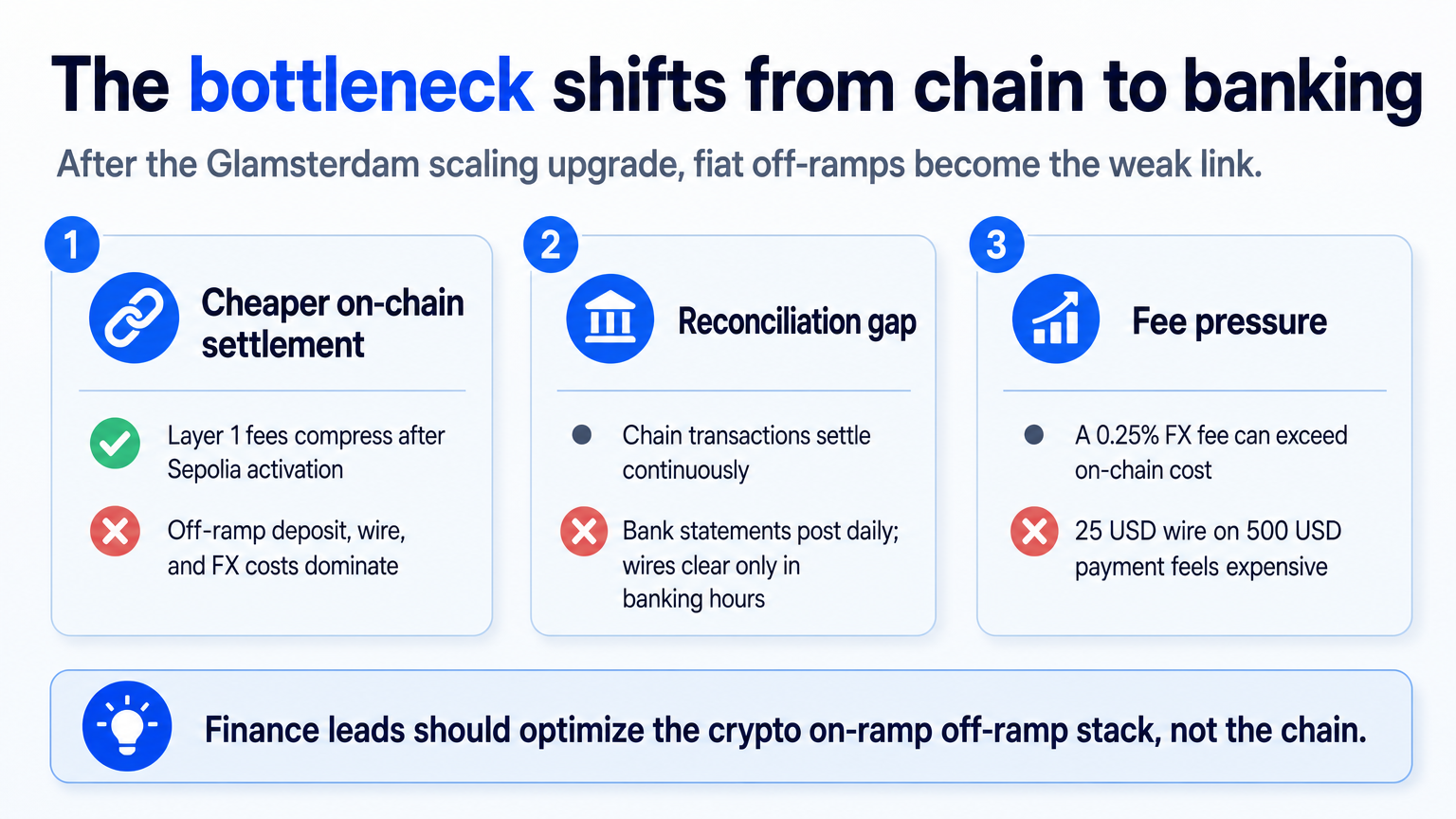
Cheaper on-chain settlement moves the bottleneck to fiat on/off-ramps
Once Layer 1 throughput improves and fees compress, the most expensive part of a crypto-to-fiat payment is no longer the chain. It is the off-ramp: deposit fees, wire fees, FX margins, and clearing time.
This changes what finance leads should optimize. A merchant or DAO that previously justified slow fiat settlement by pointing to high on-chain costs loses that excuse. The pressure moves to the crypto on-ramp off-ramp stack—specifically, how cheaply and predictably a business can convert stablecoins into usable fiat. As stablecoin payments take aim at locked prefunding cash, businesses are increasingly unwilling to keep idle fiat balances just to cover slow settlement.
Founders and DAOs face a reconciliation gap between chain speed and banking hours
DAO treasury management has always been operationally messy. Multi-signature approvals, contributor payouts in multiple tokens, and fiat reporting create a reconciliation burden that most consumer crypto apps do not address.
A faster base layer widens the gap between chain activity and bank statements. On-chain transactions are continuous and immediate. Bank statements post daily. Fiat wires clear only during banking hours. Founders and DAO treasury managers need a platform that collapses those ledgers into one view, not a wallet that shows only half of the picture.
Stablecoin and L2 settlement pressure will reshape crypto banking fees
As chain fees compress, stablecoin settlement becomes cheaper and more competitive. That puts pressure on the final fiat leg. A 0.25% FX fee or a $25 wire fee can exceed the on-chain cost of moving the underlying stablecoin by orders of magnitude, especially for smaller payments.
This is already visible in card and settlement infrastructure. Stablecoin payments have hit production in major networks, and corporate cards tied to stablecoin settlement are going mainstream. The emerging pressure point is no longer whether crypto can settle. It is whether the fiat endpoint extracts too much rent along the way.
The background: what crypto banking does and doesn't mean
From exchange balances to multi-currency business accounts
Crypto banking is often described as holding both fiat and digital assets in one account or interface. Industry explainers such as NerdWallet and Amina describe the category broadly, but operational requirements differ sharply by user. A crypto business account is not a consumer trading balance. It usually supports accounts payable, payroll, corporate cards, multi-currency receivables, and reporting. A business needs payment rails, not just asset custody.
Fintech platform vs licensed bank—and why FDIC status is a checklist item
The FDIC has signaled that banks must follow a case-by-case approval process for crypto activities. A fintech platform that partners with a bank is not the same as a licensed bank. FDIC insurance, where it exists, attaches to eligible deposits at the chartered bank—not to the software interface or to crypto assets held in custody. The marketing term "crypto bank" does not establish legal entity status or deposit insurance. Finance leads should verify both.
Consumer crypto apps vs business and DAO treasury infrastructure
Consumer pages lead with zero-fee crypto trades, but business crypto banking involves real operational fees for fiat deposits, wires, FX, and card spend. Zero-fee trading is not zero-cost treasury movement. A business that converts a stablecoin payroll run into fiat and wires it internationally will pay for that movement somewhere. The relevant question is whether the fees are disclosed and predictable. Providers such as Mercury's Web3 business banking and Wirex's business accounts target this operational layer.
What the current top results miss
No one connects L1 upgrades to day-to-day fiat and crypto treasury workflows
Most pages treat Ethereum scalability and crypto banking as separate topics. The October 17 Sepolia activation changes that. A faster chain directly affects how often a business can settle, how much prefunded cash it needs, and where its treasury friction lives.
DAO-specific controls and role-based permissions are absent
Consumer and institutional pages rarely address DAO treasury management. Role-based permissions, multi-signer controls, and automated payment workflows are not a footnote for DAOs; they are the core control environment. A treasury stack that cannot enforce spend limits per contributor or separate proposer from payer roles creates operational risk regardless of chain throughput.
Published business fees and onboarding requirements are buried or missing
Many ranking pages promise "simple onboarding" without publishing wire fees, FX margins, or SWIFT costs. For a business evaluating a crypto-friendly account, that absence is a signal. Finance leads should demand a fee schedule before opening an account, not after the first payroll run.
What to do now: a practical crypto banking checklist
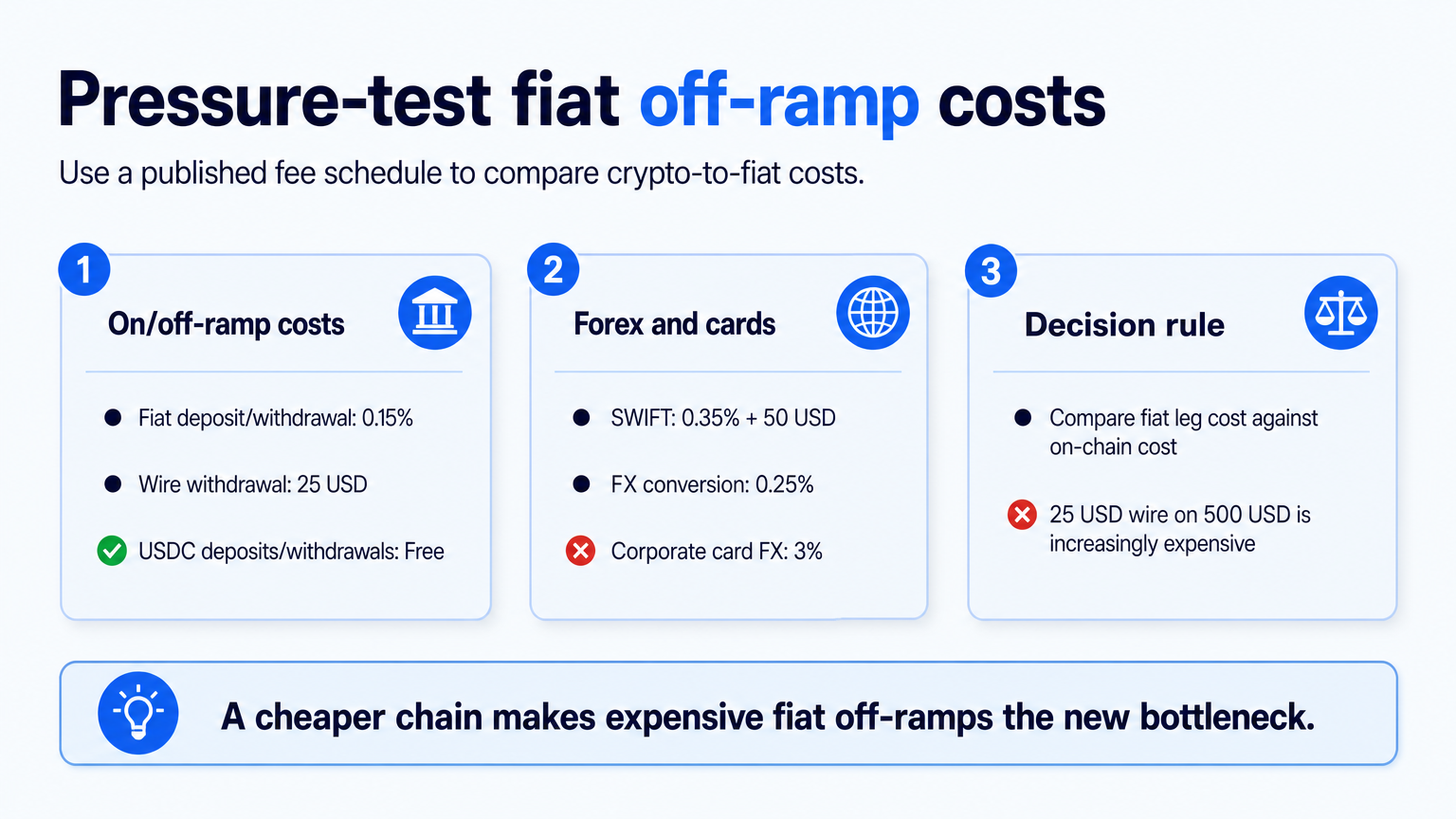
Pressure-test on/off-ramp speed and fee schedules
Before the next protocol milestone, know your fully loaded cost to move $10,000 from stablecoin into fiat and out to a vendor. The table below uses OneSafe's published business pricing as a concrete example of the fee categories that matter.
| Item | Published fee |
|---|---|
| General account opening | Free |
| Early account access | $150 |
| Monthly fee | Free or $29+ |
| Fiat deposit / withdrawal | 0.15% |
| Wire withdrawal | $25 |
| Wire deposit | $10 |
| SWIFT deposit / withdrawal | 0.35% + $50 |
| FX conversion | 0.25% or prevailing FX rate |
| Corporate card FX | 3% |
| Crypto deposits / withdrawals (USDC) | Free |
The table illustrates a decision rule: compare the fiat off-ramp cost against the on-chain cost, especially for high-frequency, lower-value payments. An upgrade that makes on-chain settlement cheap will make a $25 wire fee on a $500 payment feel increasingly expensive.
Verify custody, compliance, and legal entity status
Ask where digital assets are held and whether the provider is a licensed bank or a fintech partner. Look for institutional custody, encryption, and mandatory MFA. The right answer is not "trust us"; it is a named custody provider, a clear legal entity, and a documented compliance process.
Use a unified fiat-crypto platform such as OneSafe—without assuming it is a bank
A crypto-friendly neobank can remove much of the operational drag of running parallel fiat and crypto stacks. The key is to use it as a financial operating layer, not to mistake it for a chartered bank. A platform like OneSafe publishes its fees, supports DAO-specific controls, and combines fiat and crypto workflows in one interface. Banking services still sit with its partner institutions.
Questions finance leads should ask before the next protocol milestone
- What is the legal entity behind the account, and is it a licensed bank or a fintech partner?
- Where is digital asset custody held, and what controls cover multiple treasury signers?
- What are the fully loaded fees for a $10,000 crypto-to-fiat conversion and an outward international wire?
- What onboarding documents are required, and how long does verification take?
- Which jurisdictions are supported, and where are fiat funds held?
What to watch next
Mainnet release timing and L2 fee compression
StreetInsider's October 17 report did not specify a mainnet date. The timing will determine when expected throughput gains become live. In the interim, L2 fee compression may arrive sooner for many payment use cases.
Regulatory posture after FDIC's approval framework
The FDIC's case-by-case approval path for crypto activities will shape how many institutions choose to partner with fintech platforms. A clearer framework could expand bank participation in fiat on/off-ramps, but it will also tighten the distinction between insured deposits and crypto balances. Watch whether platforms update their disclosures accordingly. Kraken's bank acquisition is one indicator that the line between crypto firm and bank is becoming more deliberate.
Competitive pressure on stablecoin settlement and crypto-to-bank payments
Stablecoin settlement is becoming a competitive battleground. Visa's production rollout and card-linked stablecoin programs push the fiat leg to be faster and cheaper. For global business crypto banking, the winners will likely be platforms that disclose fees, reduce settlement time, and give DAOs real treasury controls.
Key Takeaways
- The October 17, 2026 Glamsterdam activation on Sepolia pushes the crypto banking bottleneck from chain throughput to fiat on/off-ramp speed, fees, and reconciliation.
- A "crypto bank" label does not establish a licensed bank or FDIC insurance—verify legal entity status, partner banks, and custody separately.
- Business crypto banking is not zero-fee consumer trading; evaluate fully loaded off-ramp costs such as wire, SWIFT, and FX against your payment volumes.
- DAO treasury management requires role-based permissions and control workflows that consumer-facing pages rarely address.
- Before the next protocol milestone, finance leads should pressure-test their crypto-to-fiat conversion costs and onboarding requirements against a published fee schedule.
Ready to see a unified fiat-crypto account built for global businesses and DAOs? Sign up for OneSafe.