Meta description: Web3 payments are going mainstream as StraitsX and Visa extend stablecoin card issuing to 100+ markets. Here’s what that means for DAOs and startups.
Web3 Payments Hit the Mainstream: Stablecoin Cards Go Global
Global web3 payments took a concrete step toward everyday use on October 16, 2026, when StraitsX, a Singapore-based stablecoin settlement provider licensed by the Monetary Authority of Singapore (MAS), announced a Visa stablecoin partnership to extend its stablecoin card issuing infrastructure to more than 100 markets, according to Claudia Pincovski at The Paypers. The move turns stablecoins into a cardholder-facing payment method just as corporate treasuries and DAOs are asking how to spend on-chain assets without brittle banking rails.
Table of Contents
- What Just Happened
- Why This Matters Right Now
- Web3 Payments in 2026: The Short Version
- Inside the Stablecoin Card Model
- What It Means for Your Organisation
- Open Questions and What We’re Watching Next
- Key Takeaways
What Just Happened
On October 16, 2026, The Paypers reported that StraitsX, a Major Payment Institution licensed by MAS, has partnered with Visa to extend StraitsX card issuing beyond Asia. The service targets fintechs, Digital Payment Token providers, wallets, and businesses that want to launch card programmes connecting stablecoin balances to Visa’s global acceptance network. Expansion remains subject to regulatory, compliance, and Visa requirements.
StraitsX reported an annualised card GTV of more than USD 6 billion across its stablecoin-backed card programmes in Asia, according to the October 16 report. The new agreement extends that infrastructure to eligible card programmes in more than 100 markets; “eligible” does not mean “available today” everywhere—each programme still needs local licensing, compliance, and Visa onboarding.
This is not Visa’s first stablecoin card experiment. Earlier programmes—covered in Visa Stablecoin Payments: From Pilot to Production—What It Means—typically involved a single issuer, a narrow set of stablecoins, or limited geographic reach. Earlier stablecoin cards often worked as a manual on-ramp: sell crypto to fiat, then spend fiat. More recent experiments like the Marqeta-Coinbase corporate card deal moved conversion to the card layer but remained tied to a specific exchange. The StraitsX-Visa approach separates stablecoin funding and settlement from card issuance, so a fintech or wallet can build on StraitsX’s infrastructure without becoming a Visa issuer—if it meets the compliance bar.
Why This Matters Right Now
Stablecoins leap from settlement rails to the point of sale
For years, stablecoin payments have been described as a better settlement rail: faster, cheaper, and more programmable than correspondent banking. What changed on October 16 is the merchant experience: cardholders transact with Visa credentials while stablecoins support the underlying funding and settlement in the background. Merchants do not need to accept stablecoins at the point of sale; they continue to receive settlement through the card network. That removes the biggest adoption bottleneck: convincing thousands of merchants to change their payment acceptance stack.
For Web3 startups: crypto corporate cards that spend themselves
A Web3 startup holding USDC in a multi-signature wallet typically faces a choice: convert to fiat for operating expenses, or keep funds on-chain and rely on a limited set of crypto-native vendors. Stablecoin-backed corporate cards break that binary. The card pulls from a stablecoin balance, converts only the amount needed at the moment of the transaction, and settles with a merchant who never touches crypto. For a startup, this means fewer large crypto-to-fiat conversions, less exchange-rate timing risk, and faster access to working capital. It also creates a new accounting decision: every card transaction becomes a taxable event in many jurisdictions, so the treasury team needs transaction-level reporting that maps card spend back to on-chain outflows.
For DAOs: real-time on-chain governance meets fiat-denominated expenses
DAOs have a harder problem: treasury management is often governed by multi-signature approval, while expenses are denominated in fiat. The StraitsX model lets a DAO keep its treasury in stablecoins and issue cards with spend limits to working groups or contributors. Governance can remain on-chain through multi-signature approvals for large disbursements, while day-to-day card spend is constrained by card-level limits. This is DAO financial management moving from a quarterly off-ramp ritual to a continuous, auditable flow—but only if the card platform supports the DAO’s existing custody and permissioning model.
Web3 Payments in 2026: The Short Version
A definition that won’t waste your time
Web3 payments are blockchain-based transactions that settle peer-to-peer without a traditional intermediary. They typically use stablecoins like USDC or USDT to reduce volatility, run on public chains such as Ethereum, Solana, or layer-2 networks, and settle in seconds to minutes rather than days. The core advantage is programmability: payment logic can be encoded in smart contracts for automated releases, escrow, or multi-signature approvals. The dominant use case has shifted from speculative transfers to operational payments—payroll, vendor invoices, and cross-border treasury moves.
The infrastructure stack: wallets, gateways, and public chains
A web3 payment gateway is the bridge between a merchant’s checkout or a business’s payment workflow and the blockchain. It accepts crypto on the front end, handles conversion if needed, and settles either in crypto or fiat. Stripe’s stablecoin payments documentation describes the merchant-facing flow for accepting stablecoins and receiving fiat settlement; Cross River’s Stablecoin Payments API covers the institutional side of digital asset settlement. The gateway handles compliance checks, wallet address management, and often crypto-to-fiat conversion—which is why choosing the right gateway is as much a compliance decision as a technical one.
What the ranking pages get right—and what they leave out
Most ranking pages correctly state that web3 payments are borderless, lower-fee, and programmable, and that stablecoins are the preferred medium because they reduce volatility. They also identify the core building blocks: self-custody wallets, custodial services, payment links, and developer-friendly APIs. What they miss is the governance and treasury angle. A web3 payment is never just a transfer; for an organisation, it is a spend decision that must be authorised, recorded, and reconciled. Stablecoin corporate cards force that reality to the surface, because every card swipe is an on-chain outflow that needs to fit the entity’s existing compliance and accounting controls.
Inside the Stablecoin Card Model
How the StraitsX-Visa flow works
Under the model described by The Paypers, stablecoins fund the card programme at the custody and settlement layer. When a cardholder makes a purchase, the card network authorises the transaction against the available stablecoin balance. Settlement occurs through Visa’s rails, and the merchant receives fiat or domestic currency as usual. The cardholder never needs to pre-convert a large balance; conversion happens at the margin, tied to actual spend. The key operational question—who bears the conversion and volatility risk during the settlement window—depends on the card programme’s configuration and the stablecoin’s peg mechanism. The source does not specify a single answer, so organisations must review programme-specific terms before issuing.
Where the risk sits (and doesn’t sit)
The merchant does not hold stablecoins and does not bear crypto risk. The cardholder bears the usual risk of price movement only on the stablecoin balance itself, which is designed to hold a peg. The programme issuer—not StraitsX and not Visa—typically sits between the stablecoin custodian and the card network, and it carries the operational risk of maintaining sufficient liquidity to satisfy card authorisations. For a DAO or startup evaluating this, the risk you most need to diligence is not the card network, but the issuer’s custody and conversion arrangements.
Direct comparison: stablecoin cards vs. traditional corporate cards
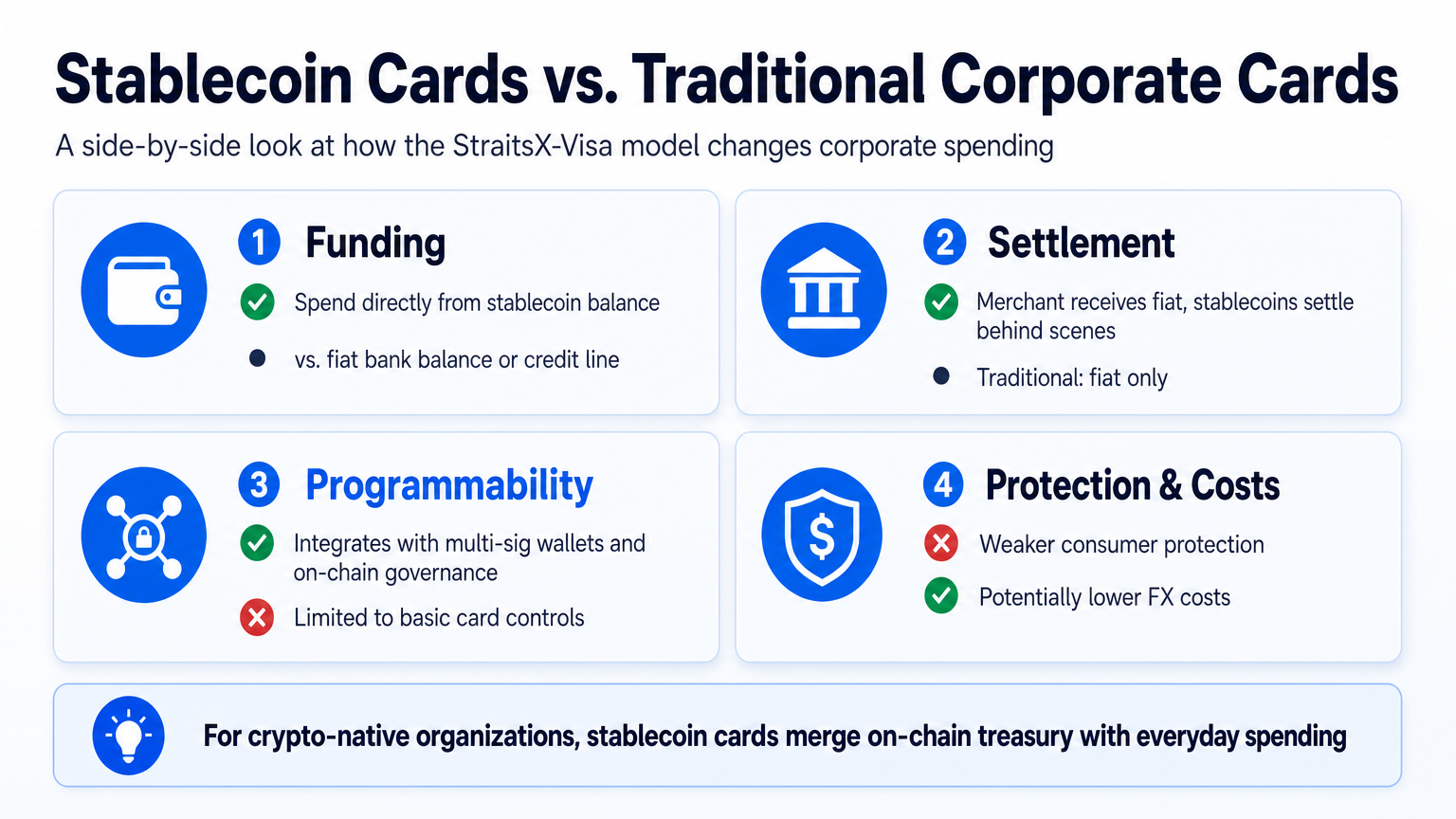
| Dimension | Stablecoin card (StraitsX-Visa model) | Traditional corporate card |
|---|---|---|
| Funding source | Stablecoin balance held in custody | Fiat bank balance or credit line |
| Settlement currency | Merchant receives fiat; stablecoin settles behind the scenes | Fiat only |
| Crypto-to-fiat conversion | Occurs per transaction or per settlement batch | Not applicable |
| Geographic reach | 100+ markets, subject to regulatory approval | Typically tied to issuing bank’s licences |
| Programmability | Can integrate with multi-signature wallets and on-chain governance | Limited to card controls and spend limits |
| Cardholder protection | Depends on programme terms; not identical to consumer card protections | Established chargeback and dispute frameworks |
| FX cost | Varies by programme and stablecoin | Typically 1–3% on foreign transactions |
What It Means for Your Organisation

Action 1: Map your current fiat and crypto spend lines
Before evaluating any card programme, list every recurring expense and its payment rail today: payroll, cloud services, contractor invoices, travel, legal retainers. Note which are already paid from a stablecoin wallet and which require manual off-ramping. The StraitsX-Visa expansion matters only if your actual spend lines can move to a card without creating new tax or accounting burdens. A payment that is cheap on-chain but expensive to account for is not a saving.
Action 2: Shortlist platforms that combine custody, compliance, and cards
A single stack for fiat and crypto removes the need to run parallel banking relationships. Evaluate providers on five criteria:
- Licensing and jurisdiction: Is the provider licensed where your entity operates? StraitsX holds an MAS Major Payment Institution licence; your card issuer must hold the equivalent where you spend.
- Custody model: Are stablecoins held in segregated custody with an institutional custodian, or commingled? Look for custodians like Fireblocks rather than a provider’s internal wallet.
- Card controls: Can you issue multiple virtual cards with spend limits, freeze cards instantly, and set per-card merchant category restrictions?
- Crypto-to-fiat conversion fees: What is the spread or fee on each transaction? The difference between 0.5% and 3% on $1 million of annual spend is $25,000.
- Reporting and accounting integration: Does the platform export transaction-level data that can be matched to on-chain outflows for your accounting team?
Platforms such as OneSafe—a financial technology company, not a bank—combine multi-currency fiat accounts, corporate cards with spend limits, and crypto on/off-ramps in a single interface. Its digital asset custody is secured on Fireblocks, mandatory multi-factor authentication is enabled at signup, and USDC deposits and withdrawals are free. For an organisation that must pay landlords in dollars and contractors in USDC, that unified model reduces the operational gap without requiring a separate banking relationship for each rail.
Action 3: Pressure-test governance for multi-signature stablecoin spending
DAOs should treat a stablecoin card as a delegated spending authority, not a replacement for on-chain governance. The practical checklist:
- Which signers approve card issuance? Keep the multi-signature treasury wallet separate from the card programme’s operational funder wallet.
- What is the per-card limit and who can change it? Limits should require the same quorum as a treasury disbursement of equivalent size.
- How are card outflows reported back to the DAO? If the provider’s API does not give real-time transaction data, the DAO loses auditability.
- What happens when a card is compromised? Freeze and reissue procedures should not require a full governance vote for every card.
- Which custodian holds the stablecoin backing the cards? Segregated custody on an institutional platform is a baseline requirement for any DAO with meaningful treasury.
Open Questions and What We’re Watching Next
Regulatory dominoes: who follows Singapore’s lead, and when?
The binding constraints are not technical; they are regulatory. StraitsX operates under Singapore’s Digital Payment Token regulation, which gives it a clear licensing path for stablecoin settlement. Other jurisdictions remain fragmented. A March 30, 2026 Federal Reserve note on Payment Stablecoins and Cross Border Payments examined the benefits and monetary policy implications of payment stablecoins, signalling continued U.S. scrutiny. What to watch: whether the EU’s MiCA stablecoin rules are applied consistently to card programmes, whether U.S. federal legislation emerges, and whether MAS-style Major Payment Institution licences become the template for other Asian markets. A single enforcement action against an unlicensed issuer would chill the entire category.
Will Mastercard and domestic schemes respond with their own stablecoin rails?
Mastercard has already signalled interest in stablecoin infrastructure—its stablecoin platform has been positioned as a network-level solution. A Visa-StraitsX expansion of this size is likely to accelerate Mastercard’s own issuer partnerships, and domestic schemes in Japan, the UAE, and Brazil may follow with localised stablecoin card rails. Competition will compress fees and improve cross-border settlement options, but it will also create a wider set of issuer-specific risks for treasuries to diligence.
Key Takeaways
- Web3 payments took another step mainstream on October 16, 2026, when StraitsX, an MAS-licensed stablecoin settlement provider, announced a Visa stablecoin partnership to extend StraitsX card issuing to more than 100 markets after reporting over USD 6 billion in annualised card GTV in Asia.
- The StraitsX-Visa model separates stablecoin funding and settlement from card issuance, allowing merchants to receive fiat while cardholders spend stablecoins without manual off-ramping.
- For startups and DAOs, crypto corporate cards reduce forced crypto-to-fiat conversions but require clear tax, custody, and governance controls before rollout.
- Regulatory fragmentation remains the biggest constraint, as shown by Singapore’s DPT licensing and the Federal Reserve’s March 30, 2026 note on payment stablecoins.