A quiet but costly friction sits at the heart of cross-border payments: cash positioned in local accounts days before a transfer begins. On October 16, 2026, PYMNTS.com highlighted a shift: stablecoin payments are being tested not just for speed, but to shrink the prefunding cash that providers must lock up in advance (PYMNTS, October 16, 2026).
The question isn’t whether stablecoins settle faster than SWIFT; it’s whether 24/7 on-chain funding can let providers—and the businesses that rely on them—hold smaller prefunded balances without breaking settlement reliability. For CFOs and DAO treasurers, that difference is working capital returned to the balance sheet.
Table of Contents
- What Just Happened: Stablecoins Move Beyond Settlement Speed
- Why It Matters: Working Capital That Stops Waiting
- The Background: How Cross-Border Prefunding Has Worked Until Now
- How To Act on This Shift: From Fiat Prefunding to On-Chain Liquidity
- What to Watch Next: The Open Questions
- Frequently Asked Questions About Stablecoin Payments
- Key Takeaways
What Just Happened: Stablecoins Move Beyond Settlement Speed
The PYMNTS report on prefunding and stablecoins (October 16, 2026)
The PYMNTS piece, “Stablecoins Take Aim at Cash Locked in Prefunding,” reports that stablecoin funding could let providers replenish destination-account positions outside traditional banking hours and closer to the moment a payment is made. Traditional prefunding forces cash into multiple bank or network accounts days before a transaction because currency cutoffs, time-zone mismatches, and batch-processing windows make real-time intraday funding impractical. Stablecoin rails settle around the clock, changing the funding rhythm: a provider could hold a USDC liquidity pool, top up local fiat only when a payment is initiated, and reduce idle aggregate cash.
Why prefunding has been a hidden cost of cross-border payments
In a typical cross-border payment, the sending institution must ensure the recipient’s bank or local payout partner has sufficient liquidity in the right currency before release. That cash is trapped in destination accounts from placement until drawdown—sometimes days. For a provider moving millions daily, even a day’s interest forgone or a drawn credit line adds material cost.
How stablecoin-based funding could let providers cut idle cash
Because stablecoin settlement time is measured in minutes, a provider can hold a single on-chain liquidity pool—say USDC—and convert to fiat only as needed. That collapses multiple dormant fiat balances into one active, programmable asset. The PYMNTS report notes the caveat: the working capital benefit is real only if providers actually run smaller aggregate balances, not merely substitute one form of prefunding for another.
Why It Matters: Working Capital That Stops Waiting
The real cost of money sitting in destination accounts before a payment goes out
Every dollar parked in a nostro account for two days earns little and ties up capital that could fund payroll, inventory, or growth. For payment companies on thin margins, the float is a direct drain. Cross River notes that stablecoin cross-border payments can compress the payment lifecycle, freeing working capital otherwise trapped in settlement pipelines.
24/7 funding outside banking hours: a structural advantage for crypto rails
Fiat funding windows are limited by banking hours, currency-specific cutoffs, and weekend closures. A Friday evening payment may not complete the funding leg until Tuesday. Stablecoins settle on blockchains that never close, so a provider can top up a payout account at 11 p.m. Sunday—exactly when the transaction needs it.
What smaller global businesses and DAOs stand to gain
The prefunding burden also hits startups paying contractors in three currencies, or a DAO treasury funding grants in multiple fiat currencies. With stablecoin-based liquidity management, these organizations can hold a single stablecoin balance and convert on demand—simplifying treasury operations and reducing the need for multiple fiat accounts.
The Background: How Cross-Border Prefunding Has Worked Until Now

The correspondent banking model and pre-positioned liquidity
Cross-border payments traditionally rely on a web of correspondent banks. The sending bank must either maintain an account with a local bank or route through an intermediary. That nostro account needs to be funded before a payment is released, tying up cash. The BIS considerations for stablecoin arrangements underline that this pre-positioning of liquidity is a core friction point in cross-border payments.
Why cash gets trapped: currency cutoffs, time zones, and batch processing
Even if payment messages move near-instantly under ISO 20022, funding still moves during business hours. A Taiwanese payer sending euro after the ECB cutoff means the euro leg won’t fund until the next business day. The provider must hold extra cash to cover the gap—a mismatch between messaging speed and funding speed often confused with settlement speed itself.
The difference between settlement speed and liquidity optimization
A common mistake is equating faster settlement with lower working capital. You can settle a payment in seconds on-chain, but if you still need fiat in ten countries by 9 a.m. Monday, working capital hasn’t moved. The real opportunity is liquidity optimization—reducing where cash sits and for how long. Stablecoins, used thoughtfully, address that deeper layer.
How To Act on This Shift: From Fiat Prefunding to On-Chain Liquidity
Assessing whether stablecoin funding fits your payment workflows
Not every flow is a candidate. Map corridor volumes, the time between funding a destination account and actual payouts, and the cost of capital. If balances sit idle over 24 hours merely to meet settlement cutoffs, those are prime targets.
A simple diagnostic: Total idle cash = average daily payout volume × average days cash sits pre-positioned. If stablecoin funding can shave 1.5 days off that average, the working capital saving is 1.5× daily volume—directly returnable to the business.
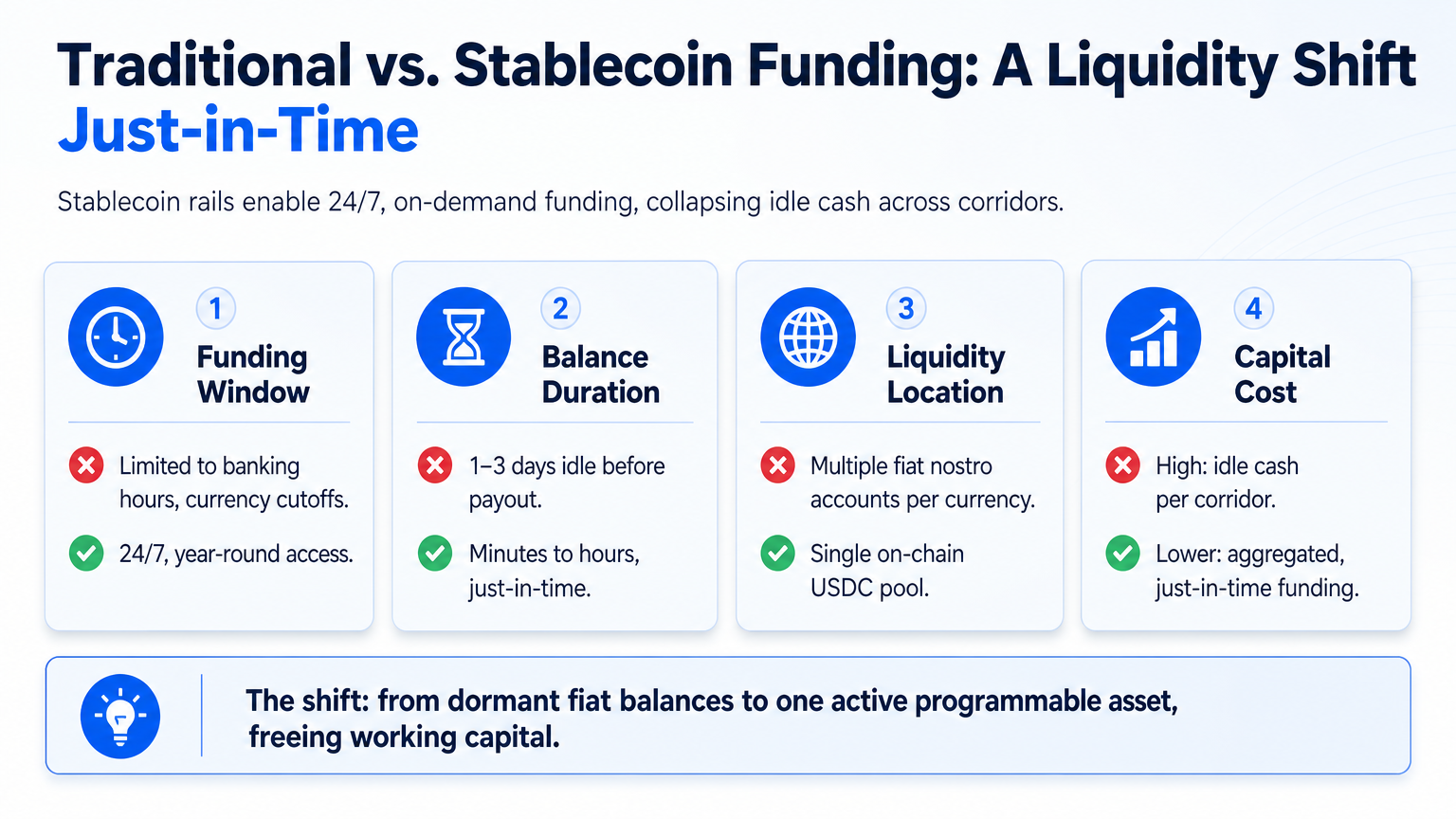
| Factor | Traditional Prefunding | Stablecoin-Based Funding |
|---|---|---|
| Funding window | Limited to banking hours, currency cutoffs | 24/7, year-round |
| Prefunded balance duration | 1–3 days typical | Minutes to hours |
| Liquidity location | Multiple nostro accounts, one per currency | Single on-chain pool (e.g., USDC) |
| Working capital cost | High: idle cash per corridor | Lower: aggregated, just-in-time funding |
| Regulatory treatment of asset | Fiat, fully regulated | Varies; stablecoin regulatory clarity evolving |
| Operational complexity | Bank management across jurisdictions | New custody & compliance controls needed |
Using a unified fiat and crypto platform to manage liquidity (the OneSafe example)
Businesses moving from fiat-only prefunding to a hybrid model often hit the gap between banking and crypto wallets. Platforms that combine fiat accounts, USDC corporate payments, and on-chain custody remove much of that friction. OneSafe, for example, offers segregated global accounts alongside instant crypto-to-fiat conversions and free USDC deposits and withdrawals. A business can hold USDC as its primary liquidity pool, then convert to fiat when payroll or vendor payments require it. DAOs managing crypto treasury management can route stablecoin liquidity into fiat payouts without separate exchange accounts. Because the platform operates through partner banks and secures digital assets on Fireblocks, custody and compliance layers are embedded.
The custody and compliance decisions that come with holding stablecoins
Replacing fiat prefunding with on-chain liquidity raises stablecoin custody risk: who holds private keys, how stablecoins are protected, and whether issuer reserves are audited and transparent. Using a qualified custodian (like Fireblocks) rather than a hot wallet is becoming standard. Stablecoin payment adoption in 2026 also faces a patchwork of regulations; verify the legal status of the chosen stablecoin in each jurisdiction.
What to Watch Next: The Open Questions
Will stablecoin prefunding actually reduce aggregate cash held, or just shift it?
The risk is providers simply hold the same value in stablecoin form, recreating the prefunding lockup on-chain. The real test is whether audits show a net reduction in average balances—or just a substitution. The Thunes blog on stablecoin pre-funding acknowledges that the benefit depends on the ability to dynamically fund positions at the last minute.
Regulatory clarity around stablecoins used for institutional funding
In the U.S., stablecoin legislation has been debated for years, and in October 2026 no comprehensive federal framework has passed. The EU’s MiCA regulation provides a regional template, but cross-border providers need consistency. Without clear rules on redemption rights and reserve requirements, institutional stablecoin funding may invite enforcement risk. Recent moves like Japan’s banks trialing stablecoin payments suggest forward-looking regulators are crafting pathways, but global standards remain absent.
The emerging infrastructure that could connect banking partners to on-chain liquidity pools
The missing link is a direct, automated bridge between an on-chain stablecoin balance and a domestic fiat payout rail. While Visa’s stablecoin payments infrastructure and Circle’s USDC settlement APIs point in that direction, most businesses still rely on manual conversions or separate off-ramps. The next 12 months will likely see platforms embed this as an API-driven workflow: detect a funding gap, mint the required fiat from a stablecoin pool, and sweep the balance afterward.
Frequently Asked Questions About Stablecoin Payments
How long do stablecoin payments take to settle?
On public blockchains like Ethereum or Solana, typically seconds to a few minutes depending on network congestion and block finality. Off-chain solutions can settle near-instantly.
What does a stablecoin payment cost?
Fees vary by network: Ethereum Layer 1 can cost several dollars, while Layer 2s (Arbitrum, Base) and Solana often charge fractions of a cent. Conversion to fiat may add a 0.1%–0.25% spread or fee.
Can stablecoin payments be reversed?
Generally no; confirmed blockchain transactions are irreversible. Some regulated issuers may freeze or reclaim funds under legal orders, but chargebacks do not exist.
Are stablecoin payments legal?
Status depends on jurisdiction. Stablecoins are generally legal to hold and transfer, but payment use—especially institutional prefunding—may require licensing and AML compliance. Consult local counsel.
Which stablecoin should a business accept?
USDC remains the most transparent and widely adopted for business-to-business use, with regular audits and deep liquidity. Other options include USDT and euro or yen proxies, but liquidity depth and issuer credibility are key.
How can businesses implement and manage stablecoin payments?
Use a platform that integrates stablecoin custody with fiat banking—such as OneSafe—to hold USDC, convert to fiat, and send payouts without managing private keys directly. Larger volumes may need a qualified custodian or payment orchestration layer.
What are stablecoin payments?
Stablecoin payments are transfers of value using blockchain-based tokens designed to maintain a stable value relative to a fiat currency, usually the U.S. dollar. They allow near-instant, 24/7 settlement without legacy intermediaries.
How do stablecoin payment flows and settlement mechanics work?
A sender initiates a transfer from wallet to wallet; the transaction is broadcast, validated, and recorded in a block. Settlement occurs at block finality. For crypto-to-fiat business payments, the recipient often converts stablecoins to fiat via an off-ramp.
How do stablecoin payments improve speed and cost efficiency?
They remove intermediary banks, eliminate currency cutoffs, and operate 24/7, settling in minutes rather than days. Costs are typically a flat network fee plus conversion spread—often lower than wire fees for large transfers—and avoid idle cash drag.
What obstacles limit broader stablecoin payment adoption?
Regulatory uncertainty, issuer counterparty risk, limited merchant acceptance, onboarding friction (KYC), and the complexity of managing crypto and fiat liquidity simultaneously. Many businesses also hesitate because stablecoins lack deposit insurance.
Key Takeaways
- Stablecoin-based funding can reduce idle cash tied up in cross-border prefunding, improving working capital.
- The structural advantage is 24/7 liquidity: just-in-time funding outside banking hours.
- Moving to a hybrid model requires new custody, compliance, and platform choices; unified fiat/crypto platforms simplify the transition.
- The real test is whether aggregate prefunded balances shrink, rather than shifting from fiat to stablecoins.
- For DAOs and global startups, holding a single USDC liquidity pool and converting on demand offers leaner treasury management.
Ready to manage your cross-border liquidity with both fiat and stablecoins in one place? Open a OneSafe account today and start reducing the working capital locked in prefunding.