
Your finance lead gets a Slack message at 4:40 p.m. A vendor wants payment today. Your product team needs funds in a wallet to cover onchain activity. A contractor in another country would rather receive stablecoins than wait for a bank transfer that may arrive days later. You have cash in a business account, but cash in a bank account and dollars onchain are not the same thing.
That gap is where fiat to crypto conversion stops being a retail feature and becomes a treasury workflow.
For finance teams, the question usually isn't “how do we buy crypto?” It's more practical than that. Which rail should fund the transaction. How much hidden spread sits inside the quote. Who approves the movement. When the money is usable. What compliance checks will hold things up. And whether the team can reconcile the whole path from bank debit to wallet credit without a spreadsheet scavenger hunt.
This matters even more for web3 startups, DAOs, and globally distributed SMEs. They're often hiring across borders, paying service providers in multiple currencies, and managing a mix of bank rails and blockchain rails at once. If you're building that team, a specialist partner such as GENTY recruitment fintech hiring can help on the people side while finance operations mature in parallel.
A modern finance stack also has to connect treasury decisions to execution. If your team handles vendor payouts, contractor settlements, or wallet funding, it helps to see how crypto business payment workflows fit into the broader movement of funds.
Table of Contents
- Centralized exchanges
- OTC desks
- Embedded on-platform conversion
- Fiat to Crypto Conversion Methods Compared
- How finance teams usually choose
- Why settlement timing changes risk
- Liquidity depth matters too
- What stablecoin-heavy flows are changing
- Headline fees rarely tell the whole story
- Rail choice changes the cost curve
- A practical way to compare quotes
- What providers will usually ask for
- The controls that matter inside the business
- Custody and onboarding questions worth asking
Introduction to Fiat to Crypto Conversion for Modern Businesses
A retail user taps “buy,” accepts a price, and moves on. A business has more moving parts.
The business usually starts with a purpose. Fund an operations wallet. Pay a market maker. Settle invoices with a partner that wants USDC. Move idle cash into a stablecoin position because a payment window opens outside banking hours. Each use case changes what “good conversion” looks like.
What businesses are actually trying to solve
Finance teams usually care about four things at once:
- Speed to usable funds so a payment can happen when the business needs it
- Net landed cost after spreads, funding fees, and transfer costs
- Controls and approvals so no one person can move money unchecked
- Reconciliation so accounting can trace every handoff
That's why fiat to crypto conversion belongs next to treasury, accounts payable, and cash management. It isn't just an asset purchase. It's part of how money moves through the company.
A fast quote means very little if the fiat arrives late, the crypto settles to the wrong wallet, or the compliance review pauses the payout.
Why the timing matters now
The scale of these flows is no longer niche. Chainalysis reporting summarized by Mercuryo shows that between July 2024 and June 2025, Bitcoin alone drew over $1.2 trillion in fiat inflows, Ethereum roughly $724 billion, other layer-1 assets about $564 billion, and stablecoins about $497 billion. In the same period, USD was the largest fiat on-ramp globally with over $2.4 trillion in total volume, ahead of South Korea with over $722 billion and the European Union with just under $250 billion, according to the same Chainalysis benchmark via Mercuryo's on-ramp trends summary.
For a finance operator, those numbers point to something simple. Fiat entry into digital assets is now a core operational bridge, not an edge case.
How Fiat to Crypto Conversion Actually Works
Think of fiat to crypto conversion as changing both the currency and the rail.
If you exchange euros for dollars at a bank, you're changing denomination. If you convert dollars in a bank account into USDC in a wallet, you're changing denomination and moving from one settlement system to another. That second part is where many teams get confused.
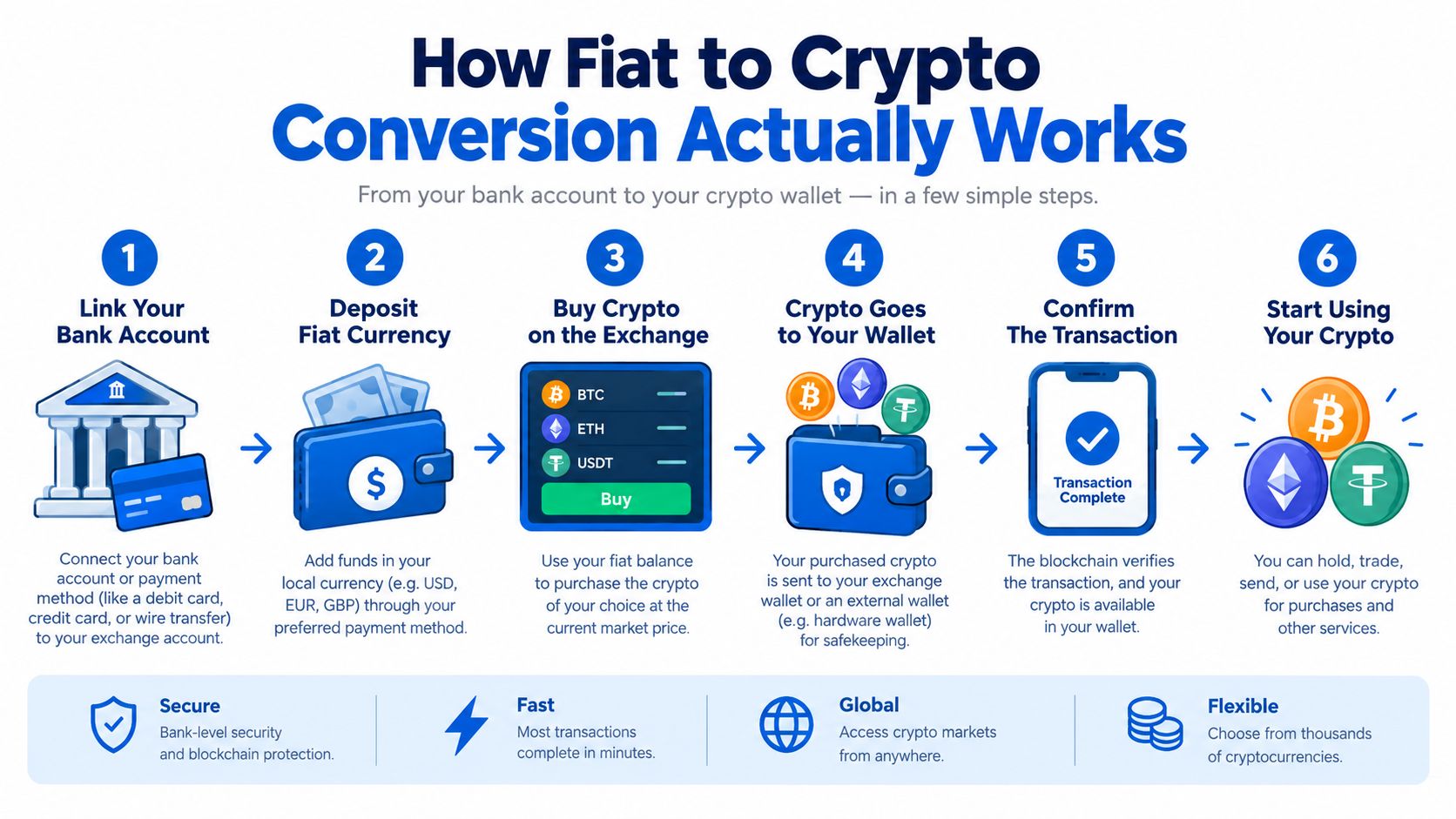
Two networks are involved
One network is traditional finance. That includes ACH, wires, SWIFT, local bank transfers, and card schemes.
The other network is blockchain settlement. That includes the wallet, the asset, and the chain where the funds will land.
Between them sits an on-ramp. The on-ramp accepts fiat, applies pricing, sources liquidity, performs compliance checks, and delivers crypto to the destination wallet or account.
The simple mental model
Here's the flow in plain language:
- Your business sends fiat from a bank account or card.
- The provider receives and verifies funds.
- Pricing is determined, often using a market rate plus spread and any method-specific fees.
- Liquidity is sourced so the provider can fill the order.
- The crypto asset is delivered to a hosted account or external wallet.
- Your team reconciles the movement across bank records and wallet activity.
That's why an internal treasury process matters as much as the exchange rate.
Practical rule: Treat conversion as a payment workflow with an FX layer, not as a trading action with a wallet attached.
Why stablecoins often sit in the middle
Businesses often use stablecoins as the bridge asset because they reduce one layer of volatility. If your vendor wants crypto but your treasury still thinks in fiat terms, a dollar-linked stablecoin is easier to budget, approve, and reconcile than a volatile token.
You'll also notice that teams operating across both systems often need process discipline before they need more providers. A clean account structure, approval matrix, and documented wallet mapping help more than one extra app. If you're sorting out those foundations, this business bank account setup guide for fiat and crypto integration is a useful operational reference.
Main Methods to Convert Fiat to Crypto Compared
Three methods handle most business conversion needs. Centralized exchanges, OTC desks, and embedded on-platform conversion all solve the same core problem, but they do it with different trade-offs.
Centralized exchanges
This is the default path for many startups. The exchange accepts fiat deposits, offers a trading venue, and lets the company buy the asset directly.
That setup works well when the finance team wants a broad asset menu and is comfortable managing exchange operations. The trade-off is operational overhead. Someone has to manage deposits, execution, withdrawals, wallet whitelists, approvals, and reconciliation.
OTC desks
An OTC desk is usually better for larger or more sensitive conversions where the business wants hands-on execution and less market signaling. Instead of hitting a public order book the same way a retail user would, the company requests a quote and settles under negotiated terms.
This can simplify large treasury moves. It can also add process friction because quote requests, confirmations, and settlement instructions often involve more coordination.
Embedded on-platform conversion
Some finance platforms let the business fund an account in fiat and convert inside the same operating environment. For a payments team, this is often the most practical route because the conversion sits close to treasury, approvals, and payout workflows.
The main benefit is fewer handoffs. The main limitation is that the business may have a narrower asset set or a more workflow-driven experience than a trading-focused one.
Fiat to Crypto Conversion Methods Compared
| Method | Best For | Settlement Speed | Cost Structure |
|---|---|---|---|
| Centralized exchange | Teams that want direct market access and broad asset availability | Varies by fiat funding method, trading execution, and withdrawal timing | Usually a mix of trading fees, spread, and withdrawal-related costs |
| OTC desk | Larger treasury moves and orders where execution handling matters | Often coordinated case by case | Usually quote-based, with pricing embedded in the negotiated rate |
| Embedded on-platform conversion | Finance teams that want conversion tied to payments and approvals | Often streamlined because banking and crypto steps sit closer together | Usually combines platform pricing with fiat rail and settlement costs |
How finance teams usually choose
Use these decision criteria:
- Transaction size matters: Larger tickets often justify OTC coordination.
- Workflow matters more than theory: If the team is doing routine operational payments, embedded conversion usually reduces back-and-forth.
- Custody handoff matters: Ask where assets sit before and after the trade, and who controls release.
- Audit trail matters: Treasury teams need a clear chain from bank movement to wallet delivery.
A lot of confusion comes from comparing these methods as if they were only price quotes. They're also different operating models.
Timing Settlement and Liquidity Behind Every Conversion
A quote can look fine and still fail the business need if the money arrives too late.
That's because fiat to crypto conversion has two clocks running at once. The bank rail has its own schedule, cutoffs, and review windows. The blockchain rail keeps moving after banking hours and through weekends. Treasury risk lives in the gap between those clocks.
Why settlement timing changes risk
If your team initiates a bank-funded conversion and the fiat leg takes time to clear, the company stays exposed to timing uncertainty. The vendor still hasn't been paid. The wallet still isn't funded. If the underlying asset target is volatile, the team may also face pricing drift between approval and usable settlement.
Near-instant stablecoin conversion changes that equation. Once fiat is accepted and the conversion executes, the business can often move into a payment or treasury action without waiting for the next banking window.
The practical question isn't “is instant faster?” It's “does instant reduce the period where my obligation exists but my funds aren't yet usable?”
Liquidity depth matters too
Large conversions don't just depend on speed. They depend on whether the provider can fill the order cleanly.
If a company needs to move meaningful size, shallow liquidity can widen the effective execution price. That's why treasury teams should care about how a provider sources liquidity, whether execution happens through an order book or quote engine, and how much slippage can appear for larger tickets. For a plain-English refresher, this guide to crypto liquidity in 2026 is helpful.
A short explainer helps here:
What stablecoin-heavy flows are changing
Operationally, stablecoins are taking a bigger role in on-ramp activity. A 2026 industry report cited in Ramp's stablecoin accounts announcement says stablecoins rose from 43% to 60% of on-ramp volume in six months. The same release also points to product demand for 24/7 conversion and settlement, including fee-free USD-to-stablecoin conversion and business stablecoin accounts.
For businesses, that shift matters because treasury movement is becoming less tied to the old “buy crypto” framing and more tied to moving working capital on always-on rails.
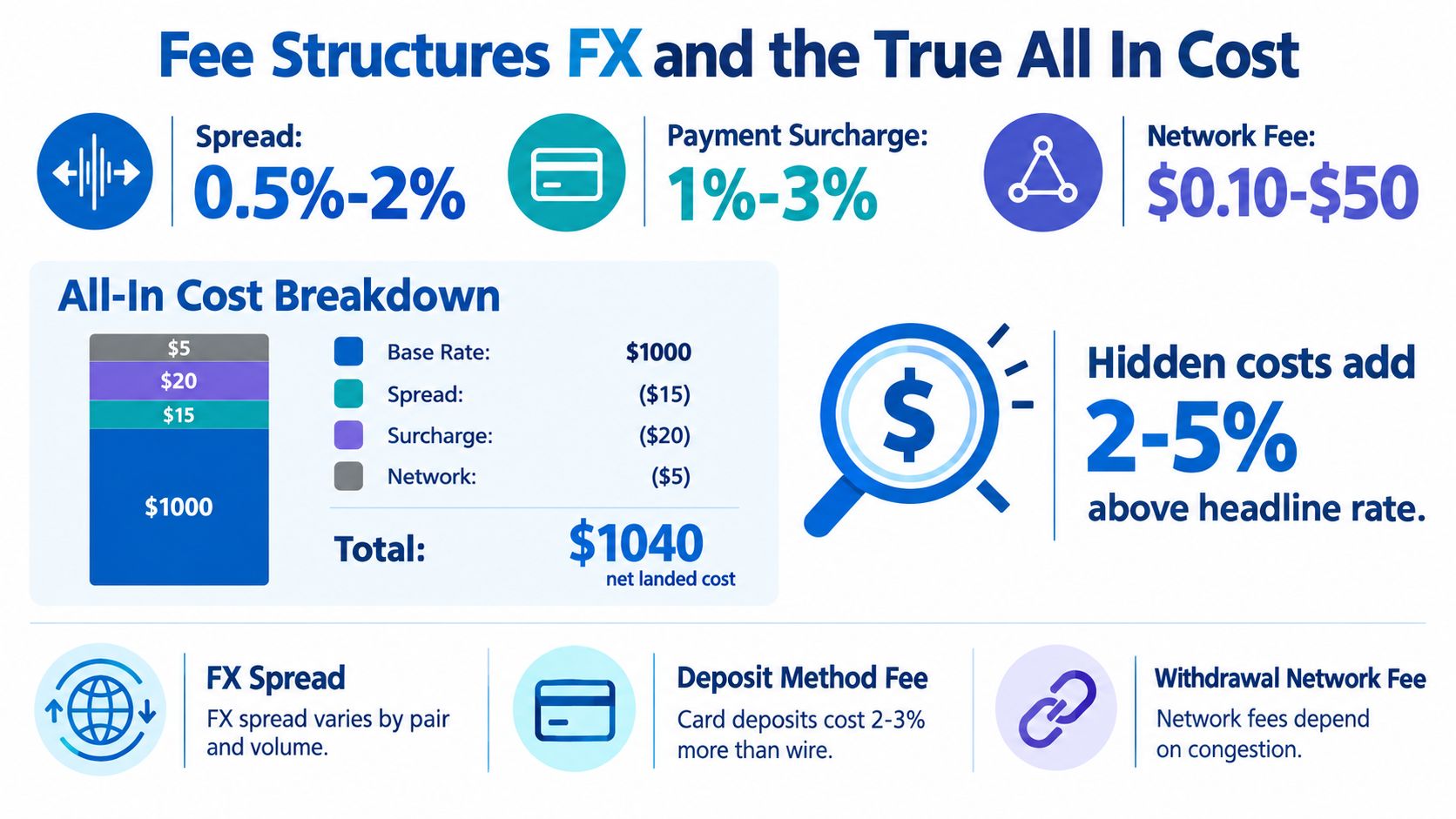
Fee Structures FX and the True All In Cost
The wrong first question is often asked.
They ask for the conversion fee. They should ask for the all-in landed cost by currency, funding rail, asset, and settlement path. That's the number that hits treasury.
Headline fees rarely tell the whole story
The cost stack usually includes several layers:
- Payment method fee: Bank transfers and card payments don't cost the provider the same amount.
- Spread: The quoted rate may sit away from the market midpoint.
- Service markup: Some providers add a platform or convenience margin.
- Network fee: The final asset delivery may add blockchain transfer cost.
Independent fee guidance summarized in Ramp's overview of stablecoin payment economics notes that payment-method fees can range from 0% for bank transfers to up to 5% for card payments, service markups can run from 1% to 8%, and spreads often add another 0.5% to 5%. The same source also notes that recent comparisons show card fees as high as 4.5% to 5.5% plus fixed minimums, while bank-transfer fees can still reach 1.4% to 2.4% depending on method and region.
That's why the posted “rate” often understates what the business pays.
Rail choice changes the cost curve
Rail dependency is one of the clearest patterns in the market. Independent industry analysis shows that bank-transfer-funded on-ramps commonly price in the 0.5% to 1.5% range, while card-funded flows are typically 2.5% to 5.5% blended because card interchange, fraud risk, and chargeback exposure add cost layers. The same analysis notes that hosted card widgets can push all-in FX and spread costs to 8% or higher, while direct-access SEPA can fall to roughly €0.10 to €0.50 per transaction with lower wholesale economics in some cases, according to Jagelski's breakdown of crypto-fiat settlement rails.
For a finance team, the lesson is simple. The more your flow depends on card networks and embedded FX, the more margin gets eaten by fees and spread. Direct bank rails usually compress cost because there are fewer intermediaries.
A practical way to compare quotes
Ask every provider for the same inputs:
- Funding method used on the fiat side
- Quoted asset amount delivered at the end
- Spread treatment and whether it's shown separately
- Network delivery assumptions including chain and wallet destination
- Settlement timing from debit to usable funds
Then compare on landed value, not marketing labels.
Regulatory Custody and Operational Controls to Know
The hard part of fiat to crypto conversion often isn't the trade. It's everything around the trade.
A corporate user is usually onboarding into a compliance workflow, a custody model, and an internal control system at the same time. If one piece is weak, the transaction may still execute, but the business creates audit, legal, or operational risk.
What providers will usually ask for
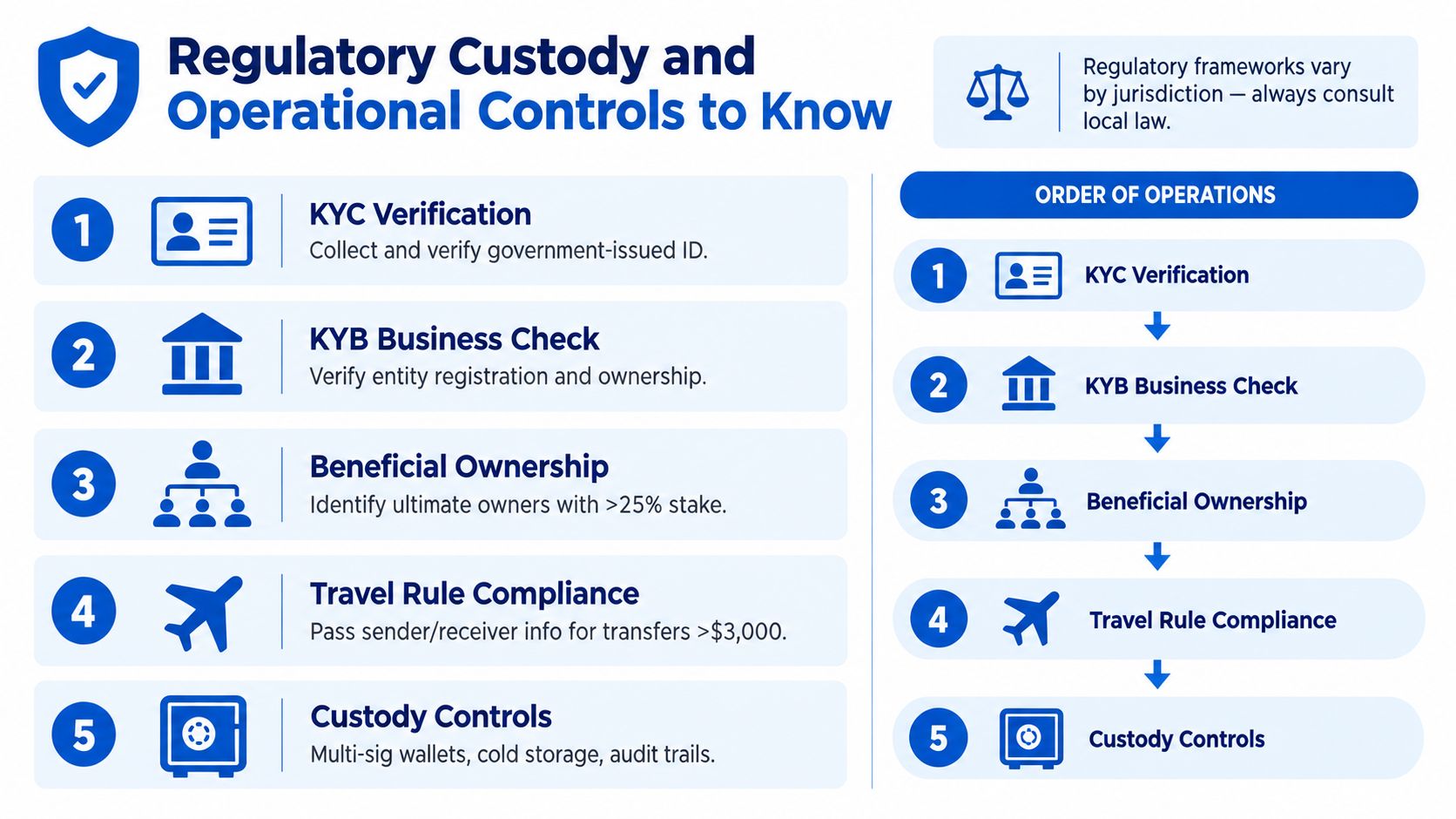
Global 2026 guidance highlighted in the earlier market discussion points to a standard baseline for business on-ramps: KYC, beneficial-ownership checks, Travel Rule recordkeeping, sanctions screening, and continuous transaction monitoring. Those are no longer edge requirements for unusual cases. They're standard expectations for many corporate flows.
That means your finance team should prepare entity documents, ownership information, wallet purpose details, and transaction context before trying to move urgent funds.
The controls that matter inside the business
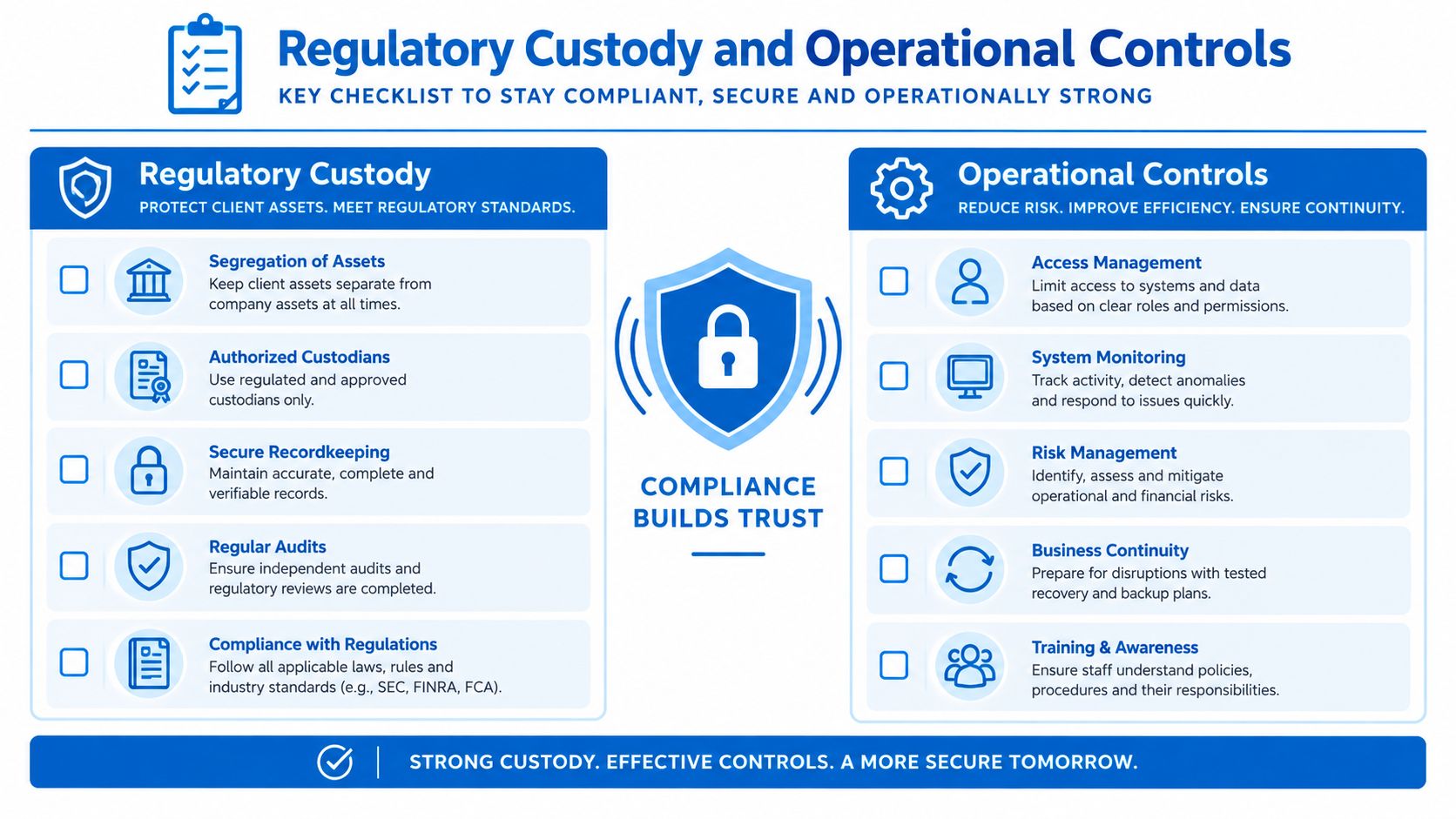
A provider can run checks on its side, but your company still needs internal controls:
- Role separation: The person requesting a conversion shouldn't always be the only person approving it.
- Wallet governance: Approved destination wallets should be documented and reviewed.
- Policy controls: Set thresholds for who can move what, and under which use case.
- Audit trail retention: Keep the approval, quote, execution record, and settlement evidence together.
Operator's checklist: If you can't explain who approved the conversion, where the funds landed, and why that wallet was allowed, your process isn't finished.
Teams that are building formal oversight around these workflows often use dedicated governance tools. A product category like a FinTech GRC platform can help centralize policy, controls, and evidence collection around regulated finance operations.
Custody and onboarding questions worth asking
For digital asset handling, ask how the provider secures assets, what approval controls exist, and whether multi-factor authentication is mandatory. For onboarding, ask what documents are required, how beneficial owners are verified, and how transaction monitoring affects ongoing use.
If your team wants a plain-language reference for those screening requirements, this guide to AML and KYC procedures for financial operations covers the basics in business terms.
How OneSafe Handles Near Instant Fiat to Crypto Conversion in Practice
Here's what this looks like when the treasury workflow is built into the operating account.
A business funds a multi-currency account through ACH, domestic wire, or SWIFT. From there, it can convert fiat into USDC with near-instant execution inside the same environment, then use USDC rails for payments, invoicing, or treasury movement. That setup is useful when the company wants fewer handoffs between its bank operations and crypto operations.
What the workflow looks like day to day
The practical sequence is straightforward:
- Fund the account in fiat: Treasury brings in USD, EUR, CAD, or other supported business funds through standard banking rails.
- Convert when the obligation appears: Instead of pre-positioning crypto too early, the team can convert close to payment time.
- Settle on USDC rails: That helps when a vendor, DAO contributor, or partner wants digital-dollar settlement outside banking hours.
- Reconcile in one place: Finance can line up fiat funding, conversion, and payment records without switching across multiple systems.
The details finance teams usually care about
From the published platform details, OneSafe supports free USDC deposits and withdrawals, multi-currency business accounts, global payments, and corporate cards. It also publishes 0.25% FX pricing for foreign exchange, supports exchange-partner routing for conversion and rate optimization, and notes that onboarding and KYB typically complete in about a week.
It also includes operational controls that matter for treasury teams, such as policy-based approvals, roles, spend limits, and Fireblocks-based digital asset custody with mandatory MFA. For a DAO treasury or a global startup paying contractors, that combination matters more than a flashy buy button. It connects approval, funding, conversion, and payout into one operating path.
The broader market backdrop supports why this category matters. One neutral market estimate summarized by DataIntelo valued the global crypto on-ramp market at $8.4 billion in 2025 and projected $34.6 billion by 2034, implying a 17.0% CAGR, with the fiat-to-crypto segment holding 67.3% of revenue in 2025, or about $5.7 billion. A separate estimate in the same summary put the broader on-ramp and off-ramp solutions market at $5.9 billion in 2025, with fiat-to-crypto at 52.3% share and Asia Pacific at 38.2% of revenue, according to DataIntelo's crypto on-ramp market report summary.
If your team needs business accounts, cross-border payments, cards, and crypto-compatible treasury rails in one workflow, OneSafe is built for that operating model. It gives finance teams a practical way to fund in fiat, convert near instantly when needed, and settle through stablecoin or banking rails without stitching together separate tools.