You're at the end of the month, and the books still don't feel settled. One bank feed has cleared, the corporate card file has a few odd timings, a SWIFT receipt landed after cut-off, and a crypto inflow shows up in the wallet before the fiat side catches up. The numbers may be close, but close isn't enough when you're signing off a close for multiple entities and currencies.
General ledger reconciliation is the control that turns that pile of moving pieces into a clean, reviewable balance. It compares what the general ledger says with the source records that support it, then forces the team to explain every gap before the books are final. If you've ever needed a plain-language reminder of the related control around restricted balances, the Alignmint glossary entry on reconcile restricted funds is a useful companion reference.
Table of Contents
What General Ledger Reconciliation Really Means
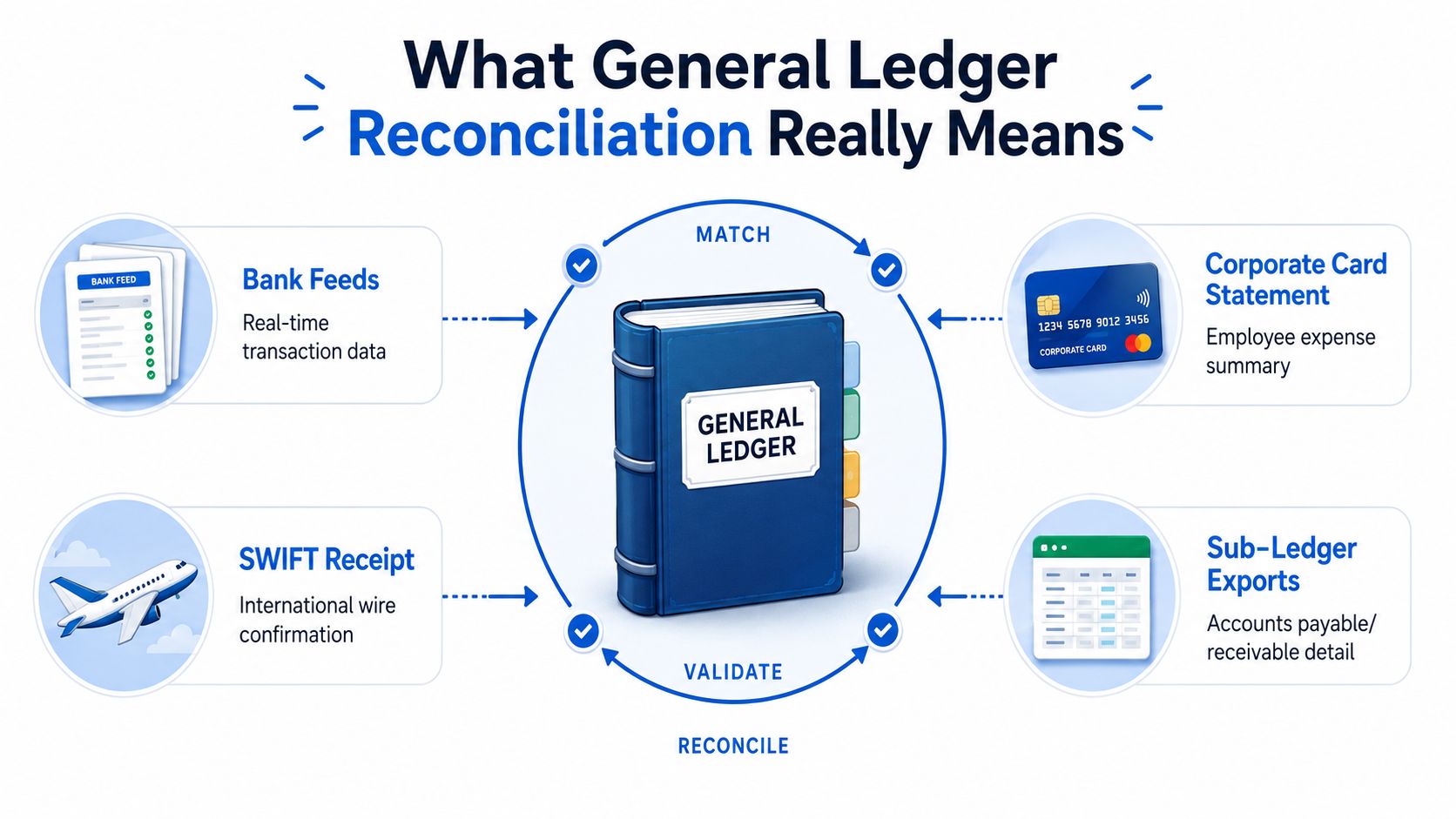
At its simplest, general ledger reconciliation is the habit of checking whether the balance in the ledger matches the independent records that support it. Those records might be a bank statement, a subledger export, a vendor invoice, a processor report, or a wallet transaction file. If the two sides don't agree, someone has to prove whether the gap is a timing issue, a coding error, or a real adjustment.
A good mental model is a receipt check at the end of a grocery run. You don't trust the cart total just because the cashier printed it, you compare it to the receipt and your own memory of what should be there. In finance, the ledger is the printed total, and the source record is the receipt.
What the ledger is really doing
The ledger is the master record, but it's only as reliable as the discipline around it. Reconciliation is what keeps it honest, because it tests the summary balance against evidence from outside the summary. That's why teams use it on cash, receivables, payables, payroll, intercompany accounts, and any balance where a mistake can sit undetected for weeks.
A finance lead usually feels the need for this control right before close. One entity has a bank feed, another has a card statement, a third has a SWIFT receipt, and the digital asset wallet says one thing while the subledger says another. The ledger may already be “booked,” but until those items tie out, the close isn't really done.
Practical rule: if a balance can move, settle later, or be recorded in another system first, it needs a reconciliation trail.
General ledger reconciliation is not bookkeeping itself. Bookkeeping records the transaction. Reconciliation checks that the record survived the trip across systems without being lost, doubled, delayed, or misclassified. It's also different from auditing, because auditing is the independent review of your control, while reconciliation is the control you run inside the business every period.
Why Reconciliation Is a Core Accounting Control
Reconciliation serves three jobs at once. It validates account accuracy, it catches errors and fraud before financial statements go out, and it creates a paper trail that a reviewer can follow without guessing. That's why public-sector guidance treats it as a recurring control, not an occasional cleanup task.
Washington State's reconciliation procedure is a good example of the discipline. It requires teams to run the general ledger report after the fiscal month closes, compare ending balances to supporting documentation, document reconciling items, and send the work for reviewer approval. That flow makes reconciliation part of close governance, not a side project.
The cadence matters as much as the method. Sage advises that reconciliation should happen at least annually, but preferably monthly or quarterly. In practice, that guidance fits how most finance teams manage risk, because waiting too long makes every discrepancy harder to explain and every reviewer question harder to answer.
Why the cadence changes behavior
A recurring schedule forces the team to deal with small exceptions while the evidence is still fresh. It also gives managers a repeatable checkpoint for approvals, rather than a one-time scramble when auditors ask for support. When the same account is reconciled consistently, patterns become visible, and bad coding habits stop hiding inside the general ledger.
For a multi-entity business, this control also protects the close calendar. Each entity may have different payment rails, different local bank statements, and different currency effects, but the reconciliation expectation stays the same. That consistency is what lets a controller compare one entity's close discipline against another's.
Bottom line: the purpose isn't to make the books look neat. It's to prove they deserve to be signed off.
For teams that want a related control example, the account payable audit guide at OneSafe's overview of accounts payable audit controls is a useful comparison point. It sits next to reconciliation in the same control family, because both depend on evidence, approval, and traceability.
The Reconciliation Process From Start to Finish
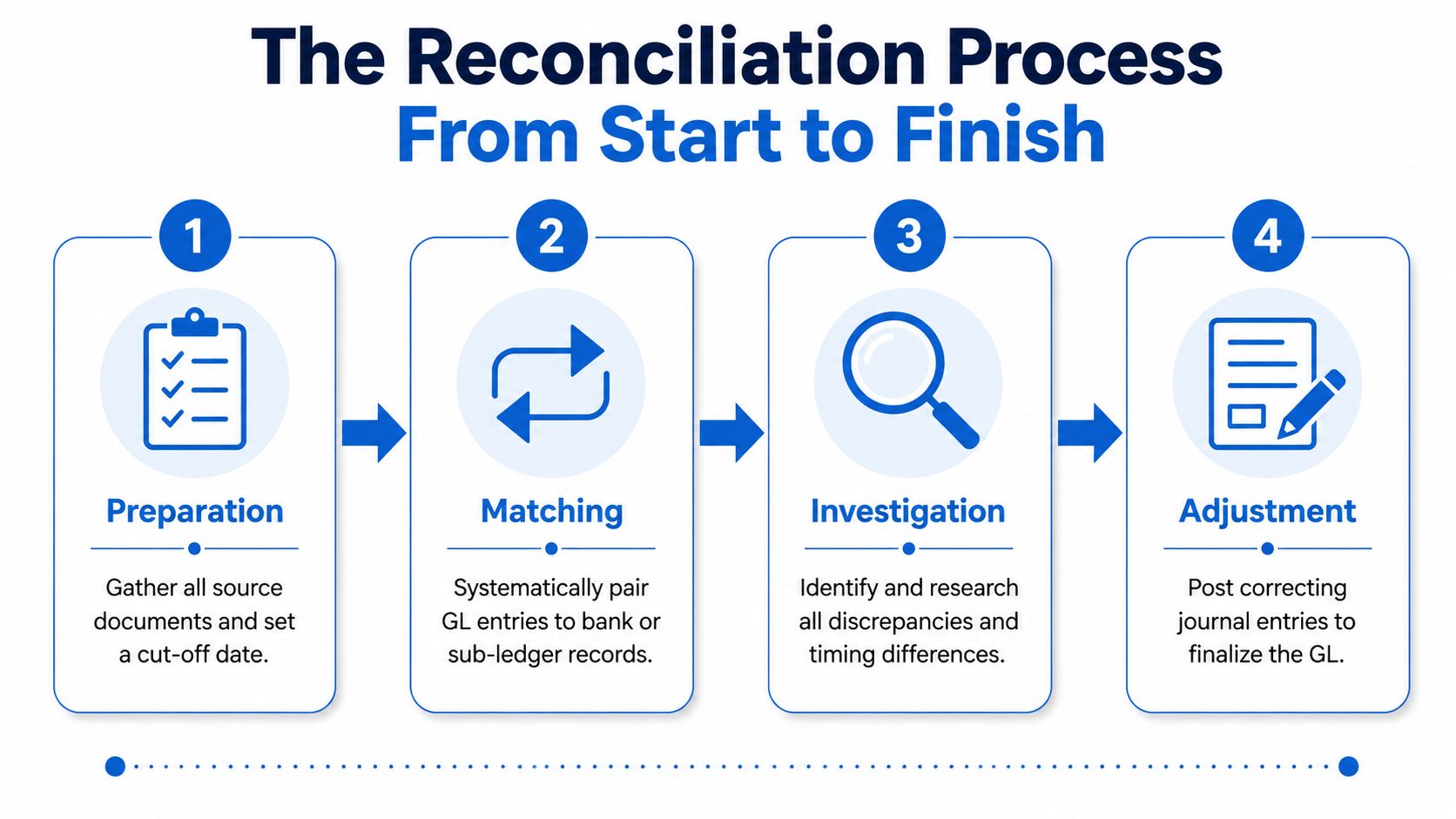
The cleanest way to think about reconciliation is as a short workflow with a fixed order. You gather the records, compare them, investigate anything that doesn't line up, and post corrections only after the mismatch is understood. That sounds obvious, but teams often reverse the order and start adjusting before they've proven what went wrong.
Step 1 through step 4 in plain English
Start with source documents. A bank statement, a subledger trial balance, or a vendor invoice report gives you the outside record you'll compare against the ledger. Without that package, the rest is guesswork.
Then move into matching. Compare the control account in the GL with the source total line by line if needed. If the amounts tie, document the tie-out and move on. If they don't, isolate the break instead of widening the search.
Investigation is where judgment matters. Some gaps are timing differences, like a transfer that posted in one system before another. Others are true errors, such as a duplicated journal entry or a transaction booked to the wrong account. That distinction keeps teams from posting unnecessary corrections.
Finally, post adjusting entries only when the evidence supports them. If a wire arrived late, that's not the same thing as a missing receipt. If a processor fee was booked to the wrong expense code, it does need a correction, and the memo should explain why.
A useful operational anchor here is the 6-hour median APQC benchmark cited by CFO for the reconciliation phase itself, not the full close (CFO's benchmark article). That matters because teams often assume reconciliation should be a quick glance. In reality, the comparison, research, and documentation can take a real block of time even before the close work around it is counted.
A reconciliation that ends in a journal entry without a clear explanation usually needs a second look, not a faster reviewer.
For teams pulling data from commerce systems, Amazon SP API financials data can be part of the source package when seller activity feeds into the ledger. The point isn't the tool itself, it's that the supporting data has to be traceable back to the control account.
Common Reconciliation Issues and How to Fix Them
Most reconciliation problems fall into a small number of buckets. The trick is not to memorize every possible anomaly, but to learn how each one behaves. Timing differences clear on their own. Missing items need evidence. Duplicates need proof of repetition. Misclassifications need a correction path.
The patterns that show up most often
| Issue | Symptom | First Fix |
|---|---|---|
| Timing difference | The ledger and source file differ, but the item appears to be in flight | Confirm cut-off, then document when each system should recognize it |
| Duplicate posting | One amount appears twice in the GL or supporting record | Trace the duplicate source and reverse the extra entry |
| Missing transaction | The source record exists, but the GL balance doesn't include it | Check feed timing, import logs, and posting status |
| Misclassification | The amount exists, but sits in the wrong account or entity | Reclassify to the correct account and explain the coding error |
| Unexplained fee | A processor or bank charge appears without detail | Pull the fee schedule, settlement advice, or processor report and attach it |
What the support file should say
A strong reconciling item reads like a short case note. It names the item, the amount, the source document, and the reason it isn't adjusted yet, or the journal entry that fixed it. That keeps the reviewer from having to reconstruct the logic from scratch.
If a bank fee lands with no narrative, the support package should include the bank statement, the fee notice if available, and the ledger line where it was booked. If a transfer cleared in one entity but not another, the memo should say which entity booked first and why that timing difference is expected. Those details matter more than polished language.
Useful habit: write the explanation as if someone else will need to defend it in six months, because they probably will.
A lot of recurring errors come from the same source, broken handoffs between systems and teams. Commerce feeds, AP imports, payroll exports, and payment processors each have their own timing and naming rules. Reconciliation catches the mismatch, but only if the team documents enough detail to make the root cause visible.
Automation and Tooling Best Practices
Manual spreadsheets still work, but they don't scale gracefully when the business grows across entities, currencies, and payment rails. The better question is not whether to automate, but where automation should stop and human review should begin. That's the logic behind exception-based workflows.
What good automation actually does
A useful tool matches obvious items automatically, keeps a trace of who approved what, and flags only the exceptions that need judgment. It also preserves attachments, comments, and adjustment history so the reviewer doesn't have to hunt through email threads later. If the software just stores a spreadsheet in a prettier interface, it hasn't really changed the control.
Materiality thresholds matter here, because not every reconciling item deserves the same treatment. Teams increasingly want the system to move clean items through quickly while surfacing only the items that exceed policy or look unusual. That creates a better review queue and reduces the chance that people stop looking closely at the hard cases.
OneSafe is one option for teams that need both banking and crypto-linked operations in one place. Its product set includes multi-currency business accounts, global payments, corporate cards, and crypto-compatible features such as USDC deposits and withdrawals, which can matter when reconciliation spans fiat and digital asset activity.
What to compare before you buy
- Audit trail depth: Can the system preserve source documents, comments, approvals, and versions together?
- Role controls: Can preparers and reviewers be separated cleanly?
- Exception handling: Does the platform show why an item failed to match, or only that it failed?
- Data connections: Can it pull from ERP, banking, subledger, and payment sources without heavy manual export work?
- Entity structure: Can it keep intercompany and multi-entity records separate enough for review?
A tool earns its keep when it shortens the time spent hunting for support and increases the time spent on judgment. That's especially true for teams closing across several subsidiaries, where one reconciliation may need local evidence, central review, and a clean audit trail in the same file.
For a related example of automated payment and invoicing flow, OneSafe's crypto invoicing guide shows how payment automation starts to intersect with reconciliation requirements once digital asset settlement enters the process.
Multi-Currency, Global, and Crypto Reconciliation
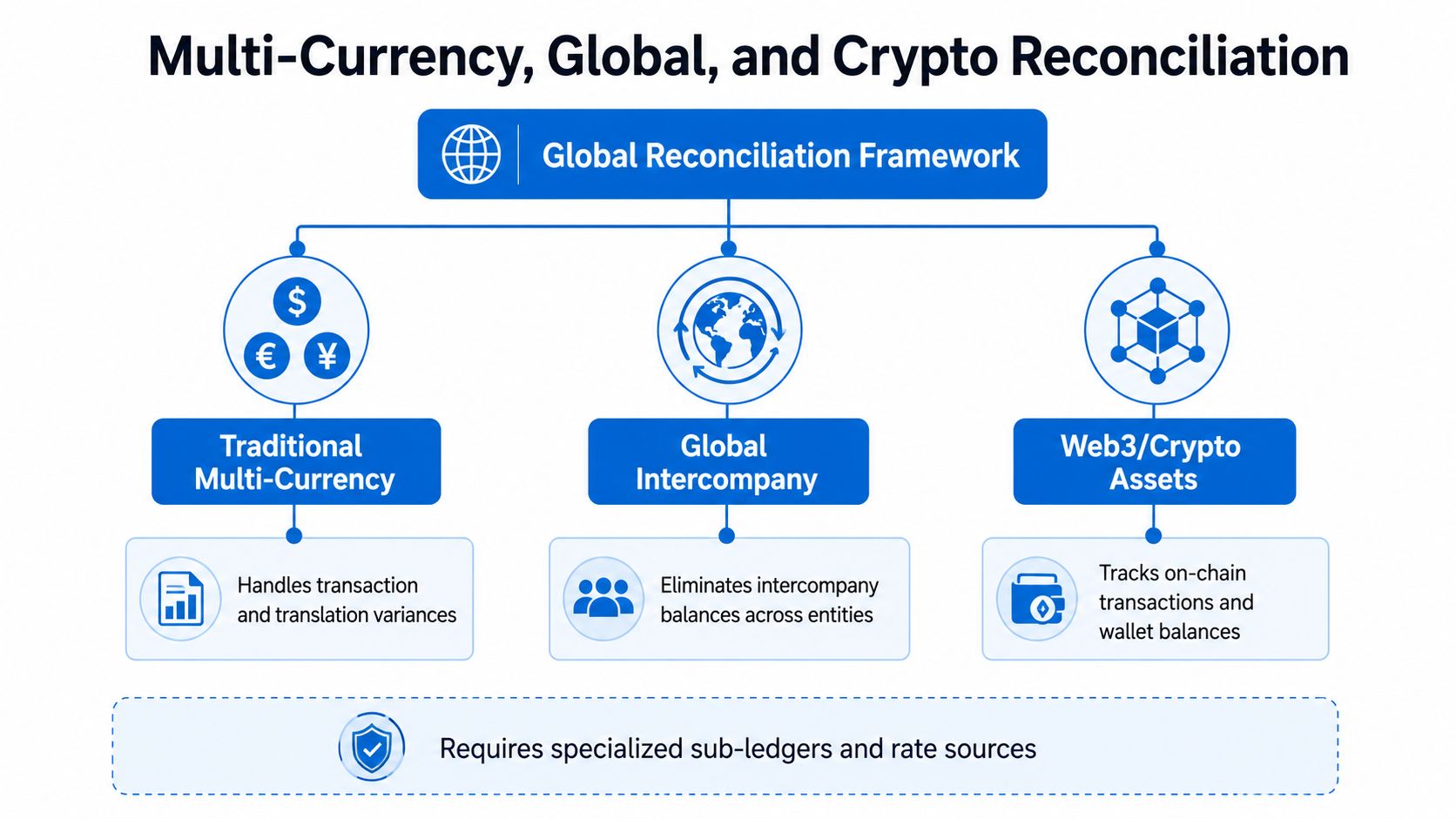
Standard checklists start to fray when a balance can be “right” in one currency and wrong in another, or correct on-chain but not belong to the right legal entity. Reconciliation in a global business must answer more than “does the amount match?”
Three questions every global recon has to answer
First, what currency is being tested. A USD-denominated control account may include activity that originated in EUR or GBP, so the team has to check both the transaction amount and the translation logic. Second, what date governs valuation. FX remeasurement belongs to the correct valuation date, not whichever date is easiest to pull from the report. Third, which entity owns the balance. Intercompany activity can look fine in aggregate while still sitting in the wrong subsidiary.
In stablecoin and crypto flows, settlement timing can create a clean ledger mismatch that isn't an error. A deposit might appear on-chain before it settles in the off-chain treasury system, or the reverse may happen depending on the rail. That means the recon memo has to distinguish between confirmed movement and posted accounting recognition.
Where standard checklists fall short
Traditional guides usually stop at bank statements and subledgers. They don't tell you how to document an on-chain transaction, how to treat wallet balance changes that bridge into fiat, or how to compare activity across DAOs and operating entities. That gap is why globally operating SMEs and web3 teams need a more explicit framework.
The core control still looks familiar, but the evidence changes. You may need a wallet export, an exchange statement, a SWIFT confirmation, a local bank record, and an internal subledger all in the same support package. The reconciliation itself becomes a map of what settled where, in what currency, and for which entity.
Rule of thumb: if the business can move value across rails, the reconciliation file has to show the route, not just the end balance.
OneSafe's multi-currency business accounts are relevant here because multi-currency settlement and crypto workflows need a place to land before they can be reconciled cleanly. That doesn't remove the control work, but it can reduce the number of handoffs the finance team has to trace.
A Practical Monthly Checklist and Quick Answers
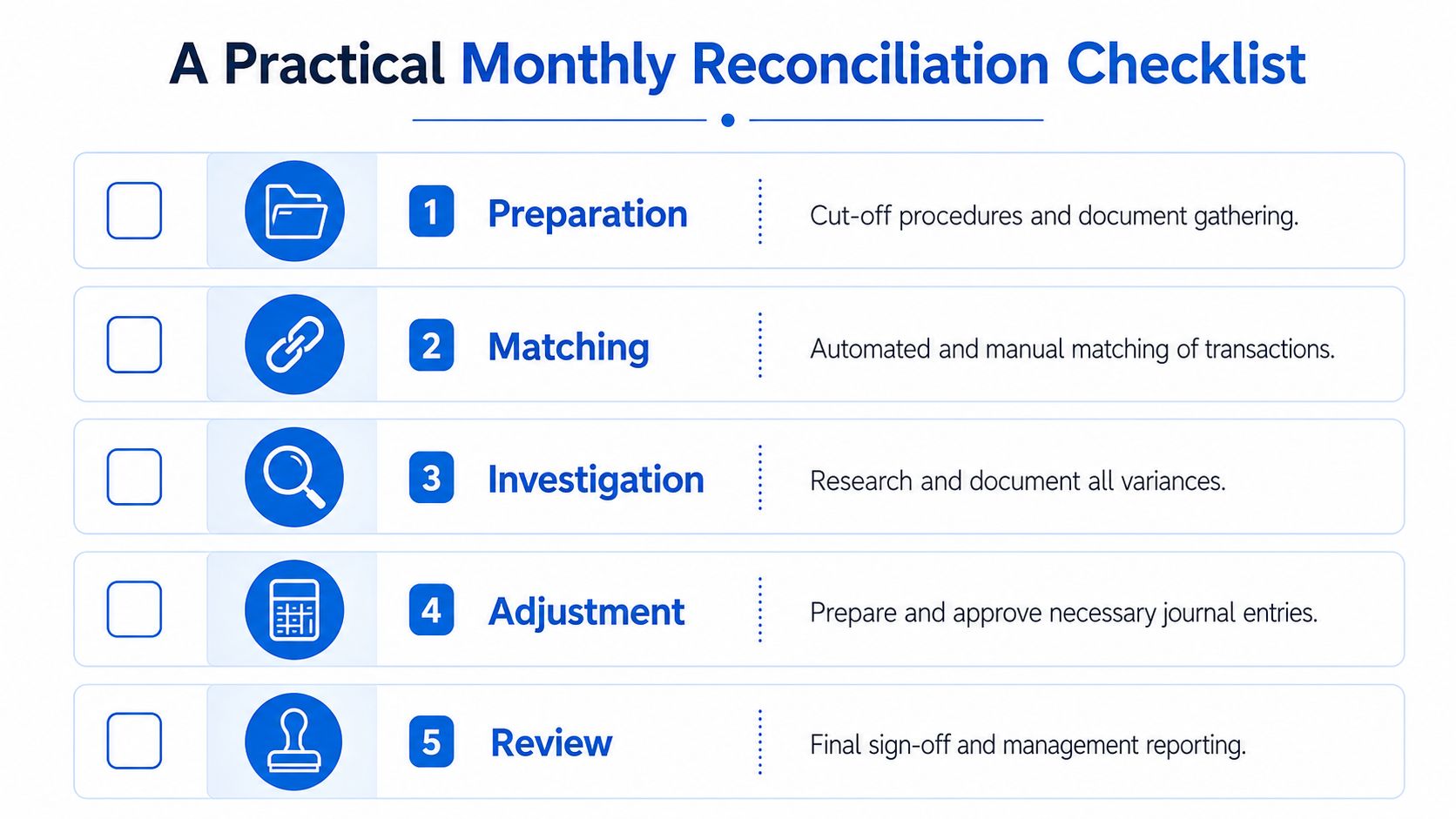
A good monthly routine doesn't need to be complicated. It needs to be repeatable enough that a new team member can run it, and strict enough that a reviewer can see what happened without asking for a second explanation. The checklist below keeps the work in order.
Monthly checklist
- Preparation. Lock the cut-off, pull the bank files, subledger exports, wallet reports, and invoices, and make sure the source package is complete.
- Matching. Tie the GL to the source records, using automation where it helps and manual review where it doesn't.
- Investigation. Separate timing differences from true errors, then document the cause clearly.
- Adjustment. Prepare only the correcting entries that evidence supports, and route them through approval.
- Review. Check the final support, sign off the account, and keep the file ready for management or audit review.
Quick answers finance leads usually ask
How often should you reconcile? Monthly is the practical cadence, with some items reviewed more often and lower-risk items handled less frequently. The governing principle is to reconcile often enough that the team can still explain the gap.
When should a reconciling item be escalated? Escalate when the item doesn't clear within the expected timing window, when the source document is missing, or when the amount is unusual enough to affect review judgment.
What does materiality threshold mean in practice? It's the point where a difference becomes large enough, or risky enough, that the team can't just note it and move on. The threshold should be tied to policy and review discipline, not convenience.
How do you reconcile fiat and stablecoin balances together? Start by separating the rails, then reconcile the off-chain bank or treasury record to the on-chain record and the GL, making sure the valuation date and entity ownership are clear.
If you run this routine every month, the work stops feeling like a fire drill and starts acting like a control. That's the difference between a close that merely happens and a close that can stand up to review.
If your team is juggling multi-entity books, mixed currencies, and crypto-linked settlement, OneSafe can be part of the operating stack that keeps those flows organized. Explore how its multi-currency accounts, payments, cards, and crypto features fit into a finance workflow at OneSafe.