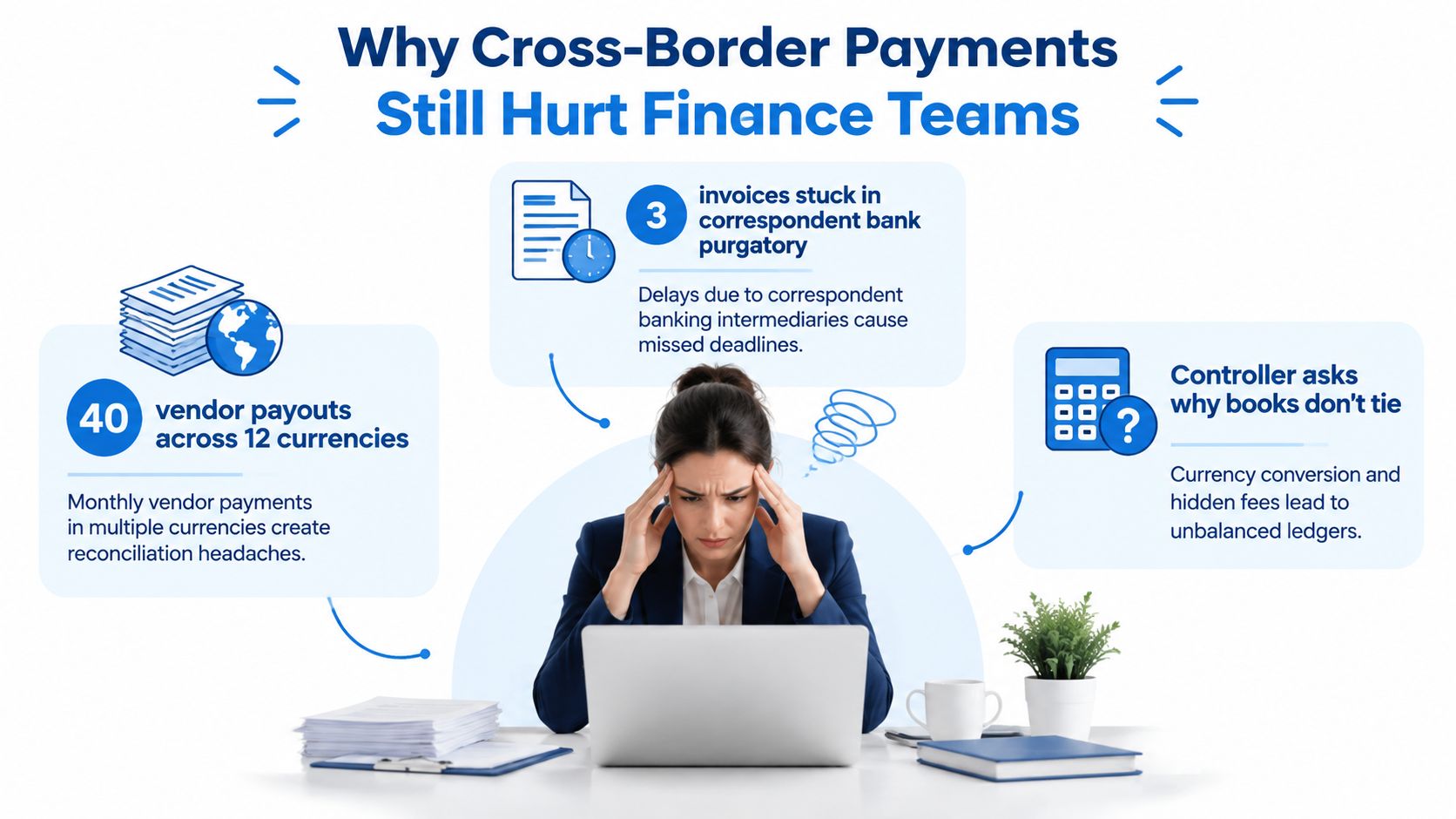
Month-end is closing, and your finance lead is juggling 40 vendor payouts across 12 currencies. Three invoices are sitting in correspondent-bank limbo, the payment-status screen gives you little useful information, and the controller wants to know why the ledger doesn't tie. The visible wire fee is the easiest part of the problem.
For companies managing global payments for business, the expense sits across fragmented bank portals, manual invoice matching, opaque FX pricing, returned payments, trapped liquidity, and exception queues. A fast rail can still produce a costly process if your team spends hours proving where money went. This guide gives you a practical framework for choosing payment rails, measuring landed cost, and reducing the operational work behind every international transfer. For more background on the mechanics of B2B transfers, see this guide to B2B cross-border payments.
Table of Contents
Why Cross-Border Payments Still Hurt Finance Teams
A supplier payment can leave your account within minutes and still create hours of finance work. The beneficiary may receive less after intermediary deductions, the remittance reference may change, and the invoice may remain unmatched. Your accounting team then checks several portals to confirm settlement while treasury explains a discrepancy created outside its own system.
For companies managing global payments for business, the visible transfer fee is only one part of the cost. Fragmented bank portals, manual invoice matching, opaque FX spreads, returned payments, trapped liquidity, and exception queues consume staff time. A faster rail can therefore cost more overall if your team must investigate every payment that fails to reconcile. This guide provides a framework for choosing rails, measuring landed cost, and reducing the work behind each international transfer. For background on B2B transfer mechanics, see this guide to B2B cross-border payments.
The volume and currency mix make control harder. An IMF analysis found that combined traditional and crypto-related cross-border flows approached about US$1 quadrillion in 2024. Financial-institution payments accounted for 80% of Swift customer and financial-institution related payments that year. The US dollar represented 53.4% of financial-institution flows and 55.1% of customer flows, while the dollar and euro together represented more than 70% of financial-institution payments and more than 80% of customer payments (IMF analysis of cross-border payments). Concentration in a few major currencies can simplify selected corridors, but it does not remove intermediary, settlement, or local-rule problems.
Start with the payment journey
Map every payment from invoice approval through ledger posting. Record the funding account, sending currency, conversion point, rail, intermediary path, beneficiary currency, confirmation method, and reconciliation result. The map shows exactly where work and failures enter the process.
Classify the friction:
- Execution friction: Manual entry, repeated approvals, and portal handoffs slow release.
- Pricing friction: The quoted fee excludes the FX spread or intermediary deductions.
- Information friction: The team cannot see status, settlement details, or rejection reasons.
- Accounting friction: The payment lacks structured data for automatic matching.
The BIS reported that sending US$200 across borders cost a global average of US$12 in 2024, or 6%, down from US$18, or 9%, roughly 20 years earlier, while transfers could still take multiple days (BIS cross-border payments monitoring). That average does not describe your landed cost. High-value supplier payments, difficult FX conversions, and recurring exceptions can make staff time and failed-payment handling more expensive than the quoted fee.
Treasury rule: Measure reconciliation, failed payments, and trapped cash before optimizing the transfer fee.
Use a simple sequence. Classify flows by urgency, value, currency, and corridor. Select the rail that fits each job. Calculate landed cost, including FX and staff effort. Then put the decision into a payment policy so every payment run follows the same logic.
The Core Payment Rails Every Business Should Know
Payment rails aren't interchangeable. Each one solves a different part of the movement from payer to beneficiary.
ACH works like a batched courier. It groups domestic debits and credits and processes them through a bank network rather than sending each transfer as an individually handled urgent item. It's usually suited to recurring domestic supplier payments, payroll-related flows, and routine payouts where immediate settlement isn't necessary.
Domestic wires resemble registered mail for high-value transfers. They're designed for urgency and finality within a supported domestic banking system. Use them when the payment is material, time-sensitive, or operationally important enough to justify a higher explicit fee.
SWIFT is a messaging network, not a single settlement account. Banks use it to exchange payment instructions across corridors where they don't have a direct relationship. Correspondent banks may then handle the actual movement of funds, which can add time, deductions, and investigation work.
FX is the conversion layer above the rail. A provider can advertise a low transfer fee while earning revenue through the exchange rate. The number that matters is the rate your company receives compared with the relevant mid-market reference, alongside any separate conversion charge.
Crypto rails, especially USDC on supported public blockchains, move value peer to peer without the traditional correspondent-bank chain. They can operate around the clock and settle quickly, but they introduce wallet-address controls, network selection, asset and counterparty screening, and regulatory responsibilities. Treat them as a treasury rail, not as a shortcut around compliance.
| Rail | What It Actually Does | Settlement Window | Typical Coverage |
|---|---|---|---|
| ACH | Batches domestic account-to-account payments | Routine processing window | Supported domestic banking networks |
| Domestic wire | Sends a high-value domestic bank transfer | Often same day when submitted before cutoff | Domestic banking system |
| SWIFT | Sends bank payment instructions across international corridors | Can take multiple days | Broad international bank coverage |
| FX layer | Converts one currency into another | Depends on the payment flow | Currencies supported by the provider |
| USDC and public-chain rails | Transfers digital value between compatible wallets or payment providers | Often near real time, subject to compliance and conversion steps | Supported digital-asset and off-ramp corridors |
The BIS recorded a median end-to-end SWIFT gpi completion time of 1 hour 38 minutes and noted that instant payment systems in over 60 countries can settle domestic transfers in seconds. It also said a cross-border flow through linked instant systems could plausibly complete in 60 seconds or less, with compliance and FX steps remaining important constraints (BIS payment innovations report). The practical conclusion is simple. Select the rail based on the full journey, not the label attached to the payment instruction.
For a closer comparison of two commonly confused options, review ACH versus SWIFT for business payments.
Matching the Right Rail to the Right Payment
The right rail depends on four questions: How urgent is the payment? How much operational certainty do you need? Which currencies and corridors are supported? What will the full process cost? A rail that looks cheap in isolation can become expensive if it creates manual exceptions.
Start with recurring domestic flows. Use ACH where available for regular supplier payouts and predictable operational expenses. It's the right choice when settlement can follow the normal processing schedule and the beneficiary accepts the format. Don't use a wire just because the amount feels important if the payment isn't time-sensitive.
For high-value supplier obligations, use a domestic wire or SWIFT when the corridor is established and the beneficiary needs a bank payment. Confirm cut-off times, beneficiary instructions, intermediary details, and who bears charges before releasing the payment. A wire is appropriate for urgency, but it shouldn't become the default for every invoice.
USDC and local instant rails deserve a controlled role in corridors where correspondent banking creates repeated delay or poor visibility. That can include selected markets in Latin America, Africa, and Southeast Asia, but only after confirming recipient capability, local conversion, screening, custody, and accounting treatment. The payment must be easier to control, not merely faster to initiate.
| Use Case | Recommended Rail | Why | Watch Out For |
|---|---|---|---|
| Routine domestic vendor payout | ACH | Batching suits predictable, non-urgent payments | Cutoff schedules, returns, and incomplete remittance data |
| Urgent domestic supplier payment | Domestic wire | Designed for time-sensitive, high-value movement | Higher explicit fees and approval risk |
| International payment to an established bank partner | SWIFT | Broad bank reach and familiar controls | Correspondent deductions, status gaps, and delays |
| Contractor payout in a corridor with weak banking access | USDC or supported local instant rail | Can reduce dependence on correspondent intermediaries | Wallet controls, compliance, off-ramp availability, and recipient acceptance |
| Repeated FX-heavy supplier payments | Multi-currency balance plus selected local rail | Holding the target currency can avoid unnecessary conversions | Idle balances, forecast errors, and account governance |
| Intercompany transfer between entities | Local rail or internal multi-currency transfer | Reduces external intermediary steps where structure allows | Entity permissions, documentation, and accounting treatment |
Turn judgment into policy
Codify the matrix in your accounts-payable workflow. Define what counts as routine, urgent, high value, or exceptional. Set a rule that new beneficiaries, unusual currencies, and high-risk corridors require enhanced review. The exact thresholds should reflect your risk appetite and cash position, not a generic industry template.
Run the same payment through a controlled test before committing a major supplier relationship to a new rail. Compare receipt timing, beneficiary net amount, reference preservation, settlement evidence, and reconciliation effort. If the new route saves a fee but creates repeated exceptions, reject it.
The True Cost of Moving Money Across Borders
A supplier payment can look cheap on the approval screen and still become expensive after settlement. Treasury needs to price the full landed cost, including the sending fee, correspondent deductions, FX spread, funding cost, failed-payment rework, reconciliation effort, and liquidity reserved for uncertainty.
Use the BIS figure cited earlier as a market signal, not as a quote for your corridor. Your actual cost depends on the route, currency pair, beneficiary bank, settlement method, and internal handling. A payment that arrives short, late, or without a usable reference can cost more than its visible fee suggests.
Build a landed-cost model
For every material corridor, calculate these components:
- Explicit payment fee: What your bank or provider charges to send the payment.
- Intermediary deduction: What correspondent banks remove before funds reach the beneficiary.
- FX cost: The difference between the applied exchange rate and your chosen market reference.
- Funding cost: The cost of pre-funding accounts or keeping idle balances in several currencies.
- Exception cost: Staff time spent investigating rejected, delayed, short, or misapplied payments.
- Reconciliation cost: Time spent collecting statements, matching invoices, and posting entries across systems.
Use observed results rather than invented precision. Sample representative payments, record the beneficiary's net receipt, and measure staff handling time from release through reconciliation. A route that saves a sending fee but repeatedly loses payment references or triggers manual investigation is not a low-cost route.
| Cost Component | ACH + Bank FX | SWIFT Wire | Crypto Rail | Unified Platform |
|---|---|---|---|---|
| Sending charge | Usually visible and predictable within the domestic scheme | Visible bank charge, often higher than routine domestic processing | Provider, network, or conversion charge | Platform and rail charges shown in one workflow |
| Intermediary deductions | Usually limited to domestic processing | Possible across correspondent hops | No correspondent bank chain, but network and off-ramp costs may apply | Depends on route and supported corridor |
| FX expense | Bank spread may be difficult to isolate | Bank or intermediary spread can be difficult to compare | Conversion spread and fiat off-ramp cost | Compare stated conversion rate and spread before execution |
| Reconciliation work | Can remain separate from payment initiation | Status and beneficiary data may be fragmented | Requires wallet, transaction, and conversion records | One ledger can reduce portal switching and matching effort |
| Exception handling | Returns and timing issues need manual follow-up | Investigations can involve several banks | Wrong address, network, or screening issue can be difficult to reverse | Embedded controls can reduce avoidable input errors |
| Liquidity impact | May require separate currency funding | Can leave cash in transit or trapped with intermediaries | Can shorten movement but still needs conversion planning | Multi-currency balances can align funding with spending |
Price the operational surface area
The payment route also determines how many systems and people touch the transaction. Each portal login, spreadsheet export, manual approval, and status email creates another point where a reference can disappear, an instruction can be duplicated, or an exception can wait unnoticed.
Infrastructure improvements do not automatically repair accounting data. A faster rail still creates work if the confirmation lacks the invoice reference, the settlement status is unclear, or the beneficiary receives a different amount than expected. Unified platforms can reduce this operational surface area by combining payment initiation, currency conversion, status tracking, and ledger data in one workflow. That benefit matters when it removes repeated portal switching and manual matching, not merely because the interface looks simpler.
The cheapest payment is the one that arrives correctly, posts cleanly, and does not require a second investigation.
Score providers on total landed cost. Include beneficiary net receipt, applied FX rate, settlement certainty, status visibility, reconciliation quality, exception frequency, and support responsiveness. Choose the rail that fits the payment's job, then test the result against your own transaction and staffing data. A premium platform can make economic sense when it reduces enough manual work and failed-payment rework to offset higher visible charges.
Regulatory and Compliance Realities
Compliance isn't a final checkpoint after treasury chooses a rail. It determines which counterparties you can onboard, which corridors you can serve, what evidence you must retain, and how quickly an exception can be resolved.
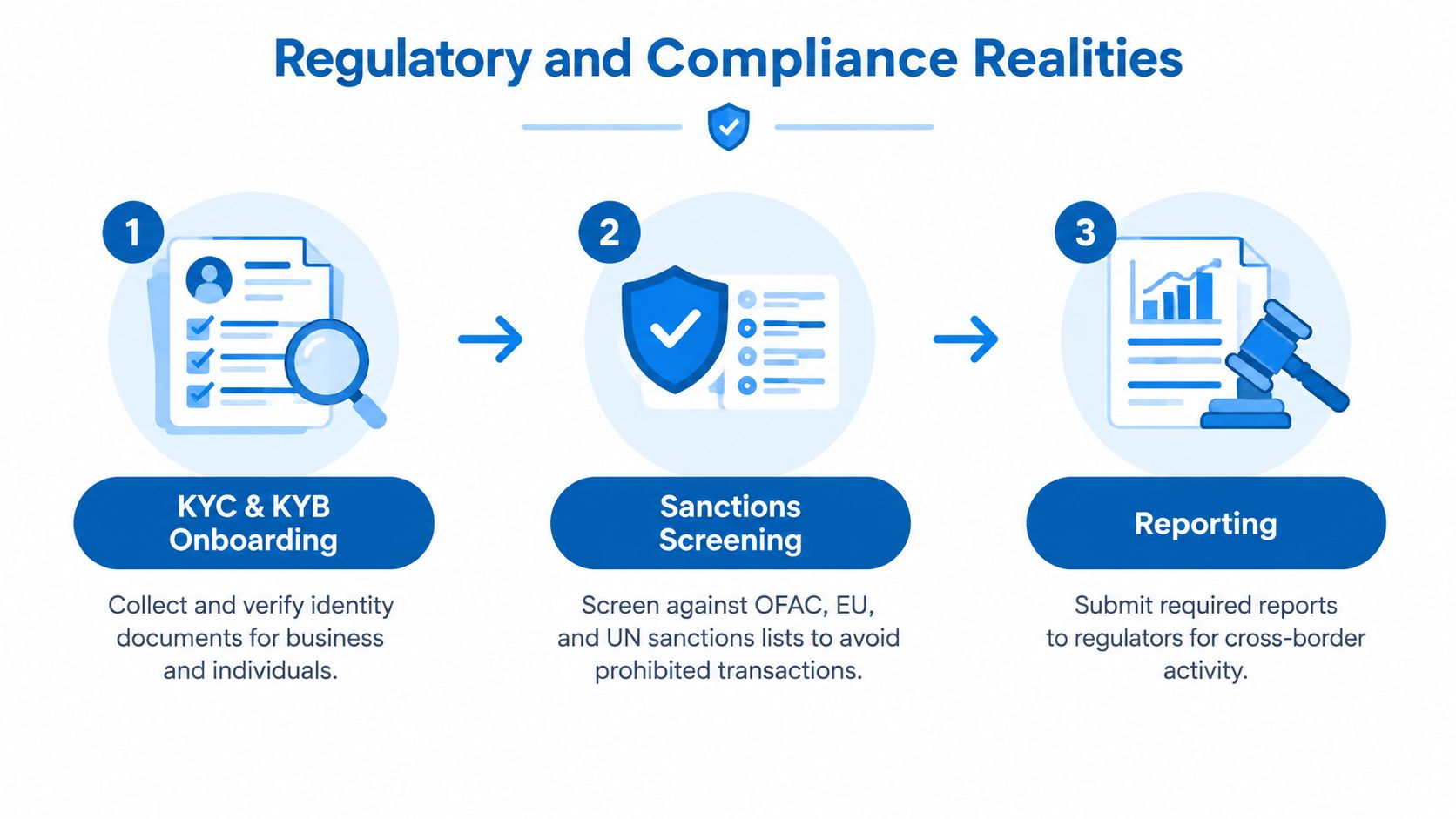
Begin with KYC and KYB. Your provider should verify the identity of the business, its owners, authorized users, and relevant counterparties. Gather incorporation records, ownership information, business activity details, source-of-funds evidence, and payment purpose data before the first urgent transfer. Missing documents at onboarding are a common reason an apparently simple payment becomes a long operational delay.
Screen before release
Screen beneficiaries, counterparties, wallets where relevant, and payment jurisdictions against applicable sanctions requirements, including OFAC, EU, and UN lists. Don't rely on a one-time onboarding check. Ownership, addresses, and risk profiles can change, so transaction monitoring needs to continue after approval.
Correspondent banks carry their own anti-money-laundering liability. That exposure helps explain why banks may de-risk entire corridors or decline certain customer types instead of investigating every case individually. Your finance team needs a documented escalation route for holds, not just a generic support inbox.
For teams handling card data alongside payment operations, technical controls matter too. Use a qualified security partner to satisfy PCI DSS requirements with automation, and keep payment data access limited to the people and systems that need it.
Match reporting to the asset and jurisdiction
Reporting duties vary by entity, activity, and location. US companies may have obligations such as FBAR, while crypto-asset activity can trigger separate reporting and recordkeeping requirements. European businesses must assess the rules that apply to their structure and transactions, including relevant crypto-asset reporting frameworks.
For digital-asset transfers, ask how the provider handles the Travel Rule, transaction monitoring, wallet screening, custody, and evidence retention. A USDC workflow can be operationally efficient, but it still requires beneficiary controls, approved networks, clear conversion records, and an accounting policy for the asset movement.
Use a compliance checklist before adding a rail:
- Licensing: Confirm which regulated entity provides each service and in which jurisdictions.
- Screening: Verify sanctions, AML, beneficiary, and wallet-screening controls.
- Approvals: Define who can add payees, release payments, and override a compliance hold.
- Records: Retain invoices, payment purpose, conversion details, approvals, and settlement evidence.
- Escalation: Set an owner and response process for rejected or held payments.
Compliance architecture belongs in the initial rail-selection conversation. If a route cannot produce the records your auditor, bank, or regulator may require, its apparent speed is irrelevant.
How Unified Platforms Reshape Global Payment Flows
Fragmented rails create fragmented evidence. One account shows the outgoing wire, another shows the FX conversion, a third contains the beneficiary response, and a separate wallet records a digital-asset transaction. The finance team then assembles the story manually.
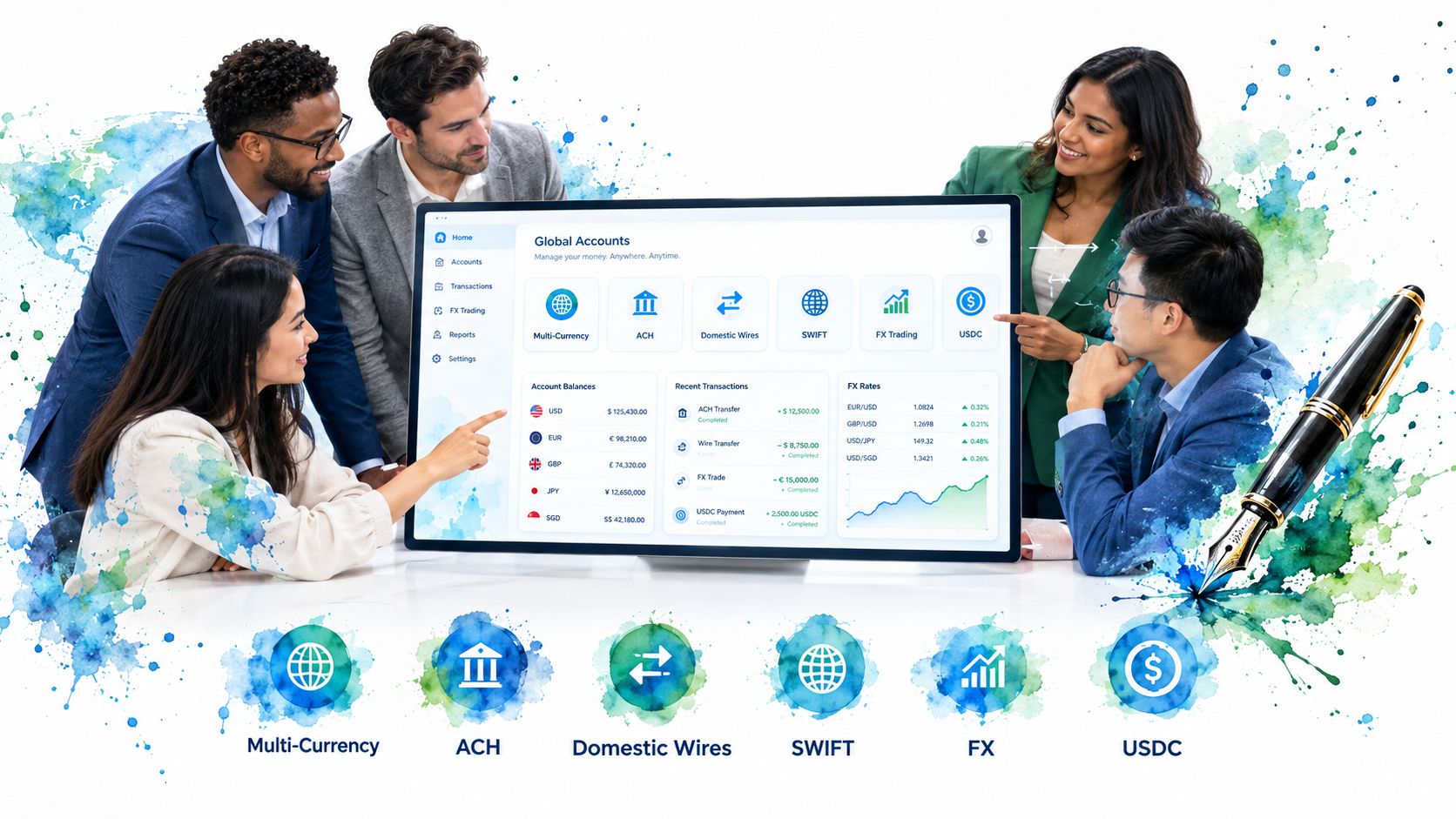
A unified platform brings those activities into one operating layer. In a practical setup, the dashboard can connect multi-currency balances, ACH, domestic wires, SWIFT, FX, and USDC workflows, while an API sends payment instructions from the ERP or accounts-payable system. The objective isn't to make every payment instant. It's to give treasury one place to control funding, approval, execution, status, and reconciliation.
Consolidate the work around the rail
A unified workflow changes the operating math in several ways:
- One reconciliation ledger: Payment IDs, beneficiary details, invoices, fees, and conversion records stay associated instead of being collected from separate portals.
- Controlled FX execution: Treasury can compare the conversion rate and spread before releasing funds, rather than discovering the impact during month-end posting.
- Batched multi-currency payouts: The team can prepare different currency payments in one run while preserving approval and reference data.
- Embedded onboarding: KYB and user permissions sit closer to the payment workflow, reducing ad-hoc email exchanges.
- Balance-aware funding: Treasury can hold currency where it expects to spend, reducing unnecessary conversion steps.
OneSafe is an example of this model. It provides multi-currency business accounts, ACH, domestic and international wires, SWIFT transfers, FX, corporate-card controls, and USDC deposits and withdrawals through one interface. That makes it relevant for companies that need both conventional bank rails and crypto-compatible settlement without stitching together separate portals and wallets.
The platform layer doesn't eliminate every cost. Providers still charge for payment execution, FX, and certain international routes, and compliance holds can still delay a transfer. It does make those costs easier to identify and compare because the workflow contains more of the relevant data.
A useful implementation test is to choose one recurring corridor and measure the complete process before and after consolidation. Track logins, manual touches, unmatched invoices, payment-status requests, failed payments, beneficiary complaints, and month-end adjustments. If the platform only changes the screen while your team still performs the same manual work, you haven't solved the underlying problem.
Use the following video as a practical product-level view of unified financial operations.
Cross-Border Treasury Best Practices
Treat treasury as an operating system, not a payment desk. Your team needs a repeatable view of cash, currency exposure, payment authority, provider performance, and fallback options.
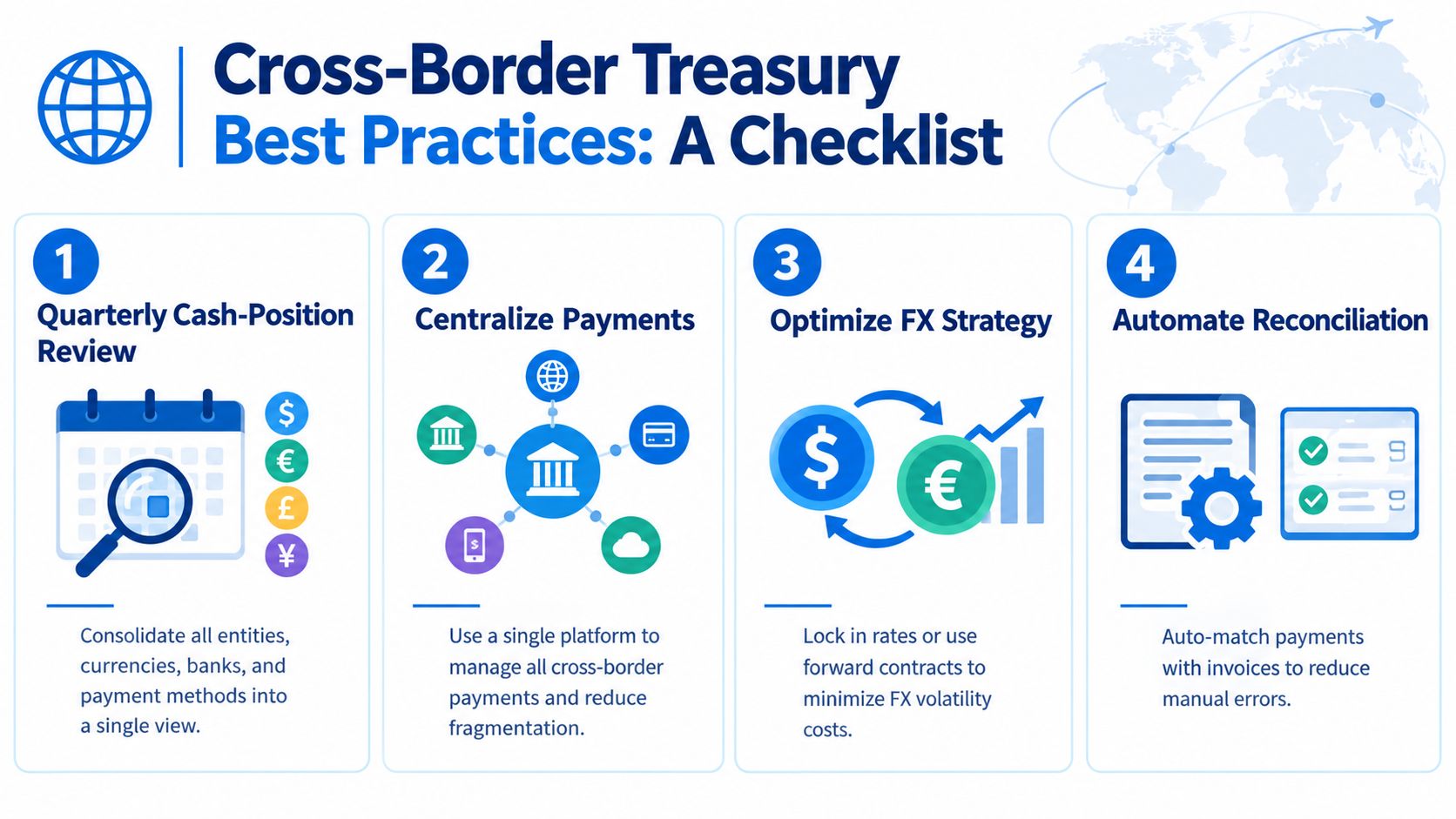
Start this quarter with a cash-position review. Consolidate every legal entity, currency, bank account, payment provider, and expected outflow into one schedule. Identify balances that are idle, trapped, or held in currencies the business doesn't spend. Then set minimum operating balances and a rebalancing cadence before adding another payment method.
Put payment authority in writing
Create a policy that names approved rails, beneficiary controls, transfer limits, approval levels, cutoff handling, and emergency procedures. Require maker-checker approval for new payees, high-risk jurisdictions, unusual currency conversions, and payments outside normal behavior.
Route recurring payroll, supplier, and intercompany flows through predictable local rails where possible. Reserve wires and more specialized routes for urgent, high-value, one-time, or corridor-specific obligations. Standardize beneficiary fields and remittance references so the receiving team gets the data needed to match the payment without email follow-up.
Automation should connect invoice approval to payment initiation and then to reconciliation. API-enabled workflows are valuable only when they pass consistent reference data through every stage. An automated payment with poor metadata creates a faster exception.
Review FX exposure every week
Forecast committed inflows and outflows by currency at least weekly. Separate firm obligations from uncertain forecasts, then decide how much net exposure the business should hedge using forwards or options. Don't wait for a large currency move to discover that a supplier obligation was unprotected.
Agree with accounting on the functional-currency treatment and document spot-trade timing, fees, and revaluation entries. Review hedge coverage quarterly as contracts, pricing, and operating plans change. Treasury and accounting should use the same exposure schedule, not maintain competing spreadsheets.
Measure providers beyond price
Track failed payments, rejected beneficiaries, settlement certainty, FX spreads, status visibility, API uptime, and support quality alongside fees and transfer time. Hold regular provider reviews, test fallback routes, and maintain contingency banking relationships for critical corridors.
For a broader operating model, see global treasury management for international companies. The right platform should support your controls, not encourage the team to bypass them for convenience.
Your action list is clear:
- This week: Map your highest-volume corridors and document every manual handoff.
- This month: Build a landed-cost scorecard using actual beneficiary receipts and exception effort.
- This quarter: Approve a rail policy, test one alternative route, and review currency balances.
- Ongoing: Monitor FX exposure weekly and provider performance at regular business reviews.
OneSafe brings multi-currency business accounts, ACH, domestic and international wires, SWIFT, FX, corporate-card controls, and USDC workflows into one interface for companies operating across borders. Visit OneSafe to evaluate whether consolidating your payment and treasury workflows can reduce reconciliation effort, improve control, and make total cross-border cost visible.