On September 8, 2026, DBS and Citi took a concrete step that reshapes the conversation around stablecoin payments for global businesses. The two banks launched a pilot enabling instant, 24/7 cross-border USD settlement using tokenized deposits, as reported by MEXC’s On-Chain Daily Report. For operators already running treasury operations with public stablecoins like USDC, this isn’t a threat—it’s a signal that the banking world is building the missing half of the digital-payment stack. The question now is how to evaluate and integrate these new rails without disrupting what’s already working.
Table of Contents
- What Just Happened: DBS and Citi Launch Tokenized Cross-Border USD Payments
- Why It Matters Now for Business Stablecoin Payments
- The Background: Tokenized Deposits and Stablecoin Payments Explained
- Concrete Implications for Your Payment Stack
- What to Watch Next and the Open Questions
- Your Questions Answered
- Key Takeaways
What Just Happened: DBS and Citi Launch Tokenized Cross-Border USD Payments
According to the MEXC On-Chain Daily Report published September 8, 2026, DBS Citi stablecoin initiatives converged in a pilot enabling instant, 24/7 cross-border USD payments using tokenized deposits. This marks the first public move to settle corporate payments directly between bank accounts on a shared permissioned ledger, bypassing the correspondent-banking network during the actual value transfer.
Tokenized deposits are digital claims on a commercial bank’s liability, recorded on a blockchain-like infrastructure but redeemable 1:1 for the underlying fiat held in a traditional bank account. Unlike public stablecoins (USDC, USDT) that circulate on open, permissionless networks, these tokenized claims operate within a closed ecosystem governed by the issuing banks. The pilot effectively wraps existing dollar deposits into a programmable token, enabling near-instant settlement between two pre-identified institutional accounts—no blockchain gas fees, no decentralized validators, just a bank-grade liability with the speed of a blockchain transfer. For a detailed comparison, see Stablecoin Payments vs. Tokenized Deposits: The Real Story.
Why It Matters Now for Business Stablecoin Payments
For years, stablecoins have been the only practical tool for 24/7, low-cost cross-border settlement outside the traditional banking system. When two systemically important banks launch a pilot that mimics the instant-settlement value proposition of a stablecoin, it validates that the underlying need—a digital dollar that moves instantly across borders—is a core infrastructure upgrade. It also signals to regulators that the technology can be deployed within a regulated perimeter, which may accelerate clarity for stablecoin regulation 2026. As more than 21 U.S. banks have been exploring their own stablecoin or deposit-token initiatives, this trend is already reshaping the regulatory discussion (see 21 Banks Issuing Stablecoins Reshapes Regulation).
Business stablecoin payments have already set the expectation for instant settlement. Companies that settle invoices and payroll in USDC in minutes will now see that speed as the floor. DBS and Citi’s move makes it clear that the correspondent-banking model is being replaced not just by crypto-native rails but also by incumbent banks. This pilot is a live implementation of what the Oliver Wyman paper called “a foundation for stable digital money,” proving that a permissioned ledger can handle real value transfer between regulated entities. Treasury officers can no longer treat “crypto” and “bank” as separate domains.
The Background: Tokenized Deposits and Stablecoin Payments Explained
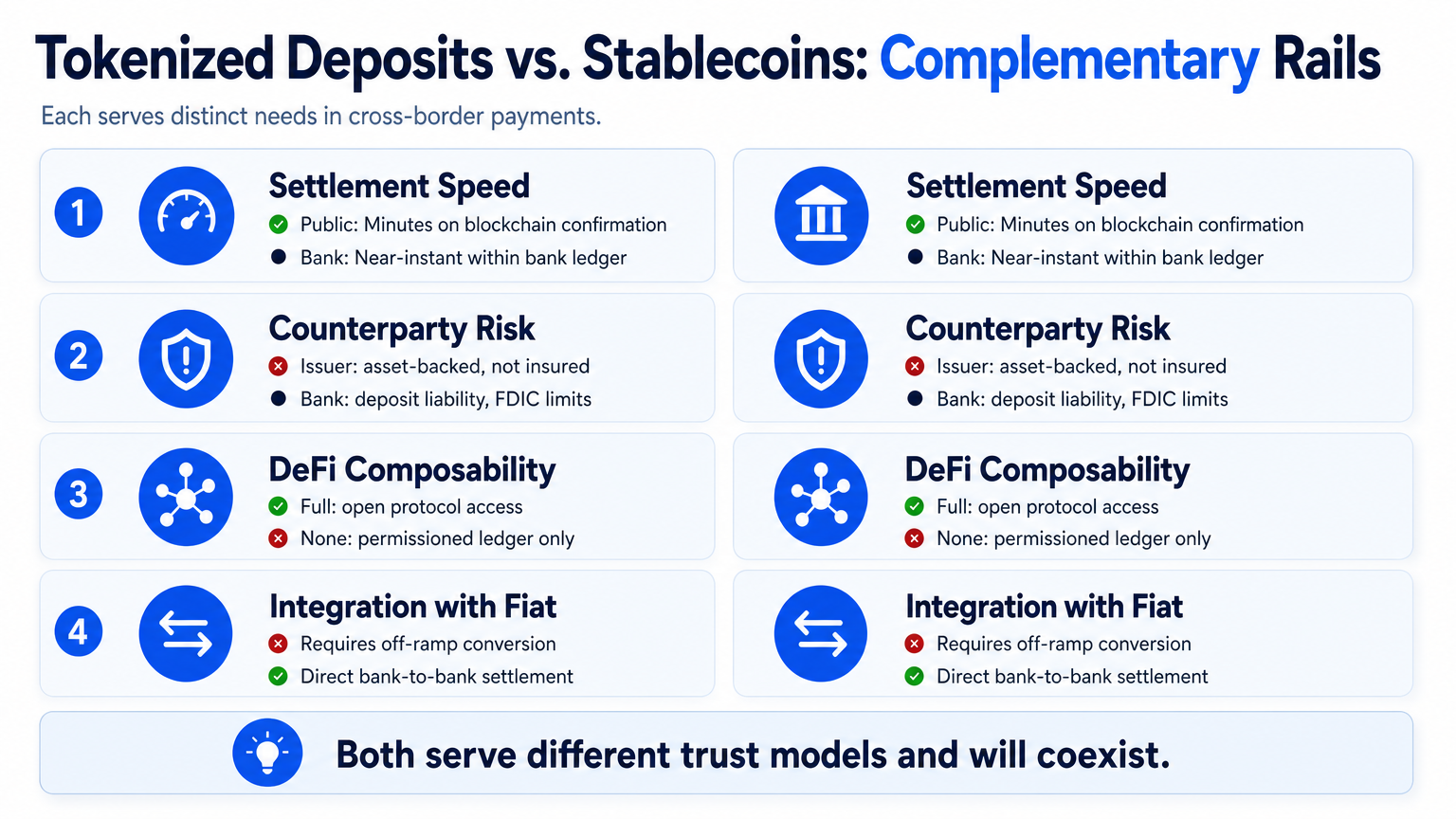
Public stablecoins—typically USDC or USDT—are digital obligations of a non-bank issuer, settled on public blockchains. For a business, they offer instant, low-cost cross-border transfers and native composability with DeFi protocols. However, they require careful management of issuer credit risk, custody, and compliance obligations. Despite these hurdles, volumes have surged (see Stablecoin Payments Surge on Polygon: What It Means for Business).
The stablecoin vs tokenized deposits distinction matters operationally. Tokenized deposits are not a sudden invention. The KPMG analysis on deposit tokens frames them as a bridge preserving the existing two-tier banking structure while adding programmability. In the U.S., the CSBS issued guidance on tokenized deposits in late 2025, confirming state-chartered banks could issue them under existing banking laws.
| Feature | Public Stablecoins (e.g., USDC) | Bank Tokenized Deposits (DBS/Citi pilot) |
|---|---|---|
| Settlement speed | Minutes (blockchain confirmation) | Near-instant (within bank-controlled ledger) |
| Counterparty risk | Issuer: asset-backed, not FDIC-insured | Issuing bank: deposit liability, FDIC limits apply |
| Composability with DeFi | Full | None—permissioned ledger only |
| Custody model | Self-custody, qualified custodian, or institutional wallet | Held at the issuing bank |
| Compliance burden | Requires on-chain analytics, Travel Rule | Built into bank’s KYC/AML framework |
| Integration with fiat rails | Requires an off-ramp to convert to bank money | Direct bank-to-bank settlement, no off-ramp |
| Regulatory status | Evolving; subject to stablecoin-specific frameworks | Treated as a traditional bank deposit per CSBS |
Concrete Implications for Your Payment Stack
The DBS/Citi pilot is a bilateral arrangement. It is not yet an open network. Public stablecoins remain the only widely accessible instrument for instant cross-border payments with counterparties outside those banks. The Brookings Institution analysis notes that tokenized deposits and stablecoins serve fundamentally different trust models—both are likely to coexist.
The real opportunity is convergence. A supplier might want a bank token while the payer holds USDC. A DAO may need to pay a traditional service provider in a manner the provider’s bank recognizes instantly. The infrastructure to bridge these—a neobanking stablecoins platform that can hold, convert, and route both fiat and crypto—becomes essential. OneSafe already demonstrates this dual-rail approach with multi-currency fiat accounts, wire transfers, and free USDC deposits and withdrawals. While OneSafe is a financial technology company, not a bank, its architecture treats fiat and crypto as equally native. When tokenized deposits become accessible, platforms like OneSafe can incorporate them as an additional rail.
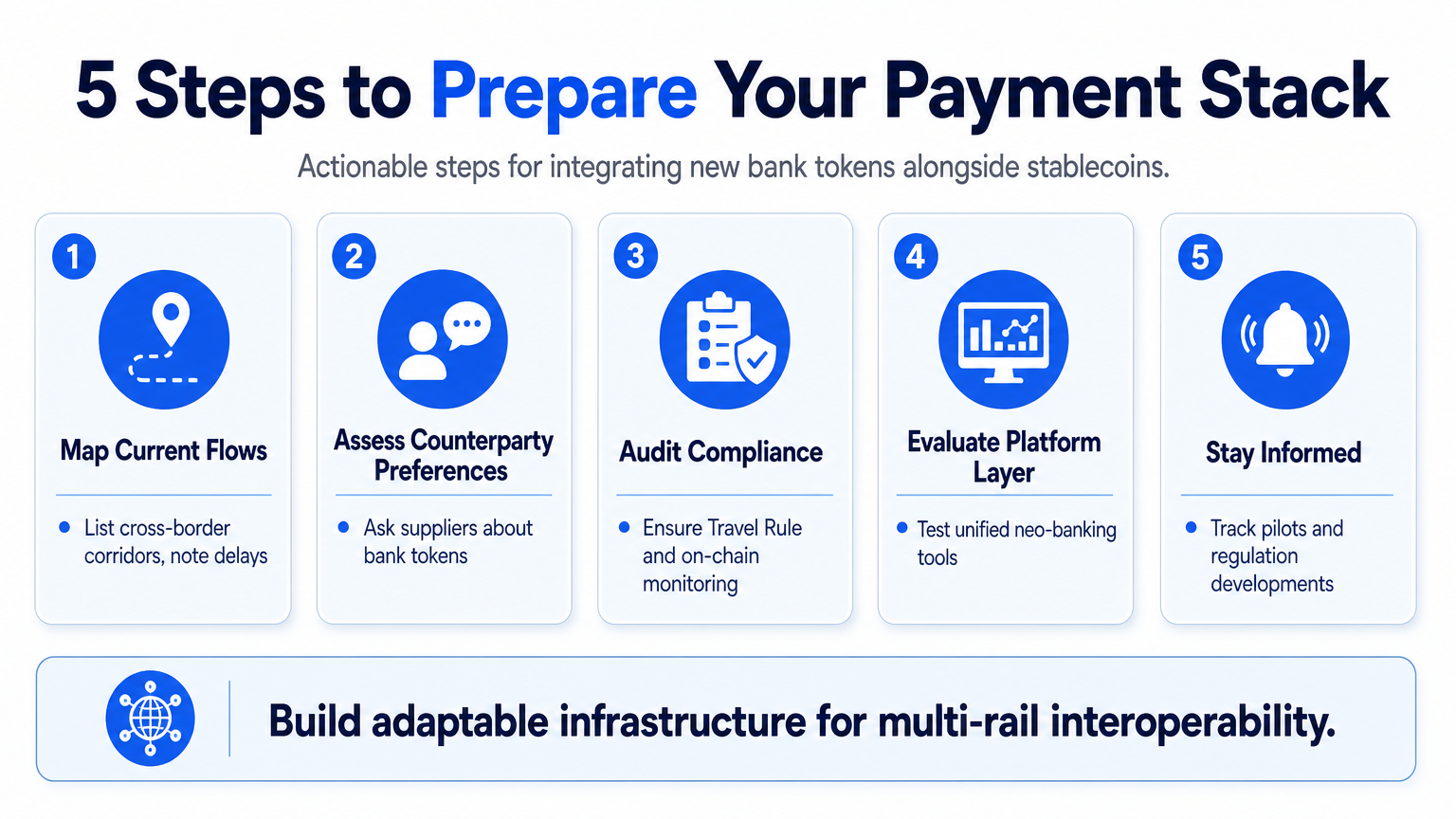
Actionable steps today:
- Map your current flows: List all cross-border corridors, noting which use stablecoins, wires, and where delays hurt most.
- Assess counterparty preferences: Ask suppliers if they’d accept a bank-issued digital dollar when available.
- Audit compliance exposure: Ensure Travel Rule and on-chain monitoring is robust.
- Evaluate your platform layer: Can your tools handle multiple tokenized dollar representations? Test a unified neo-banking platform.
- Stay informed: Track bank pilots and stablecoin regulation 2026 developments; solidify your existing stablecoin operations.
What to Watch Next and the Open Questions
The pressure on other global transaction banks is now enormous. Expect JPMorgan, Standard Chartered, and others to accelerate their own projects. Tokenized deposits currently sit in a gray comfort zone—treated like bank deposits, they avoid separate stablecoin rulemaking. But as volumes grow, specific guidance will be needed. The UAE has already moved aggressively (see Why UAE Stablecoin Regulation Is Winning in 2026), while Africa’s regulators are crafting stablecoin-specific payment rules (Stablecoin Regulation: Africa’s Payments Lifeline). The contrast could create regulatory arbitrage.
For DAOs and Web3 treasury needs, a permissioned bank token offers little benefit over a traditional wire unless it can be seamlessly swapped into a public stablecoin or used in DeFi. The real value would emerge if a bank token could be bridged trustlessly to a public chain—something the current DBS/Citi architecture does not permit. Until then, bank tokenized deposits primarily benefit traditional corporates, not crypto-native treasuries. The crypto-to-fiat payments bridge remains critical.
Your Questions Answered
What exactly did DBS and Citi announce on September 8, 2026?
On September 8, 2026, MEXC’s On-Chain Daily Report detailed that DBS and Citi enabled instant, 24/7 cross-border USD payments using tokenized deposits. The pilot allows direct settlement between bank accounts on a permissioned ledger, removing correspondent-banking delays while keeping funds within the regulated banking system.
How does tokenized deposit settlement differ from stablecoin payment flows?
A stablecoin payment uses a public blockchain: USDC moves from a wallet to the payee’s address, finalized on block confirmation. A tokenized deposit settlement happens inside a bank’s permissioned ledger—the token is a digital representation of a deposit liability, transferred between identified accounts instantly. The legal claim remains a deposit, not a bearer instrument on a decentralized network.
Does this mean stablecoins are becoming obsolete?
No. Stablecoins remain essential for permissionless access—paying a contractor without a bank relationship, interacting with DeFi, or moving value across jurisdictions. Tokenized deposits are for bank-to-bank settlement between known parties. The two will coexist.
Should my business change its payment strategy?
Not immediately. If stablecoins work for your counterparties, stick with them. Use this announcement to evaluate whether your treasury infrastructure can incorporate bank-issued tokens later. Build a stack that handles multiple dollar representations.
What's the regulatory outlook for stablecoins vs tokenized deposits in 2026?
Tokenized deposits are treated as traditional bank deposits under existing law, giving them a clearer path in the U.S. and Singapore. Stablecoins face evolving, dedicated regulation—the GENIUS Act and MiCA set standards for reserves and redemption. The trend is toward a two-tier system: bank tokens for regulated settlement, public stablecoins for open, programmable money.
How can businesses using stablecoins integrate with traditional banking rails?
Use a platform that natively bridges fiat and crypto. A neo-banking platform like OneSafe allows businesses to hold fiat, send wire transfers, and convert between USDC and fiat instantly. When tokenized deposits become accessible, such platforms can add that rail.
What steps should a finance lead take today?
Document current payment flows by rail, identify gaps where instant settlement reduces cost, ensure compliance is robust for both blockchain and banking rails, adopt a unified operational layer, and watch for pilot expansion—be ready to test, but don’t pre-commit resources to an unproven network.
Key Takeaways
- The DBS/Citi pilot proves instant, 24/7 cross-border settlement is now a priority for major banks.
- Public stablecoins remain the only instrument for permissionless, composable digital-dollar payments. Businesses should continue using them.
- The optimal strategy for global businesses, Web3 startups, and DAOs is a dual-rail infrastructure managed through a unified neo-banking platform.
- Finance leads should audit current payment stacks, prepare for multi-rail interoperability, and track regulatory developments without abandoning existing processes.
- The convergence of banking and blockchain rails is now operational—build adaptable treasury operations.
Ready to manage both fiat and crypto payments on a single, future-proof platform? Open a free OneSafe account today.