
International contractor payments average 37 to 42 days from invoice submission to receipt, according to Payoneer research cited by GetOnTop. That delay turns a simple payout into a cash flow problem, and once FX markup and tax paperwork enter the picture, the answer to how to pay international contractors becomes a control system, not a button click.
Table of Contents
Why Paying International Contractors Is Harder Than It Should Be
A contractor in another country can finish the work, send the invoice, and still wait a long time to get paid. That delay ties up working capital, changes how contractors price their services, and turns routine accounts payable into a relationship issue when the money arrives late or in the wrong amount.
The hidden cost shows up even when the transfer fee looks small. The exposure is usually in the FX spread, the timing of conversion, and who absorbs the difference when the market moves between invoice approval and payout. If the agreement does not say whether the payer or the contractor carries that risk, the shortfall is often resolved invoice by invoice, which is the least efficient way to handle it.
A payment method is only part of the cost
A finance team can approve a transfer because the sender fee looks manageable, then discover the contractor received less than expected after conversion. The problem is not just the rail itself. It is the gap between the market rate and the rate used, plus any fee structure that shifts value out of the payment before it reaches the contractor.
Practical rule: if the contract does not define who absorbs FX movement, rate timing, and conversion spread, you are leaving margin leakage open for negotiation on every invoice cycle.
That is why paying international contractors belongs in treasury as much as in accounts payable. AP can send the money, but treasury has to decide whether the company is buying certainty, speed, or lower total cost. Those are different outcomes, and providers rarely give you all three on the same terms.
The result is a trust issue as much as a payment issue. Contractors care about what lands in their account, not what the payer intended to send. When settlement drags and the final amount shifts because fee responsibility and conversion timing were never written down, the relationship starts to feel less like a professional engagement and more like a dispute waiting to happen.
For companies that are still sorting out contractor classification and cross-border onboarding, OneSafe's guide to global hiring options is a useful place to compare operational models before payments start. If the contractor is working under a digital nomad visa spain arrangement, that legal setup may also affect how the engagement is structured, which makes payment terms even more important to define clearly.
Classifying Your Contractors and Understanding Local Requirements
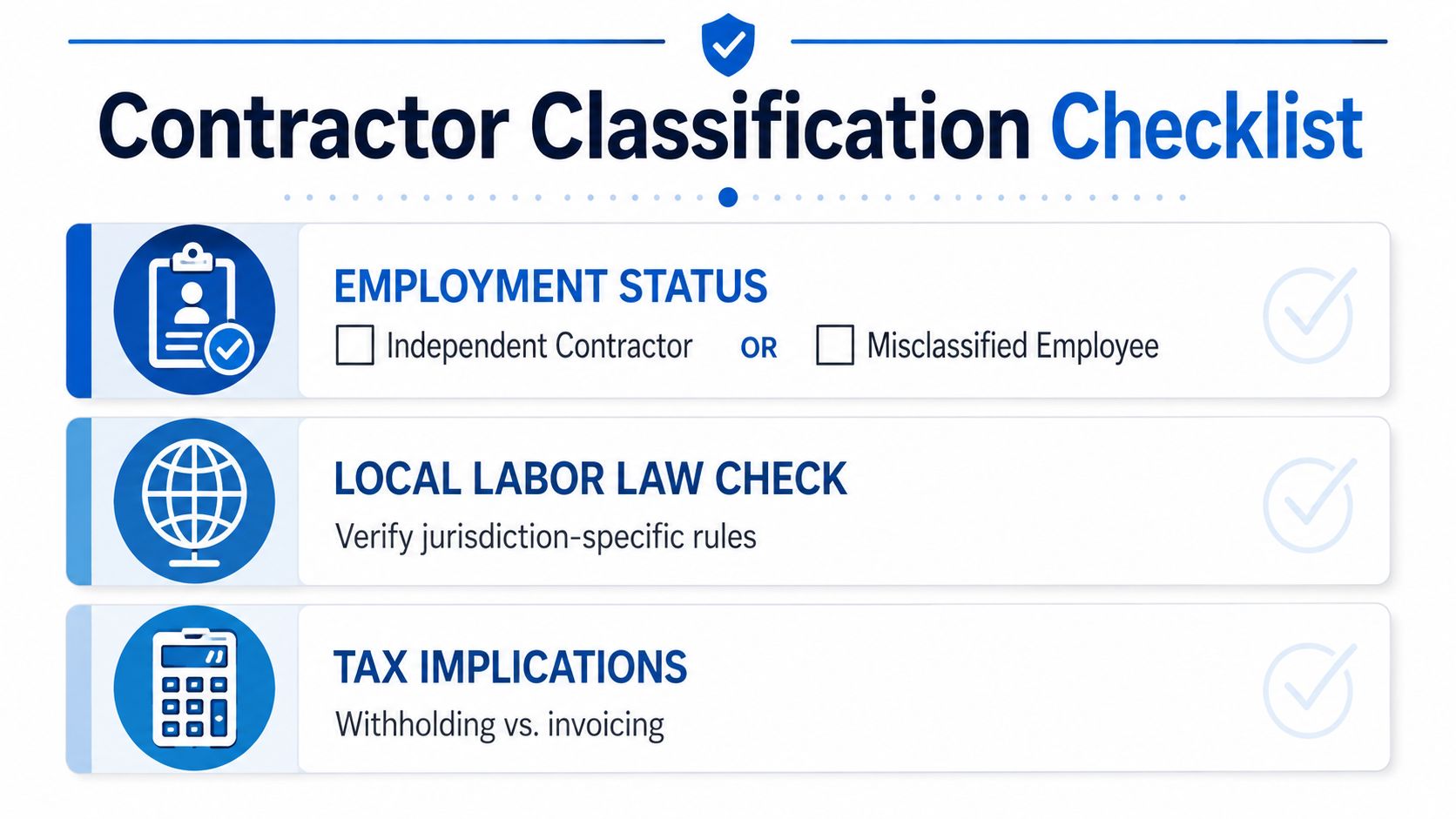
A contractor can look straightforward on paper and still be an employee in the country where they work. The test changes by jurisdiction, but the pressure points are usually the same, how much control you exert, whether the relationship looks ongoing, and whether the person is operating with real independence. If you assign hours, direct the workflow, or manage the person like staff, the contract label will not protect you.
A proper classification review starts with control, permanence, and business independence. The contractor should decide how the work gets done, should ideally serve more than one client, and should invoice you as a business rather than function as hidden payroll. If those signals do not line up, the payment rail is secondary. The risk sits in the relationship itself.
Tax forms and onboarding need to happen before the first invoice
For U.S.-linked workflows, collect W-9 forms from U.S. persons and W-8BEN/W-8BEN-E from foreign individuals or entities before any payment leaves the account. That paperwork is not just administrative clutter. It gives finance and tax teams a baseline for how the engagement is being treated, and it helps reduce the chance that a contractor gets paid under the wrong tax assumptions. Some U.S.-source services can also trigger 30% withholding, so the onboarding file needs to be complete before the first invoice is approved.
The practical sequence is simple, but it needs discipline:
- Verify contractor status first: confirm the worker controls how the service is delivered and is not being managed like staff.
- Collect the right tax form: W-9 for U.S. persons, W-8BEN or W-8BEN-E for foreign payees in U.S.-linked workflows.
- Store invoices and contracts centrally: keep the signed agreement, invoice, tax form, and payment confirmation in one place.
- Check local payout rules: some jurisdictions require settlement in local currency, and some invoicing rules can conflict with the payment rail you prefer.
That is where onboarding gets messy in practice. A clean file on the AP side can still fail if the local engagement terms are off, especially when the contractor is working across borders and residency status matters. If you are also dealing with mobile contractors or location-independent workers, a resource like digital nomad visa spain can help you understand how residency, work status, and payment setup can intersect in practice.
For teams building a broader hiring stack, contractor classification should be checked against the same control standards used in structured international hiring and EOR workflows. A useful starting point is this EOR solutions overview for startups, especially when the line between contractor management and employer-style oversight starts to blur.
Choosing the Right Payment Rail for Your Contractor Mix
A contractor payment setup that works for one corridor can create friction in another. The rail should fit the contractor's location, how often you pay, and how much FX risk you are willing to carry in the agreement. A bank wire still makes sense for some large, one-off payments, but it becomes a blunt tool once you are paying recurring invoices in multiple currencies. The decision has to balance speed, coverage, and total cost, not just the headline transfer fee.
SWIFT wires still reach a wide range of countries, which is why they remain common. Toku's comparison shows that international bank wires usually take 3 to 5 business days and can carry 2% to 4% over the mid-market rate, per Toku. Consumer payment apps can be even more expensive, with 4% to 5% per transaction in that benchmark, while global payment platforms usually sit between 0.4% and 2%. A platform can look clean in the dashboard and still be a poor fit for the country pair you pay every month.
Match the rail to the payment pattern
The practical split is straightforward. Use broader, slower rails when you are making occasional large transfers. Use controlled platforms or local rails when you pay the same contractors every month and want fewer surprises in settlement and reconciliation. Batch payments in the same currency whenever you can, because fewer transactions usually means fewer fees and fewer conversion events.
| Payment Rail Comparison for International Contractors | |||
|---|---|---|---|
| Payment Rail | Settlement Speed | Typical Total Cost | Best For |
| Bank wire or SWIFT | 3 to 5 business days | 2% to 4% over mid-market, plus transfer fees | Large one-off payments and broad country reach |
| Consumer payment apps | Varies | 4% to 5% per transaction | Small, informal transfers where cost is less important |
| Global payment platforms | Varies | 0.4% to 2% | Recurring contractor payouts with better control |
| Stablecoin payroll | Same day | About 25 basis points over mid-market, roughly 0.25% | Recurring payouts, especially in volatile-currency environments |
Stablecoin payroll is a useful reference point because it shows how different the economics can be when settlement happens the same day at around 25 basis points over mid-market, roughly 0.25%, per Toku. That will not be right for every contractor, but it is a strong option to test when speed and conversion control matter more than using the default bank path.
For a broader view of cross-border transfer options inside a payment stack, the cross-border payments guide is a practical companion. If you are comparing a company payroll service UK setup with contractor payouts, Umbrella Company's overview is a useful reminder that payment structure and worker type shape the delivery model.
Contract rule that saves money: lock the FX reference rate in writing, decide who pays the fees, and let contractor location drive the rail, not internal convenience.
The right rail is rarely the same for every contractor. A developer in Europe, a designer in Latin America, and a web3 contributor paid in stablecoins do not belong in the same default flow.
Managing FX Risk and Hidden Conversion Costs
A cross-border payout can lose margin long before it leaves your account. The issue is not only transfer fees, it is who carries the FX move between invoice and settlement, and whether the contract says so clearly. Companies often talk about avoiding hidden fees, then leave rate timing and fee absorption undefined, which is where disputes and quiet margin leakage start, as discussed by Remote.com. The contract should state whether the payer or the contractor takes the exchange-rate risk.

Three ways to define the rate
You generally have three workable models. One is to lock the FX rate at the invoice date, which gives the contractor certainty but can leave the payer exposed if settlement slips. Another is to lock it at the payment date, which keeps treasury aligned to the actual transfer but makes contractor cash flow less predictable. The third is to use a mid-market reference with a defined spread, which cleanly separates market movement from provider margin.
The right choice depends on who can absorb volatility. If your company bills clients in the same currency it uses to pay contractors, locking the rate closer to payment date usually keeps treasury cleaner. If the contractor is pricing in a local currency with thin margins, invoice-date certainty may matter more. The point is to choose intentionally, not let the payment provider make that decision by default.
Write the fee clause clearly
Fee allocation needs the same treatment. If the company absorbs transfer fees, say so. If the contractor absorbs them, say so. If you split them, define the split and name the rail that creates the cost. Ambiguity is what turns a routine payout into a back-and-forth over who underpaid whom.
Use plain language like this in the contract:
Payment will be calculated using the mid-market exchange rate on the payment date, unless otherwise agreed in writing. Transfer fees and FX conversion costs will be borne by [payer/contractor/shared] and will not change the agreed service amount.
That clause works because it separates service price from payment mechanics. It also makes disputes easier to resolve when the actual payout differs from the invoice total because of provider markup, spread, or rail choice.
For teams that want a structured multi-currency setup, a multi-currency business accounts structure can reduce repeated conversion at the account layer. OneSafe is one of the options that combines multi-currency holding with payment execution, but the contract still has to define who carries the FX risk.
Building the Payment Workflow from Onboarding to Payout
A workable contractor payout process has four control points, and each one removes a failure mode. Tipalti's framework is the right backbone here, onboarding and collecting details first, agreeing terms in writing, choosing the rail, then executing payment with records preserved for audit, per Tipalti. That sequence keeps the team from sending money before the paper trail is ready.
Four controls that belong in the flow
Start with onboarding. Collect banking details, tax forms, and a signed agreement before the contractor submits a payment request. Missing account details cause more delays than most finance teams admit, and once the invoice is in the queue, it's harder to slow the process down.
Then lock the terms. Amount, currency, schedule, and the FX and fee allocation rules should all be written down before the first payout. If the payment terms are still being negotiated after the invoice arrives, the AP queue becomes a negotiation queue.
Next, select the rail based on the country pair and the frequency of the work. The right choice for an occasional consultant won't always fit a recurring contributor, especially when batching can reduce per-payment fees and conversion events.
Finally, preserve the records. Signed contracts, invoices, payment confirmations, and tax forms belong in one system, not scattered across email threads and spreadsheets. That's what makes audits survivable and month-end reconciliation predictable.
A platform can fit into this flow without replacing it. OneSafe, for example, supports multi-currency accounts, global payments, corporate cards with spend controls, and crypto-compatible features, so a finance team can hold funds, pay contractors, and track approvals in one place. For a DAO paying three contractors in three currencies, the operational advantage is less about marketing claims and more about not having to reconcile three different toolsets after the payout run.
Operational habit that matters: if a contractor can't be paid from the data already in the system, onboarding wasn't finished.
The most common failure points are boring and expensive. Banking data is missing, FX terms are vague, or tax documentation was never collected. Fix those three and the payout process stops breaking in the same places.

Tax Compliance, Withholding, and Recordkeeping Best Practices
A payment can clear and still leave the books wrong. In cross-border contractor work, the tax form, the withholding rule, and the payout record have to line up before money moves, or finance ends up fixing avoidable problems later. In U.S.-linked workflows, that starts with the right form set, W-9 for domestic persons and W-8BEN or W-8BEN-E for foreign individuals or entities, with 30% withholding applying to some U.S.-source services, as noted by GetOnTop. Finance teams should treat tax documentation as part of payment setup, not as a year-end cleanup task.
Store the paperwork where the payout data lives
The cleanest recordkeeping setup keeps the payment history, FX rate, fee breakdown, and contractor documents in the same ledger. Then the basic questions are easy to answer later, what was owed, what was sent, what rate was used, and what form supported the payout. If that information lives in separate tools, reconciliation turns into a manual hunt at the worst possible time.
A practical recordkeeping stack should include:
- Signed contractor agreement: show the scope, currency, schedule, and fee responsibility.
- Invoice copy: keep the original invoice and the approval trail together.
- Tax form file: retain the relevant W-8 or W-9 documentation centrally.
- Payment confirmation: store proof of transfer and the final amount received.
- FX reference record: capture the rate used and the date it was applied.
Some countries require local-currency settlement, and payers should already have the correct tax forms on file before payment begins, per Boundless HQ. That matters because local invoice rules or payout restrictions can conflict with your preferred rail, and the provider will not sort out that mismatch for you.
The practical fix is to standardize the contract language. If the agreement says the payment settles in local currency, write down the conversion rule beside it. If the contractor absorbs FX, make sure the invoice format does not suggest a different treatment. Most compliance problems start as mismatched assumptions, and those are cheaper to correct in the contract than after the payout run.
Payment Templates and the Contractor Payout Decision Checklist
A payout policy works better when the contract does the heavy lifting up front. The agreement should spell out the FX reference rate, who absorbs transfer fees and conversion spread, and when payment is due. That is where companies usually lose margin. If the rate timing is unclear, treasury books one number while the contractor expects another. If fee responsibility is vague, the shortfall shows up later in reconciliation or in a dispute.
Boundless HQ notes that upfront deposits of 25% to 50% are common for project work, with the balance paid on completion or in stages, while market practice often clusters around net 15 to 30 days for invoices, per Boundless HQ.
Contract language you can adapt
Use language like this for FX:
The payment amount will be converted using the mid-market exchange rate on the payment date, unless both parties agree otherwise in writing.
Use this for fees:
Transfer fees and FX conversion costs will be absorbed by [payer/contractor/shared], and the service fee will remain unchanged by payment rail selection.
Use this for timing:
Payment terms will be net 15 or net 30, with milestone billing permitted for project work and deposits allowed where both parties agree.
That wording removes the usual ambiguity. Finance can model the outflow, and the contractor can see whether the invoice amount already assumes the conversion cost or whether it will be deducted later. Without that clarity, a payment that looks fine on paper can settle at a different net amount than either side expected.

Decision checklist for every new contractor
- Confirm classification first: make sure the engagement is contractor work in the relevant jurisdiction.
- Collect the right form: W-9, W-8BEN, or W-8BEN-E, depending on the payer and payee relationship.
- Choose the rail by frequency: recurring payments need predictable cost, while one-off projects can justify a wire.
- Lock the FX rule in writing: decide whether the rate is invoice date, payment date, or mid-market with a defined spread.
- Set fee responsibility: payer, contractor, or shared, but never undefined.
- Save the records: contracts, invoices, confirmations, and tax forms should stay in one system.
For teams that split payments by profile, the pattern is usually clear. Crypto-native web3 teams often prefer stablecoin rails and multi-currency accounts because they reduce payment friction and give tighter control over settlement timing. Traditional SMEs with mixed jurisdictions usually do better batching by currency and fixing FX terms in every contract, since the operational burden is lower and the accounting treatment is easier to defend.
The simplest rule finance teams follow is direct. Define the rate, define the fee, define the form. Do that before onboarding, and most cross-border payment problems never get a chance to start.