International banking accounts let companies hold, exchange, receive, and send money across currencies and borders, while regulated banking services may be provided through partner institutions. The infrastructure behind them is substantial: global cross-border bank credit reached $34.7 trillion in Q1 2025, according to the Bank for International Settlements.
A global company often discovers the need during an ordinary finance week. A SaaS business receives a large US-dollar payment from an enterprise customer, pays contractors in euros, settles a software bill in British pounds, and moves part of its treasury into stablecoins. The company may have customers, employees, vendors, and digital assets in different systems, yet its domestic bank account still treats every transaction as an exception.
The right account structure can turn those exceptions into repeatable workflows. The wrong structure can leave finance teams chasing intermediary banks, converting currencies at poor moments, and explaining payment delays to suppliers. International banking accounts aren't just a way to “go global.” They're an operating layer for cash management, settlement, compliance, approvals, and treasury visibility.
Table of Contents
- The account details determine how money arrives
- The platform and the regulated institution are different layers
Why Global Businesses Need International Banking Accounts
Consider a cross-border SaaS company with a US customer base and a distributed European team. Enterprise customers pay in US dollars, contractors submit invoices in euros, and the treasury manager occasionally converts fiat reserves into stablecoins for digital-asset settlement. With one domestic account, the finance team may need to convert incoming dollars before every euro payout, send international wires through correspondent banks, and reconcile payment confirmations across several systems.
That friction affects more than convenience. A delayed contractor payment can damage trust, while an unexpected conversion can reduce the margin on a customer contract. If finance can't see its non-domestic balances clearly, it also becomes harder to decide whether to retain currency for upcoming expenses or convert it immediately.

One account profile, several operating needs
A multi-currency structure gives the finance team separate currency balances under one business identity. The company can receive dollars, retain euros for contractor payouts, and schedule payments according to local processing windows instead of converting every balance back into its home currency.
The payment workflow becomes easier to manage:
- Collection: Customers can pay using receiving details suited to their currency and corridor.
- Allocation: Finance can assign incoming funds to payroll, vendors, tax reserves, or treasury.
- Settlement: The team can pay counterparties in the currency they expect, where the account supports that rail.
- Reconciliation: Statements and transaction records can feed a central accounting process.
The international business payments guidance from OneSafe is useful for teams mapping these flows before choosing a provider.
The underlying market is not a niche corner of finance. BIS data recorded cross-border bank credit at $32.6 trillion at the end of 2024, followed by further growth in later releases, which illustrates the scale of the infrastructure supporting international settlement and foreign-currency credit (BIS banking statistics). For a founder, the practical conclusion is simple: international banking accounts exist because businesses need a persistent way to coordinate money across jurisdictions, not because every payment deserves a bespoke wire request.
Understanding the Core Concept
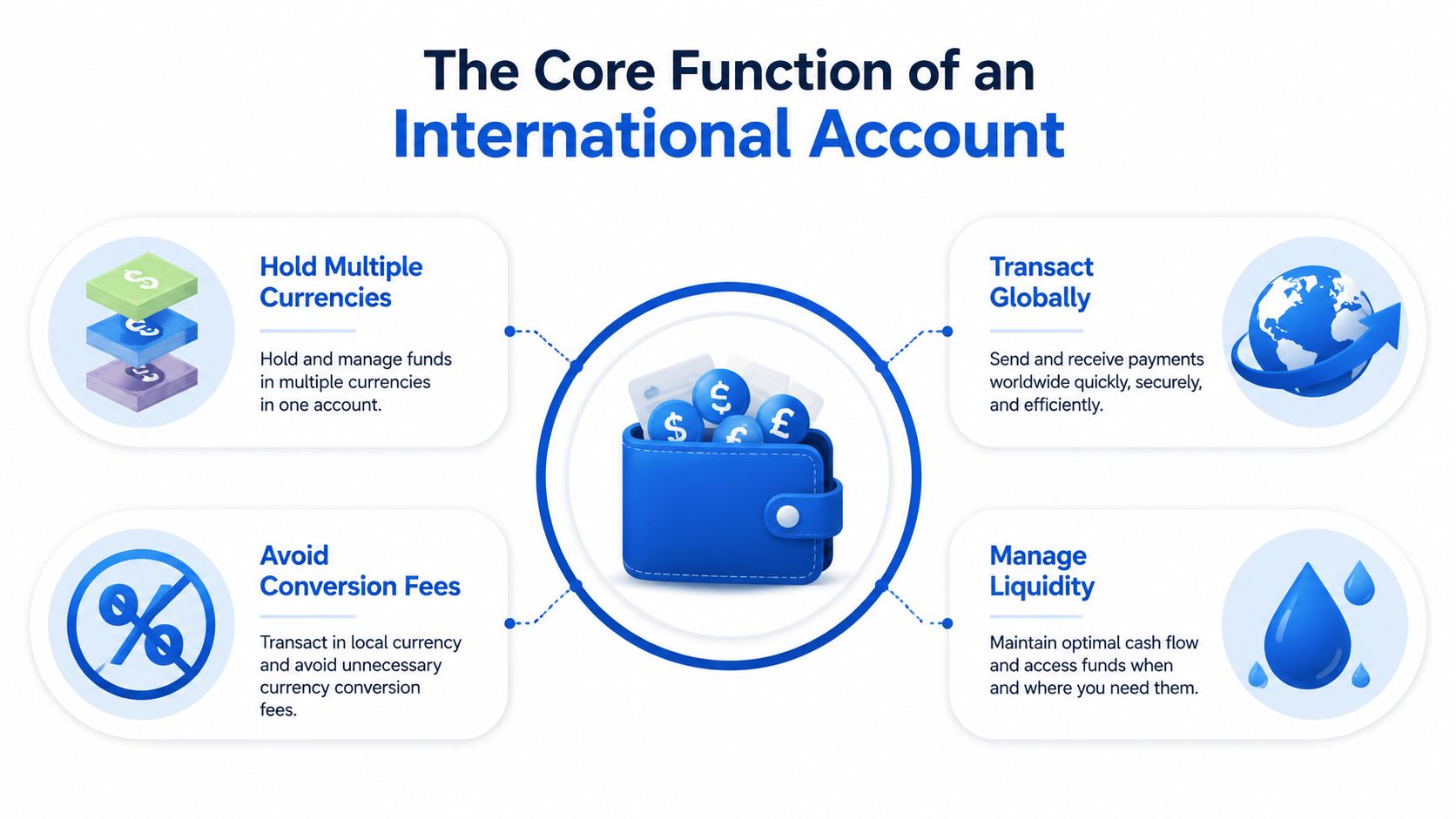
Start with the operating function, not the account label. An international banking account gives a business a way to hold and use multiple currencies within one managed account profile. Each currency behaves like a distinct ledger, so a dollar balance, euro balance, and pound balance can be tracked separately even when the company manages them from one interface.
That structure answers three practical questions. What money has arrived? Which currency does the company owe? When should a conversion happen? If a business receives euros and has euro-denominated obligations, it may avoid an unnecessary conversion into its home currency and back again, subject to the provider's pricing and supported rails.
The account details determine how money arrives
A provider may give a company local receiving details for selected markets, along with SWIFT or BIC information for international transfers. Some platforms also issue virtual account details that help identify inbound receivables, even though the underlying funds may be held by a regulated banking or payments institution.
These details aren't interchangeable:
- Local routing details can support domestic collection where available.
- SWIFT or BIC details identify institutions for international bank transfers.
- Virtual accounts can help separate customer receipts or marketplace collections for reconciliation.
A payment that appears simple to the sender may pass through several banking relationships. The BIS describes correspondent banking through nostro and vostro accounts, where institutions update balances across jurisdictions rather than moving money through one uninterrupted channel (BIS correspondent banking paper). More intermediary legs can mean more operational work, possible fee deductions, and greater timing uncertainty.
The platform and the regulated institution are different layers
The dashboard may provide onboarding, payment initiation, user permissions, reporting, and automation. A partner institution may custody funds, maintain the regulated account relationship, and provide access to payment rails. Those roles matter because a polished interface doesn't automatically mean the platform itself is a bank.
Crypto-native teams should apply the same distinction to fiat-to-crypto workflows. A platform may let a company convert fiat into stablecoins or send funds to a wallet, while custody, banking, compliance, and transaction execution can involve different regulated or specialized partners. Finance leaders should ask who holds funds, who executes payments, which entity performs verification, and how records are produced for audit.
Key Account Features for Cross-Border Operations
A useful account comparison starts with finance tasks, not marketing categories. The team needs to know how it will collect revenue, pay suppliers, control employee spend, convert currencies, and reconcile transactions.
Six features that affect daily work
Currency access matters when revenue and expenses arrive in different denominations. Retaining a supported currency can help a company pay a supplier without an automatic conversion, while local receiving details can make customer collections easier. The relevant question isn't how many currencies appear on a website. Ask which currencies support holding, receiving, sending, cards, and conversion independently.
Payment rails determine how a payment travels. Local rails may suit recurring vendor or payroll payments where they're available. SEPA can be relevant for euro transfers within its supported area, while SWIFT is often used for broader international bank transfers or corridors without a suitable local option. Finance should compare supported destinations, beneficiary requirements, settlement expectations, and intermediary deductions.
Foreign exchange needs more scrutiny than a headline rate. Request a live quote, identify the spread or stated fee, check whether the price changes by currency, and ask whether a larger transfer can use a locked rate. A rate that looks competitive for a small conversion may not be equally transparent for treasury-sized transactions.
Cards solve a different problem. A team card can pay for advertising, software, travel, or vendor services, but the important controls are merchant restrictions, spending limits, approval policies, and transaction visibility. A card program without governance moves uncontrolled spending into another channel.
Integrations connect payments to the accounting system. API access, webhooks, exports, and connectors can reduce manual matching between invoices, bank movements, and wallet activity. Check whether the integration supports the fields your ledger needs, including currency, beneficiary, reference, fees, and approval history.
For teams operating in Australia, regulatory context should sit beside product comparison. The ATO and AUSTRAC rules for cross-border transactions provide a useful starting point for understanding reporting and compliance responsibilities.
| Feature | Primary Finance Task | Example Use |
|---|---|---|
| Multi-currency balances | Preserve operating liquidity | Keep euros available for European contractor invoices |
| Local and international rails | Choose an efficient payment route | Use a local rail for a supported recurring vendor payment |
| FX execution | Control conversion timing and cost | Convert only the amount needed for an upcoming obligation |
| Corporate cards | Govern distributed spending | Give a marketing lead a limited card for approved tools |
| Roles and approvals | Separate preparation from authorization | Require a finance manager to approve a high-value wire |
| Accounting and API integrations | Reconcile activity | Push payment references and fees into the company ledger |
A detailed overview of multi-currency business accounts can help finance teams translate these features into actual operating workflows.
How Different Global Companies Use These Accounts
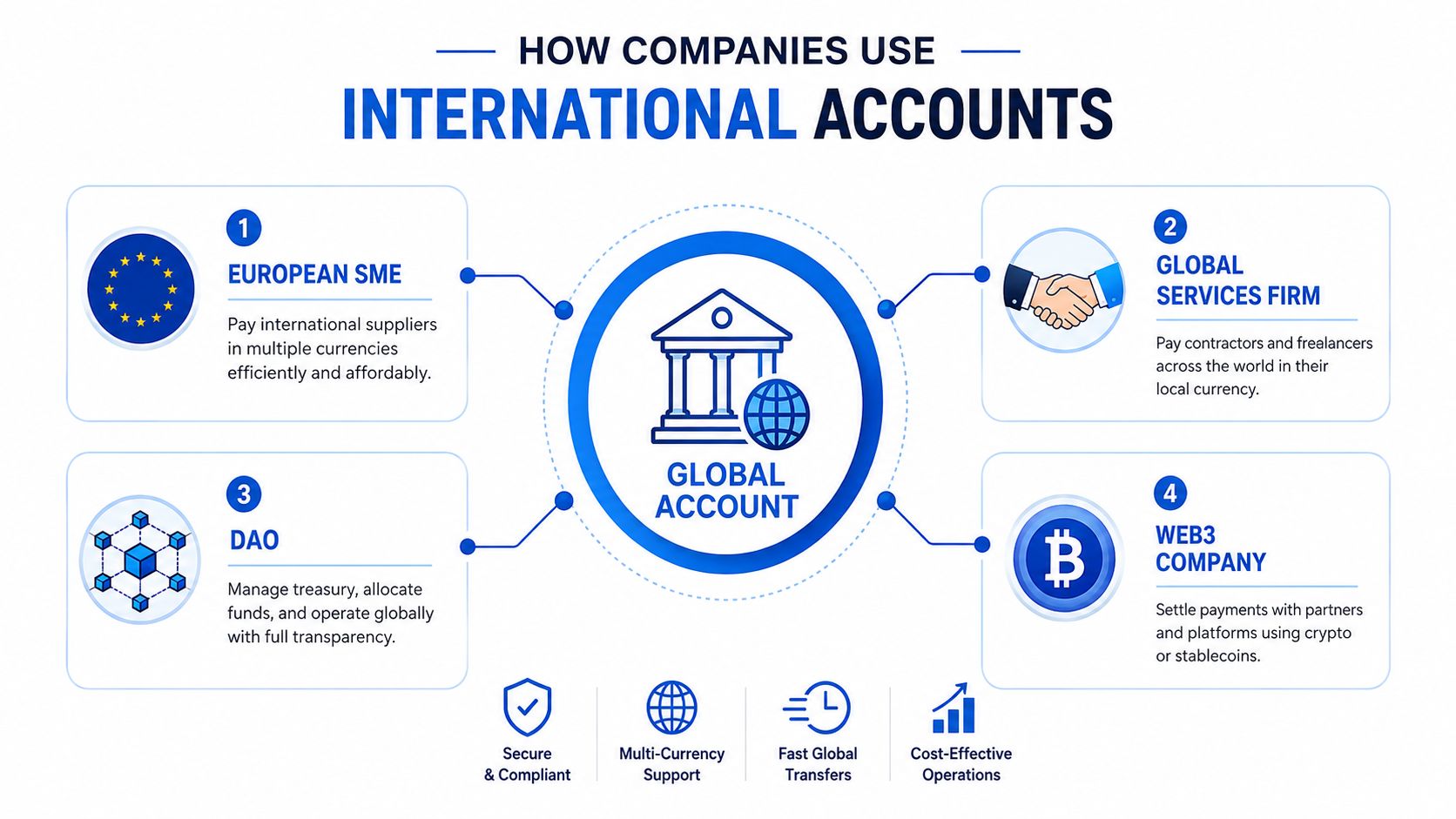
The same account can support very different treasury jobs. A European importer, a contractor-heavy services firm, a DAO, and a web3 company may all need multiple currencies, but their control requirements and payment sequences aren't identical.
Four operating scenarios
A European SME paying suppliers may receive customer revenue in one currency while supplier invoices arrive in another. Holding the supplier currency, where supported, lets the company schedule payments from an existing balance instead of waiting for a conversion before each due date. The operational win is predictable supplier settlement and cleaner invoice matching.
A global services firm paying contractors needs repeatability. The finance lead can collect client funds, group contractor payments by currency, confirm beneficiary details, and release payouts through the appropriate rail. The account doesn't remove the need for review, but it can put preparation, approvals, and records in one process.
A DAO managing a treasury often separates governance from execution. Treasury contributors may propose a payment, an authorized signer may approve it, and the operations team may convert or distribute funds according to an internal policy. The account layer can help coordinate fiat obligations while wallets and on-chain systems handle digital assets.
A web3 company settling on and offchain operations may receive stablecoins, convert part of the balance into operating currencies, and pay vendors through bank rails. The key control is the handoff between wallet activity and fiat accounting. Every conversion needs a clear reference, beneficiary, approval record, and reconciliation path.
For readers tracking the convergence of banking infrastructure and digital assets, blockchain banking news from The Coin Course offers context on how institutions are exploring ledger-based transaction infrastructure. The broader lesson is that crypto-native treasury isn't separate from finance operations. It still needs beneficiary controls, cash forecasting, settlement records, and compliance evidence.
Global Onboarding and Eligibility Requirements
Opening an international account is better understood as a risk assessment sequence than as a form. The provider needs to understand the legal entity, the people who control it, the activities it conducts, the countries involved, and the transactions it expects to make.
Prepare the applicant file first
Start with the company's legal identity. Prepare incorporation records, registered address information, ownership details, director information, business descriptions, expected transaction corridors, and evidence that explains the source and purpose of funds. The exact documents vary by provider and jurisdiction, so don't assume that a certificate of incorporation will answer every question.
Then identify the people behind the company. UBOs, or ultimate beneficial owners, and directors may need personal identification and address verification. Authorized users can face separate KYC checks, even when they don't own the business. Beneficiary verification may also occur when the company adds a recipient or initiates a payment that doesn't match its normal activity.
A practical preparation list includes:
- Entity profile: Legal name, registration information, business model, and operating countries.
- Ownership map: UBOs, directors, control rights, and ownership percentages where requested.
- Activity evidence: Website, contracts, invoices, customer descriptions, and expected payment flows.
- User records: Identification and authorization details for people who will access the account.
- Digital-asset explanation: Wallet ownership, crypto activities, counterparties, and source-of-funds evidence for web3 businesses.
Understand what the provider verifies
The provider checks more than document completeness. It may assess whether the company's jurisdiction is supported, whether its activity falls within an accepted risk category, and whether a partner institution can service the requested currencies and payment corridors. A crypto business may be eligible for one service but not another, depending on the proposed use of fiat accounts, cards, conversions, and digital assets.
Data handling also deserves a place in the diligence file. Teams that operate across jurisdictions can consult material on data residency with digna while asking providers where verification records are stored and who can access them.
Approval isn't the end of compliance. Providers can request updated documents, review transaction patterns, monitor beneficiaries, and ask for explanations when activity changes. Teams considering offshore accounts should treat jurisdiction, ownership transparency, and ongoing reporting as core design questions, not administrative details.
Comparing Providers by Business Needs
A provider should earn its place in the finance stack by fitting the company's payment map. Brand familiarity matters less than whether the account can receive the currencies customers use, pay the corridors vendors require, and produce records the finance team can reconcile.
Use the criteria below as a neutral evaluation scaffold.
| Criterion | What to evaluate | Why it matters | Operating impact |
|---|---|---|---|
| Supported currencies | Holding, receiving, sending, and card support by currency | A displayed currency may not support every function | Reduces unnecessary conversions |
| Payment methods | Local rails, SWIFT, domestic wires, bulk payments, and beneficiary rules | Different corridors need different routes | Influences speed, fees, and supplier experience |
| FX pricing | Spread, stated fee, quote timing, and rate locks | The visible rate may not show total cost | Improves budget and margin control |
| Transfer fees | Outbound, inbound, intermediary, urgent, and return charges | Fee schedules can vary by route | Helps finance forecast payment cost |
| Cards | Virtual and physical cards, limits, merchant controls, and currencies | Team spending needs policy enforcement | Reduces uncontrolled reimbursements |
| Access controls | Roles, approvals, MFA, device controls, and audit logs | Multiple users increase authorization risk | Creates accountable payment operations |
| Crypto support | Fiat on-ramps, off-ramps, stablecoin handling, and wallet controls | Web3 teams need a clear asset transition | Connects digital and traditional treasury |
| Geographic coverage | Entity jurisdictions, user locations, beneficiary countries, and restricted regions | Availability can differ by service | Prevents late-stage onboarding failure |
| Regulatory structure | Bank, EMI, MSB, or partner arrangement | The contracting and custody model affects diligence | Clarifies responsibilities and protections |
| Integrations | Accounting tools, APIs, exports, and reconciliation fields | Manual data movement creates errors | Supports scalable finance workflows |
The strongest choice depends on the operating profile. A cash-intensive company may value branch services, while a remote software business may prioritize local receiving details and API automation. A DAO may put approval governance first, whereas a marketplace may care most about bulk payouts and reconciliation.
Ask each provider to demonstrate a real workflow. Give it a sample customer receipt, a supplier payment, a currency conversion, a card approval, and a rejected beneficiary. The response will reveal more than a feature page.
How OneSafe Supports Global Finance Operations
OneSafe fits the operating model described above by combining multi-currency business accounts, payment functions, corporate cards, and crypto-compatible workflows in one platform. Regulated banking services are delivered through partner institutions, while OneSafe provides the interface for account visibility, onboarding, payment management, controls, and automation.
That structure can support several finance patterns. A SaaS company collecting US dollars and paying euro-denominated contractor invoices can use separate currency balances, payment rails, and FX execution within a centralized workflow. A DAO can coordinate stablecoin treasury movements with fiat operating payments, while a marketplace can organize multi-currency receipts and scheduled payouts.
Mapping the platform to finance work
OneSafe's stated capabilities include USD, EUR, and CAD business accounts, international wires, domestic transfers, ACH, and SWIFT payment support. Its crypto-compatible functions include USDC deposits and withdrawals, crypto payments, and fiat-to-crypto or crypto-to-fiat conversions. For web3 organizations, invoicing can support settlement in crypto or fiat, which helps connect commercial records to treasury activity.
Controls remain essential. Corporate cards can use spending limits, merchant controls, and policy-based approvals, while role-based access can separate payment preparation from authorization. Security measures include mandatory multi-factor authentication and Fireblocks-based digital-asset custody, according to the publisher information provided for this article.
Finance teams should also examine the fee schedule against their own transaction mix. OneSafe publishes plan options, FX pricing, card charges, deposit and withdrawal fees, and SWIFT pricing. The relevant test isn't whether a fee looks low in isolation. It's whether the complete workflow, including conversion, transfer, card, and reconciliation costs, remains understandable at the company's actual volume.
A Practical Verification Checklist
Opening the account is the start of the operating relationship, not the finish line. Before moving meaningful revenue or payroll activity, run a controlled review that tests the provider against the transactions your team performs.
Payment coverage
List every required currency, corridor, beneficiary type, and payment method. Ask whether each route uses a local rail, SWIFT, or another method, then test a low-value transfer to confirm the recipient receives the expected amount and reference.
FX and fees
Request a sample quote for a normal conversion and ask the provider to identify the rate, spread, fixed charge, and recipient-side deductions. Review monthly charges, minimum-balance rules, non-resident surcharges, inactivity fees, card costs, and conversion margins. Swiss banks, for example, may charge non-resident clients CHF 10 to CHF 30 per month, while French residents can face penalties reaching €10,000 for failing to report foreign accounts in applicable circumstances, as discussed in this cross-border banking fee and reporting guide.
Compliance and evidence
Confirm the KYB and KYC documents required before applying. Ask how beneficiary verification works, how long reviews can take, and whether the platform preserves an audit trail for approvals, documents, conversions, and wallet transfers.
Security and controls
Check MFA, role permissions, approval thresholds, device management, card freezes, beneficiary whitelisting, and alert settings. Run a test with separate preparer and approver users rather than assuming the controls work as described.
Recurring operations
Model a complete month of activity, including customer receipts, vendor payouts, contractor payments, card spend, conversions, refunds, and reconciliation. The BIS distinguishes broader cross-border claims from credit measures, and its latest releases show the continuing scale of international banking activity (BIS cross-border claims and credit data). Your provider review should apply the same discipline at company level: define each flow, identify its responsible person, and record its total cost.
OneSafe brings multi-currency accounts, cross-border payments, corporate cards, crypto-to-fiat workflows, and approval controls into one platform for global and web3 businesses. Visit OneSafe to review how its partner-delivered banking services and unified finance tools could fit your company's payment, treasury, and reconciliation workflows.