Meta description: Fibank partners with Bitpanda to offer crypto banking. Learn what this means for businesses and DAOs, and how neo-banks like OneSafe offer full crypto banking.
How Fibank's Crypto Banking Move Impacts Businesses
First Investment Bank (Fibank), one of Bulgaria's largest banks, plans to integrate crypto-asset investment services into its My Fibank mobile app through Bitpanda Enterprise, with launch expected in early 2027. The move marks a significant milestone in crypto banking—legacy banks beginning to embed digital assets into the same interface customers already use for everyday banking. But for businesses and DAOs evaluating crypto banking services, the real question is whether a bank-added crypto layer can match what native neo-banks already deliver.
Table of Contents
- What Just Happened: Fibank Partners Crypto Banking with Bitpanda
- Why This Matters Now for the Crypto Banking Landscape
- What Businesses and DAOs Should Take Away
- Regulatory Context: FDIC Caution vs. European Momentum
- What to Watch Net: More Banks, More Integration, More Demand
- Summary Table: Legacy Bank Crypto Integration vs. Native Neo-Bank
- Key Takeaways
What Just Happened: Fibank Partners Crypto Banking with Bitpanda
The Partnership: How Bitpanda Enterprise Powers the Integration
On October 11, 2026, TokenPost reported that First Investment Bank (Fibank) will integrate crypto-asset investment services into its My Fibank mobile banking app. The underlying infrastructure will be provided by Bitpanda Enterprise, Bitpanda's institutional division, which will exclusively provide the crypto-asset services—a clear deployment of Bitpanda enterprise crypto solutions. The integration means Fibank customers will not need a separate application—crypto investing sits inside the existing mobile banking platform.
This is a classic example of crypto Banking-as-a-Service (BaaS): a regulated bank partners with a licensed crypto infrastructure provider rather than building custody, trading, and compliance systems from scratch. As Lightspark's glossary explains, BaaS lets traditional financial institutions offer crypto products without holding keys or managing blockchain nodes themselves.
Launch Timeline and the 1 Million Customer Milestone
The rollout is expected in early 2027. Fibank reports more than 1 million existing mobile banking customers who would gain access to the new service. According to The Paypers, the move would make Fibank the first bank in Bulgaria to offer crypto-asset investment directly through its own banking app.
For a bank of Fibank's size, this is a low-risk, high-reach strategy: leverage an existing user base and a proven enterprise crypto stack, add a revenue stream, and avoid the capital expenditure of a proprietary build. The trade-off—and the core limitation for businesses—is that "investment services" are not the same as operational crypto banking.
Why This Matters Now for the Crypto Banking Landscape
Mainstream Validation of a Model Neo-Banks Already Run
The Fibank crypto integration matters less for what it launches and more for what it signals: a mid-sized European bank has concluded that crypto demand from its retail base is too large to ignore. It validates a model that neo-banks like OneSafe have operated for years—combining fiat and crypto in a single interface.
But Fibank's version is custodial and investment-focused, not transactional. A retail customer can buy and hold crypto; a business cannot yet use it to pay vendors, run payroll, or manage cross-border invoices in stablecoins. The distinction is crucial. As NerdWallet's guide to crypto banking notes, true crypto banking includes spending, conversion, and payments—not just custody and trading.
The Gap Between Legacy Bank Integrations and Native Neo-Banking
Fibank is not alone. U..S. Bank resumed Bitcoin custody services for institutional investment managers in 2025, using third-party custody partners. Sygnum Bank operates as a regulated digital asset bank. But these are either narrow-use (investment custody) or full-bank replacements requiring significant regulatory capital.
What none of these legacy approaches deliver is the operational flexibility of a native neo-bank for businesses: multi-currency accounts, automated crypto-to-fiat conversion, stablecoin invoicing, and role-based permissions for DAOs. Fibank's move is welcome, but it does not close that gap. It widens awareness of it.
What Businesses and DAOs Should Take Away
The Limitations of a Bank-Aded Crypto Layer
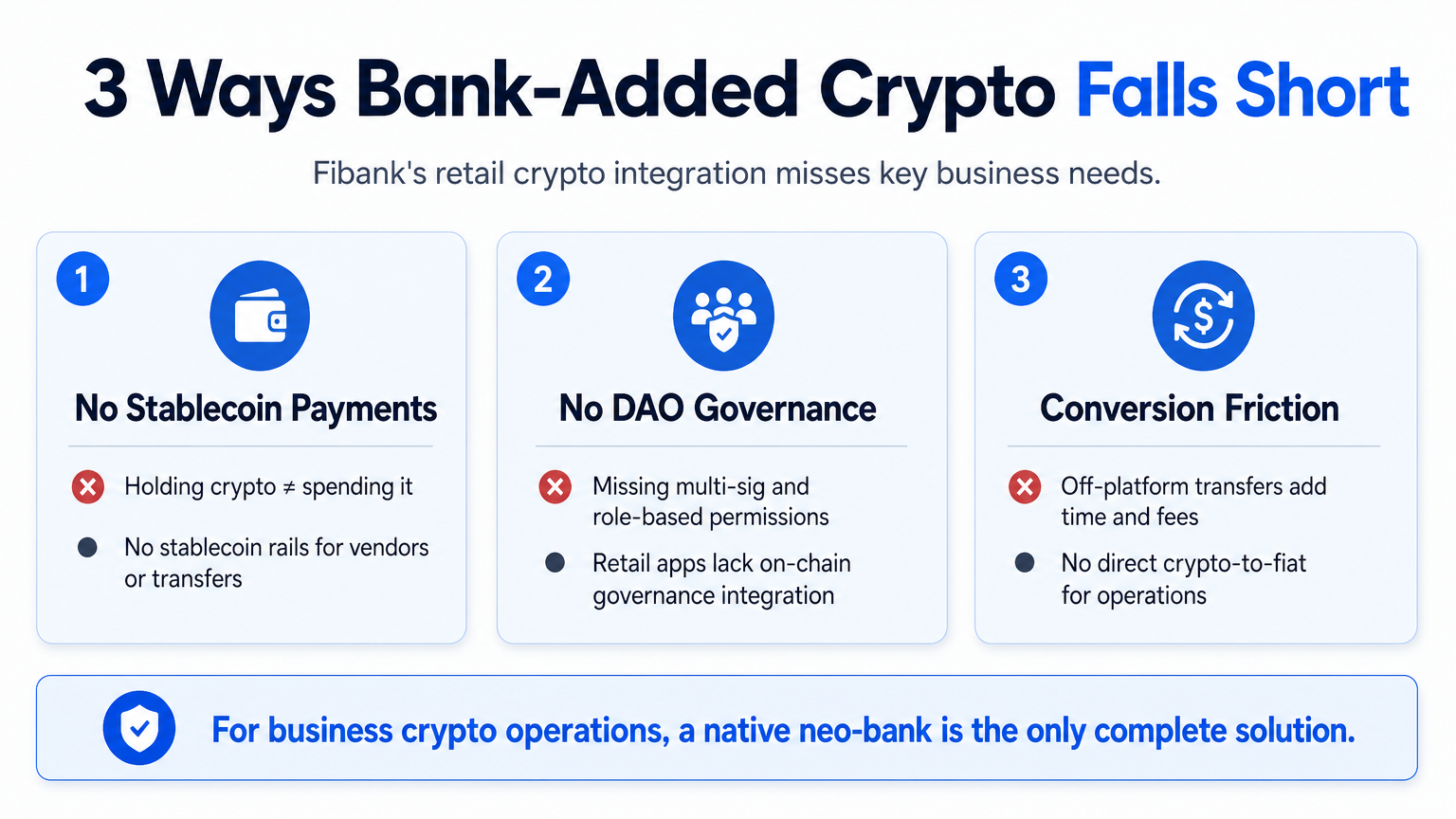
TokenPost's reporting confirms Fibank's integration is a retail product—nvestment services inside a mobile app, not business banking. For a company or DAO that needs to pay contractors in USDC on Tuesday and convert to EUR for payroll on Friday, a bank-added crypto layer falls short in three ways:
- No direct stablecoin payments: holding an asset is not the same as spending it. Fibank's integration does not mention stablecoin rails for vendor payments or cross-border transfers.
- No multi-entity or DAO governance: DAOs require customizable roles, multi-signature approval flows, and on-chain governance integration—features absent from any bank's retail app.
- Conversion friction: even if crypto is held, converting it to fiat for operational use typically requires off-platform transfers, which adds time and fees.
A useful comparison comes from Mecury's business banking for crypto companies, which explicitly separates banking from custody. The regulatory reason: custody carries different capital and insurance requirements than deposit-taking. That is why your crypto is not FDIC-insured, even if it sits inside a bank app.
How Platforms Like OneSafe Already Deliver Multi-Currency, Multi-Aasset Operations
OneSafe—a financial technology company, not a bank—provides the capabilities that legacy banks are still building toward. Through banking partners, OneSafe offers multi-currency business accounts in USD, Euro, and CAD, with crypto-to-fiat conversion and vice versa, corporate cards with spend controls, automated payments, invoicing in fiat and stablecoins, and dedicated DAO banking features like customizable roles and permissions.
The difference is structural. A neo-bank built for crypto-native businesses treats fiat and crypto as two sides of the same ledger, not as an add-on to a retail app.
Regulatory Context: FDIC Caution vs. European Momentum
FDIC Guidance and the US Wait-and-See Approach
In the United States, the Federal Deposit Insurance Corporation has repeatedly cautioned that crypto assets are not insured and carry volatility risk, even when held with a bank partner. This is where the conflict with products like FV Bank's crypto money market accounts becomes explicit.
FV Bank markets its crypto custody and money market accounts as secure and yield-generating. The FDIC responds that no crypto asset is covered by deposit insurance, and customers should not assume principal protection. The reasoned position: FV Bank may be operationally secure, but "secure" is not the same as "insured." Any yield above short-term Treasury rates implies risk; businesses should treat crypto-held funds as risk capital, not operating cash.
The U..S. Bitcoin Resrve Bill conversation further complicates US policy: federal custody of Bitcoin may happen, but that does not extend deposit insurance to private business accounts.
MiCA and Why Europe Is Becoming the Crypto Banking Hub
Europe's Markets in Crypto-Assets (MiCA) regulation, fully applicable to crypto-asset service providers from December 30, 2024, has created a clearer framework. Fibank's move fits a broader pattern: stablecoin regulation deadlines in the EU are forcing banks and providers to choose between compliance and exit. Bitpanda holds a MiCA license, which is why the Fibank partnership works.
For businesses operating across borders, the European trajectory matters more than the American one. MiCA provides a single rulebook; the US remains fragmented. That divergence will drive more companies and DAOs to structure their crypto banking through EU-licensed providers, even if they operate elsewhere.
What to Watch Net: More Banks, More Integration, More Demand
Preictions for European Bank Adoption in 2027–2028
Fibank is unlikely to be an outlier. The cost of BaaS integration is falling, and MiCA has reduced legal ambiguity. Expect a wave of mid-sized European banks to announce similar partnerships in 2027, focused on retail crypto investing first, business banking later—if at all.
The more interesting question is whether any legacy bank will launch a true multi-currency business account with stablecoin payments in the next 24 months. Given the regulatory capital and compliance overhead, it is more likely that banks will continue to partner with neo-banks rather than compete directly.
What Stablecoin Dominance Means for Cross-Border Business Payments
Stablecoin dominance in cross-border payments is no longer speculative. Mastercard's CEO sees a cross-border future for stablecoin payments, and Visa-Gate stablecoin card expansion shows card networks building rails. Stablecoin payments enterprise adoption is accelerating as businesses demand faster, cheaper cross-border settlements. The Fibank integration—while not stablecoin-focused—adds another data point: banks are responding to customer demand for crypto exposure, and stablecoins are the most demanded crypto asset class for business use.
For a business sending payroll to three countries, the arithmetic is simple: a SWIFT wire costs $35–50 and takes 1–3 days; a USDC transfer settles in minutes at near-zero cost. The platforms that can convert USDC to local fiat and pay out via local rails will win.
Summary Table: Legacy Bank Crypto Integration vs. Native Neo-Bank
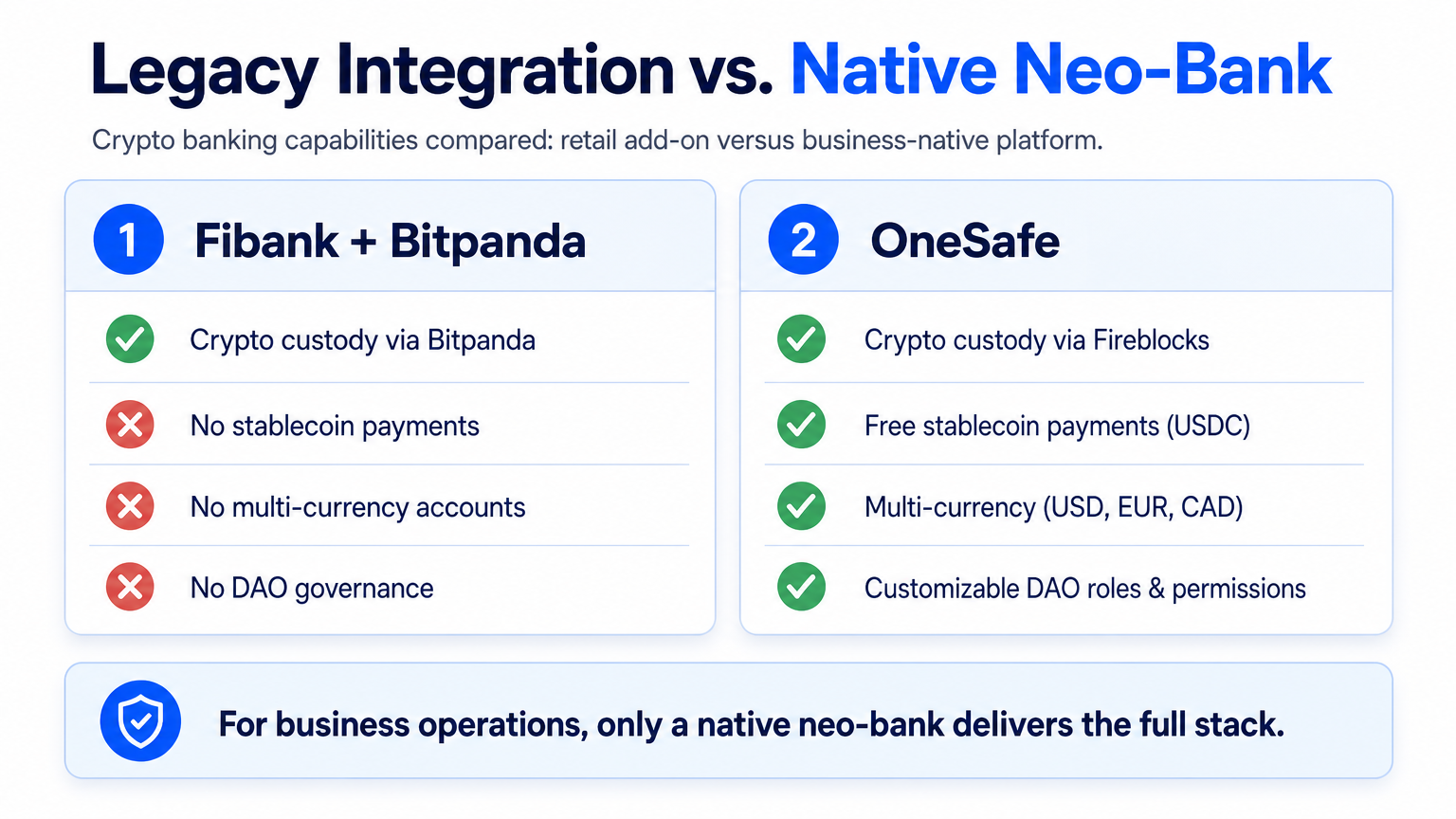
| Capability | Fibank / Bitpanda (retail) | OneSafe (business/DAO) |
|---|---|---|
| Crypto custody | Yes, via Bitpanda | Yes, via Fireblocks |
| Crypto-to-fiat conversion | No (investment only) | Yes, instant |
| Stablecoin payments (USDC) | No | Yes, free deposits/withdrawals |
| Multi-currency business account | No | Yes (USD, EUR, CAD) |
| Corporate cards with spend limits | No | Yes, virtual cards included |
| DAO roles & permissions | No | Yes, customizable |
| Onboarding time | Existing bank customers only | Typically <1 week |
| FDIC insurance on fiat | Yes, for bank deposits | Via partner bank (where applicable) |
| Crypto asset insurance | None | None (market risk) |
Key Takeaways
- Fibank's planned crypto integration, reported by TokenPost on October 11, 2026, is a retail investment feature, not a business banking product—it validates demand but does not serve DAOs or cross-border companies.
- The regulatory gap between FDIC caution in the US and MiCA clarity in Europe means businesses should choose crypto banking providers carefully, understanding that crypto assets are never insured.
- Neo-banks like OneSafe already deliver what legacy banks are only beginning to build: multi-currency accounts, stablecoin payments, and DAO-native governance within a single interface.
- For frequent cross-border payments, stablecoin rails beat SWIFT on speed and cost, and providers that can bridge USDC to local fiat will dominate.
- The next 24 months will bring more bank partnerships, but the operational gap between bank-added crypto layers and native neo-banking will remain.
Open a OneSafe account to manage fiat and crypto in one place, built for businesses and DAOs.