Table of Contents
- description: "Visa and Gate launch a crypto payments card for stablecoin spending in 40+ countries. Learn what stablecoin integration means for startups and DAO treasury stablecoins."
- The Visa-Gate Card: A Milestone for Stablecoin Payments
- Stablecoin Payments Basics
- From Headlines to Your Treasury: Practical Implications
- Getting Started with Stablecoin Payments Today
- What to Watch Next
- Key Takeaways
description: "Visa and Gate launch a crypto payments card for stablecoin spending in 40+ countries. Learn what stablecoin integration means for startups and DAO treasury stablecoins."
Stablecoin Payments Expand: Visa-Gate Card & What It Means
On October 11, 2026, Visa and crypto exchange Gate announced a crypto payments card rollout across more than 40 countries, according to Simply Wall Street.[^1] The card links directly to users’ digital asset balances on the Gate platform, letting holders spend at any merchant in Visa’s global network. By plugging stablecoin payments into existing card rails, this partnership moves stablecoins from specialist apps into the daily checkout flow—and that has immediate implications for the startups and DAOs that want to use stablecoins in their treasuries, payrolls, and cross-border operations without adding another layer of point solutions.
The Visa-Gate Card: A Milestone for Stablecoin Payments
What the deal entails (and what it doesn’t)
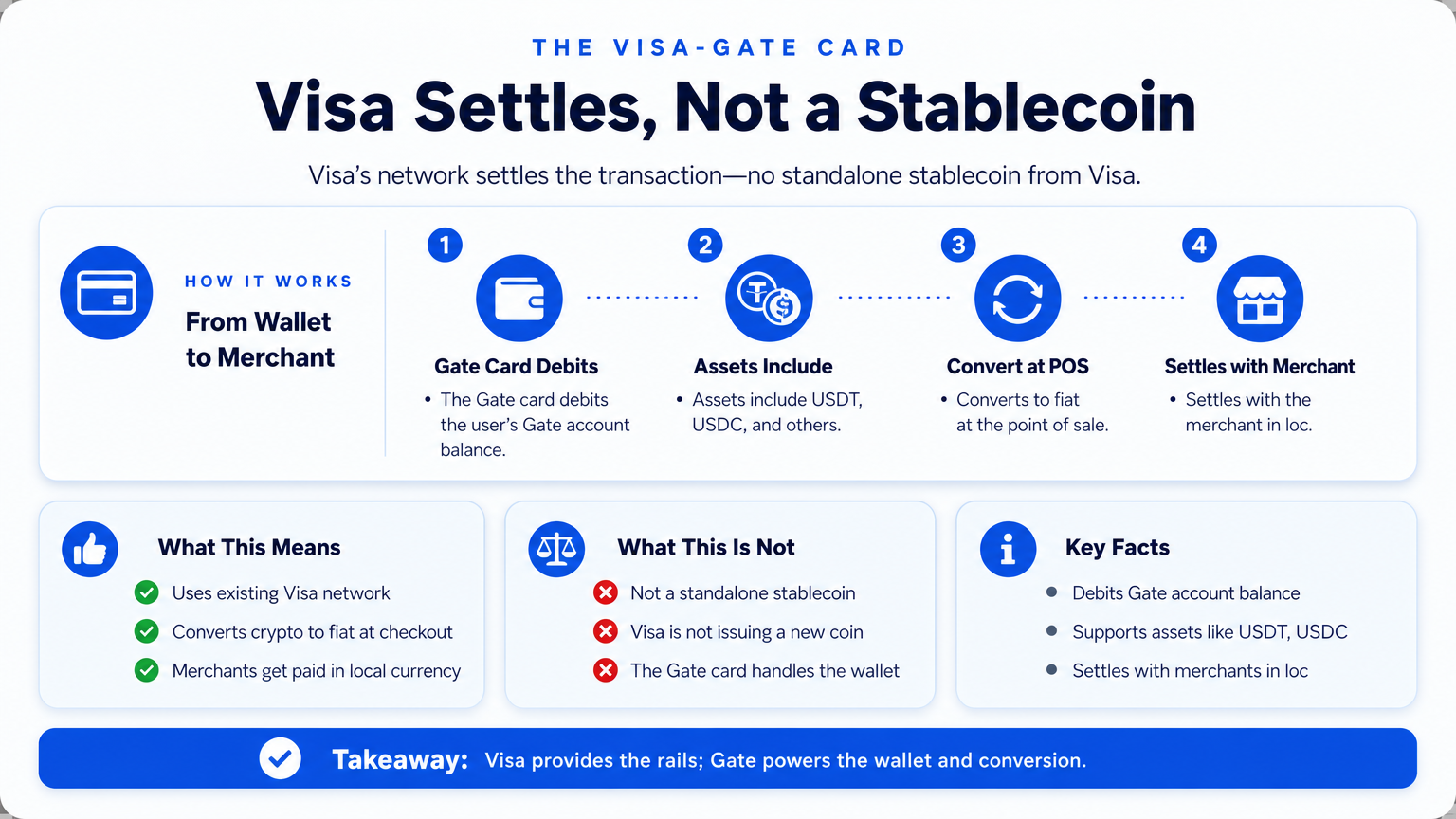
Visa (NYSE: V) is not launching a standalone stablecoin. Instead, its network settles the transaction: the Gate card debits the user’s Gate account balance (in assets that include USDT, USDC, and others), converts to fiat at the point of sale, and settles with the merchant in local currency. The card is rolling out to more than 40 countries,[^1] although Gate has not listed the full set of supported jurisdictions at the time of writing.
- The card works like a typical Visa debit card—spend at any of the 80 million+ merchants that accept Visa.
- Conversion from crypto to fiat happens instantly in the background.
- Issuance, KYC, and custody remain on the Gate exchange, not on a bank’s ledger.
Critically, the card is a consumer-product, not a business card. It does not directly solve corporate treasury challenges such as multi-signature approvals, bill payments in stablecoins, or automated reconciliation with accounting systems. That gap is where a unified fiat-crypto business account becomes the more powerful tool for a startup or DAO.
Why it matters more than previous stablecoin pilots
Earlier stablecoin-card trials—from Crypto.com’s prepaid cards to the Coinbase Card—were largely domestic or limited to a small number of markets. The Visa Gate stablecoin integration extends stablecoin payments into exactly the same rails retailers already use for traditional card transactions, on a near-global scale. It also follows a series of infrastructure moves by payments giants: SAP and Circle partnered on business stablecoin payments,[^2] and Mastercard’s CEO recently stated that stablecoins could reshape cross-border payments.[^3]
The difference now is the breadth of acceptance and the speed of conversion. Visa’s push signals that stablecoin payment processors are no longer a niche; they are becoming embedded in the core payment stack. For businesses that already hold USDC or USDT in their treasury, this lowers the barrier to turning that liquidity into operational spending without pre-funding a separate fiat account.
Stablecoin Payments Basics
A stablecoin is a digital asset pegged to a reference asset, typically the U.S. dollar (USDC, USDT). A stablecoin payment transfers these assets on-chain, where the recipient can hold them or convert to fiat via an off-ramp. The Fireblocks glossary notes that stablecoin payments “leverage blockchain efficiency” to move funds 24/7 with instant settlement finality.[^4]
For cross-border transactions, stablecoin payments beat wires on speed (settlement in seconds, not days), predictable cost (network fees of a few cents versus $50+ wire fees), and round-the-clock availability. However, recipients may need instant fiat conversion (adding a spread and off-ramp fee), refunds/chargebacks don’t exist natively, and regulatory treatment varies by jurisdiction.
From Headlines to Your Treasury: Practical Implications
Cross-border stablecoin payments lower friction for global startups and DAOs
For a startup with contractors in Southeast Asia and customers in Europe, stablecoin payments can collapse a multi-day, multi-bank process into a single blockchain transaction. In a multi-currency treasury, stablecoins serve as a bridging asset: hold dollars in USDC, pay vendors in stablecoins they can instantly swap, or use a corporate card that converts stablecoins at the point of sale—much like the Visa-Gate card, but with business controls. This setup can reduce the need for holding multiple fiat currency balances across several banks, consolidating liquidity in one account. However, it demands careful management of FX risk and compliance.
The compliance and FX trade-offs you need to price in
Stablecoin adoption introduces two cost categories that don’t exist with a single-bank fiat account:
Conversion costs. Moving between fiat and stablecoin incurs a spread and/or fee. For example, a platform might charge 0.15% on fiat deposits/withdrawals and 0.25% on FX conversions. The Visa-Gate card likely embeds a spread in its instant conversion—Gate hasn’t disclosed the exact rate. Businesses must compare this all-in cost against traditional wires.
Regulatory compliance. Accepting or holding stablecoins in a business wallet may trigger money transmission laws. The Coinbase CFTC win brought some clarity,[^5] but rules are evolving. The EU’s MiCA framework imposes a 2027 compliance deadline for stablecoin issuers and service providers;[^6] any business holding or converting stablecoins for customers must track that timeline.
Why a unified fiat-crypto account changes the math
These trade-offs become manageable when a business uses a platform that combines traditional fiat banking features with crypto wallets, rather than patching together separate services. With an integrated account:
- You receive a USD wire, hold it, and convert a portion to USDC with a known fee—without leaving the platform.
- Corporate cards with spend limits and real-time conversion allow your team to spend stablecoin balances just like fiat, but with better controls.
- For DAOs, customizable roles and permissions mean multisig treasury management can sit alongside fiat bill payments and payroll in one interface.
This single-pane-of-glass approach reduces intermediaries and the operational risk of manual reconciliation between crypto and fiat ledgers.
Getting Started with Stablecoin Payments Today
How can my business start accepting stablecoin payments?
Define the use case (inbound customer payments, outbound contractor payments, or internal treasury rebalancing). Check your legal and tax posture—stablecoin receipts may be treated as barter or foreign currency receipts. Then choose infrastructure: for most treasury use cases, a multi-currency business account stablecoins platform that handles both fiat rails and stablecoin wallets simplifies operations. Stablecoin integration for startups often starts with a unified account that bridges crypto and fiat.
What are the fees and limitations?
Fees break into three layers:
- On-chain network fees vary by blockchain. Polygon and Solana cost fractions of a cent; Ethereum mainnet can spike to $20+. Choose a cheaper network for routine payments.
- Conversion and off-ramp fees. Fiat to USDC conversion fees typically range from 0.1% to 1.0%. For instance, a platform like OneSafe charges 0.15% on fiat deposit/withdrawal, $25 for a wire, 0.25% FX (or prevailing rate) for conversions, and free USDC deposits/withdrawals.[^7] Corporate card FX fees may run 3%.
- Limitations. The biggest practical limitation is refund capability—stablecoin transactions are final, with no native chargeback. Businesses selling to consumers must build a trust-based refund process or use escrow. Large fiat conversions may still require a deep-liquidity banking partner, and some processors impose daily limits.
Is it better to use a dedicated stablecoin processor or a combined fiat‑crypto platform?
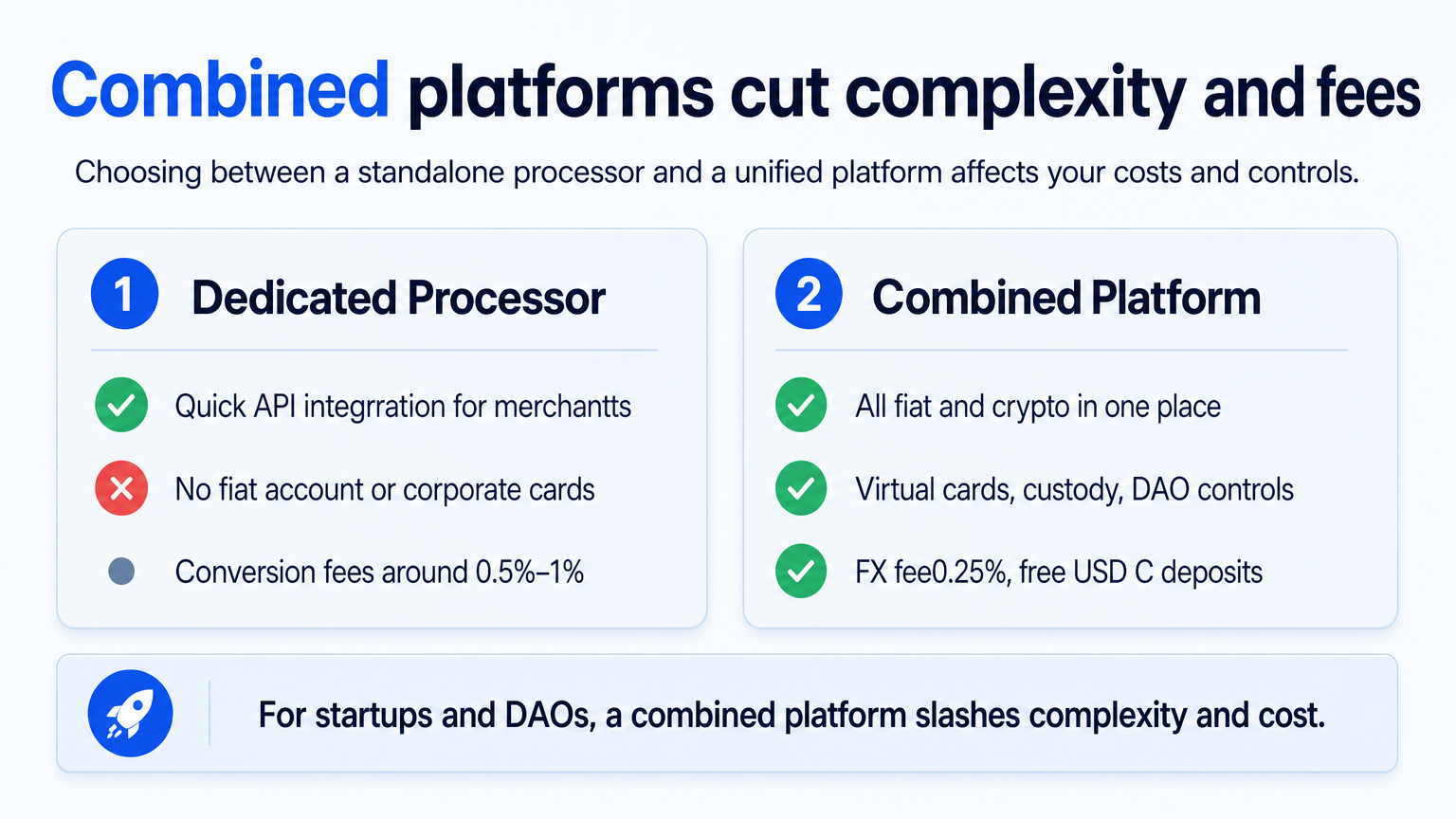
| Feature | Dedicated stablecoin payment processor | Combined fiat-crypto platform (e.g., OneSafe) |
|---|---|---|
| Primary function | Accept stablecoin payments from customers; settle to fiat | Manage all fiat & crypto finances: payments, cards, FX, custody |
| Onboarding | Quick API integration for merchants | Full business account with KYB; typically completed within a week |
| Fiat account | May require a separate bank account for settlement | Multi-currency fiat accounts included |
| Corporate cards | Rarely offered; not core | Virtual cards with spend limits, top-up in multiple crypto tokens |
| FX & conversion fees | Often ~0.5%–1% per conversion | 0.25% FX fee or prevailing rate; 0.15% fiat deposit/withdrawal; free USDC deposits/withdrawals |
| Crypto custody | Usually lightweight; funds converted immediately | Secure custody (Fireblocks) with ability to hold crypto long-term |
| Supported assets | Only specific stablecoins (e.g., USDC on select networks) | USD, EUR, CAD accounts + multiple crypto tokens |
| DAO treasury controls | None | Customizable roles, permissions, and multi-signature workflows |
| Best for | E-commerce merchants wanting to accept stablecoins | Global businesses and DAOs that need a single platform for all treasury operations |
For a startup or DAO that already holds stablecoins and wants to pay contractors or manage fiat-crypto liquidity without juggling multiple services, a combined platform reduces complexity by eliminating the need to pre-fund external wallets and manually reconcile.
What to Watch Next
The U.S. is moving toward a cohesive stablecoin framework, with the Coinbase CFTC ruling[^5] and the $1B card spending surge highlighting consumer demand.[^8] The EU’s MiCA 2027 deadline[^6] will force compliance for platforms operating there. Build on infrastructure that already embeds KYB and AML.
Mastercard has voiced its cross-border stablecoin ambitions,[^3] and network-agnostic crypto cards from Wirex and MetaMask[^9][^10] are expanding. Expect more networks to shrink the functional gap between a crypto wallet and a transaction account.
DAO treasury stablecoins sit at the intersection of crypto-native holdings and real-world obligations—paying contributors and grant recipients. A platform that automates fiat wire and stablecoin payroll while providing multisig governance over outflows is the next step. The recent integration of Euro IBANs into crypto payroll rails[^11] shows payroll is the killer app marrying stablecoin infrastructure with business banking.
Key Takeaways
- The Visa-Gate crypto payments card (October 11, 2026) makes stablecoin payments available at tens of millions of merchants across 40+ countries.
- Treat it as a signal to upgrade treasury infrastructure—a consumer card alone won’t fix multisig controls or accounting integration.
- Choose a unified fiat-crypto business account over a standalone processor to eliminate reconciliation and compliance bottlenecks.
- Watch for regulatory deadlines in 2027 and network expansion from Mastercard and others—the infrastructure is solidifying fast.
Ready to move your business treasury into a single account that handles both fiat and stablecoin payments? Explore OneSafe’s platform and open an account today.
[^1]: Simply Wall Street, “Visa (V) Puts Crypto Spending Into 40 Plus Countries With New Payment Card,” October 11, 2026, https://simplywall.st/stocks/us/diversified-financials/nyse-v/visa/news/visa-v-puts-crypto-spending-into-40-plus-countries-with-new [^2]: Circle Blog, “Stablecoin Payments Enter SAP: What CFOs Should Do Now,” referenced October 2026, https://www.onesafe.io/blog/stablecoin-payments-sap-circle-tereina-what-finance-leads-should-do [^3]: Mastercard, “Stablecoin Payments: Mastercard CEO Sees Cross-Border Future,” https://www.onesafe.io/blog/stablecoin-payments-mastercard-ceo-cross-border [^4]: Fireblocks, “Stablecoin Payments | Glossary,” https://www.fireblocks.com/glossary/stablecoin-payments [^5]: OneSafe Blog, “Stablecoin Regulation Update: Coinbase’s CFTC Win & Your Business,” https://www.onesafe.io/blog/stablecoin-regulation-coinbase-cftc-business-impact [^6]: OneSafe Blog, “EU Stablecoin Regulation: 2027 Compliance Deadline & Actions,” https://www.onesafe.io/blog/eu-stablecoin-regulation-2027-deadline [^7]: OneSafe product facts, as of October 2026. Fees: fiat deposit/withdrawal 0.15%, wire withdrawal $25, SWIFT 0.35%+$50, FX 0.25% or prevailing rate, corporate card FX 3%, USDC deposits/withdrawals free. [^8]: OneSafe Blog, “Stablecoin Regulation: $1B Card Spending Surge Explained,” https://www.onesafe.io/blog/stablecoin-regulation-1b-card-spending-surge [^9]: Wirex, “Stablecoin & Crypto Card for Global Spend,” https://www.wirexapp.com/stablecoin-and-crypto-card [^10]: MetaMask, “Crypto Card | Spend crypto for everyday purchases,” https://metamask.io/card [^11]: OneSafe Blog, “Crypto Payroll Gets a Euro IBAN Boost from Bringin,” https://www.onesafe.io/blog/crypto-payroll-bringin-euro-iban