Your operations lead has been asked to pay a vendor in Berlin, a contractor in Manila, and a SaaS provider in Singapore during the same reconciliation cycle. The finance team sees three fee structures, two unclear FX rates, and a four-day delivery estimate that nobody can explain. That isn't a banking problem alone. It's a process failure in international payment processing.
The right payment stack should tell you which rail fits each corridor, what the recipient will receive, which compliance checks may delay the transfer, and how the transaction will reconcile inside your ERP. This guide focuses on the five decisions worth making this quarter: choosing default rails, calculating landed cost, setting a workable compliance posture, deciding whether crypto-fiat flows belong in the treasury stack, and narrowing vendors by geography and payment profile.
Table of Contents
Why International Payment Processing Matters Now
International payments become expensive when finance teams treat every transfer as a one-off wire. A payment to Germany, the Philippines, and Singapore may involve different local rails, settlement windows, intermediary banks, currency conversions, and beneficiary requirements. The sender sees one instruction. Operations has to manage the entire chain.
That distinction matters because fast messaging doesn't guarantee fast receipt. SWIFT's 2024 data says 90% of payments sent over its network reach the destination bank within one hour, ahead of the G20 target for 75% of cross-border payments to reach the end customer within one hour by 2027 (SWIFT data and G20 target). The remaining friction increasingly sits after the message arrives, in beneficiary-bank posting, local clearing, compliance review, cut-off times, and corridor-specific exceptions.
Treat payment choice as an operating decision
Your default rail should reflect the corridor and use case, not the provider your team happens to know. A recurring euro supplier payment may deserve a local-style rail, while a complex or high-value transfer may require a bank wire. A contractor who accepts stablecoins creates another option, but only if your controls can document the conversion and payout.
Use this decision order:
- Map the corridor. Record send currency, receive currency, beneficiary country, payment purpose, expected frequency, and required arrival window.
- Calculate landed cost. Include transfer fees, intermediary deductions, FX spread, failed-payment risk, and reconciliation effort.
- Confirm compliance fit. Check KYB requirements, sanctions screening, supported business activity, and handling of unusual ownership structures.
- Assess crypto-fiat compatibility. Separate counterparties who can receive stablecoins from those who still need local bank money.
- Test vendors with live corridors. A polished dashboard isn't evidence that the route works reliably at your actual cut-off time.
Practical rule: Judge a payment provider by what the beneficiary receives and how reliably you can reconcile it, not by the fee displayed before you click send.
How Cross-Border Payments Actually Move
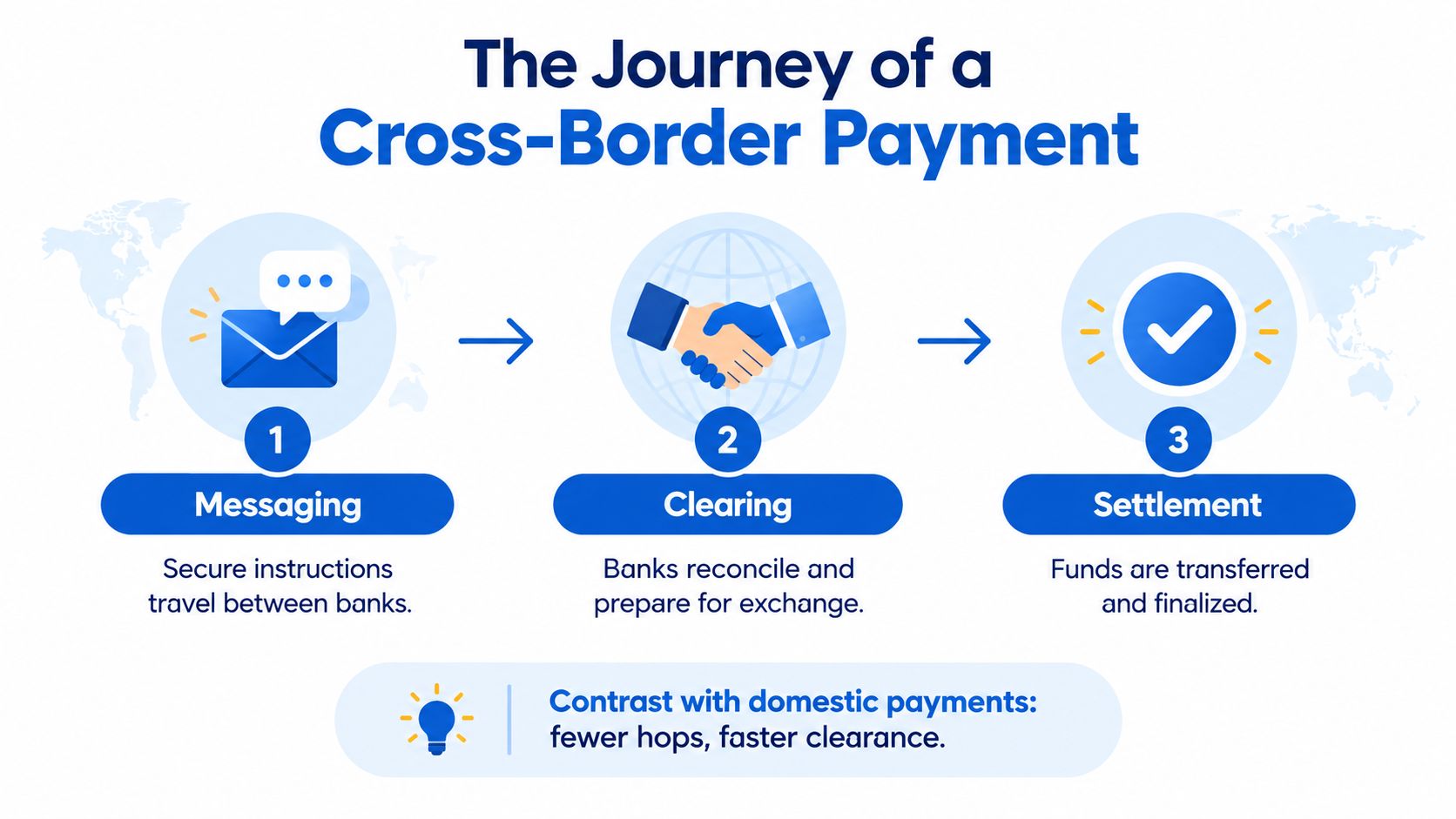
International payment processing is the full stack that moves value between financial institutions in different countries. It includes messaging, which communicates payment instructions, clearing, which determines obligations between institutions, and settlement, which finalizes the transfer of funds. Domestic payments often use one national scheme across these layers. Cross-border payments usually combine several networks and institutions.
The rails your team will encounter
SWIFT is primarily a secure messaging network. Correspondent banks use it to exchange payment instructions, while the actual movement of funds takes place through accounts and settlement arrangements between banks. SWIFT gpi improves tracking and message visibility, but it doesn't remove every downstream delay.
ACH and SEPA resemble domestic rails because they process payments within defined regional or national systems. Businesses can reach them internationally through providers that maintain local accounts, partnerships, or licenses. That can reduce unnecessary correspondent-banking steps when the corridor is supported properly. For a practical comparison of the underlying approaches, review ACH and SWIFT payment differences.
Visa and Mastercard support card-funded payments and payouts. They're useful when the payer already operates through cards or when customer convenience matters, but card economics, chargeback exposure, and settlement rules differ from bank transfers.
API-driven bank transfer networks connect business software directly to payment infrastructure. Their value isn't just a faster API. The provider must still handle account access, currency conversion, compliance, beneficiary validation, and local settlement.
Why correspondent banking still matters
Suppose your bank doesn't hold a direct account relationship with the recipient's bank. It may send the payment through one or more intermediary institutions that maintain the necessary accounts and currency access. Each participant can introduce a compliance review, a cut-off constraint, a deduction, or an exception requiring manual repair.
The stack therefore has three separate questions: did the message arrive, did the banks clear the obligation, and did the beneficiary receive usable funds? Optimizing only the first question creates misleading speed claims. The operational target is an end-to-end payment that arrives in the correct currency, with the expected amount, within the promised window, and with enough structured data to reconcile.
Where Speed and Cost Really Come From
The messaging layer gets most of the attention because it is visible and modern. It isn't the only source of delay, and often isn't the largest cost driver. The practical levers are corridor design, intermediary handling, and FX pricing.
BIS analysis of SWIFT gpi data found a median processing time of under two hours overall, while the fastest corridors completed in under five minutes and the slowest took more than two days (BIS analysis of SWIFT gpi transactions). The same analysis found that fewer intermediaries than expected were involved on average and that agent count had little or no effect on speed. Compliance stops, liquidity positioning, mismatched operating hours, and local processing friction matter more than hop count alone.
Compare the route, not the logo
A USD payment to a USD beneficiary may use a domestic-style route. A USD payment converted into Philippine pesos may depend on correspondent relationships, local liquidity, beneficiary-bank posting, and regulatory checks. Those are different products even if the sender initiates both from the same dashboard.
The table below is a qualitative operating model, not a universal tariff. Your provider should replace each field with corridor-specific evidence.
| Corridor | Typical intermediaries | Per-hop fee | FX spread | Delivery time |
|---|---|---|---|---|
| Same-currency domestic-style route | Few or none | Usually low or disclosed | Usually limited if no conversion | Often quicker |
| Major-currency cross-border wire | May include correspondent banks | Can include deductions | Depends on provider and currency pair | Varies by cut-off and posting |
| Emerging-market payout with conversion | May include local partners and correspondents | Often less predictable | Can materially affect receipt | Sensitive to compliance and local processing |
| Stablecoin-to-fiat payout | Onchain provider and fiat off-ramp | Network and provider pricing apply | Applies at conversion | Depends on off-ramp and bank posting |
Don't choose a route because it has fewer visible hops. Choose it because the provider can show the all-in received amount, explain the settlement window, and support exceptions when the beneficiary bank rejects or holds the payment.
FX, Fees, and the Real Landed Cost
The sticker fee is only one line in the payment. Finance teams should model three layers: the outbound transfer charge, deductions from correspondent or intermediary institutions, and the FX spread between the reference rate and the provider's rate.
For a $10,000 payment, the illustrative calculation in the brief shows a mid-market equivalent of $9,820 received, a 2% bank FX margin reducing that amount to $9,624, then a $35 wire fee and $25 intermediary fee producing $9,564 received. That represents a 2.6% all-in drag in the stated example (FX and landed-cost example data).
Ask for the reference rate
A provider can advertise a free transfer while earning revenue through the exchange rate. That isn't automatically unacceptable, but it must be measurable. Ask for the mid-market reference rate, the exact spread, all outbound charges, possible intermediary deductions, and the amount the beneficiary should receive.
Use this table as a diligence template. It compares the types of costs you should request, not guaranteed market pricing.
| Cost component | Traditional bank | SWIFT fintech | Modern payment platform |
|---|---|---|---|
| Outbound transfer fee | Request the fixed charge and pricing tier | Confirm wire and SWIFT charges | Confirm corridor-specific pricing |
| Intermediary deductions | Ask whether fees are shared or charged to the recipient | Request historical deduction examples | Verify whether local settlement avoids correspondent deductions |
| FX pricing | Demand the reference rate and written spread | Compare quote against mid-market | Check whether pricing is stated by corridor or currency |
| Settlement visibility | Confirm tracking and beneficiary posting status | Review event-level tracking | Test webhooks, status codes, and reconciliation exports |
| Failed-payment handling | Ask who repairs incorrect instructions | Verify investigation workflow | Confirm return fees and re-send process |
A useful internal control is to record the quoted rate, reference rate, sender debit, recipient credit, and payment timestamp for every pilot. Without those fields, your team can't distinguish a provider's fee from an intermediary deduction or an FX loss.
KYB, Compliance, and Data Standards
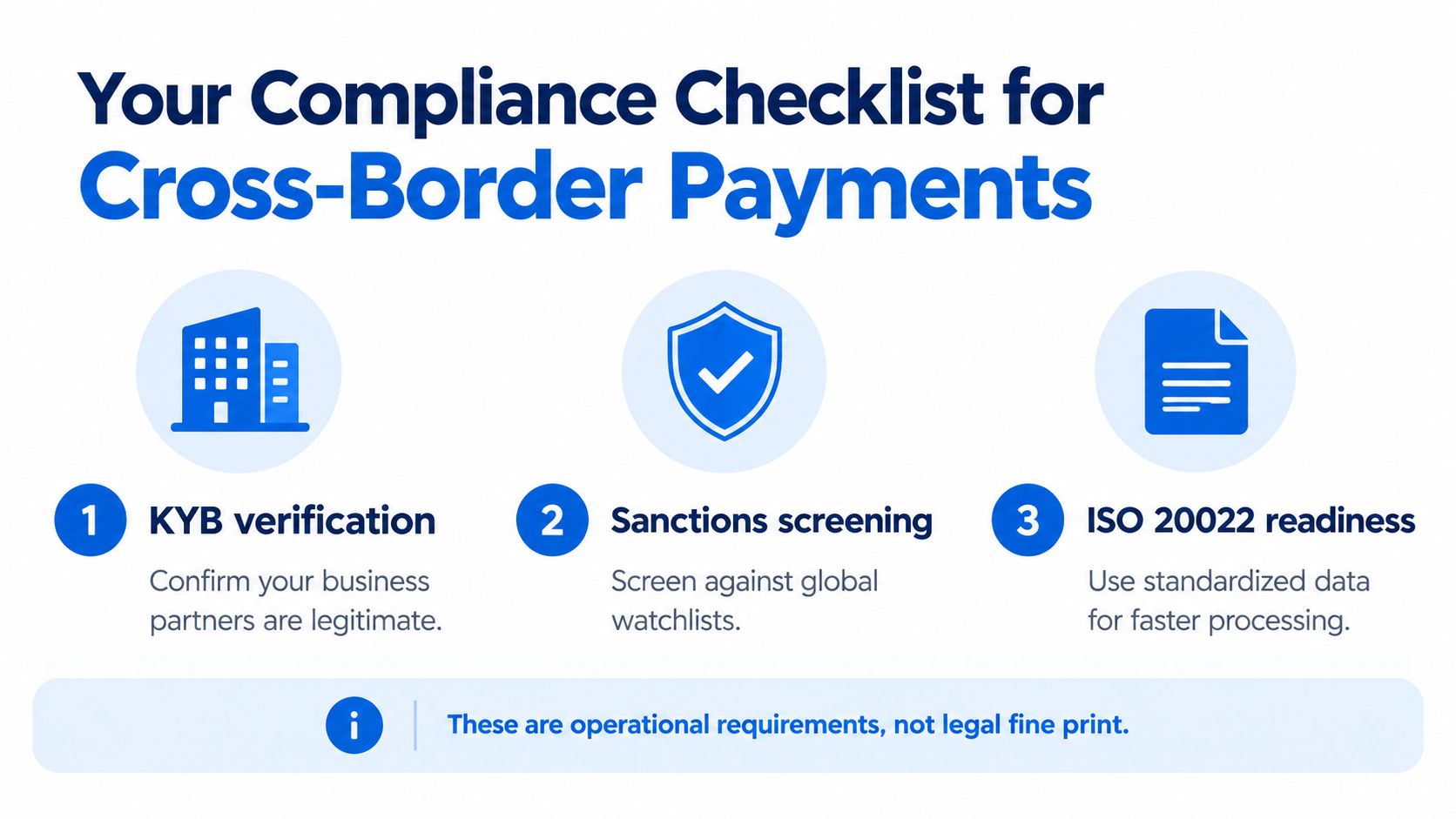
Know Your Business, sanctions screening, and payment data quality belong in operations, not in a legal folder nobody opens until a transfer is blocked. Every provider has its own risk model, but a cross-border business should expect requests for incorporation records, beneficial-owner information, director identification, proof of address, and a clear description of actual business activity.
Ownership structures deserve early attention. A startup with a simple structure may move through onboarding cleanly. A DAO, holding company, trust arrangement, or web3 business with several entities may trigger additional questions about control, source of funds, customers, products, and transaction purpose.
Build the file before the payment is urgent
Sanctions screening can involve relevant lists from the United States, European Union, United Kingdom, and United Nations, along with provider-specific risk controls. Your team should know whether screening happens at onboarding, at transaction time, or both, and what happens when a name match requires review.
ISO 20022 changes the quality of information moving with a payment. Structured addresses, richer remittance data, and identifiers such as Legal Entity Identifiers can support reconciliation and reduce avoidable rejection risk. The migration burden is real, though. Your ERP, invoice workflow, beneficiary master data, and compliance process must produce clean structured information, or faster rails will process bad instructions more quickly (payment infrastructure and ISO 20022 modernization).
Ask each vendor:
- Document requirements: What must be uploaded, and which files need certification or translation?
- Review ownership: Who handles a false-positive sanctions match?
- Message support: Which ISO 20022 fields are required, and are legacy MT messages still supported?
- Data retention: Can you export payment and screening records for audit and reconciliation?
Crypto and Fiat Working Together
For web3 companies, DAOs, and businesses paying contractors in stablecoins, crypto-fiat integration is a treasury design choice. It works when the business separates the onchain asset movement from the regulated fiat payout and assigns controls to both.
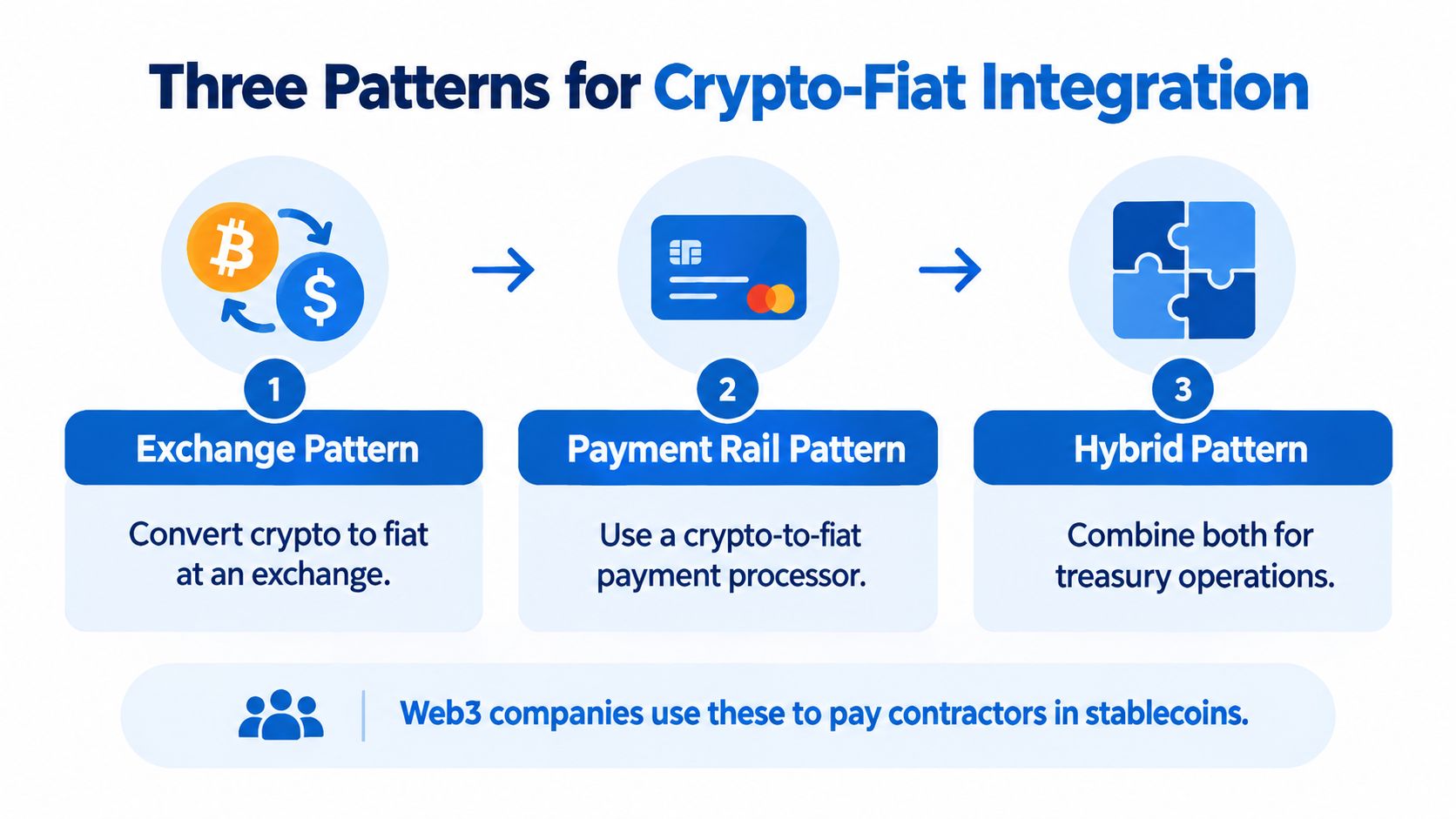
Three patterns are practical.
- Convert at the payout edge. Hold USDC or another supported stablecoin onchain, then convert into local currency through a licensed on-ramp or off-ramp when a contractor needs bank funds.
- Pay in stablecoins directly. Maintain a stablecoin balance and pay contractors in USDC when the contractor accepts it, documents the arrangement, and can manage the asset responsibly.
- Run a hybrid treasury. Receive stablecoins, sweep part of the balance into fiat, and preserve the remainder for crypto-native obligations. This avoids forcing every payment into the same rail.
Stablecoin transfers can settle in seconds and may cost under $1, but those figures don't determine the end-to-end experience. Off-ramp timing, banking-partner reliability, beneficiary verification, licensing, and local payout availability matter more than choosing one chain over another. The off-ramp can become the bottleneck even when the onchain transaction is complete.
Treasurers should also reconcile wallet balances, conversion rates, fees, transaction hashes, beneficiary identities, and fiat settlement records. Teams comparing providers may benefit from evaluating crypto data aggregation tools before they design reporting around fragmented wallet and exchange data.
The deciding question is simple: which counterparties are stablecoin-native, and which still require bank money? If both groups matter, a crypto-compatible business payment workflow should support both without forcing the finance team to maintain disconnected ledgers.
Choosing the Right Vendor for Your Stack
Vendor selection should start with your payment map, not a product demonstration. A SWIFT-native bank may suit high-value wires and established treasury controls. A regional ACH aggregator may be better for recurring local payouts. Card-based processors fit customer payments and card-funded disbursements. Crypto on/off-ramps serve stablecoin-native flows, but their banking and licensing relationships need separate scrutiny.
Score every contender against the same six criteria.
| Criterion | What to verify | Red flag |
|---|---|---|
| Total fee transparency | Recipient credit, sender fee, intermediary treatment, and return charges | “Free” transfer with no FX explanation |
| Corridor coverage | Supported send and receive currencies, local rails, and beneficiary banks | Coverage described by country only |
| FX margin disclosure | Reference rate, spread, quote validity, and reporting | Provider won't state the comparison rate |
| Custody model | Who holds fiat or digital assets, account segregation, and withdrawal controls | Unclear custody or weak withdrawal governance |
| KYB and sanctions fit | Documents, screening model, review path, and supported entity types | Onboarding starts only after a payment fails |
| Web3 compatibility | Stablecoin support, wallet controls, conversion, and reconciliation | Crypto support limited to deposits with no payout workflow |
Test the operating reality
Ask each provider the same two questions:
- What is the all-in landed cost on this exact corridor, for this currency pair and payment amount?
- What does settlement look like at 5 p.m. on a Friday?
The second question exposes cut-off times, weekend handling, liquidity constraints, and whether “same day” means processed by the provider or credited to the beneficiary. Request a sample statement, status webhook, return notice, and reconciliation export before signing.
If your business needs a unified interface for multi-currency accounts, ACH, domestic and international wires, SWIFT, corporate controls, and USDC workflows, OneSafe is one platform to include in the comparison. Evaluate it against the same corridor, pricing, KYB, custody, and reporting tests as every other vendor.
Pitfalls and a 30-Day Action Plan
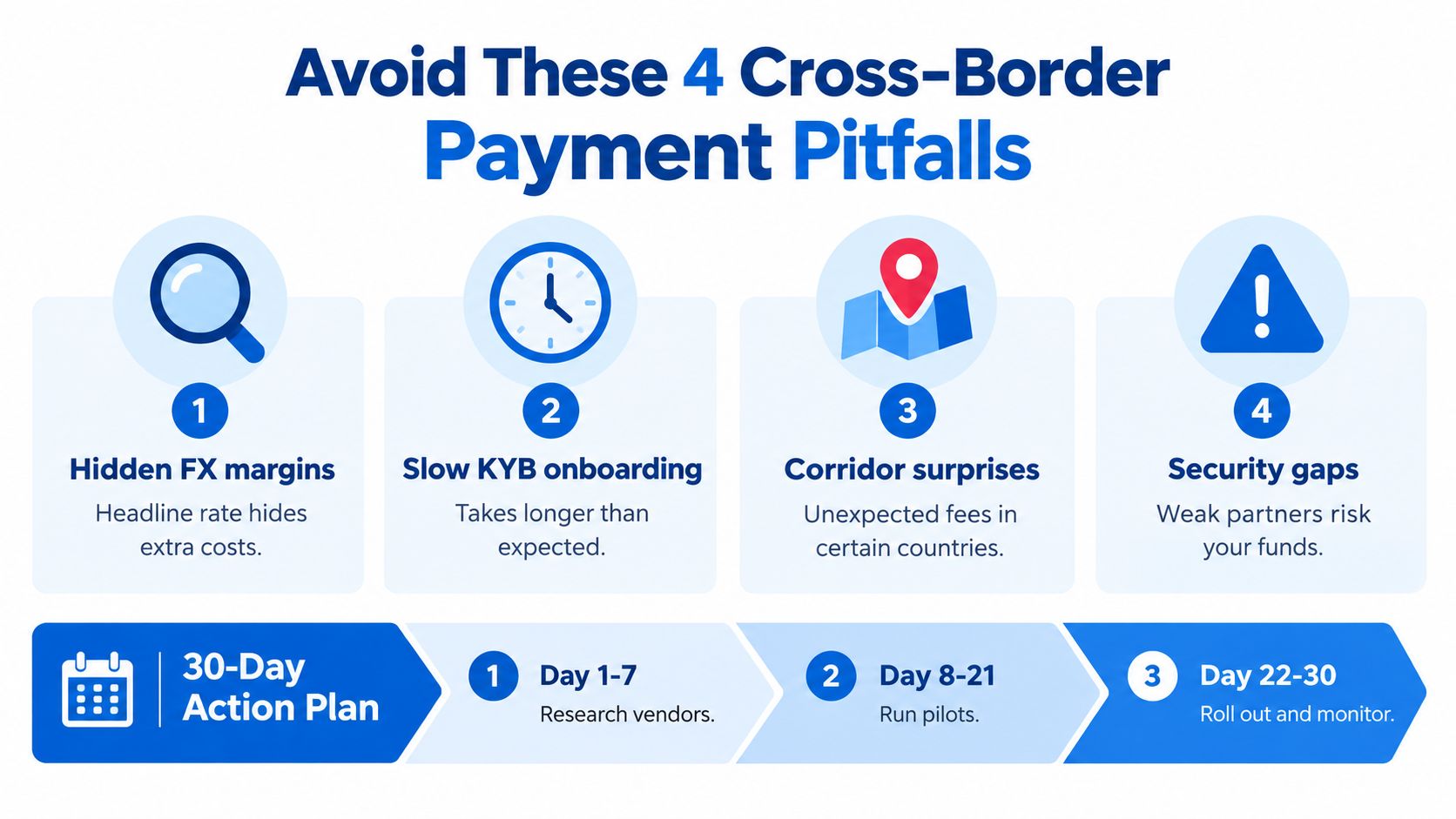
Four failures repeatedly create avoidable cost.
Hidden FX margins make an inexpensive wire look expensive only after settlement. Require the provider to quote the mid-market reference rate, stated spread, sender debit, expected recipient credit, and every known deduction in writing.
Slow KYB onboarding becomes a cash-flow emergency when finance starts the review after an invoice is overdue. Prepare ownership records, incorporation documents, director information, proof of address, and business-purpose details before you need the first production payment.
Corridor surprises appear when a route works in a sandbox but fails with a real beneficiary bank, local currency, or payment purpose. Run a small live transaction, test a return, confirm cut-off handling, and record the actual received amount.
Settlement delays can extend the time between invoicing and usable cash. Put corridor-specific service expectations in writing, then monitor submitted, accepted, cleared, credited, returned, and manually reviewed states separately.
The cost-and-transparency problem is still material for smaller businesses. Global 2025 KPIs showed only slight improvement since 2023, while the average cost of sending $200 rose from 6.4% in 2024 to 6.5% in 2025, and the cost of sending $500 remained 4.3% (FSB 2025 consolidated progress report). Speed alone won't fix a corridor where fees are unpredictable.
Execute the review in four weeks
- Days 1 to 7, map and benchmark: List every corridor, currency pair, payment purpose, frequency, beneficiary type, and required arrival window. Capture the current landed cost and failure points.
- Days 8 to 14, shortlist: Score banks, local-rail providers, payment platforms, and crypto-fiat vendors against the six criteria above.
- Days 15 to 21, run pilots: Complete KYB in parallel, send a small live payment through each serious contender, and test status tracking, reconciliation, and returns.
- Days 22 to 30, standardize: Choose the provider by corridor, document FX reporting, configure approval controls, and monitor actual recipient credit against the quote.
Don't award the contract to the vendor with the cleanest demo. Award it to the provider that can price your exact corridors, onboard your entity, explain every exception, and prove what happens when the payment is sent late on a Friday.
OneSafe gives global businesses a single interface for multi-currency accounts, international wires, local payment flows, corporate controls, and crypto-fiat operations. If you're evaluating international payment processing for an SME, web3 company, or DAO, compare your mapped corridors and landed-cost requirements through OneSafe and start with a controlled pilot.