A finance lead at a global SaaS company is staring at a $48,000 invoice from a supplier in Mexico City. The supplier wants funds quickly, the vendor master contains U.S. bank details for the payer, and the payment deadline is approaching. The obvious question seems simple: should the team send an ACH payment or initiate a SWIFT transfer?
That framing creates expensive mistakes. ACH and SWIFT aren't interchangeable payment methods, and the right choice depends on more than whether a payment crosses a border. The practical decision comes down to predictability versus reach, then to the delivered value, timing, reversibility, compliance requirements, and operational risk within the specific corridor.
ACH remains the dominant U.S. batch payment rail by scale. The Federal Reserve reported 20.109 billion commercial ACH transactions in 2024, worth $42.497 trillion, with an average transaction value of $2,113. The same series recorded 21.585 billion transactions and $47.101 trillion in value in 2025, equivalent to about 86.3 million transactions per business day that year. Federal Reserve ACH statistics show why ACH remains central to payroll, recurring collections, and domestic vendor payments.
SWIFT solves a different problem. It provides standardized financial messaging between institutions across borders, usually through correspondent banking relationships. The rest of this guide treats ACH vs SWIFT as an operating decision, not an academic comparison.
Table of Contents
- ACH vs SWIFT criteria comparison
- Geography determines the first branch
- Speed depends on preparation, not just the rail
- Cost is a total-cost question
- Settlement behavior changes the control design
- Start with the beneficiary's bank
- Put urgency beside the cost
- Inspect the corridor
- Confirm controls and reporting
- Is SWIFT legally required for every international payment?
- How should finance teams compare the fees?
- Can a business run ACH and SWIFT from one account?
- How do crypto-native teams handle fiat payouts?
What ACH and SWIFT Actually Do for a Business
The SaaS finance lead has two very different workflows in front of them. An ACH instruction may be cheap and familiar, but it generally works only when the beneficiary can receive funds through a participating U.S. banking arrangement. A SWIFT payment can reach an international bank, but the payment may travel through intermediary institutions, each adding timing, information, or foreign-exchange uncertainty.
ACH is a domestic clearing rail
ACH, or Automated Clearing House, is a U.S. batch payment network. It processes electronic credits and debits between participating financial institutions. Employers use it for direct deposit, businesses use it for supplier payouts, and companies use it for recurring billing because the network is designed for repeatable, scheduled flows.
The Federal Reserve and the Electronic Payments Network process ACH activity in batches. That structure supports low-cost domestic movement, but it also means funds aren't generally available in real time. Settlement is usually one to three business days, while Same Day ACH still operates within network processing windows and cutoffs, as explained in this ACH and SWIFT timing comparison.
For a U.S. payroll file, that trade-off is acceptable. The treasury team knows the pay date, submits the file ahead of the processing window, and reconciles a predictable batch. For an international supplier, a domestic ACH instruction may not solve the actual delivery problem at all.
Businesses that need a deeper operational explanation can review this guide to ACH payment processing, particularly when deciding whether a domestic credit or debit workflow fits a recurring payment program.
SWIFT carries instructions across institutions
SWIFT is a global financial messaging network, not a bank account and not a settlement system by itself. It began in 1973, founded by 239 banks from 15 countries, and the first message was sent in 1977 after the network expanded to 518 institutions across 22 countries. SWIFT now says its network spans every continent, more than 200 countries and territories, and more than 11,000 institutions worldwide. SWIFT's history and network development explain how the system became foundational to international wires and correspondent banking.
A SWIFT message tells financial institutions how to route and process a payment. The actual movement of funds depends on the banks involved, the currencies used, local clearing systems, compliance checks, and intermediary relationships. International payments commonly settle in one to five business days, and intermediary banks can make delivery less predictable. Routable's ACH versus SWIFT overview outlines that operational difference.
Practical rule: Use ACH when the beneficiary and payment purpose fit the U.S. domestic batch system. Use SWIFT when the payment needs international bank reach, structured cross-border messaging, or a correspondent route.
Comparing ACH and SWIFT on the Criteria That Matter
A finance lead needs a matrix that can survive a payment-operations meeting. The table below focuses on the criteria that affect execution, not on superficial labels.
ACH vs SWIFT criteria comparison
| Criterion | ACH | SWIFT |
|---|---|---|
| Geography | Primarily U.S. domestic | International reach across more than 200 countries and territories |
| Processing model | Batch processing through ACH operators | Financial messaging through banks and correspondent institutions |
| Typical settlement | Usually 1 to 3 business days | Commonly 1 to 5 business days for cross-border payments |
| Same-day capability | Same Day ACH operates within network cutoffs | Timing depends on bank, corridor, currency, and cutoff alignment |
| Cost profile | Generally lower for routine domestic payments | Higher potential fees, intermediary charges, and FX costs |
| Best operational fit | Payroll, recurring billing, and U.S. supplier batches | Cross-border B2B, regulated corridors, and large international payments |
| Reversibility | Certain transactions may be returned, disputed, or reversed under applicable rules | Settled wires are generally harder to recover |
| Reach and routing | Depends on domestic participation and account details | Uses international institution identifiers and correspondent relationships |
Geography determines the first branch
ACH is the natural choice for a U.S. employee payroll run or a batch of payments to U.S.-based suppliers. SWIFT is the practical default when the beneficiary bank is outside the United States and the payment needs an international banking route.
That doesn't mean every cross-border payment must use a traditional SWIFT wire. A provider may collect funds through a domestic ACH account and complete the final payout through a local rail. The treasury question is whether the beneficiary can receive the payment through the route selected.
Speed depends on preparation, not just the rail
ACH rewards scheduling. Submit the file before the applicable window and the business can manage routine payment dates with relatively little intervention. Miss the window, and a payment may wait for the next processing cycle.
SWIFT can be faster for an urgent international payment, but it isn't automatically immediate. Cutoffs, intermediary banks, sanctions screening, currency availability, and beneficiary-bank processing all affect the final arrival time. A finance team should compare delivered funds by the required deadline, not just the time needed to create the instruction.
Cost is a total-cost question
ACH usually wins the headline fee comparison for domestic, high-volume payments. SWIFT can add sending-bank fees, receiving-bank deductions, correspondent charges, and an FX spread. Those costs matter more when the payment is frequent or the invoice value is modest.
For a large supplier payment, the fee itself may matter less than failed delivery, trapped working capital, or a missed contractual deadline. Cost should include the operational consequences of delay and repair work.
Settlement behavior changes the control design
ACH batches make it suitable for scheduled processes, but they don't provide continuous real-time settlement. SWIFT sends instructions through a chain of institutions, which gives international reach but creates more points where information or timing can diverge.
Treasury teams should build beneficiary verification, payment approval, cutoff calendars, and reconciliation around that difference. Don't select a rail first and discover its control requirements after a payment fails.
Why the Real Question Is the Corridor, Not the Rail
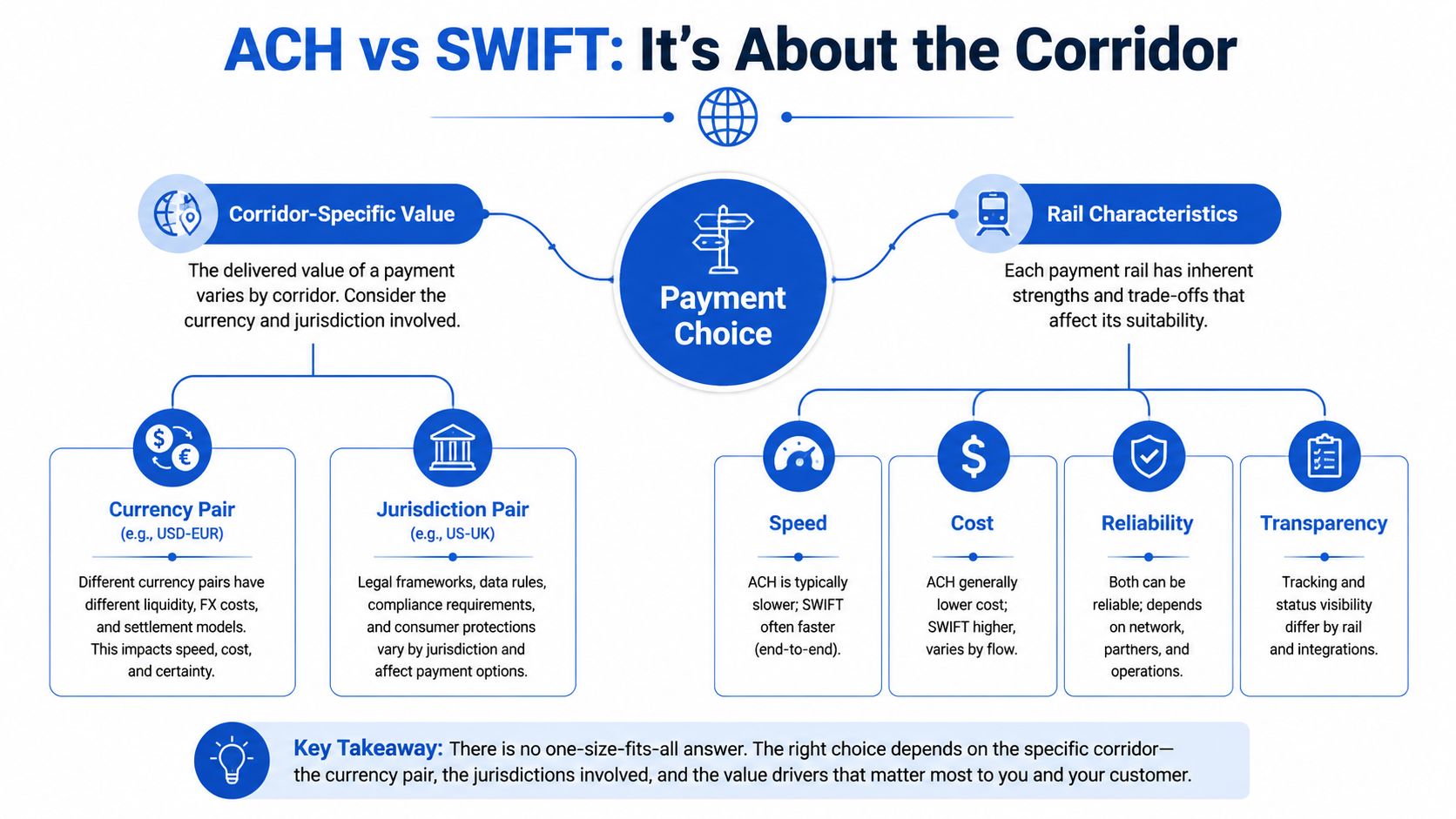
The strongest payment decision isn't “domestic or international.” It's which route delivers the expected currency, amount, and traceability to this beneficiary in this jurisdiction.
A payment from the United States to Mexico behaves differently from one sent from the United States to a euro-area beneficiary. Currency conversion, local clearing access, beneficiary-bank requirements, intermediary availability, and compliance review can all change the result. The same SWIFT instruction can therefore produce a different delivered-value outcome across two corridors.
Evaluate delivered value
A treasury operator should compare four outputs for each corridor:
- Beneficiary amount: How much arrives after FX conversion and any deductions?
- Delivery certainty: Can the payer identify the expected arrival window before submitting?
- Traceability: Can the team see where the payment sits if the beneficiary doesn't receive it?
- Operational fit: Do cutoffs, documentation, and local account requirements match the business process?
This is why a domestic ACH credit followed by a local payout can sometimes outperform a direct SWIFT wire into Mexico, Brazil, or the Philippines. The domestic leg may fund a provider efficiently, while the local payout reaches the beneficiary through infrastructure designed for that jurisdiction. The right comparison is the full movement of money, not the first instruction the payer submits.
SWIFT is also addressing the information gap. Its new payments scheme is designed around upfront fee and FX transparency, full-value delivery, more efficient last-mile processing, and end-to-end visibility. SWIFT has described a 2026 rollout planned across more than 40 banks, with initial live processing already underway in more than 25 banks across 11 countries. Those figures and the planned timing come from SWIFT's consumer-payments framework announcement.
For finance teams, better tracking won't eliminate corridor differences. It will make them easier to measure. A payment platform that supports cross-border workflows should expose the route, FX outcome, charges, and status rather than treating every international payment as an opaque wire. Teams evaluating this model can review cross-border payments infrastructure through that corridor-specific lens.
The winning rail is the one that delivers the right value, in the right currency, through the right jurisdiction, with enough visibility to reconcile it.
When ACH Is Not the Cheapest Option You Have
ACH has a powerful cost advantage for planned domestic payments. But the nominal transaction fee isn't the full economic cost, especially when the payment is urgent, difficult to recover, or tied to a production deadline.
Reversibility carries a price
ACH's dispute and return characteristics can protect a payer from certain errors, but they can also create uncertainty for the recipient. A supplier may treat an ACH credit as pending until the funds are fully available and the transaction risk has passed. A wire's settlement is generally more final, which can be a feature when both parties need certainty.
Suppose a vendor payment is reversed after the supplier has released inventory. The finance team now has to investigate the return, confirm the beneficiary details, repair the invoice status, and send the money again. Even without a large bank fee, the administrative cost and commercial damage can exceed the original ACH saving.
Cutoffs create hidden timing costs
Same Day ACH still depends on network windows. A payment submitted after the relevant cutoff may move to the next business day, while the vendor continues to measure performance against the original due date. That delay can trigger a late fee, hold an account release, or stop a supplier from starting work.
SWIFT has cutoffs too, and correspondent chains can introduce their own delays. The difference is that an international wire may be the only viable route when the beneficiary requires funds in a foreign bank account and the deadline is firm. The correct comparison is not “cheap ACH versus expensive SWIFT.” It's planned ACH versus the cost of missing the operational window.
Urgency changes the answer
A payment needed before a local business opening may justify a higher-cost wire because the alternative exposes the company to a much larger commercial risk. This is especially true for a critical supplier, a closing condition, or a regulated counterparty that won't release assets until cleared funds arrive.
The BIS describes ACH-like deferred net settlement systems as unable to make funds available in real time, while Same Day ACH remains tied to banking windows rather than continuous availability. At the same time, G20 cross-border payment targets aim for 75% of payments to be available within one hour by the end of 2027, a target discussed in the BIS overview of cross-border payment improvements.
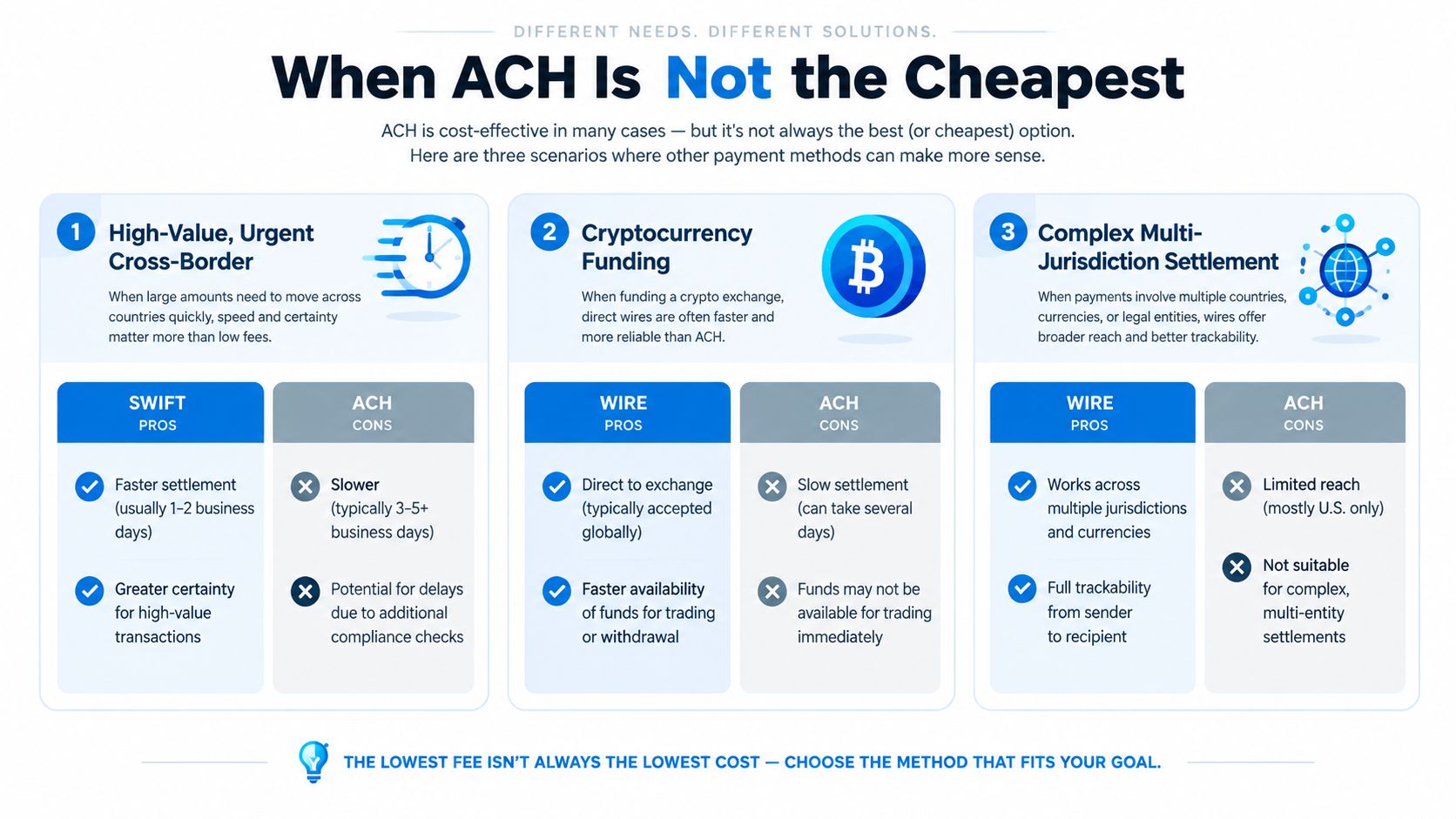
The operator's rule is simple: price timing risk before approving the cheaper rail. ACH is inexpensive when the business can plan around its windows. It isn't automatically inexpensive when a missed cutoff threatens revenue, inventory, payroll, or a contractual obligation.
ACH and SWIFT Use Cases by Business Type
The best rail depends on the payment pattern, the beneficiary's bank, and the consequence of delay. Geography helps identify the candidates, but the operating purpose makes the recommendation.
ACH vs SWIFT use cases by business pattern
| Business Pattern | Recommended Rail | Why It Fits |
|---|---|---|
| U.S. payroll | ACH | Employers can submit a batch ahead of payday and provide direct deposit through a familiar domestic process |
| U.S. supplier payouts | ACH | High-volume payments benefit from scheduled processing and domestic account reach |
| Recurring subscriptions or collections | ACH | Credits and debits support predictable billing cycles and repeatable authorization workflows |
| Cross-border B2B invoices | SWIFT or a corridor-specific local payout | The beneficiary may need international routing, foreign currency, and bank documentation |
| Regulated-jurisdiction payments | SWIFT | Banks and counterparties may require structured payment information and compliance review |
| Large-value treasury settlement | SWIFT or another appropriate wire route | Greater finality and international reach can matter more than a low nominal fee |
| Payments where local rails are fragmented | SWIFT | A correspondent network may provide the route needed to reach the beneficiary bank |
Where ACH earns the default
A U.S. employer paying domestic staff has a clear use case. The payer sends one payroll file, employees receive funds through their bank accounts, and the treasury team can reconcile the batch against the payroll register.
The same logic applies to a software company paying a group of U.S. vendors. If invoices are approved before the processing window, ACH reduces manual intervention and avoids treating every supplier as a separate urgent wire. Subscription businesses also use ACH credits or debits when customers and merchants can align payment authorization with recurring billing cycles.
Where SWIFT earns its cost
A U.S. manufacturer paying a foreign component supplier may need SWIFT because the supplier's bank requires international settlement and supporting information. A regulated financial institution may also need a structured message and a clear audit trail before releasing funds.
Large-value settlement presents a different rationale. A corporate treasury entity paying another treasury entity may prioritize finality, beneficiary verification, and cross-border reach over the lowest possible unit fee. Businesses working through complex corridors should review B2B cross-border payment workflows before selecting a standard payment template.
If a jurisdiction has weak, fragmented, or unreliable local clearing access, SWIFT can provide the correspondent route that a domestic ACH process can't. The payer still needs to confirm fees, timing, currency, and documentation before submission.
How Multinational and Crypto-Native Teams Use Both
Multinational finance teams rarely have the luxury of choosing one rail for every payment. They may pay U.S. contractors through ACH, fund a European operating account through a local transfer, send a regulated international invoice through SWIFT, and convert digital assets into fiat for a supplier during the same close period.
That creates a systems problem. Each bank portal can have different beneficiary fields, approval rules, cutoff calendars, status codes, and statement formats. The payment itself may be correct while reconciliation becomes slow because the team has to assemble evidence from several disconnected systems.

One beneficiary record, multiple payment decisions
A unified treasury workflow should separate the beneficiary from the rail. The vendor record holds the approved bank and compliance information. The payment instruction then selects ACH, SWIFT, a domestic wire, or a supported digital-asset conversion based on the invoice and corridor.
That distinction matters for crypto-native companies and DAOs. A team may hold USDC, need to convert part of its treasury into local currency, pay U.S. contractors through ACH, and settle a regulated overseas counterparty through SWIFT. Re-keying the same beneficiary across separate workflows increases the chance of account errors and makes the close harder to audit.
OneSafe is one example of a platform that combines multi-currency business accounts with ACH, domestic and international wires, SWIFT transfers, stablecoin workflows, beneficiary records, and unified reporting in one interface. The practical value isn't choosing a single rail. It's allowing the operator to make a payment-level decision without changing the underlying banking workflow every time.
A treasury team can also use this type of setup to keep balances in the currency required for an upcoming payment, apply approval controls before release, and reconcile fiat and crypto activity against the same ledger. Those controls don't remove corridor risk, but they make the risk visible before the payment is submitted.
The following video provides additional context for teams designing payment workflows across fiat and digital assets.
Choosing the Right Rail for Your Next Payment
Use a short decision process before anyone clicks submit. The purpose is to prevent a routine ACH instruction from being used for a payment that requires international reach or a firm delivery deadline.
Start with the beneficiary's bank
If the beneficiary bank is in the United States and the payment is routine, ACH deserves the default. If the beneficiary bank is outside the United States, an international route enters the decision immediately. That may be SWIFT, or it may be a domestic funding leg followed by a local payout supported by the provider.
Don't classify the payment by the vendor's headquarters alone. A global supplier may invoice from one country while receiving funds through an account in another.
Put urgency beside the cost
Ask when the beneficiary must have usable funds, not when the treasury team must send the instruction. Planned payroll and recurring vendor batches can use ACH when the schedule leaves room for processing windows.
A payment needed the same day, particularly after the relevant ACH cutoff, should be evaluated for a faster international or wire route. The decision should include the cost of a late delivery, not merely the fee displayed on the payment screen.
Inspect the corridor
Review the currency pair, beneficiary jurisdiction, local payout method, expected deductions, and FX conversion before choosing SWIFT. Corridors such as the United States to Mexico, the Philippines, or certain African markets may produce different outcomes depending on local payout availability and correspondent-bank pricing.
The right question is whether the beneficiary receives the expected amount with sufficient traceability. A local payout option can be preferable where it provides clearer delivered value than a direct SWIFT chain.
Confirm controls and reporting
Sanctions screening, beneficiary verification, approval policies, and documentation requirements must match the counterparty and jurisdiction. Don't assume that a high-value or regulated payment should use SWIFT solely because it sounds more formal. Confirm what the beneficiary bank and compliance process require.
Running both rails through one business account can reduce reconciliation breaks. The team keeps shared beneficiary data, payment approvals, and reporting in one workflow instead of logging into separate bank portals for a single invoice.
Frequently Asked Questions About ACH vs SWIFT
Is SWIFT legally required for every international payment?
No. SWIFT is a messaging network, and not every international transfer must use the same route. The beneficiary bank, currency, jurisdiction, financial institutions, and provider determine the available method.
A regulated or sanctions-sensitive corridor may require more structured bank messaging and enhanced review. Don't treat SWIFT as a universal legal requirement. Confirm the receiving bank's instructions and the compliance requirements for the transaction.
How should finance teams compare the fees?
Start with the amount the beneficiary receives. ACH generally has a lower nominal cost for domestic payments, while SWIFT can involve sending-bank, correspondent, receiving-bank, and FX charges.
Then add the cost of delay, repair work, rejected payments, and missed cutoffs. A low-fee ACH instruction isn't economical if it arrives too late for the supplier's release condition. A higher-cost SWIFT payment may be financially rational when certainty and international reach protect the underlying transaction.
Can a business run ACH and SWIFT from one account?
Yes, if its banking or payment platform supports both methods. The important controls are shared beneficiary records, clear approval rules, consistent payment status reporting, and reconciliation that distinguishes the rail without splitting the ledger.
The platform should also show the expected route and currency outcome before submission. That gives treasury a payment-level choice instead of forcing the business to maintain separate workflows for every banking relationship.
How do crypto-native teams handle fiat payouts?
They typically convert a treasury-held digital asset into the currency needed by the beneficiary, then select the appropriate fiat rail. A U.S. contractor may fit an ACH workflow, while a regulated overseas counterparty may require an international bank transfer or SWIFT route.
The operational challenge is keeping the conversion, beneficiary approval, payment instruction, and accounting record connected. A unified ledger can help the team avoid re-keying the same vendor and can make the fiat and digital-asset sides of the payout easier to reconcile.
OneSafe provides multi-currency business accounts and payment workflows that support ACH, domestic and international wires, SWIFT transfers, and crypto-to-fiat operations from a unified interface. If you're tired of choosing rails through disconnected bank portals, visit OneSafe and evaluate whether its workflow fits your next domestic or cross-border payment.