
On September 13, 2026, Ripple declared it is targeting the $13 trillion corporate treasury market to expand its stablecoin business — a move that forces finance leaders to rethink crypto treasury management from the ground up. A bearish market report published only hours earlier warns that bitcoin could crash to $10,000 as it increasingly mirrors volatile U.S. equities. Together, these events demand founders and finance leads stop treating “crypto” as a single asset class. Instead, they must split settlement rails from reserve assets — and then build the operating stack that makes that split work.
Table of Contents
- What just happened: Ripple's corporate treasury push and a bitcoin risk warning
- Why this matters now for crypto treasury management
- The background: crypto treasury management in one minute
- Implications: what founders and finance leads should do now
- What to watch next and open questions
- Key Takeaways
What just happened: Ripple's corporate treasury push and a bitcoin risk warning
Ripple's $13T stablecoin bet (reported September 13, 2026)
Pluang reported that Ripple is targeting corporate treasury as a $13 trillion opportunity to grow its stablecoin business. Ripple intends to bring blockchain-based settlement to corporate treasurers through Ripple Treasury, positioning stablecoins — primarily RLUSD — as a faster, programmable alternative for payouts and liquidity management. The global corporate treasury market handles trillions in payment flows and inter-company netting, much still bound by correspondent banking friction. As Kranz Consulting notes, digital asset treasury operations require structured frameworks that most corporate teams lack.
This isn’t Ripple’s first enterprise push, but it explicitly frames the corporate treasury stack — not cross-border remittances or speculation — as the next adoption surface. Platforms like Banxa's crypto treasury management are already building infrastructure to connect corporate workflows with on-chain settlement.
Bitcoin's 'digital gold' status collides with equities (reported six hours ago)
A bearish market report via Pluang, undated but current, states bitcoin risks falling to $10,000 as it loses its independent “digital gold” status and now closely tracks the S&P 500. The report ties this to fears of Federal Reserve tightening, warning that an equity correction could pull bitcoin down with it.
For treasury teams, the implication is sharp: volatile crypto reserves can no longer be assumed an equity diversifier. The bitcoin-equity correlation once dismissed as temporary now appears structural. As Fortris explains, finance teams must build allocation frameworks that account for this relationship.
Why these two stories belong in the same conversation
The same morning that one corner of crypto markets pitches $13 trillion in corporate stablecoin adoption, another warns the flagship crypto reserve asset could see a 70% drawdown. This contradiction proves that stablecoin settlement infrastructure and volatile crypto reserve allocation live on completely different logic paths. Conflating them corrupts treasury governance.
Why this matters now for crypto treasury management
The two news items cement a split that was long overdue: one conversation is about payment rails — faster, cheaper stablecoin settlement — while the other is about reserve assets held for appreciation or hedging. For years, crypto treasury management lumped them together, forcing CFOs to either reject all of it or accept unjustified risk. As of September 14, 2026, that distinction is unavoidable.
Stablecoin infrastructure is being sold directly to CFOs. Ripple’s target isn’t crypto-natives; it’s a pitch to corporate treasury teams that already manage multi-currency fiat positions and want to cut wire costs and automate flows. PwC's analysis confirms stablecoins are evaluated for payment efficiency, not speculation. AlphaPoint’s 2026 guide shows institutional-grade infrastructure exists. Broader trends — Stablecoin Payments Get a Boost with Circle-Tazapay Deal and 21 Banks Issuing Stablecoins Reshapes Regulation — illustrate stablecoins moving from exchange settlement to the middle-market treasury suite. The CFO’s inbox is starting to include stablecoin demos, not just crypto investment pitches.
Volatile crypto reserves can no longer be assumed a diversifier. The bitcoin-equity correlation, now persistent during a tightening cycle, means any bitcoin allocation must be stress-tested under an equity-correlated downside scenario, not the “digital gold” assumption.
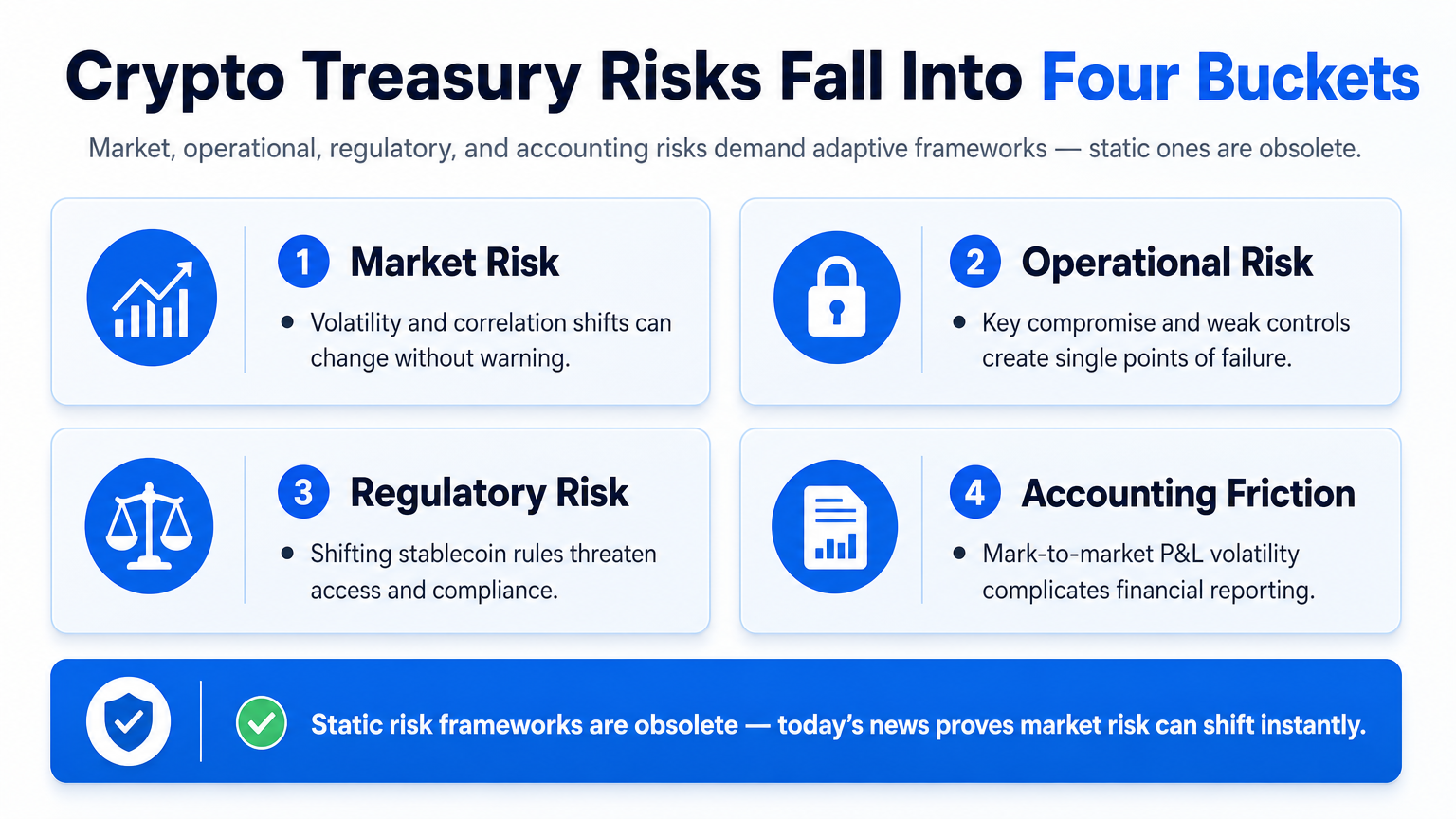
Crypto treasury risks fall into four buckets: market risk (volatility and correlation shifts), operational risk (key compromise, weak controls), regulatory risk (shifting stablecoin rules), and accounting friction (mark-to-market P&L volatility). Today’s news highlights that market risk can shift without warning, making static risk frameworks obsolete.
Building controls starts with segregation of duties: multi-signature or MPC-based custody, cold/hot wallet segregation, and policy-based transaction limits. Programmable approval workflows — multi-person sign-off chains — mirror traditional AP processes. For DAO treasury management, role-based permissions with on-chain enforcement replace paper policies, but the principle is identical: no single point of failure. A fiat-crypto platform that surfaces both fiat and on-chain balances in one dashboard makes these controls operationally feasible.
Tools now cover the full lifecycle. Custody providers like Fireblocks and BitGo handle storage; platforms like OneSafe combine fiat accounts, multi-currency wallets, and stablecoin on/off-ramps with corporate cards and bill payments. Crypto treasury accounting subledgers track tax lots and valuations, feeding general ledgers. The tooling stack has matured to a multi-signer, auditable suite, but adoption depends on whether the platform bridges fiat and crypto natively.
The background: crypto treasury management in one minute
What is crypto treasury management? It’s managing digital-asset balances — stablecoins, volatile cryptocurrencies, tokenized assets — alongside fiat positions with the same governance, liquidity, and reporting rigor as traditional treasury. The unique additions are 24/7 settlement, self-custody key management, and reconciling blockchain-native ledgers with fiat accounting.
How is it different? Traditional treasury operates on banking hours with days-long settlement and bank-held custody. Crypto treasury operates real-time, always-on, with the treasurer securing private keys. Volatility windows are compressed, reconciliation is more complex due to on-chain fees, and the line between “payment” and “investment” blurs. Treasury teams must manage liquidity across fiat rails and blockchain networks, often in a single dashboard.
How does it affect accounting? Under U.S. GAAP, crypto assets are typically indefinite-lived intangibles requiring impairment testing — though fair-value treatment may be coming. Each transaction can be a taxable event, so cost-basis tracking is critical. Crypto treasury accounting creates a dual-ledger requirement: an on-chain subledger tied to fiat books with continuous mark-to-market updates. For stablecoins treated as cash equivalents, accounting is simpler, but auditors still require proof of reserves.
Does the future require crypto support? The adjudicated position: stablecoin settlement support will become table stakes for globally operating treasuries; volatile crypto reserve allocation remains a discretionary, risk-managed decision most will cap or avoid. Today’s news — a $13 trillion stablecoin opportunity alongside an equity-correlated reserve warning — vindicates this nuanced view. The future doesn’t require holding bitcoin, but it increasingly requires sending and receiving stablecoin payments without breaking compliance or accounting.
Implications: what founders and finance leads should do now
Ripple’s move signals stablecoin infrastructure is moving from proof-of-concept to product. The window to ignore stablecoin rails is closing — not because adoption is mandatory now, but because banking partners and counterparties will soon support them. Immediately pilot a stablecoin payment flow (receiving or sending USDC) through a platform that integrates fiat accounts, so the treasury team learns reconciliation and custody patterns before volume arrives.
Bitcoin’s equity correlation demands reclassifying any bitcoin holding from “diversifier” to “risk asset” with equity-like volatility limits. Set a hard allocation cap as a percentage of total cash reserves, re-evaluated quarterly against forward equity risk. If bitcoin moves with the S&P 500, treat it like a concentrated equity position — permissible only with board approval and a defined exit threshold.
Separate payment rails from reserve assets. The decision to adopt a stablecoin for dollar settlement is an efficiency play. The decision to hold bitcoin is an investment play requiring separate risk governance. Enforce this separation explicitly in policy.
Set volatility limits before the next drawdown. Define a maximum permissible daily mark-to-market loss for any crypto reserve position, expressed as a percentage of operating cash. Without that, an equity-correlated decline could force an ill-timed liquidation. Use the new correlation as the baseline scenario, not a tail risk.
Build a unified fiat and crypto workflow. A single platform showing all balances — USD, EUR, USDC — eliminates spreadsheet lag. Corporate cards, ACH, wire, and stablecoin on/off-ramps through one approval chain allow paying a supplier in USDC in the morning and covering payroll in USD in the afternoon, using one ledger. That operational coherence lets a finance lead actually close the books.
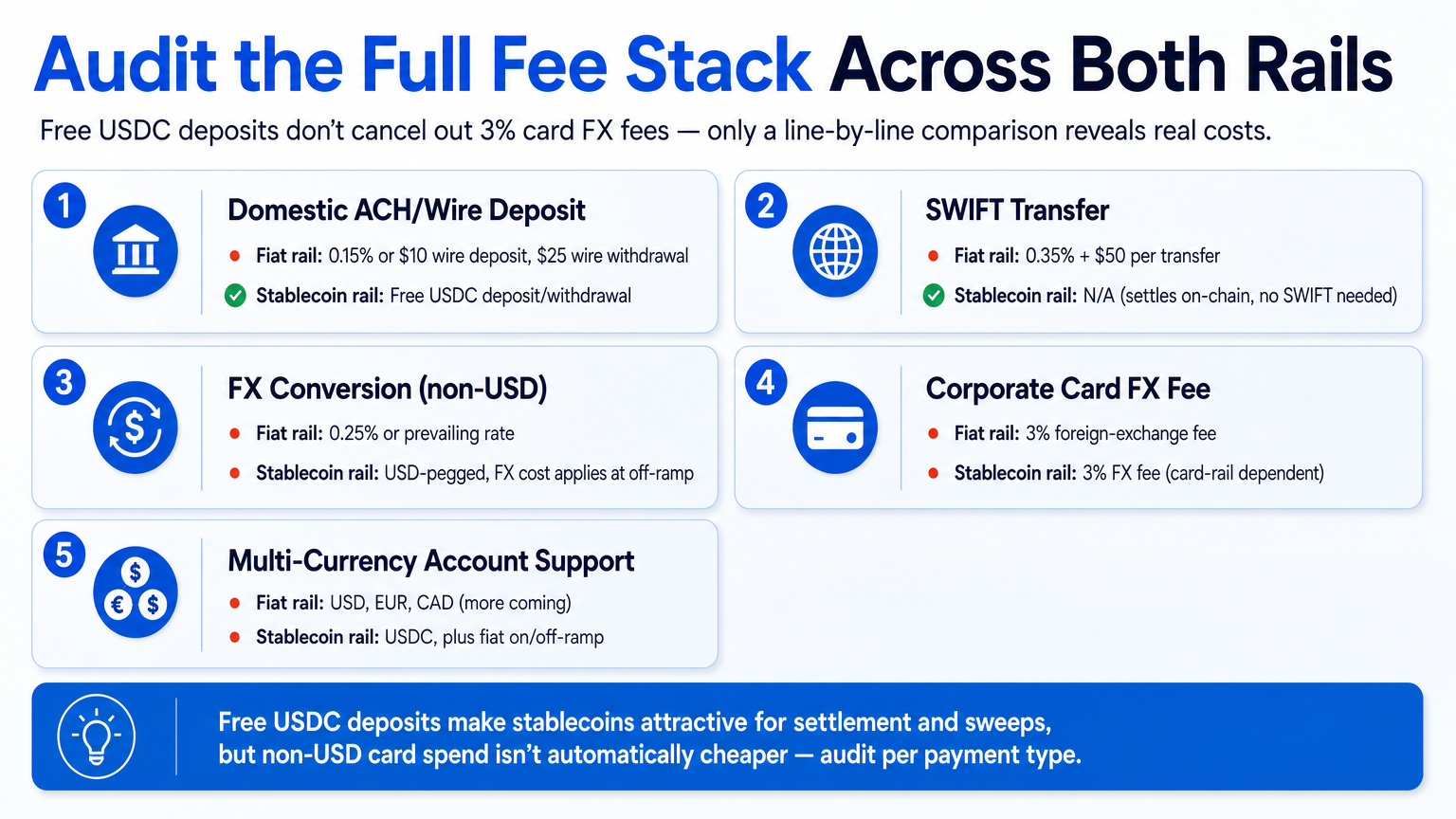
Audit the full fee stack across both rails. Stablecoin treasury ops are often pitched as “near-zero cost,” but only if you ignore on/off-ramp fees, FX spreads, and card charges. Below is a worked comparison.
| Treasury Activity | Fiat Rail (traditional) | Stablecoin Rail (USDC via platform) |
|---|---|---|
| Domestic ACH/Wire Deposit | 0.15% or $10 wire dep., $25 wire w/d | Free USDC deposit/withdrawal |
| SWIFT Transfer | 0.35% + $50 | N/A (settles on-chain) |
| FX Conversion (non-USD) | 0.25% or prevailing rate | Stablecoin is USD-pegged; FX cost at off-ramp |
| Corporate Card Foreign-Exchange Fee | 3% | 3% (card-rail dependent) |
| Multi-Currency Account Support | USD, EUR, CAD (more coming) | USDC, plus fiat on/off-ramp |
Key insight: free USDC deposit/withdrawal makes stablecoin rails attractive for settlement and sweeps, but the 3% card FX fee means non-USD card spend isn't automatically cheaper just because the settlement layer is stablecoin-based. Audit per payment type.
For DAOs and Web3 startups: make approvals and payouts programmable. DAO treasury management needs on-chain custody that respects governance: multi-signature wallets with role-based permissions mirroring governance token voting. A fiat-crypto platform like OneSafe lets DAOs set up customizable roles — contributors who initiate payments, multi-party signers who approve — and stream automated payouts in stablecoins while holding fiat reserves. This eliminates the unsafe pattern of one operator with unilateral wallet access. Programmable approvals with on-chain verification make DAO treasury operations audit-ready.
What to watch next and open questions
Stablecoin regulation and bank partnerships. The April 2026 U.S. stablecoin bill and parallel moves in Korea-Europe and the UAE are drawing the regulatory perimeter now. Treasury teams must verify that their stablecoin issuer has clear banking partners and reserves attestations — a regulatory action could freeze balances.
Bitcoin’s equity correlation. The bearish correlation snapshot is important, but more critical is the assumption that correlation can reappear under stress. Track rolling 90-day bitcoin-S&P 500 correlation; set a threshold (e.g., above 0.7) that triggers a mandatory review of any bitcoin reserve allocation.
Will the $13T corporate treasury market move on-chain? Ripple’s ambition faces hurdles: ERP integration, bank comfort, auditor acceptance, and behavioral inertia. Watch for real corporate treasury pilots — not fintech demos. If a mid-market company publicizes a case study on reduced wire costs or faster inter-company settlement via stablecoins, that signals the opportunity is more than a headline.
Key Takeaways
- Treat stablecoin settlement rails and crypto reserve assets as two independent decisions: one is an efficiency upgrade; the other is a risk-managed investment.
- The September 13, 2026 Ripple announcement and the undated correlation report together prove that one part of crypto can move toward broad treasury adoption while another enters a downdraft — only split governance protects a treasury from that divergence.
- Set a hard volatility limit on any bitcoin or crypto reserve position now, using equity-correlated stress scenarios instead of digital gold assumptions.
- Build a unified fiat-plus-crypto operating stack — multi-currency accounts, corporate cards, wire/ACH, and stablecoin on/off-ramps — to eliminate dual logins and make daily operations auditable.
- Audit the full fee stack across fiat and stablecoin rails: free USDC deposits don’t cancel out 3% card FX fees, and only a line-by-line comparison reveals the real cost.
For finance teams ready to unify fiat and crypto operations in a single platform with built-in controls, sign up for OneSafe to start building a treasury workflow that matches today’s reality.