On September 28, 2026, crypto banking platform Limited closed a $19 million seed round—the largest early-stage raise in a neglected niche: business and DAO neo-banking that unites fiat and digital assets. The funding signals that venture capital is finally targeting the underserved middle of the market, where multinational SMBs and DAOs still cobble together tools for cross‑border payments, treasury, and payroll. This article examines what Limited’s raise means for the crypto banking for startups space, how platforms like OneSafe already address these needs, and the trade‑offs every business must weigh before choosing a crypto fiat platform.
Table of Contents
- What Just Happened: Limited’s $19M Seed Round
- Why This Matters for Crypto Banking Now
- The Background in Brief
- Concrete Implications for Global Businesses and DAOs
- What OneSafe’s Approach Tells Us About the Market
- What to Watch Next
- Crypto Banking FAQ
- Key Takeaways
- Sources
What Just Happened: Limited’s $19M Seed Round
Limited, a crypto enterprise banking platform, raised $19 million on September 28, 2026, according to Dealroom.co. The company is building a single banking layer for multinational firms to manage fiat and crypto assets without relying on separate banks and exchanges. While Limited has not disclosed its full product roadmap, the funding memo targets the compliance, treasury, and operational fragmentation that enterprise platforms overlook and personal wallets cannot handle—exactly the gap that business crypto bank alternatives have been trying to close.
Why This Matters for Crypto Banking Now
Stablecoin payment volumes exceeded $220 billion in the first half of 2026, and more than 75% of U.S. banks now offer at least one crypto service, per the HIFI analysisand the crypto banking tipping point report. Yet most of that activity serves retail or large institutions. Founders running a cross‑border operation with aDAO treasury or paying contractors in US C have had few turnkey options. Limited’s raise confirms that multinational crypto banking demand is now too big to ignore, and the middle ground—where a startup with a $300k treasury needs compliant, multi‑currency accounts with role‑based access—is finally being filled.
The Background in Brief
Crypto banking evolved from exchange‑based custody to purpose‑built neobanks. Platforms like Mercury showed how to deliver frictionless online business banking for startups, but they stopped short of native crypto. OneS fe and others emerged to combine multi‑currency fiat accounts with on‑chain asset custody. The FDIC’s2025 guidance allowed banks to engage in crypto if risks are managed, while clarifying digital assets are not FDIC‑insured. This regulatory clarity, together with the joint stablecoin regulation push in2026, created a framework where fintechs that partner with banks can offer secure crypto‑fia t conversion. At the same time, DAOs—holding over $30billion in treasuries—remain underserved by both traditional banks and pure‑crypto tools.
Concrete Implications for Global Businesses and DAOs
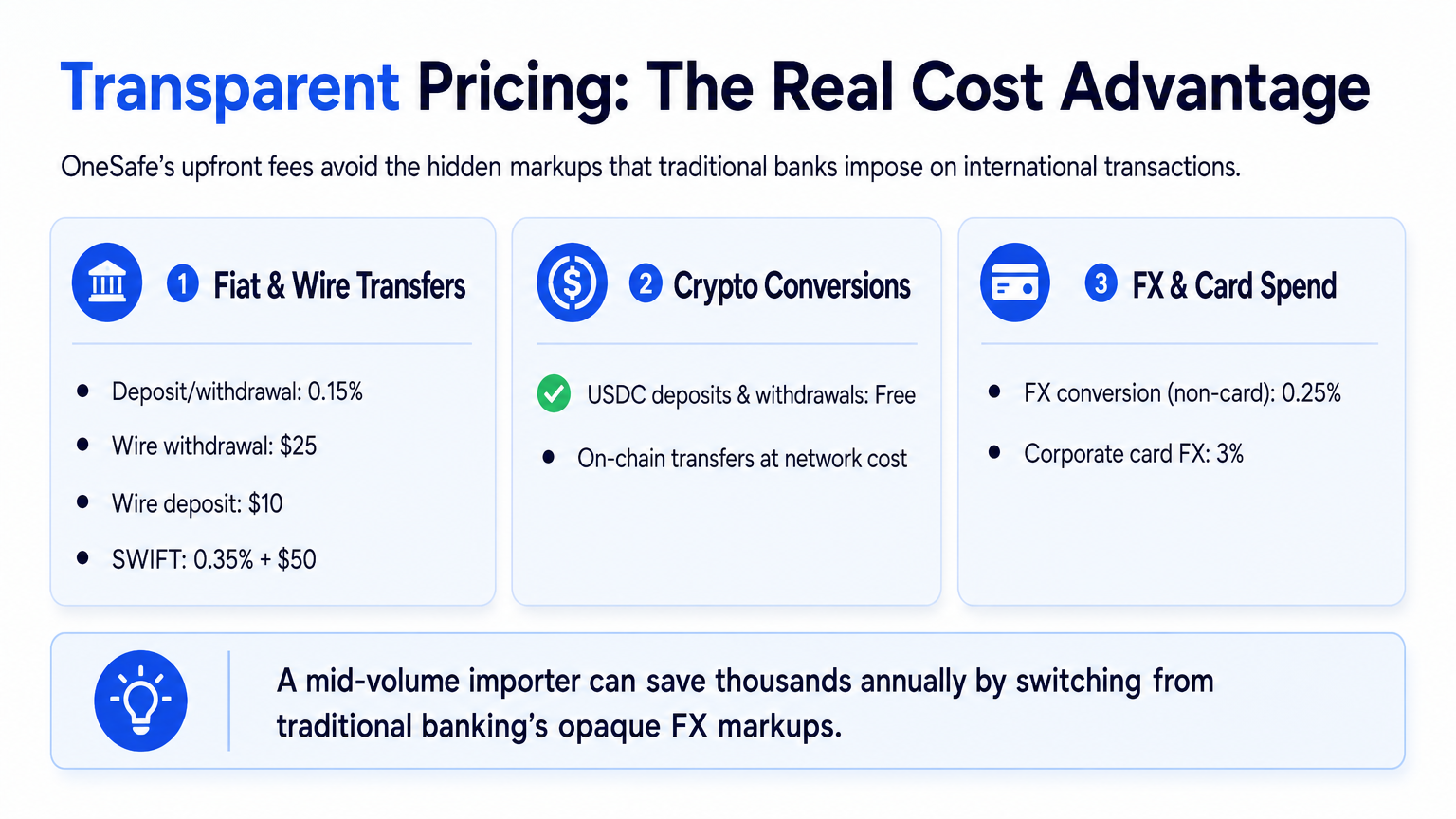
A unified fia t and crypto payments platform eliminates the cost and delay of moving funds between a bank account and an exchange. For an importer that invoices in EUR, pays suppliers in USD, and holds reserves in US C, the ability to convert currencies instantly and schedule bill payments in either asset removes a major operational headache. OneSafe’s published fee schedule (below) exemplifies the transparency the market demands.
| Service | Fee / Rate |
|---|---|
| Fiat deposit / withdrawal | 0.15% |
| Wire withdrawal | $25 |
| Wire deposit | $10 |
| SWIFT deposit / withdrawal | 0.35% + $50 |
| FX conversion (non-card) | 0.25% or prevailing FX rate |
| Corporate card FX | 3% |
| Crypto deposits / withdrawals (US C) | Free |
Traditional banks often bury FX markups; transparent platforms can save a mid‑volume importer thousands annually. For DAOs, a neo banking for DAOs platform must support permissioned roles—initiator, approver—and segregate funds for grants, payroll, and expenses. Combined with multi‑currency invoicing, automated bill payments, and payroll in one stack, the system becomes the financial operating system for distributed teams. A business can issue an invoice in CAD, receive US C, convert to USD for an ACH payroll, and pay a vendor in EUR—all with an audit‑ready log. That’s the promise of a well‑executed crypto bank for businesses.
What OneSafe’s Approach Tells Us About the Market
OneSafe, a financial technology company (not a bank), illustrates the current state of crypto banking services. It supports multi‑currency accounts (USD, EUR, CAD, with more coming), secure crypto custody via Fireblocks, and fee‑free virtual corporate cards. Onboarding takes about a week with formation documents, government ID, and (for U.S. entities) an EIN. The platform offers DAO‑tailored features: permissioned roles, automated workflows, and segregated accounts. The critical trade‑off: fiat deposits are not FDIC‑insured, and digital assets are not insured against value loss, though they benefit from institutional‑grade security. For many startups, the speed, crypto capabilities, and global reach outweigh the absence of deposit insurance, especially when only operational balances are kept in the account.
What to Watch Next
A $19 million seed can buy significant engineering talent, but the true moats are regulatory licensing and trust. Expect existing platforms to accelerate feature rollouts while Limited races to ship. Consolidation among smaller web3 payments companies may follow, and traditional banks are more likely to acquire neobank platforms than build from scratch. On the regulatory front, proposals for a Federal Stablecoin Insurance Fund and jurisdictional shifts (EU’s MiCA, Singapore) will shape the landscape. Businesses should track developments through analyses like the US Stablecoin Regulation Push Abroad.
Crypto Banking FAQ
hat is crypto banking, and how does it work for businesses? A platform that combines a business bank account with integrated cryptocurrency custody, on/off‑ramp conversion, and often corporate cards. One dashboard gives a CFO oversight of all balances, ACH transfers, US C payments, and card issuance.
ow does a crypto bank differ from a traditional bank? Most crypto banking platforms are fintechs, not chartered banks, so fiat deposits are typically not FDIC‑insured. However, they offer faster onboarding, lower international fees, and native digital asset support that traditional banks still avoid. See the choosing a crypto business bank account guide.
ho needs a crypto banking platform now? Any business transacting in multiple fiat currencies and crypto, or employing a global team. This includes Web3 startups, DAOs, and cross‑border firms where manual workarounds are no longer tenable—especially as regulators expect proper records. OneSafe processes over $800 million in volume for more than1,000 businesses across30+ countries.
s crypto banking safe for company funds and DAO treasuries? Safety depends on the custody model. OneSafe uses Fireblocks and requires multi‑factor authentication. Fiat funds sit with partner banks but are not FDIC‑insured. The safest approach: keep only operational capital on the platform, move long‑term holdings to cold storage, and use permissioned roles to prevent unauthorised transfers.
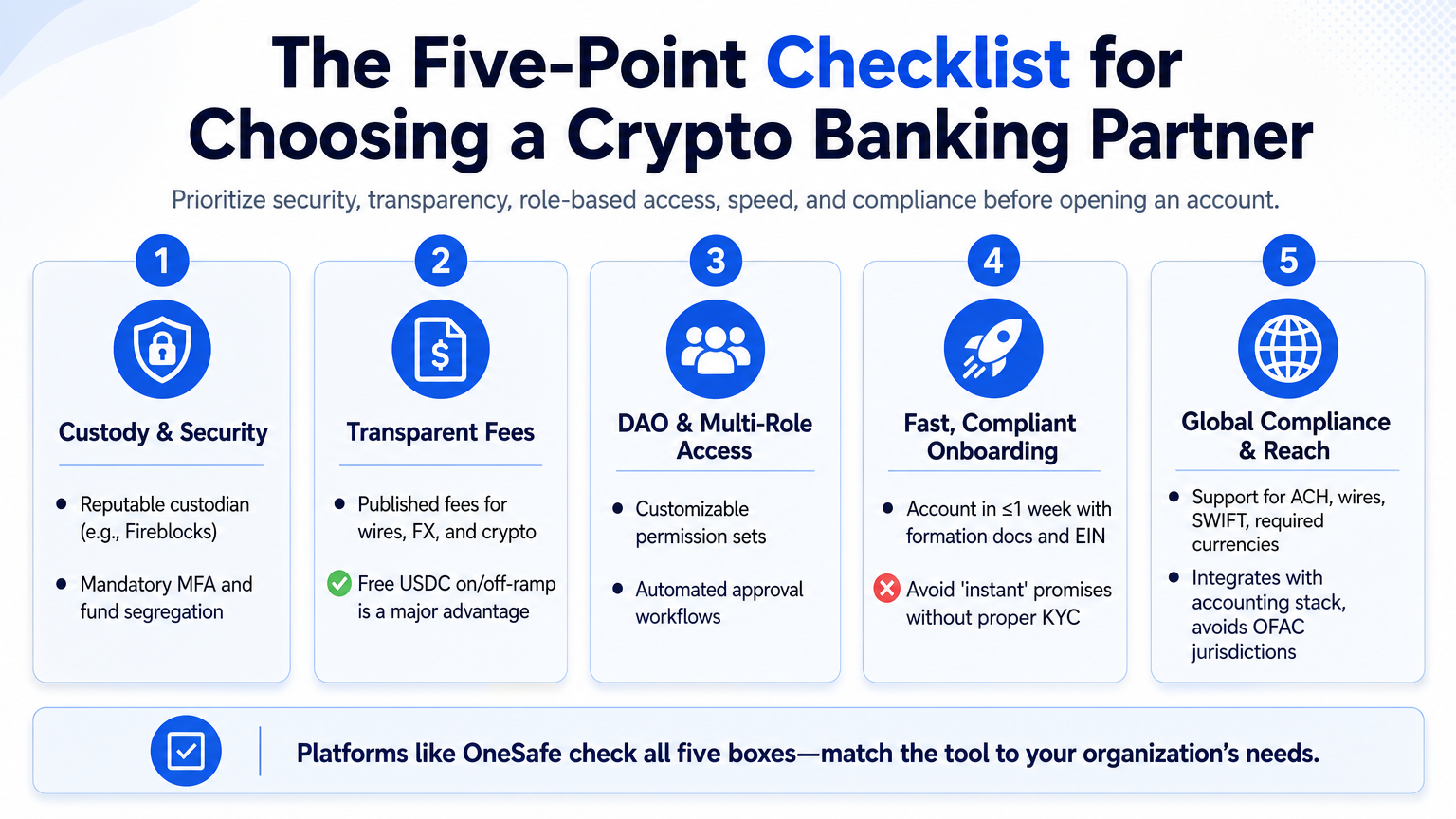
at should I look for when choosing a crypto banking partner? Use this five‑point checklist:
- *Custody and security: reputable custodian (e.g., Fireblocks), mandatory MFA, fund segregation.
- *Fee transparency: published fees for wires, FX, and crypto conversion; free US C on/off‑ram is a major advantage.
- *DA O and multi‑role support: customisable permission sets and automated workflows.
- *Onboarding speed: realistic account opening in ≤1 week with formation docs and EIN; avoid “instant” promises without proper KY B.
- *Global reach and compliance: support for ACH, wires, SWIFT, required currencies, and integration with your accounting stack, while avoiding OFAC‑sanctioned jurisdictions.
Platforms like OneSafe check all five boxes and appear alongside a handful of others in the best crypto‑friendly business bank accounts list. Match the tool to your organisation’s size and structure.
Key Takeaways
- Limited’s $19mm seed on September28,2026 signals VC conviction in crypto banking for businesses and DAOs—the ignored middle tier.
- Current platforms like OneSafe deliver unified fiat accounts, crypto custody, corporate cards, and role‑based access, replacing fragmented relationships.
- Automated multi‑currency invoicing, bill payments, and payroll reduce operational risk for DAOs and global SMBs.
- Fiat deposits are not FDIC‑insured, so keep only operational funds on the platform and move reserves to insured accounts or cold storage.
- Evaluate a partner on custody security, fee transparency, DAO‑friendly permissions, onboarding speed, and global coverage.
Ready to unify your fiat and crypto treasury? Open an account with OneSafe.
Sources
- Online Business Banking For Startups, Small Businesses ...
- Choosing a Crypto Business Bank Account in 2026
- 7 Best Bank Accounts for Crypto Business in 2026 - Aspire US
- 5 Best Crypto-friendly Business Bank Accounts in 2026
- Banking and Exchange Startups funded by ...
Ready to put this into practice? Get started with onesafe.io.