
Table of Contents
- title: "Stablecoin Payments: Mastercard's New Security Tool Explained" description: "Mastercard's Stablecoin Security adds pre-settlement risk scoring. See compliance shifts, DAO treasury management, and OneSafe stablecoin integration."
- Mastercard's Stablecoin Security: What Just Changed
- The Pre-Settlement Risk Score That Travels With Every Payment
- Launch Partners and the 113-Country Footprint
- Why This Matters for Businesses Using Stablecoin Payments
- Stablecoin Payments 10: The Foundation the Screening Was Built On
- Actions to Take Now for Seamless Screened Stablecoin Transactions
- What to Watch Next
- FAQ: Stablecoin Payments After Mastercard's Move
- Key Takeaways
title: "Stablecoin Payments: Mastercard's New Security Tool Explained" description: "Mastercard's Stablecoin Security adds pre-settlement risk scoring. See compliance shifts, DAO treasury management, and OneSafe stablecoin integration."
Stablecoin Payments: Mastercard's New Security Tool Explained
Mastercard's Stablecoin Security: What Just Changed
On October 19, 2026, Mastercard introduced Stablecoin Security, a risk-intelligence service that screens Mastercard stablecoin payments for fraud, scams, and sanctions exposure before funds move onchain, according to Startup Fortune's October 24, 2026 report. The tool embeds compliance checks directly into the pre-settlement phase, replacing retrospective post-transaction analysis.
Mastercard now acts as a checkpoint rather than just a processing network. Each transfer receives a risk score that travels with the payment, giving banks and payment providers a decision signal before settlement finalizes. For businesses using Mastercard stablecoin payments rails, screening is no longer optional or retrospective; it is front-loaded into the payment flow.
The Pre-Settlement Risk Score That Travels With Every Payment
Mastercard blends two historically separate data streams: card network data—transaction patterns, merchant categorizations, and fraud signals—plus blockchain analytics from partners like Chainalysis. The result is a composite risk score delivered through an API that banks can plug into existing fraud and compliance infrastructure.
Before a USDC or other payment stablecoin transfer executes, the screening layer evaluates sender/receiver addresses and transaction patterns against sanctions lists, known scam wallets, and fraud indicators. If the score exceeds a configurable threshold, the payment can be held, flagged, or blocked entirely. This is not opt-in at the partner level: businesses routing stablecoin payments through participating rails will encounter screening whether they choose it or not.
Launch Partners and the 113-Country Footprint
Mastercard launched Stablecoin Security with two initial partners: Borderless.xyz, which connects financial institutions to licensed stablecoin providers across more than 113 countries and 72 currencies, and Keyrails, focused on high-value cross-border trade in emerging markets. Both are Start Path alumni (Startup Fortune, October 24, 2026). The current launch already spans significant developed and emerging-market corridors; a broader global rollout is planned for 2027.
Why This Matters for Businesses Using Stablecoin Payments
Stablecoin payments grew because they bypass traditional banking friction: faster settlement, lower costs, and 24/7 availability. A pre-settlement screening layer introduces a new variable—one that can either protect a business from sanctions exposure or slow the speed that made stablecoins attractive.
Compliance vs. Speed: The New Reality
Payroll in USDC across ten countries, creator payouts, affiliate commissions, and cross-border supplier payments may now face additional latency as each transaction is scored. For high-volume batching, even a few extra seconds per transaction compounds quickly.
Mastercard's new tool scores stablecoin payments for fraud and sanctions risk using blended card and blockchain data. The scoring model evolves as wallets accumulate onchain history. A wallet that passes today may trigger review tomorrow after interacting with a sanctioned mixer or receiving funds from a flagged address. Compliance is becoming continuous, not transactional—a one-time KYB check no longer suffices when every payment carries its own risk evaluation.
How Screening May Affect Approval Rates and Onboarding
Payment providers set their own risk thresholds. A conservative bank partner may flag even moderate-risk transactions, causing holds, manual reviews, or rejected payments that a business cannot control. Onboarding also changes: providers may evaluate not just incorporation documents and beneficial ownership, but also the onchain behavior of wallets the business has historically transacted with. A startup funded by a venture DAO two years ago could face scrutiny if that DAO's treasury ever touched a flagged address.
Chainalysis stablecoin risk management maps wallet relationships across entire transaction graphs. A second-degree connection to a sanctioned wallet can trigger elevated risk scoring under certain configurations.
Stablecoin Payments 10: The Foundation the Screening Was Built On

Payment stablecoins are blockchain tokens designed to hold a stable value relative to a fiat asset, usually the US dollar. USDC and USDT are backed by reserves—cash, Treasury bills, and other liquid assets. A stablecoin transfer settles onchain in seconds for fractions of a cent, while SWIFT wires can take three to five business days and cost $25–$50.
The GENIUS Act has been advancing through US legislative processes and explicitly contemplates a framework for regulated payment stablecoin issuers, including reserve, redemption, and compliance standards. The GENIUS Act clarifies interest rewards for stablecoin holders, but its broader implication is that regulated stablecoins will face the same AML and sanctions screening as fiat bank transfers. OCC stablecoin rules are reshaping crypto treasury management, and Mastercard's move aligns with that trajectory. The direction is clear: screened stablecoin payments are becoming the default.
Actions to Take Now for Seamless Screened Stablecoin Transactions
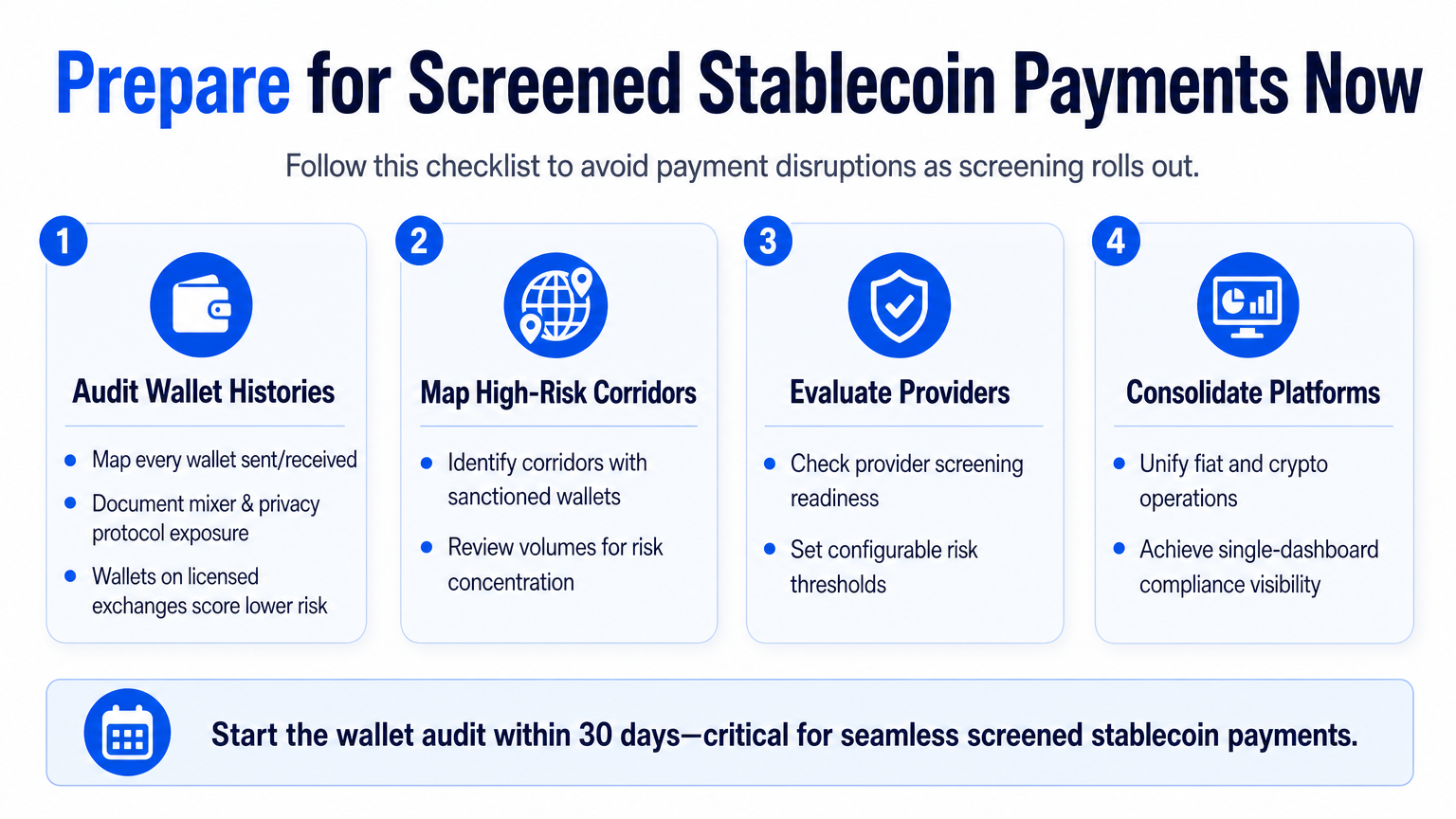
Businesses cannot opt out when their provider implements screening, but they can prepare operations so screening does not become a bottleneck.
Audit Your Compliance Infrastructure
Map every wallet your business has ever sent funds to or received funds from. Document source-of-funds history, interactions with mixers or privacy protocols, and exposure to regulated exchanges versus peer-to-peer platforms. Wallets that interact exclusively with licensed exchanges and known institutional counterparties will score lower risk. Re-audit quarterly because blockchain payment risk scoring models can retroactively affect current scores.
Consolidate Fiat and Crypto Finances with a Unified Platform Like OneSafe
Screening creates operational friction when fiat compliance systems remain separate from crypto payment flows. OneSafe stablecoin integration provides a single interface for ACH transfers, international wires, bill payments, and stablecoin on/off-ramps. When a screened USDC payment is held for review, compliance teams can see it alongside fiat wire activity in one dashboard instead of toggling between a banking portal and a blockchain explorer. The platform supports secure crypto custody through Fireblocks, and DAOs managing payroll in USDC plus vendor payments in fiat gain consolidated visibility—a compliance necessity as screening layers become mandatory. The unified fiat-to-crypto on-ramp and off-ramp also avoids extra latency when converting screened stablecoin payments to fiat.
Plan for Global Screening Mandates in 2027
Mastercard has indicated a global rollout in 2027. Businesses outside the current 113-country launch have a window to prepare, but it is closing.
| Action | Timeline | Priority |
|---|---|---|
| Wallet hygiene audit (all counterparty addresses) | 30 days | Critical |
| Map high-risk transaction corridors | 60 days | High |
| Evaluate payment providers for screening readiness | 90 days | High |
| Consolidate fiat/crypto operations on a unified platform | 6 months | Medium |
| Train compliance team on blockchain risk scoring | Ongoing quarterly | Medium |
| Establish screened payment dispute/review process | Before Q2 2027 | High |
For cross-border stablecoin settlement and DAO treasury management across multiple jurisdictions, this checklist is the minimum viable preparation.
What to Watch Next
The 2027 Global Rollout and When Card Networks Follow
Mastercard's 2027 global expansion is the stated timeline, but competitive dynamics may accelerate adoption. Visa has signaled that onchain settlement is a strategic priority. If Mastercard's tool proves effective, expect Visa to launch a comparable service. Stablecoin payments will increasingly route through the same compliance infrastructure that governs card transactions, making crypto compliance 2026 resemble traditional payment compliance.
Will Transaction Screening Become a Commodity or a Bottleneck?
The open question is whether Mastercard's risk scoring API becomes a utility that all stablecoin payment flows pass through—creating a single point of friction—or whether multiple providers emerge and fragment choice. Commodity screening may raise fees slightly but preserve speed. Bottleneck screening could push niche corridors around the layer, recreating fragmentation. AI agents pushing stablecoin payments into business mainstream add another dimension: thousands of agent-driven micro-transactions need screening at machine speed, not manual review queues.
FAQ: Stablecoin Payments After Mastercard's Move
Ready to launch your stablecoin strategy?
Build pre-settlement screening into planning from day one. Choose a provider that has integrated stablecoin security screening or has a committed timeline. Structure treasury on a unified platform, audit wallet histories before onboarding counterparties, and budget for occasional manual reviews.
Which stablecoins are supported?
Mastercard's initial launch supports payment stablecoins through its partner networks; USDC is currently the most widely integrated. The screening API is blockchain-agnostic at the API level, so it can evaluate transactions on Ethereum, Solana, Polygon, and other networks where stablecoins move. Specific coverage depends on the payment provider. OneSafe currently supports USDC deposits and withdrawals with zero fees.
How do refunds work?
Refunds inherit the same risk evaluation. If the original sender's wallet is flagged between the original payment and the refund, the return transaction may be held or rejected. Businesses should notify customers that stablecoin refunds may be subject to compliance review and provide alternative rails if needed.
How do payment fees work?
Mastercard has not published specific API pricing. Integrating providers may pass costs through as a per-transaction stablecoin payment fee or a small conversion spread. Even with a screening surcharge, stablecoin rails should still undercut traditional wire fees significantly. OneSafe's USDC deposits and withdrawals remain free as of October 2026, with fiat on/off-ramp fees at 0.15%.
How do stablecoin conversions work?
Screening occurs before settlement. If the receiving wallet is flagged during the inbound screening, funds may be held before they reach the wallet, preventing conversion. A unified platform that handles custody and conversion reduces handoffs where funds could stall. OneSafe's integrated fiat-to-crypto on/off-ramp handles conversion at 0.25% or prevailing FX without moving funds between separate wallet and exchange.
Is my money safe?
Mastercard's screening adds a pre-settlement risk signal, but it does not custody funds. Safety also depends on the stablecoin's reserve backing, custody solution, and provider security. OneSafe secures digital assets through Fireblocks custody infrastructure and enforces Multi-Factor Authentication (MFA) at signup.
Key Takeaways
- Mastercard's October 19, 2026 Stablecoin Security screens stablecoin transfers for fraud and sanctions before settlement, making pre-transaction compliance the new baseline.
- Businesses should audit wallet histories now—mixer, unregulated DeFi, or flagged-address interactions can retroactively trigger payment holds.
- Consolidating fiat and crypto operations on a unified platform, including OneSafe stablecoin integration, reduces screened-payment friction and gives compliance teams single-dashboard visibility.
- The 2027 global rollout leaves a limited window to evaluate providers, train compliance staff on blockchain risk scoring, and establish screened-payment dispute procedures.
- Screened stablecoin fees may rise slightly as infrastructure costs pass through, but will remain far below traditional cross-border wire costs.
Ready to manage screened stablecoin payments alongside fiat treasury in a single platform? Explore OneSafe's unified financial infrastructure.



