On October 24, 2026, Israel’s Prime Minister Benjamin Netanyahu ignited a political and regulatory firestorm by suggesting the country should prepare to use cryptocurrency to evade international sanctions. Reported by The Times of Israel, the PM’s comments drew immediate condemnation from the Bank of Israel and opposition leaders, who warned the proposal would damage Israel’s financial integrity. The episode has cast a harsh spotlight on the entire crypto banking sector, forcing every business that moves money between fiat and crypto to confront a sharp question: how sanctions-proof is their banking setup, really?
What follows is a dated analysis of the development and its concrete implications for platforms, businesses, and DAOs that rely on compliant crypto banking infrastructure. The real story is not about crypto’s vulnerability to misuse—on-chain forensics have already made large-scale evasion impractical on regulated platforms—but about why rigorous neo-banking for crypto will now become non-negotiable for every global operator.
Table of Contents
- What just happened
- Why it matters now for crypto banking
- The background a newcomer needs
- Concrete implications for your business
- What to watch next
- Key Takeaways
What just happened
The PM’s comments and the immediate backlash
Netanyahu reportedly told a closed-door cabinet meeting that Israel should “prepare for a world in which sanctions are more common” by exploring the use of digital currencies as a workaround. The remarks, published by The Times of Israel on October 24, 2026, were swiftly opposed.
The Bank of Israel’s leadership issued a statement the same day warning that any attempt to systematically evade international sanctions via crypto would undermine the country’s financial reputation and invite retaliatory measures from allied nations. Opposition figures echoed the concern, framing the proposal as a reckless gamble that could isolate Israel’s banking sector from the global dollar clearing system. The central bank’s unease underscores a reality often lost in public discourse: regulated crypto banking is not an anonymous free-for-all—it operates within tightly monitored rails that can detect and report suspicious activity faster than casual observers realize.
Historical context: crypto’s use in sanctions evasion
While cryptocurrencies have been used by sanctioned entities in the past—most notably by North Korean state actors laundering funds through mixers and unregulated exchanges—those incidents almost always exploited unlicensed offshore venues with weak or nonexistent KYC processes. On any compliant crypto bank or fiat crypto platform, those gaps do not exist. Every regulated crypto banking operation today is subject to the same Bank Secrecy Act, AML, and OFAC screening requirements as traditional banks, if not more.
What are the risks of using crypto for sanctions evasion?
For a nation or large entity attempting sanctions evasion at scale, the risks are immediate and severe: transaction histories on public blockchains are permanent, and forensic firms like Chainalysis can trace flows back to on-ramps within hours. Any regulated crypto banking platform that inadvertently processes such funds faces asset freezes, license revocation, and criminal liability. Off-chain, counterparty banks flag anomalous flows instantly. While retail-level evasion is possible on unregulated platforms, institutional-scale evasion through legitimate crypto banking channels is practically impossible—a point the PM’s proposal ignores entirely.
Why it matters now for crypto banking

A reputational blow to an already scrutinized sector
The crypto banking sector has spent years building trust with regulators, auditors, and partner banks. A G7 leader openly discussing crypto as a sanctions-dodging tool reopens old wounds. Even if the proposal never becomes policy, it gives ammunition to critics who still equate crypto with crime. For neo-banking for crypto platforms, that means renewed scrutiny from correspondent banks and payment networks, potentially leading to account closures or higher compliance costs.
How compliant platforms actually make evasion harder
The irony is that the very platforms now under suspicion are the ones that make evasion substantially more difficult. A compliant crypto bank integrates four defensive layers absent from unregulated venues:
- Perpetual KYC and KYB: business and individual identity verification against global watchlists before any account is active, with ongoing re-screening.
- On-chain transaction monitoring: blockchain analytics tools flag interactions with sanctioned addresses in real time.
- Geographic restrictions: automatic blocks on customers from OFAC-sanctioned jurisdictions.
- Fiat on/off-ramp controls: every conversion to or from fiat passes through banking partners that run their own sanctions checks.
Together, these layers ensure that a regulated crypto banking environment is arguably more transparent than many conventional cash-based shadow banking channels.
Increased regulatory pressure is now a certainty
Regardless of the proposal’s outcome, the episode will accelerate the timeline for new crypto sanctions guidance. Expect the FATF to issue a public statement within months, and national regulators to demand enhanced transaction-level reporting from crypto banking platforms. For compliant actors, this will mean better, not worse, clarity—as the OCC Stablecoin Rules: What Global Businesses Need to Know already signaled for stablecoins, the regulatory perimeter is tightening in a way that benefits licensed, transparent providers.
The background a newcomer needs
What is crypto banking?
Crypto banking refers to financial technology platforms that let businesses hold, move, and convert both fiat currency (like USD, EUR) and cryptocurrencies (like USDC, Bitcoin) through a single account, often with multi-currency ledgers, corporate cards, and cross-border payment rails. As Nerdwallet’s guide explains, crypto banking can encompass everything from a traditional bank adding a crypto wallet to a dedicated platform offering full treasury management in both asset classes (Nerdwallet, “Crypto Bank and Crypto Banking 101”).
How does it differ from traditional banking?
Traditional banks custody fiat deposits, process wires, and sometimes offer crypto access through a brokerage-like add-on. A crypto friendly bank (or neo-banking for crypto) is built from the ground up to treat fiat and crypto as equal first-class assets. That means instant on-chain settlement, API-driven treasury workflows, automated reconciliation, and native support for stablecoin payments—all without the batch processing delays of legacy infrastructure. Services are delivered through partnerships with regulated banks, so the platform itself is a technology provider, not a licensed bank holding customer deposits directly.
Crypto banking 101: fiat and crypto in one place
A typical fiat crypto platform offers: multi-currency accounts (USD, EUR, CAD, and more), ACH and wire transfers, corporate cards with spend limits, foreign exchange, and crypto on/off-ramps. Accounting integrations, automated invoicing, and role-based permissions for teams are standard. The goal is to replace fragmented banking relationships with a single, secure interface—exactly as Milkroad’s overview highlights when it contrasts the speed and global reach of these platforms with traditional banking friction (Milkroad, “Crypto Banks - Regulations, Safety, Benefits, & Risks”).
Who uses crypto banking—and why the stakes are high
Global businesses, Web3 startups, and DAOs are the primary users. For a startup that pays contributors in stablecoins while invoicing clients in fiat, a crypto business banking platform is an operational necessity, not a luxury. This cross-border flexibility, however, comes with heightened compliance demands. Because these platforms sit at the intersection of two regulatory regimes—one for fiat, one for digital assets—the stakes are higher: a misstep in sanctions screening can trigger a cascade of partner bank reviews. That’s why the compliance backbone matters absolutely.
The compliance backbone: KYC, KYB, and on-chain monitoring
Every regulated platform builds its entire offering on a foundation of identity verification, suspicious activity reporting, and blockchain surveillance. KYB (Know Your Business) checks review formation documents, ultimate beneficial owners, and EIN numbers. KYC (Know Your Customer) validates government-issued IDs. On-chain monitoring tools screen every deposit and withdrawal for links to sanctioned wallets, mixers, and high-risk entities. The result is a compliance fabric that far exceeds what most traditional SMEs encounter with a conventional business account.
Concrete implications for your business
If you’re already on a compliant platform, here’s what changes
First, expect your provider to tighten controls. You may see additional attestation requests for high-value cross-border transactions and more frequent KYB refreshes. Document your own sanctions screening policy; a simple internal memo can accelerate partner reviews. Second, your competitive moat just got wider: as regulatory noise increases, counterparties will preferentially do business with companies that can demonstrate a compliant crypto banking setup.
If you’re unbanked or using piecemeal tools, the risk just spiked
Businesses that cobble together personal wallets, unregulated exchanges, and multiple fiat accounts now face the largest exposure. A single transaction passing through an unvetted on-ramp can freeze your entire cash flow—sometimes without warning—if a counterparty wallet gets flagged. With sanctions scrutiny elevated, the tolerance for informal setups is evaporating. Moving to a dedicated platform with integrated compliance is not just risk reduction; it’s a survival move.
How can businesses ensure their crypto banking platform is compliant?
Ask hard questions and demand verifiable answers. The table below provides a practical due-diligence checklist you can use today.
| Compliance dimension | What to verify |
|---|---|
| Custody infrastructure | Does the platform use institutional-grade custody (e.g., Fireblocks, BitGo) with segregated accounts? |
| KYC/KYB rigor | What documents are required at onboarding? Business formation papers? Ultimate beneficial owner ID? |
| Sanctions screening | Does the platform run real-time checks against OFAC, EU, and UN lists? Are blockchains analyzed for high-risk addresses? |
| Geographic restrictions | Is access blocked from OFAC-sanctioned countries and specific sanctioned regions? |
| Partner bank oversight | Do fiat custodial partners conduct independent AML/sanctions reviews on flows? |
| Audit trail | Does the platform maintain immutable logs of all transactions, approvals, and identity verifications for regulatory reporting? |
| DAO-specific controls | For Web3 organizations, does the platform support customizable role-based permissions and on-chain treasury governance? |
| Regulatory posture | Is the platform actively engaged with regulators (e.g., participating in FATF consultations, holding required state money transmitter licenses where applicable)? |
A compliant crypto banking platform that can answer “yes” to all of these—and provide evidence—is one built to weather intensified scrutiny.
Why are DAOs and Web3 startups particularly affected?
DAOs face a unique double bind. Many operate without a traditional legal wrapper, making KYB more complex, while their treasuries often sit in multi-sig wallets that must be managed alongside fiat operational funds. The Israel sanctions episode will force every DAO to ask: can we immediately prove every wallet we interact with is sanctions-clean to a skeptical banking partner? A unified platform that combines DAO banking with native on-chain monitoring and role-based permissions removes that uncertainty. Without it, a DAO may find its fiat rails disconnected overnight if a single contributor’s transaction raises a flag. This is not hypothetical; as the France DeFi Liability Proposal: Next Phase of DeFi Compliance analysis shows, regulators are moving to treat DAO treasuries with the same seriousness they apply to any financial intermediary.
What should businesses do in light of this news?
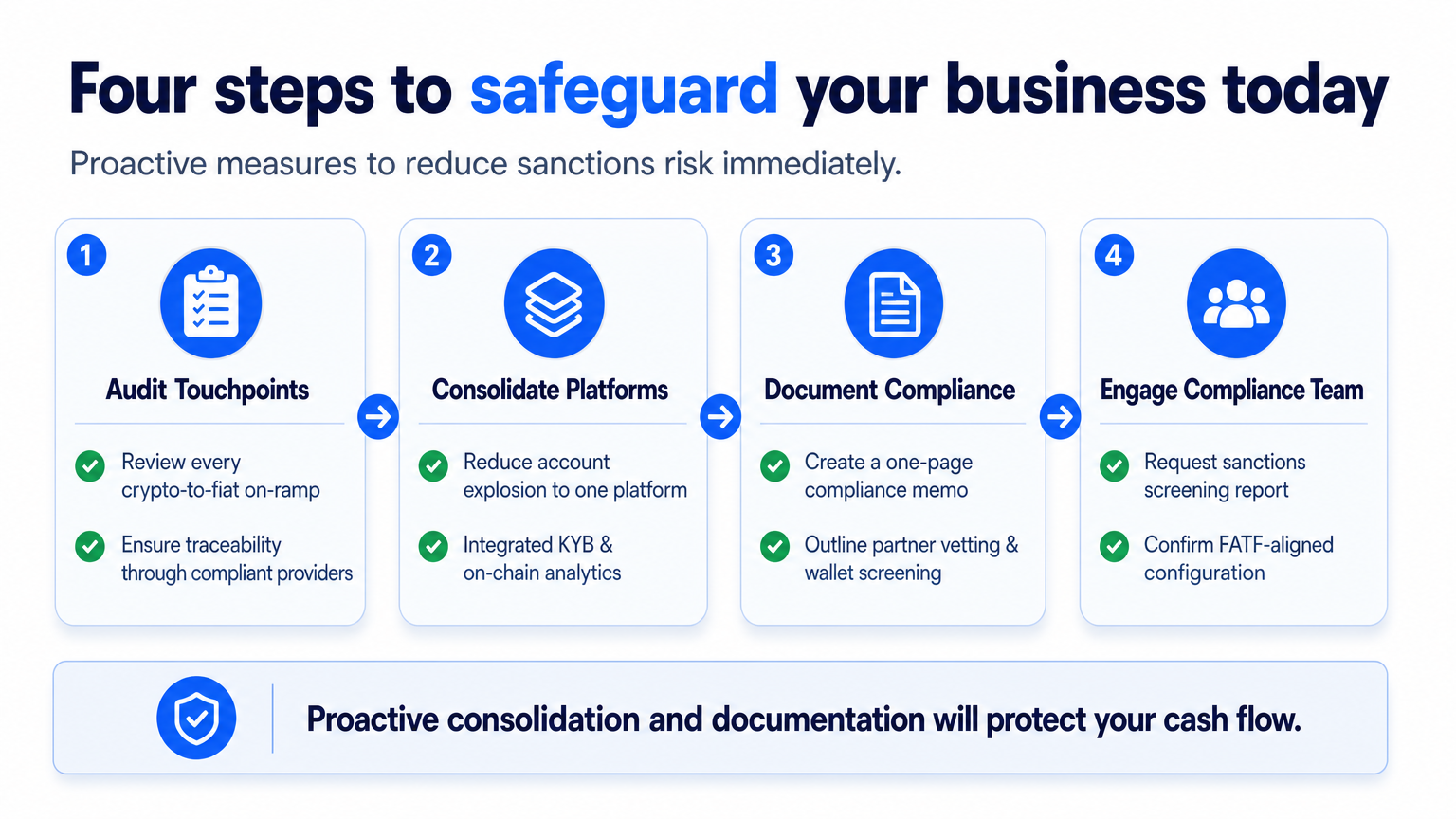
- Audit your crypto-to-fiat touchpoints immediately. Every on-ramp, off-ramp, and payment rail you use must be traceable through a sanctions-compliant provider.
- Consolidate to a single compliant platform. Reduce the explosion of accounts; a dedicated crypto business banking platform with integrated KYB, automated reporting, and on-chain analytics cuts your surface area.
- Document your due diligence. Create a one-page memo outlining your compliance framework, partner vetting, and wallet screening policy. This document will be invaluable if a banking partner asks questions.
- Engage your platform’s compliance team proactively. Ask for a current sanctions screening report and confirm that your configuration meets the latest FATF recommendations.
What to watch next
Will other nations follow or distance themselves?
Watch for official statements from the EU, UK, and Singapore. Each has deep crypto banking sectors and will want to signal either alignment with or distance from any notion of state-sponsored sanctions evasion. If a bloc doubles down on its own stringent supervision, it could fracture consensus on global crypto banking norms.
The FATF and global standard-setters’ likely response
The Financial Action Task Force (FATF) is almost certain to issue a public statement referencing the proposal and reiterating that its Travel Rule and risk-based approach apply to all virtual asset service providers. Expect a new interpretive note within 6–12 months that clarifies expectations for sovereign-linked transactions. The Stablecoin Regulation: Senate Eyes Clarity Act — What’s Next? landscape suggests that jurisdictions with clear rules will attract the bulk of compliant business.
New compliance features coming to crypto banking platforms
The industry will respond by making sanctions screening even more visible to end users. Look for real-time transaction risk scores displayed at the point of transfer, automated alerts for wallet age and mixer interaction, and more granular dials that allow businesses to set risk thresholds. Custody partners like Fireblocks are already expanding their policy engines; expect integrated platforms to adopt them as standard within the next two quarters.
The bigger question: can crypto ever be both private and compliant?
The Netanyahu episode reignites an old debate. On a truly private, permissionless network, sanctions evasion cannot be fully prevented. But the world of open, regulated crypto banking has already made its choice: compliance wins. For businesses, that means accepting that the rails they operate on are transparent—and that this transparency is precisely what preserves their access to the global financial system. The real frontier now is not privacy, but programmability: building compliance that is always-on, automated, and verifiable on-chain in real time.
Key Takeaways
- Netanyahu’s October 24, 2026 proposal to use crypto for sanctions evasion is a political statement, not a viable strategy—compliant regulated platforms make large-scale evasion practically impossible.
- The immediate effect on crypto banking will be heightened scrutiny from partner banks and an acceleration of mandatory transaction-level reporting.
- Businesses that already operate on a compliant crypto banking platform with robust KYC/KYB and on-chain monitoring face lower risk; those using pieced-together solutions must audit and consolidate now.
- DAOs and Web3 startups carry specific exposure because their treasuries often straddle on-chain and fiat worlds without a unified compliance framework—closing that gap is urgent.
- The regulatory response will favor transparent, licensed providers and push the entire sector toward embedded, real-time sanctions controls.
For businesses ready to move their fiat and crypto operations onto a single, compliance-first platform built for the demands of 2026’s regulatory environment, start onboarding with OneSafe today.