On October 24, 2026, the X100 protocol became the latest cautionary tale in crypto treasury management when an attacker seized control of its governance, liquidated treasury positions, and extracted $4.85 million in minutes. The incident didn’t exploit a smart‑contract vulnerability — it exploited the blurry line between organizational process and on‑chain execution. For treasury teams at DAOs, Web3 startups, and any business holding digital assets, the breach redraws the threat model: governance, not just code, is now a primary attack surface.
Table of Contents
- What happened in the X100 exploit?
- Why This Exploit Matters Now for Crypto Treasury Teams
- What is crypto treasury management?
- How does crypto treasury management differ from traditional?
- Where Standard Treasury Playbooks Break Down
- What does secure treasury management look like for crypto?
- Five Actions to Protect Your Treasury Immediately
- What's Next for Crypto Treasury Management
- Does the future of treasury management require support for crypto assets?
- Key Takeaways
What happened in the X100 exploit?
On-chain records show an unknown actor took control of X100 governance on Ethereum, converted treasury tokens and liquidity positions into 4.85 million USDT, and then withdrew 550,000 X tokens. The attacker didn’t exploit a code bug. Instead, by likely compromising key thresholds or exploiting a low‑quorum vote, they passed a malicious proposal that reassigned control of the treasury. No time‑lock or pause mechanism stood in the way; the drain completed in a few blocks, typical of a well‑rehearsed operation.
Why This Exploit Matters Now for Crypto Treasury Teams
It Wasn’t a Smart Contract Bug—It Was Governance Failure
Most treasury security frameworks prioritize code audits and multisigs. The X100 exploit bypassed them by attacking the human‑defined rules that govern fund movement. The attacker became the authorized decision‑maker, echoing earlier governance attacks on projects like Beanstalk. Governance failure remains the most underestimated vector in crypto treasury management, precisely because it straddles technology and organizational design.
The Same Flaw Exists in Many DAO Treasuries
Many DAO treasuries still operate with flat multisig structures, short voting windows, and no time‑locked execution. When signer keys sit in browser extensions or are shared among a handful of core team members, one compromised device can cascade into a full treasury drain. According to analysis by Liminal Custody, insufficient role segregation and weak proposal execution delays are among the most common vulnerabilities in DAO treasury operations today.
What is crypto treasury management?
Crypto treasury management is the discipline of overseeing, safeguarding, and optimizing an organization’s digital asset holdings — from stablecoins used for payroll to governance tokens held for strategic influence. It encompasses on‑chain cash flow, risk exposure, compliance, and the operational controls that prevent unauthorized outflows.
How does crypto treasury management differ from traditional?
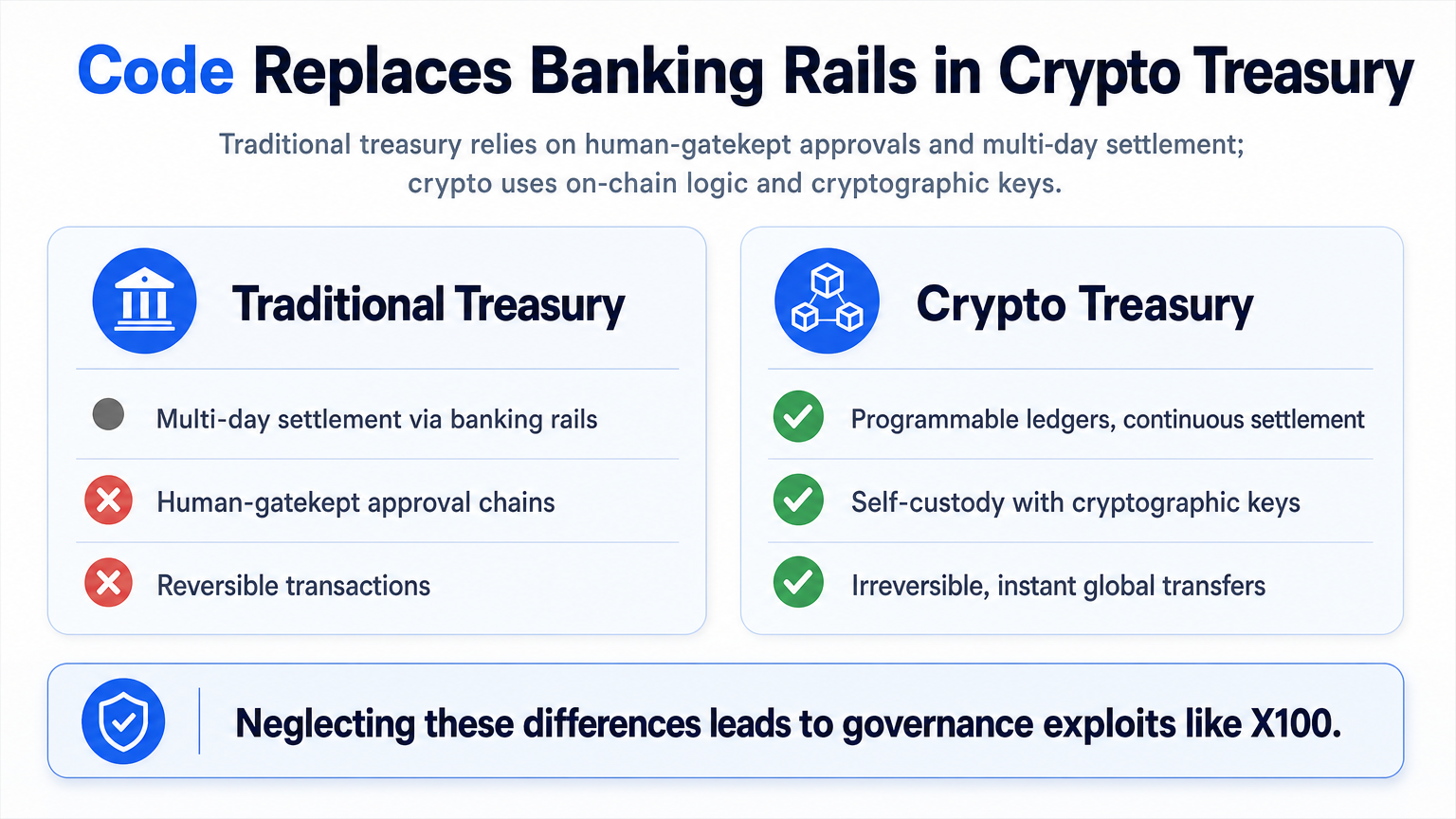
The core difference is that crypto treasuries operate on programmable, publicly verifiable ledgers with continuous settlement and self‑custody. A single transaction, if authorized, is irreversible and can move millions across borders in seconds. Traditional treasury teams rely on banking rails, multi‑day settlement, and human‑gatekept approvals; crypto must replicate those safety layers with on‑chain logic and cryptographic key management. The X100 exploit shows what happens when that translation fails.
Where Standard Treasury Playbooks Break Down
Generic crypto treasury guides emphasize multisig, diversification, and audits. While those are necessary, the X100 case reveals where they fall short.
Governance Exploits: The Overlooked Risk
Most teams treat governance as a community concern, not a treasury security concern. Yet governance is the ultimate key to the treasury. If an attacker can pass a proposal that reallocates funds or changes the signer set, no smart‑contract audit will stop them. The Chainlink Education team describes a DAO treasury as “collectively owned and managed,” but that collective ownership is only as strong as the process that enforces it. In the X100 incident, the attacker didn’t hack the vault; they became its master. This governance attack is absent from most treasury management checklists.
Multisig Isn’t Enough If Keys Aren’t Properly Segregated
A multisig wallet distributes signing authority, but if those keys sit on the same cloud provider, inside a single co‑working space, or share a recovery phrase, the distribution is illusory. Social engineering to obtain one signer’s seed phrase can turn a multisig wallet into a single‑key wallet. Kranz Consulting notes that effective segregation demands hardware security modules, geographically separate custodians, and strict operational procedures — not just a higher “m‑of‑n” number.
What does secure treasury management look like for crypto?
Secure crypto treasury management in a post‑X100 world requires weaving governance controls directly into financial operations: time‑locked execution (24‑72 hours before finalizing), role‑based access with granular permissions, institutional‑grade custody like Fireblocks which uses MPC to eliminate single points of compromise, automated risk monitoring, and spending policies encoded to reject out‑of‑policy transfers automatically.
Five Actions to Protect Your Treasury Immediately
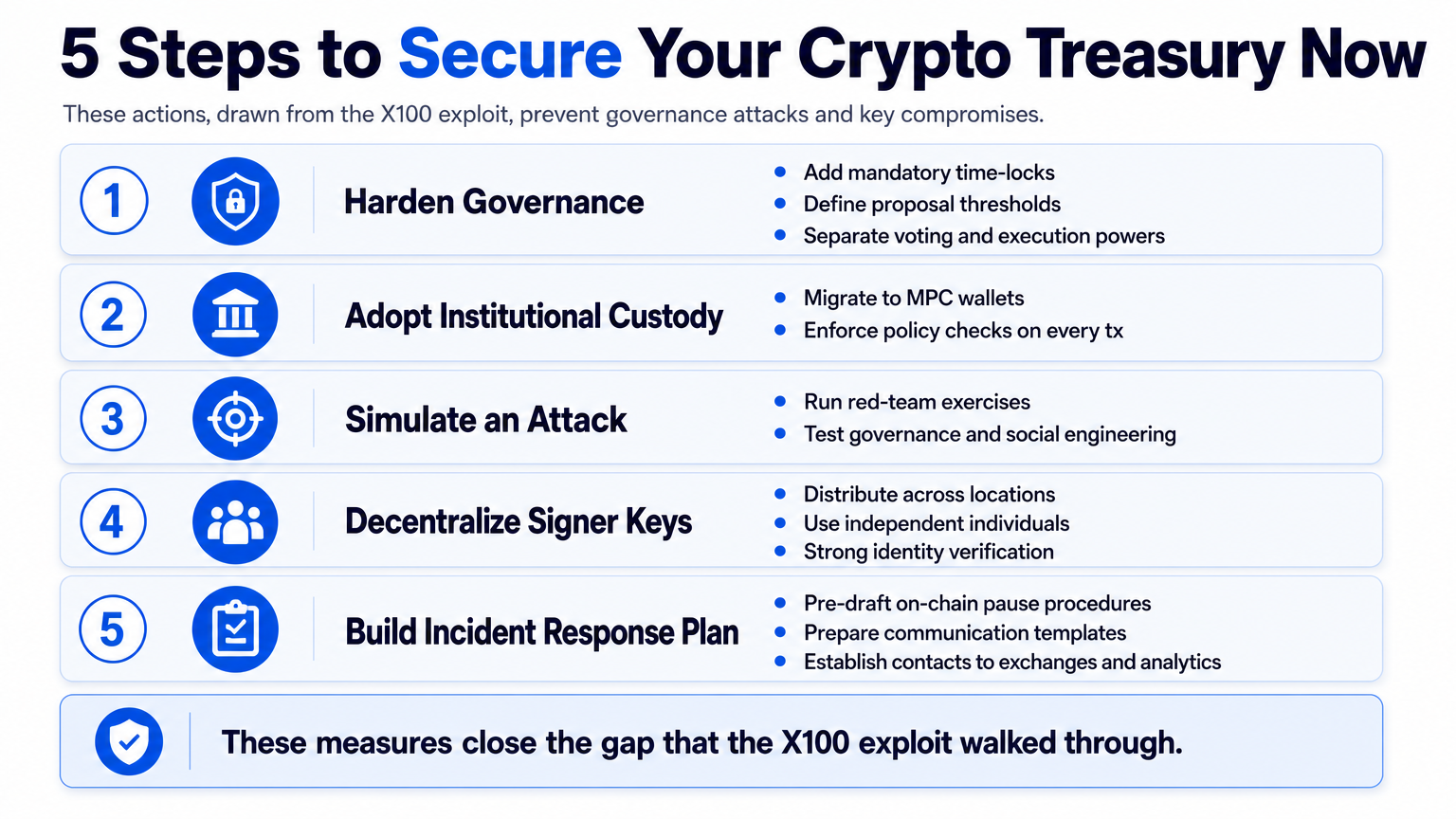
Drawing from the X100 breakdown and current best practices, here are five concrete steps any crypto treasury team can take.
| Action | Core Tactics | Why It Matters |
|---|---|---|
| 1. Harden governance | Add mandatory time‑locks, define proposal thresholds, separate voting and execution powers. | Prevents an attacker from rushing a malicious proposal to execution before the community can react. |
| 2. Adopt institutional custody | Migrate assets to a custody platform like Fireblocks; use MPC wallets, not simple multisigs. | Eliminates single‑key compromise and enforces policy checks on every transaction. |
| 3. Simulate an attack | Run a red‑team exercise: try to drain a test treasury using only governance and social engineering. | Exposes real‑world weaknesses that audits miss, especially around key management and proposal mechanics. |
| 4. Decentralize signer keys | Distribute keys across different physical locations, devices, and independent individuals with strong identity verification. | Renders social engineering and single‑point physical theft ineffective. |
| 5. Build an incident response plan | Pre‑draft on‑chain pause procedures, communication templates for X and Discord, and contact paths to exchanges and blockchain analytics firms. | In a rapid‑drain scenario, every minute of hesitation costs money; a rehearsed playbook saves time. |
These measures collectively close the gap that X100 walked through. Prevention demands time‑locks, role separation, and supermajority thresholds for any treasury‑affecting proposal. Pairing institutional custody with policy engines replaces fragile manual processes, while red‑team exercises and rehearsed response plans ensure the organization can react instantly.
What's Next for Crypto Treasury Management
Global regulators are increasingly scrutinizing how organizations custody and transact with digital assets. The Stablecoin Regulation: Senate Eyes Clarity Act developments and the OCC’s recent rulemaking on stablecoins signal that formal treasury controls — segregated accounts, proof of reserves, operational risk management — will become mandatory. DAOs that can demonstrate institutional‑grade governance will find it easier to access banking services and insurance.
A new wave of platforms is bridging fiat and crypto operations under one roof. For instance, OneSafe provides a neo‑banking environment that combines Fireblocks digital asset custody with customizable role‑based permissions, multi‑currency accounts, and automated payment workflows — all designed so a DAO’s treasury can enforce the same checks and balances a corporate finance team expects. By unifying crypto treasury management with traditional payment rails, these platforms aim to eliminate the process gaps that the X100 exploit exploited. The future of treasury management will look less like a collection of wallets and more like a hardened financial operating system.
Does the future of treasury management require support for crypto assets?
Yes — and not just for crypto‑native organizations. As stablecoin adoption grows for B2B payments and corporate balance sheets begin to hold tokenized real‑world assets, modern treasury functions will need to handle digital assets natively. The Crypto Treasury Management Advisory Services practice at FTI Consulting already reports that non‑crypto firms are asking how to incorporate tokenized funds into their cash management. The X100 attack shows the risks are real, but it also proves that the tools and governance models to manage those risks are maturing. Organizations that ignore crypto treasury capabilities will be left unable to access instant settlement, programmatic spending controls, and the efficiencies of on‑chain finance.
Key Takeaways
- The October 24 X100 exploit was a governance attack, not a code vulnerability, converting $4.85M in treasury assets after the attacker seized voting or signing authority.
- Standard crypto treasury checklists miss the primary risk: weak proposal execution rules and concentrated signer keys.
- Effective DAO treasury security demands time‑locked governance, role‑based permissions, and institutional custody — not just a higher m‑of‑n signature requirement.
- Platforms that integrate Fireblocks custody, automated policy enforcement, and unified fiat‑crypto accounts are closing the gap that generic multisig setups leave open.
- Future treasury management, even for traditional firms, will require native crypto support as stablecoin payments and tokenized assets become mainstream.
For a unified platform that secures both fiat and crypto treasuries with Fireblocks custody and DAO-native controls, start with OneSafe’s financial operating system.