

You're probably living in the gap between how money moves and how your books need to look. One vendor wants EUR, a contractor wants USDC, investors wired USD, and somewhere in the middle someone is asking why the bank statement, the wallet ledger, and the accounting file all tell a different story.
A multi-currency business account is the cleanest answer I've seen in production, but only if you use it for more than payments. It gives you one relationship to hold, receive, and send several currencies, with local details like USD routing numbers, UK sort codes, and EUR IBANs so money can land in the right currency and stay there until you decide to convert it multi-currency banking report.
Table of Contents
Why Global and Web3 Teams Need a Multi-Currency Business Account
A web3 startup can look tidy on a spreadsheet and still create operational chaos once real money starts moving. I have seen teams pay a European vendor in EUR, compensate contractors in USDC, and keep treasury in stablecoins while a single-currency bank account kept forcing conversions at the wrong moment. That does more than irritate finance. It creates reconciliation gaps, FX leakage, and a compliance trail that takes longer to explain than to run.
A multi-currency business account solves the structure problem first. It lets a company hold, receive, and send multiple currencies from one relationship instead of opening separate local accounts in every market, and providers often expose local receiving details like IBANs, sort codes, and routing numbers so funds can land through domestic rails. For teams comparing options, the operating model described in OneSafe's international payments overview shows how cross-border payments and multi-currency balances can sit in the same workflow. That matters because money can stay in its original currency until finance chooses to convert, which gives the team control over FX timing rather than handing that decision to the bank.
Why fragmentation hurts operating teams
The operational drag usually shows up in small, annoying ways. A contractor invoice arrives in one currency, treasury sits in another, and the accountant has to prove why the conversion happened on that day at that rate. If your legal structure is spread across jurisdictions, the problem gets worse because every transfer can touch a different entity, a different ledger, and a different audit expectation.
Practical rule: if a payment, a wallet balance, and the accounting entry all sit in different currencies, you don't have a payment problem, you have a finance architecture problem.
That is why teams working across Europe, the US, and offshore entities often look at this kind of setup alongside formation and jurisdiction planning, not after the fact. A useful primer for that broader setup is EU Inc benefits for founders, especially if you are comparing operating simplicity with legal complexity.
For businesses that need a practical starting point, a multi-currency account can sit next to a broader cross-border payments workflow. The goal is not to add another tool for its own sake. It is to stop making every incoming and outgoing payment trigger a separate decision about conversion, settlement, and bookkeeping.
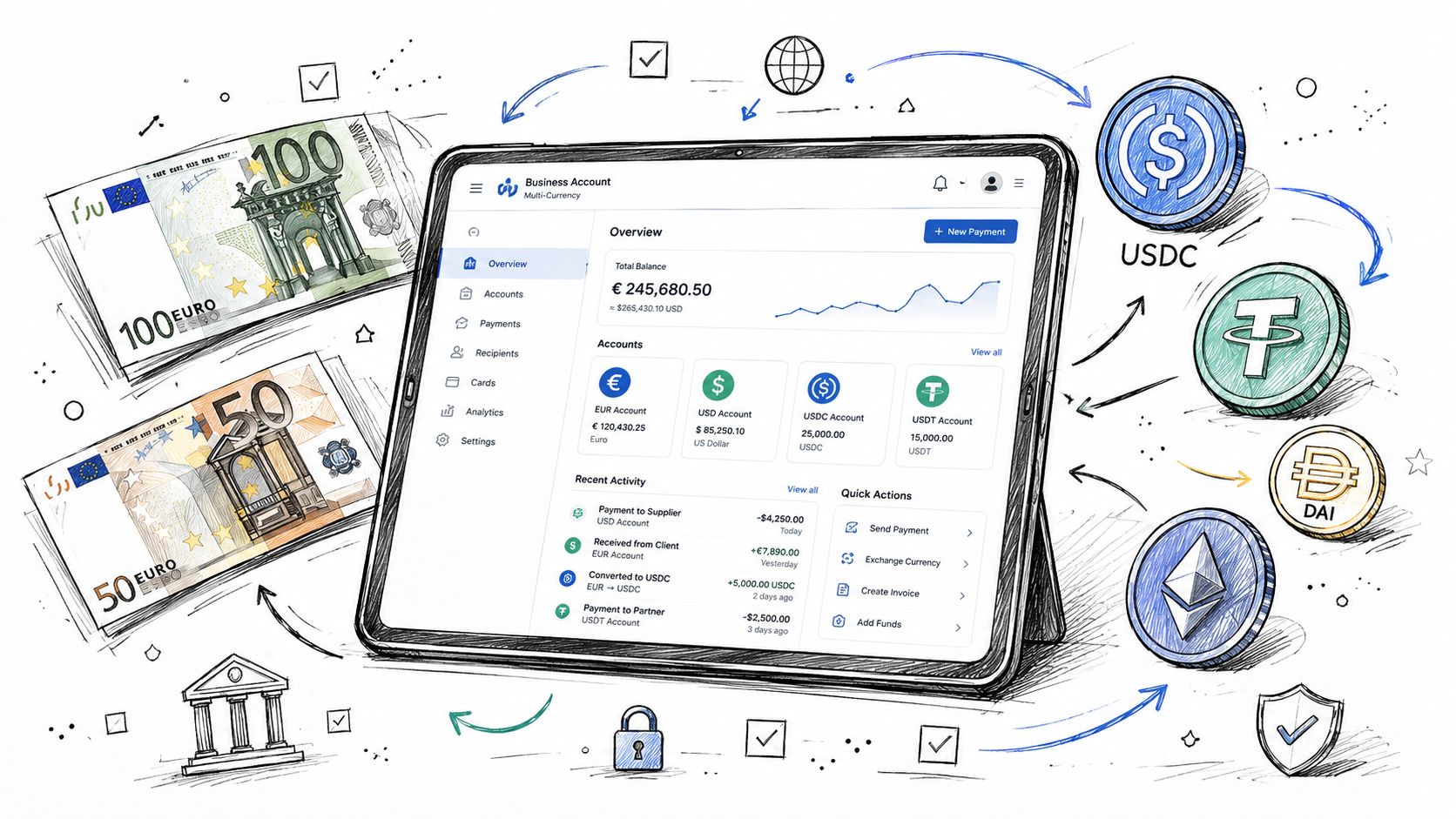
The historical shift matters too. Multi-currency accounts were once a niche treasury tool, but digital cross-border providers made them standard infrastructure for global SMEs, contractors, and export-oriented firms. This means the question is no longer whether your business can use one. It is whether your current setup is costing you time every week.
How Multi-Currency Accounts Work Under the Hood
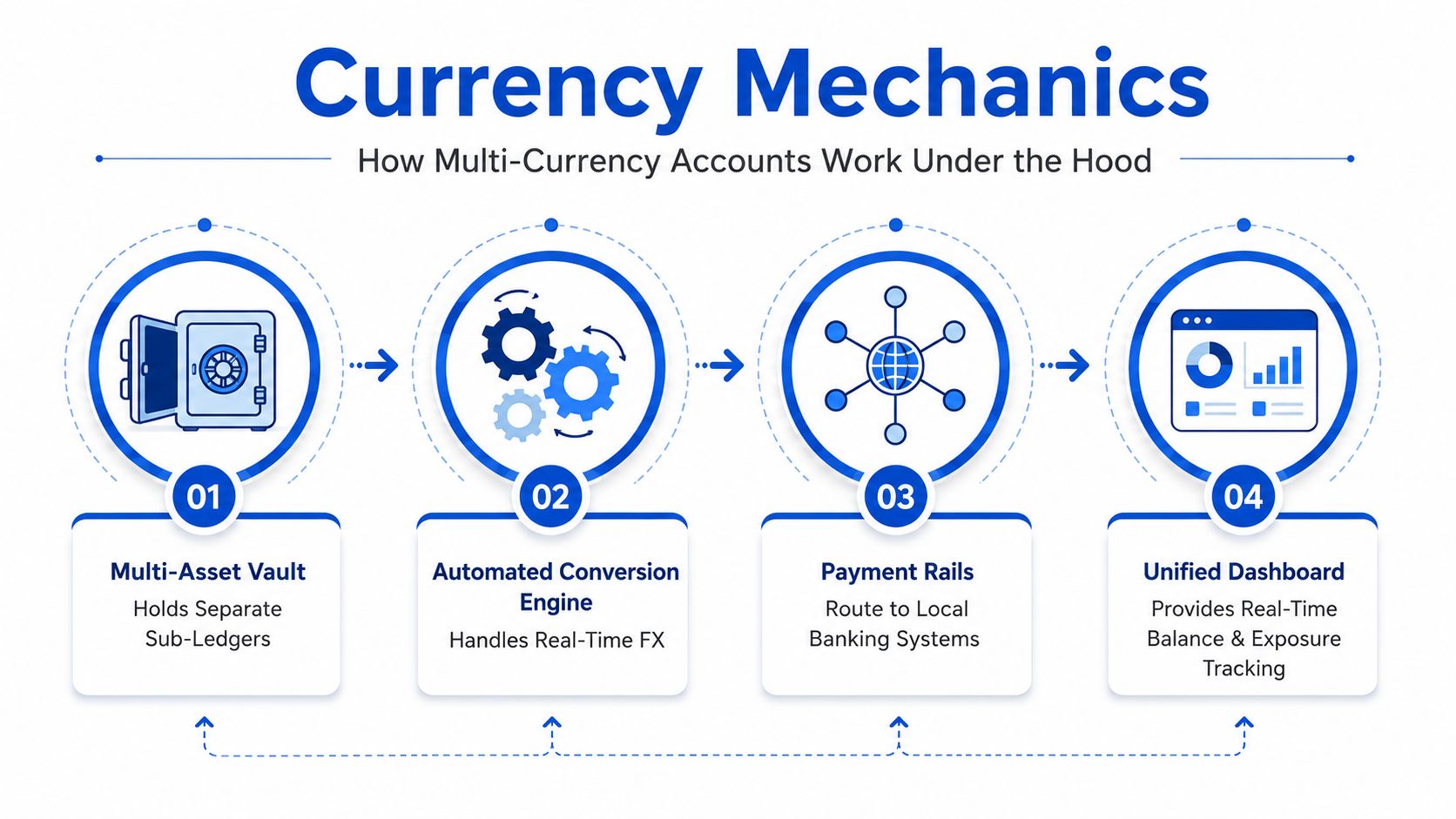
At the technical level, the useful thing about a multi-currency business account is that it does not behave like a single vault with a forced exchange desk at the door. It behaves more like a set of currency-specific sub-ledgers under one account relationship. A USD inflow can stay USD until you explicitly convert it or pay it out, which avoids automatic conversion on arrival and reduces timing risk when markets move against you multi-currency business accounts.
Local rails beat defaulting to SWIFT
The second piece is routing. If a provider gives you local receiving identifiers, such as IBANs for EUR, sort codes for GBP, and routing and account numbers for USD, it can often push transfers through domestic systems like SEPA, Faster Payments, and ACH instead of falling back to SWIFT. That usually matters more than people expect. Local rails are generally simpler to reconcile because the payment arrives in the recipient's currency and does not need a chain of intermediary banks to finish the job multi-currency business accounts.
A clean treasury setup usually follows this pattern:
- Receive locally. Clients or exchanges pay into the local currency detail that matches the invoice or settlement currency.
- Hold intentionally. The balance stays in that currency rather than being auto-converted.
- Convert only when needed. Treasury chooses the timing, instead of letting the banking stack choose it.
- Pay out in the target currency. Outbound transfers can match the payee's currency, which lowers friction in reconciliation and reduces needless currency churn multi-currency accounts.
What changes in daily operations
The practical win is not abstract efficiency. It is fewer forced conversions, cleaner books, and better control over where FX cost lands. Many businesses concentrate about 80% of international payment volume in just two or three currency corridors, so a small number of routes can drive most conversion decisions and FX expense multi-currency business account. That is why treasury teams care so much about matching hold currency to spend currency.
Most companies do not need every currency under the sun. They need the right few currencies, local receiving details, and a clean way to postpone conversion until the payout is ready.
Modern platforms have also moved beyond bare balances. They commonly bundle corporate cards, batch payments, and transparent FX pricing, and some support 30+ currencies with transfer coverage across large global networks multi-currency business account. That combination is what turns the product from a niche bank substitute into a working finance layer for international operations, especially when entity-level accounting, stablecoin reconciliation, and FX timing all have to line up in the same close cycle.
A lot of the work sits behind the account screen. Finance teams still have to map each wallet, bank rail, and legal entity to the right ledger account, then reconcile every transfer against invoices, vendor bills, or on-chain activity. If a web3 company receives stablecoins and then cashes out later, the treasury team has to match the on-chain receipt, the fiat conversion, and the accounting entry without losing the original currency context. That is where many “multi-currency” setups fall apart in production, because the balance is easy to see but the operational trail is not.
Evaluating Providers and Understanding Real Costs
A provider comparison starts with the money path, from receipt to payout. Many products can show multiple currencies, but only some let funds move through fiat and crypto workflows without forcing your team to jump between systems. One example in the market is OneSafe, which publishes a fee structure that includes free or $29+ monthly plans, $10 wire deposits, $25 wire withdrawals, 0.15% fiat deposit and withdrawal fees, 0.35% + $50 for SWIFT, and a 3% FX fee on cards, with a 0.25% FX rate for foreign exchange OneSafe service details.
What to compare beyond the headline fee
If you're running global operations, the basic-looking account can get expensive fast. The actual cost often shows up in the spread between the rate you see and the rate you receive, plus the time spent chasing confirmations, matching transfers, and fixing ledger errors. Crypto compatibility also matters, because many web3 teams do not want one provider for fiat and another for digital assets.
OneSafe also lists USDC deposits and withdrawals as free, plus near-instant crypto-to-fiat conversions, Fireblocks-based custody, and mandatory MFA OneSafe service details. For teams that need to pay vendors or contractors from both sides of the fiat and crypto divide, that unified workflow often matters more than shaving a few basis points off one isolated transfer.
| Feature | OneSafe | Traditional Bank | Generic Fintech |
|---|---|---|---|
| Multi-currency support | Fiat and crypto workflow in one interface | Usually single-currency first | Often supports balances, but limited crypto workflow |
| FX visibility | Published pricing, including card FX and stated FX rate | Often less transparent | Varies by provider |
| Wire handling | Deposit and withdrawal fees are published | Commonly higher, but inconsistent | Usually available, pricing varies |
| Crypto compatibility | USDC support and crypto-to-fiat conversion | Rare | Often limited or absent |
| Security controls | MFA and Fireblocks custody are listed | Bank-grade controls, but crypto not native | Varies widely |
Eligibility and onboarding reality
Geography is the other filter. OneSafe states that it serves global companies with exclusions for OFAC-sanctioned countries and certain U.S. states OneSafe service details. That matters because onboarding time means nothing if your entity cannot open the account in the first place.
For web3 teams, I also look for a provider that can handle policy controls without forcing the finance team to micromanage every transfer. Roles, merchant controls, approvals, and limits need to be configurable from the start. If the platform cannot support that, you end up recreating governance in spreadsheets.
The Hidden Risk of Holding Foreign Balances
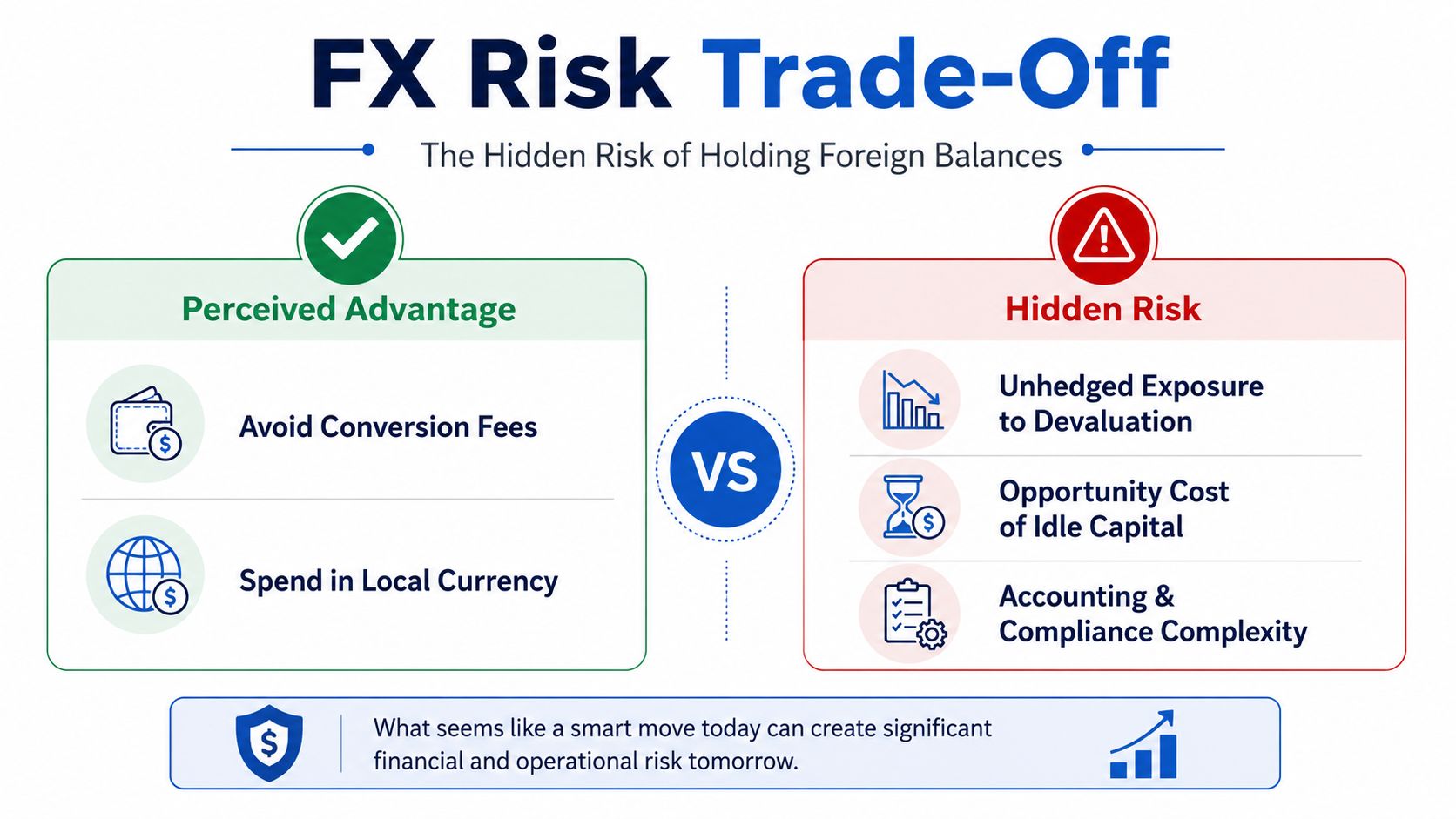
The biggest misconception I see is that a multi-currency business account automatically lowers FX risk. It does reduce forced conversion risk, but that is a different problem. If you wait to convert because you want a better rate, you get more flexibility, and you also take on exchange-rate volatility.
That trade-off matters because FX markets move quickly and at scale. BIS data shows average daily FX turnover reached about US$9.6 trillion in April 2025, up 28% from 2022, and the US dollar was on one side of 89.2% of all trades Stripe's multicurrency accounts overview. The treasury decision is happening inside a market that is deep, liquid, and repriced constantly.
When holding helps and when it hurts
Holding foreign balances usually makes sense when inflows and outflows line up in the same corridors. If you collect revenue in EUR and pay suppliers or contractors in EUR, keeping that balance in the same currency can cut repeated conversion and make reconciliation easier. The earlier point about concentrated corridors matters here, because a business that mostly operates in two or three currencies can often manage exposures deliberately rather than reactively, as noted earlier.
Immediate conversion is often the better call when cash flow is irregular or margins are thin. A smaller company with unpredictable inflows cannot always wait for a better rate, and idle foreign balances can turn into a bookkeeping burden as well as a market risk. The right answer depends on whether you are running a treasury policy or just hoping the rate moves in your favor.
Decision rule: hold foreign balances only when you can name the expense that balance will pay, and the timing window is short enough that volatility does not erase the savings.
A simple operating test helps. If the foreign currency will be spent soon, and the spend currency matches the hold currency, keeping it on balance often makes sense. If you do not have a near-term use for it, the balance is exposure, not efficiency.
The hidden operational burden becomes apparent here. Foreign balances do not sit in isolation, they sit beside entity-level books, intercompany charges, and, for web3 teams, stablecoin inflows that still need clean reconciliation to fiat records. A treasury stack that looks tidy at the account level can still create work if the accounting layer cannot map every currency movement back to the right entity and purpose. If you are also combining fiat and crypto operations, keep bank account setup and business fiat crypto integration close at hand, because that is usually where the reconciliation gaps appear.
For offshore structures, the balance question is even more sensitive. A Cayman company, BVI entity, Panama vehicle, or DAO wrapper can hold foreign currency for a valid commercial reason, but the books still need to show why the money is parked there, who controls it, and when it will move. A practical starting point is the open offshore company and bank account checklist, since formation documents and banking prep often determine whether treasury can be run cleanly later.
The goal is not to add another tool for its own sake. It is to keep foreign balances aligned with real payables, real timing, and a ledger that can survive audit, tax review, and an abrupt FX move.
Step-by-Step Onboarding Checklist for Web3 and Offshore Entities
Web3 companies and offshore entities usually do not fail onboarding because they lack a bank-friendly name. They fail because the documents do not tell a coherent story. If you are setting up a treasury stack for a Cayman company, a BVI entity, a Panama vehicle, or a DAO wrapper, the provider wants to see who owns the business, what the money is for, and how funds move in and out.
What to prepare before you apply
Start with the corporate basics. You will usually need the certificate of incorporation, proof of address, and beneficial ownership declarations, but web3 teams should also have token economics material, wallet ownership evidence, and internal governance documents that explain how treasury is controlled. If your cap table is messy or your proof-of-funds trail is incomplete, review slows down quickly.
A useful external checklist for offshore formation and banking preparation is open offshore company and bank account. For a broader view of how fiat and crypto workflows fit together, keep bank account setup and business fiat crypto integration close at hand when you are mapping your setup.
How to run the review without stalling
OneSafe says its KYB process is designed for startups and web3 entities, with initial completion typically within about a week when documents are complete OneSafe service details. That timeline only helps if the team uploads clean files the first time. The common blockers I see are missing director IDs, unclear wallet provenance, and internal ownership structures that no one can explain in a single sentence.
Use this rollout order once the account is approved:
- Define roles clearly. Separate admin access, approver access, and cardholder access.
- Set spending policies early. Vendor payments, contractor payouts, and treasury conversions should not use the same approval path.
- Assign limits by function. Ops should not have the same ceiling as treasury.
- Verify payout destinations. Check bank details and wallet addresses before the first live transfer.
- Test one small flow. Run a low-risk payment, then reconcile it end to end.
A clean onboarding file saves weeks later. I have watched teams spend more time fixing entitlement mistakes than they spent preparing the original application.
Managing Regulatory and Treasury Complexity Across Jurisdictions
A multi-currency business account helps move money, but it does not remove the accounting burden that follows. Entity-level books still need to show which legal entity held which balance, when a stablecoin conversion happened, and whether a transfer was a vendor payment, an intercompany movement, or a treasury reallocation. That is the part many guides leave out, and it is the part that creates friction during audits and close.
The broader payments environment still makes this worth fixing. The World Bank's remittance data shows the average cost of sending US$200 globally was 6.62% in Q4 2024, far above the UN Sustainable Development Goal target of 3% NerdWallet's multicurrency accounts coverage. That is a reminder that payment efficiency alone does not solve multi-jurisdiction finance. Entity mapping, tax treatment, and proof-of-funds work still sit on top of the account layer.
What finance teams need to document
Treasury teams should treat every cross-border movement as an event that needs context. Was the receipt fiat or crypto? Which entity owned it at the time? Was the conversion operational or speculative? If a stablecoin wallet funded a fiat account, the trail still has to connect those balances cleanly.
For Chinese-speaking stakeholders or regional operators supporting China-facing entities, resources like 为中国企业提供支持 can help frame the local advisory angle alongside the payments stack. The operational point stays the same across jurisdictions. You need a ledger that can explain the money without a meeting.
Practical rule: if your accountant cannot explain a transfer without asking the treasury lead for Slack context, the process is not audit-ready yet.
Software and policy have to work together. The account is infrastructure, not the whole answer. You still need accounting rules for FX gains and losses, intercompany funding notes, and a repeatable way to attach wallet activity to legal entities before month-end closes. For DAO-oriented structures, OneSafe's DAO resource is a useful reference for how these controls get organized in a live treasury.
Real-World Use Cases from DAOs and Global Startups
A DAO paying contributors and a BVI startup handling investor wires can look unrelated on paper. In production, they run into the same operational problems, just under different legal wrappers. Both need a clean way to receive funds, move them into the right currency, and keep an audit trail that holds up when accounting asks where the money sat at each step.
DAO payroll without treasury fog
A DAO I've worked around collected donations in USDC, held operating balances in that form, and converted into EUR when European developers needed payment. That cut down the need to route every contributor invoice through a separate fiat stack. The same treasury also issued corporate cards with spend limits, so smaller operating expenses did not have to go through manual reimbursement chains.
The value was never the card itself. It came from seeing treasury movement clearly and matching payouts to the right entity before month-end close. The finance lead could tell what stayed in crypto, what moved into fiat, and where operating spend landed. For teams building DAO treasury controls, OneSafe's DAO-focused resource shows how these workflows are usually organized in a live setup.
BVI startup bridging investor wires and vendor crypto
A BVI startup with irregular revenue used USD as its main holding currency after investor wires landed, then converted only when a vendor preferred stablecoins. That avoided making a rate decision too early and kept treasury from guessing on FX timing before the payment was due. When the vendor wanted faster settlement, the team used the crypto-to-fiat path without changing the rest of the banking setup.
That kind of setup works only when the payment rail, the holding currency, and the accounting entry all tell the same story. If one of those pieces is missing, the finance team ends up reconstructing transactions during close instead of reviewing them.
For multi-jurisdiction teams, the hidden burden is usually not the transfer itself. It is entity-level accounting, stablecoin reconciliation, and deciding when to convert so FX moves do not create avoidable noise. A multi-currency business account helps only if it supports that workflow in production, not just on a product page.


