OCC Opens Stablecoin Path: What It Means for Crypto Banking
On November 3, 2026, the Office of the Comptroller of the Currency finalized a rule that lets community banks issue stablecoins through subsidiaries for the first time. The move reshapes the crypto banking landscape, giving businesses that already use stablecoin payments a regulated, bank-grade on-ramp—and forcing every startup and DAO to reconsider its banking stack. For platforms like OneSafe, built to unify fiat and crypto operations, the rule doesn’t just signal evolution; it rewrites what “crypto-friendly business banking” can mean.
Table of Contents
- What Just Happened: OCC Paves the Way for Bank-Issued Stablecoins
- Why This Matters for Your Business’s Crypto Banking Strategy
- Crypto Banking, Explained: A Quick Primer for Founders and Finance Leads
- The OneSafe Angle: A Neo-Banking Platform Built for This Moment
- What You Should Do Now: Practical Steps for Businesses and DAOs
- What to Watch Next: Open Questions After the OCC Ruling
- Key Takeaways
What Just Happened: OCC Paves the Way for Bank-Issued Stablecoins

The November 3, 2026 rule change explained
Under the GENIUS Act, the OCC published a final rule that permits community banks to create subsidiaries dedicated to stablecoin issuance. The agency’s review, reported by PYMNTS.com on November 3, 2026, found that existing bank and nonbank stablecoin issuers generally operate above $1 billion in issuance. The new framework carves out a path for smaller players: the rule retains a $5 million capital floor after an issuer’s first three years, lowering the barrier for community lenders.
For businesses, the operational facts matter. The OCC’s data revealed that 34% of “quick-follower” credit unions already consider themselves operationally prepared to support stablecoins, and 9% are actively engaged. Small banks can start downstream immediately—testing the technology by using stablecoins issued and redeemed by another institution—before spinning up their own issuance.
| Key Rule Parameter | Detail |
|---|---|
| Finalized date | November 3, 2026 |
| Issuing entity | Community bank subsidiary |
| Capital requirement | $5 million floor after 3 years |
| Current issuer scale | Existing issuers exceed $1 billion in stablecoin circulation |
| Credit union readiness | 34% operationally prepared, 9% actively engaged |
How it fits into the GENIUS Act
The rule finalizes a major piece of the GENIUS Act’s vision: a supervised bridge between traditional banking and tokenized dollars. By putting stablecoin issuance inside the bank perimeter—with capital, liquidity, and reporting requirements—the OCC aims to reduce the fragmentation that has long plagued settlement networks. That fragmentation, and the correspondent bank problem it creates for stablecoin payments, is something we’ve analyzed before. Now, the regulatory plumbing is being laid for a unified fiat and crypto track.
Why This Matters for Your Business’s Crypto Banking Strategy
Stablecoins go mainstream: what it means for payments and settlements
Bank-issued stablecoins could slash settlement times from days to near-instant, even across borders. A business that currently routes a supplier payment through a correspondent chain can, once these rails mature, settle directly in a regulated stablecoin held on a crypto banking platform. The compliance edge is significant: stablecoins issued under OCC supervision come with explicit reserve and redemption obligations, lowering counterparty risk compared to unregulated offshore alternatives.
The end of “banking” vs. “crypto” silos
Until now, businesses have been forced to maintain separate relationships: a traditional bank for fiat operations and a crypto-native service for token payments. The OCC ruling starts erasing that line. A community bank can now offer a stablecoin alongside deposit accounts, making fiat and crypto integration a capability of the banking relationship itself, not just a fintech overlay.
Why is stablecoin issuance important for crypto banking?
Stablecoin issuance is the origination layer for programmable money. Without regulated issuance, crypto banking platforms have had to rely on third-party tokens, each with its own reserve risks and legal uncertainty. Bank-issued stablecoins bring clarity—if your business uses a stablecoin that a supervised institution stands behind, your treasury management and audit trail become simpler. For platforms that already bridge fiat and crypto, this means they can offer clients a path from a regulated bank-issued digital dollar directly into payroll, invoicing, and vendor payments without leaving a unified interface.
How does the OCC rule affect my business banking options?
In the near term, your banking options expand in two directions. First, you may soon be able to open a stablecoin account directly with a community bank, holding a tokenized dollar that sits inside the regulated banking system. Second, crypto banking platforms that operate as technology companies—partnering with chartered banks—can integrate those bank-issued stablecoins into their own services, offering you business crypto accounts that mix fiat, stablecoins, and other digital assets with full compliance coverage. The gap between “crypto-friendly business banking” and traditional treasury management narrows dramatically.
Crypto Banking, Explained: A Quick Primer for Founders and Finance Leads
What is a crypto bank?
A crypto bank, in practice, is rarely a chartered bank. Most so-called crypto banks are fintech platforms that provide business accounts supporting both fiat and cryptocurrency—these are neo-banking for startups operations, not depository institutions. They partner with licensed banks for fiat custody and payments, while handling crypto custody themselves or through institutional-grade partners like Fireblocks. They offer ACH transfers, wire payments, corporate cards, and on/off-ramps for crypto, all in a single dashboard. As the NerdWallet crypto banking primer notes, the term covers everything from custody services to full-fledged hybrid accounts—but without bank charters.
What is a stablecoin bank?
A stablecoin bank is a regulated financial institution that issues stablecoins directly, typically through a subsidiary, and maintains the reserves that back them. The OCC’s rule now explicitly allows community banks to become stablecoin banks, subject to capital and supervision. This contrasts with nonbank stablecoin issuers that may operate under state trust charters or offshore regimes. For the first time, a business can have a banking relationship with the very entity that mints the stablecoin it uses—a shift that could redefine the correspondent banking problem we’ve tracked.
The role of stablecoins in fiat-to-crypto bridging
Stablecoins act as the on/off-ramp lubricant: you convert fiat into a dollar-pegged token, move it on-chain, pay a contractor, then the recipient converts back to fiat—all without the delays of SWIFT. The OCC’s move ensures that this bridging can happen inside a fully supervised framework, reducing the settlement and custody risks that have kept conservative finance leads away from crypto.
The OneSafe Angle: A Neo-Banking Platform Built for This Moment
Where OneSafe fits: unified fiat and crypto accounts, on/off ramps, and DAO tools
OneSafe isn’t a bank—it’s a financial technology company that partners with licensed institutions to deliver business crypto accounts. The platform already serves over 1,000 businesses across 30+ countries, having processed more than $800 million in transaction volume. Within a single interface, you get multi-currency fiat accounts (USD, Euro, CAD, with more coming), corporate cards, and crypto wallets with custody secured on Fireblocks. For DAOs, customizable roles and automated payment workflows make OneSafe a genuine DAO financial platform—handling payroll, invoicing, and cross-border payments in both fiat and stablecoins.
The platform charges 0.15% on fiat deposits and withdrawals, domestic wire fees of $25 (deposit $10), and SWIFT at 0.35% plus $50. Crypto deposits and withdrawals in USDC are free. Those economics matter for startups evaluating whether a unified neo-banking partner can reduce overhead compared to stitching together multiple providers.
How the OCC rule could expand OneSafe’s utility for your business
With community banks now able to issue stablecoins, the stablecoins that flow through OneSafe’s on/off-ramps could eventually be issued by supervised U.S. banks—not just by offshore entities or fintech-specific trusts. That means the platform could integrate direct redemptions with the issuing bank, tighter reserve transparency, and simplified compliance for your treasury. In effect, OneSafe could act as the operating system that connects your business to a growing network of bank-issued digital dollars, with the full fiat and crypto integration you already rely on. The trail from a client payment in a bank-minted stablecoin, to an ACH payout for your team, to a corporate card expense run becomes a single, auditable flow.
What You Should Do Now: Practical Steps for Businesses and DAOs
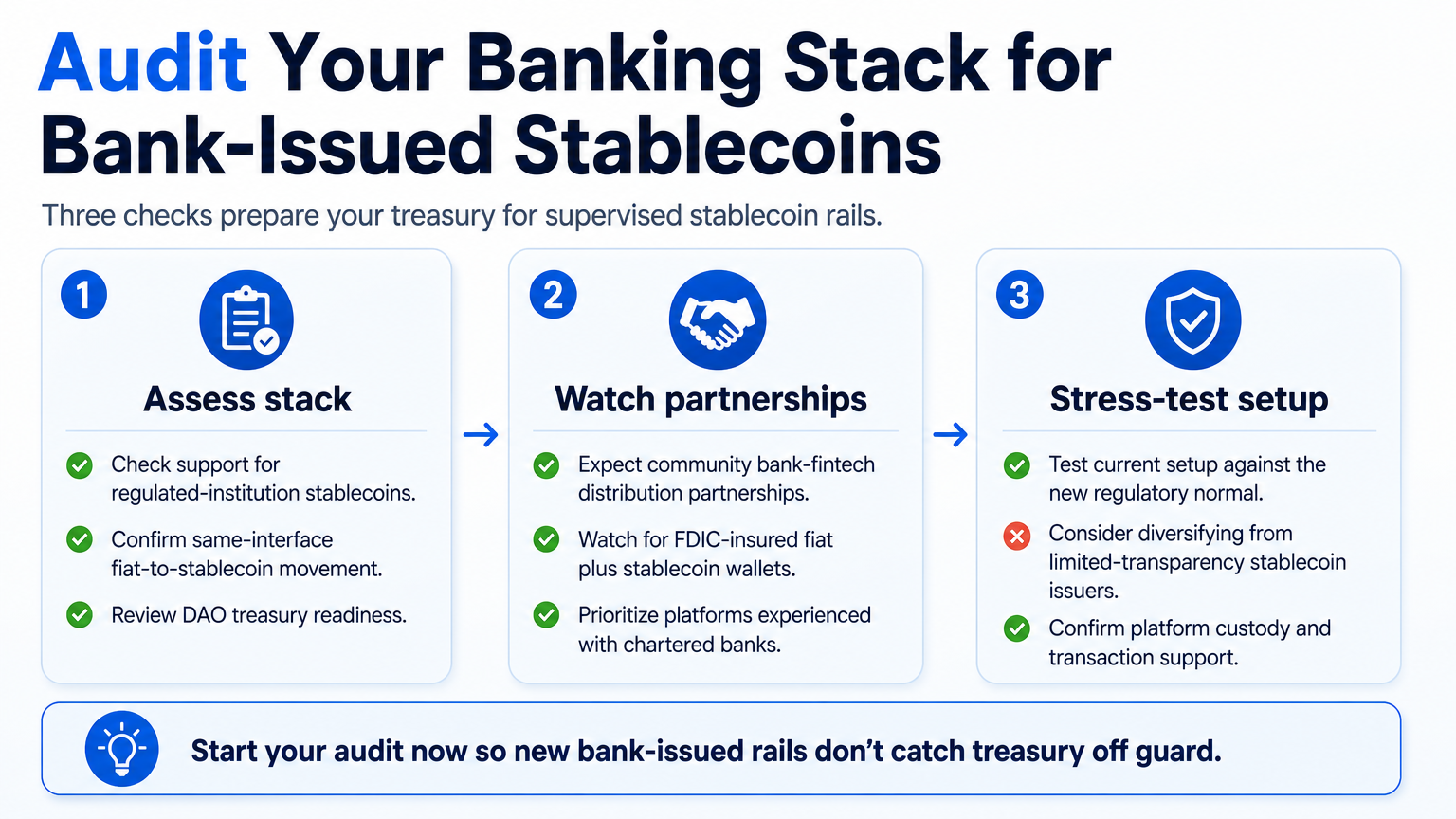
Assess your current banking stack
Ask three questions: (1) Does my crypto banking partner currently support stablecoins issued by regulated financial institutions, or only general-purpose tokens? (2) Can I move funds from a fiat account to a stablecoin and back in the same interface without third-party jumps? (3) Is my DAO’s treasury structure ready for a world where the stablecoin itself sits inside a bank’s balance sheet? If you don’t have clear answers, now is the time to evaluate providers against these new rails.
Watch for new compliance and partnership options
Expect community banks to partner with fintech platforms to distribute their stablecoins. You may soon see offers for accounts that combine FDIC-insured fiat deposits with bank-issued stablecoin wallets, accessible through a single API. In the meantime, keep an eye on platforms that have already navigated the compliance-heavy process of partnering with chartered institutions—those partnerships are the predicate for integrating bank-issued stablecoins smoothly. For a broader look at how compliance demands are shifting, our DeFi compliance analysis highlights the stakes.
What should I do now as a startup using crypto banking?
Start by stress-testing your current setup against the new regulatory normal. If your stablecoin of choice is issued by a nonbank entity with limited transparency, consider diversifying into bank-issued alternatives once they become available. Then, confirm that your crypto banking platform can custody and transact in those tokens. Platforms like OneSafe, designed from the ground up to handle both fiat and crypto, are positioned to connect you to this emerging bank-issued stablecoin ecosystem without rebuilding your back office.
For teams that need to keep their own content engine running without daily distractions, Joyrise plans, writes and publishes illustrated SEO articles to your Webflow blog every day, with your first article ready before you pay.
What to Watch Next: Open Questions After the OCC Ruling
Will community banks actually issue?
Skepticism is warranted. Community banks face technical, compliance, and customer-education hurdles. However, the OCC’s readiness data—34% of credit unions prepared, with 9% already active—suggests adoption could move faster than it did in earlier crypto waves. Watch for pilot programs in Q1 2027. As we noted in the context of Custodia’s Supreme Court case, access to banking rails for crypto ventures has been contentious; this rule flips the script by inviting banks to become issuers themselves.
How regulators will treat neo-banks and fintech platforms
The OCC rule focuses on issuers, not distributors. Neo-banking platforms that custody stablecoins or facilitate payments will likely face continued state-level scrutiny and evolving federal guidance. The Stablecoin Regulation walling-off warning we examined remains relevant: regulators want clear firewalls between bank activities and uninsured crypto activities. Platforms that already maintain strict separation—fiat services through partner banks, crypto through compliant custodians—will find the path forward smoother.
The global ripple effect
The HKMA’s tokenized settlement pilot and Brazil’s crypto banking license deadline both show that regulators worldwide are watching the U.S. model. If bank-issued stablecoins become the norm, cross-border payment corridors could coalesce around these tokens. Our analysis of the HKMA pilot’s implications suggests that interoperability standards will be the next battleground.
Key Takeaways
- The OCC’s final GENIUS Act rule, dated November 3, 2026, permits community banks to issue stablecoins through subsidiaries with a $5 million capital floor after three years, lowering barriers for supervised stablecoin issuance.
- Stablecoin payments can now originate inside the regulated banking perimeter, reducing fragmentation and counterparty risk for businesses that use crypto banking platforms.
- Crypto banking platforms like OneSafe—fintechs that unify fiat and crypto—will be the connective tissue between bank-issued stablecoins and everyday business finance, from payroll to global vendor payments.
- Startups and DAOs should audit their banking stacks now for compatibility with bank-issued stablecoins and watch for partnership announcements from community banks.
- Global regulators are likely to follow, but the initial U.S. framework gives businesses a head start in building compliant, stablecoin-native treasury operations.
To operate on the new rails before they become the default, open a OneSafe account today.