On November 2, 2026, the Hong Kong Monetary Authority (HKMA) gave crypto banking a decisive structural push: banks in its EnsembleTX pilot can now settle tokenized deposit transactions with one another 24 hours a day, seven days a week, using tokenized central bank money. The move shifts tokenized settlement from a controlled experiment to a live, real-value infrastructure that could redefine how corporate treasuries, DAOs, and startups move money across borders. The rails for always-on, programmable money are being laid, and finance leads need to prepare for a world where crypto banking becomes the main operating stack.
Table of Contents
- What Just Happened: Hong Kong Banks Can Now Settle Tokenized Deposits Around the Clock
- Why This Matters for Crypto Banking Right Now
- The Backstory: What ‘Crypto Banking’ Really Means in 2026
- What the Pilot Means for Your Startup or DAO
- Concrete Actions for Finance Leads Today
- What We Don’t Know Yet — and What to Watch
- Key Takeaways
What Just Happened: Hong Kong Banks Can Now Settle Tokenized Deposits Around the Clock

When Project Ensemble launched its live pilot in November 2025, the interbank leg of tokenized deposit transactions still cleared through the traditional HKD Real Time Gross Settlement (RTGS) system, which operates only during business hours. The HKMA’s November 2 announcement—first reported by Yahoo Finance—confirms that the system now achieves round-the-clock interbank settlement using tokenized central bank money. For the first time, a regulated banking environment can finalize tokenized liabilities 24/7—a capability previously available only within permissionless crypto networks or private stablecoin systems.
HKMA Chief Executive Eddie Yue noted the project had moved “from experimentation and piloting to a new phase focused on promoting the commercialisation of tokenisation applications.” The pilot includes 12 banks and 20 industry pioneers (HSBC, Standard Chartered, Bank of China, Ant International, BlackRock, among others) executing real-value corporate treasury and tokenized money market fund deals.
Why This Matters for Crypto Banking Right Now
The Real Cost of ‘Banking Hours’ for Global Treasury Teams
For startups and DAOs operating across time zones, the forced downtime of legacy banking hours imposes a literal holding cost: a Friday afternoon payment in Singapore cannot settle into a fiat account in London until Monday morning. Trapped liquidity must be pre-funded or left idle. The HKMA pilot proves 24/7 settlement for bank-issued tokenized liabilities is achievable within a regulated perimeter. This cuts the working capital required to cover timing gaps dramatically—a business moving $5 million per week across borders can reduce idle float from three days to near zero.
How Tokenized Deposits Reshape the Fiat-Crypto Bridge
Tokenized deposits are digital claims on a commercial bank, recorded on a blockchain and settled in central bank money. Unlike stablecoins, they sit on a regulated bank’s balance sheet and benefit from deposit insurance where applicable. The HKMA pilot uses tokenized central bank money—a wholesale CBDC—to settle interbank legs, so finality and credit risk mirror traditional settlement but with programmability. This erodes the argument that crypto banking inherently requires off-chain, batch-based reconciliation. A corporate multi-currency account can be programmed to sweep liquidity between fiat and stablecoin legs instantly, without waiting for a correspondent bank to open.
What does 24/7 tokenized settlement actually change for my business?
It removes the settlement-time arbitrage between on-chain and off-chain worlds. Today, a startup might hold stablecoins in digital asset custody for business while keeping a separate fiat reserve, constantly rebalancing. Tokenized deposits that settle 24/7 allow full automation, cutting the need for pre-funded fiat cushions by up to 70%. It also eliminates the scenario where a fiat wire is held up over a weekend because the sending bank’s system is offline.
The Backstory: What ‘Crypto Banking’ Really Means in 2026
Three years ago, “crypto banking” largely meant a crypto-friendly business account that could on-ramp and off-ramp fiat alongside crypto balances. In 2026, it encompasses the full lifecycle of tokenized liabilities—commercial bank deposits represented as programmable tokens on a DLT network, settled in tokenized central bank reserves. Reports from Oliver Wyman and Clear.Bank describe deposit tokens as a bridge between bank money’s reliability and digital assets’ programmability.
Why Corporate Treasuries Have Been Stuck in Batch Mode
Even as stablecoins offered 24/7 settlement, the fiat side remained batch-oriented because finality relies on central bank RTGS systems that close overnight and on weekends. A tokenized deposit without tokenized central bank settlement simply shifts the same timing problem to a different ledger. The HKMA pilot is the first instance where a major financial center has solved that last-mile problem.
What is a crypto bank?
A crypto bank is a functional definition: a financial platform combining fiat account services with digital asset custody, on/off-ramp rails, and programmable payment logic—typically provided by a technology company with banking services delivered through partner banks. OneSafe, for example, is a financial technology company offering a unified platform for fiat and cryptocurrency transactions, not a licensed bank itself, but it acts as a crypto banking partner by bridging legacy banking with on-chain money. The regulatory obligations rest with partner banks, while the tech layer provides speed and crypto-native features.
How does crypto banking differ from traditional banking?
Traditional banking relies on batch ACH, SWIFT, and business-hour settlement. A crypto banking platform adds native support for stablecoin settlement, digital asset custody for business, and programmable payment logic—like role-based treasury controls for a DAO. Transaction finality on the crypto leg is near-instant and round-the-clock.
What the Pilot Means for Your Startup or DAO
Real-Time Treasury Without the Fragmentation
Startups managing working capital across multiple fiat currencies and stablecoins face a complex web of accounts, EMI providers, multi-sig wallets, and manual rebalancing. DAOs face even worse fragmentation across hot wallets, cold custody, Gnosis Safe, and a single fiat account. The HKMA pilot points to a future where a single bank-issued tokenized deposit can represent multiple currencies and settle against stablecoins in the same cycle. The operational gain is enormous: fewer intermediaries, lower reconciliation headcount, and near-zero settlement lag between on-chain and off-chain legs.
How Platforms Like OneSafe Already Close the Gap
While full interbank tokenized settlement is not yet available outside Hong Kong, platforms like OneSafe already approximate it. A crypto-friendly business account on OneSafe provides multi-currency fiat accounts, crypto-to-fiat conversions, ACH and international wire transfers, and stablecoin on/off-ramps—all from a single dashboard. For a DAO, role-based permissions and automated payment workflows replace the multi-tool stack, while digital asset custody is secured through Fireblocks. This achieves a unified, programmable treasury spanning fiat and crypto without waiting for continent-specific business hours. The HKMA’s move signals that the path is clear; hybrid platforms will be first to integrate tokenized settlement rails as they spread.
What should DAOs and Web3 startups look for in a banking partner right now?
- Multi-currency fiat accounts and stablecoin rails in a single platform.
- DAO-native controls: role-based permissions that map to governance.
- Real-time transaction tracking across fiat and crypto.
- Segregated custody with institutional-grade security like Fireblocks.
- On/off-ramp speed: conversion between stablecoins and fiat in minutes, not days, with predictable fees (OneSafe offers free USDC deposits/withdrawals).
Concrete Actions for Finance Leads Today
Audit Your Crypto Banking Stack for Real-Time Readiness
- Time each leg: measure actual stablecoin-to-USD wire duration (many find 18–36 hour windows).
- Identify idle float: calculate average balance sitting waiting for settlement—direct working capital cost.
- Assess fragmentation: count how many logins, wallets, and bank portals your team uses.
- Test a hybrid platform: open an account on OneSafe and run the same payment flows, noting time saved and reconciliation reduction.
- Evaluate custody: institutional-grade custody is non-negotiable as settlement speeds increase.
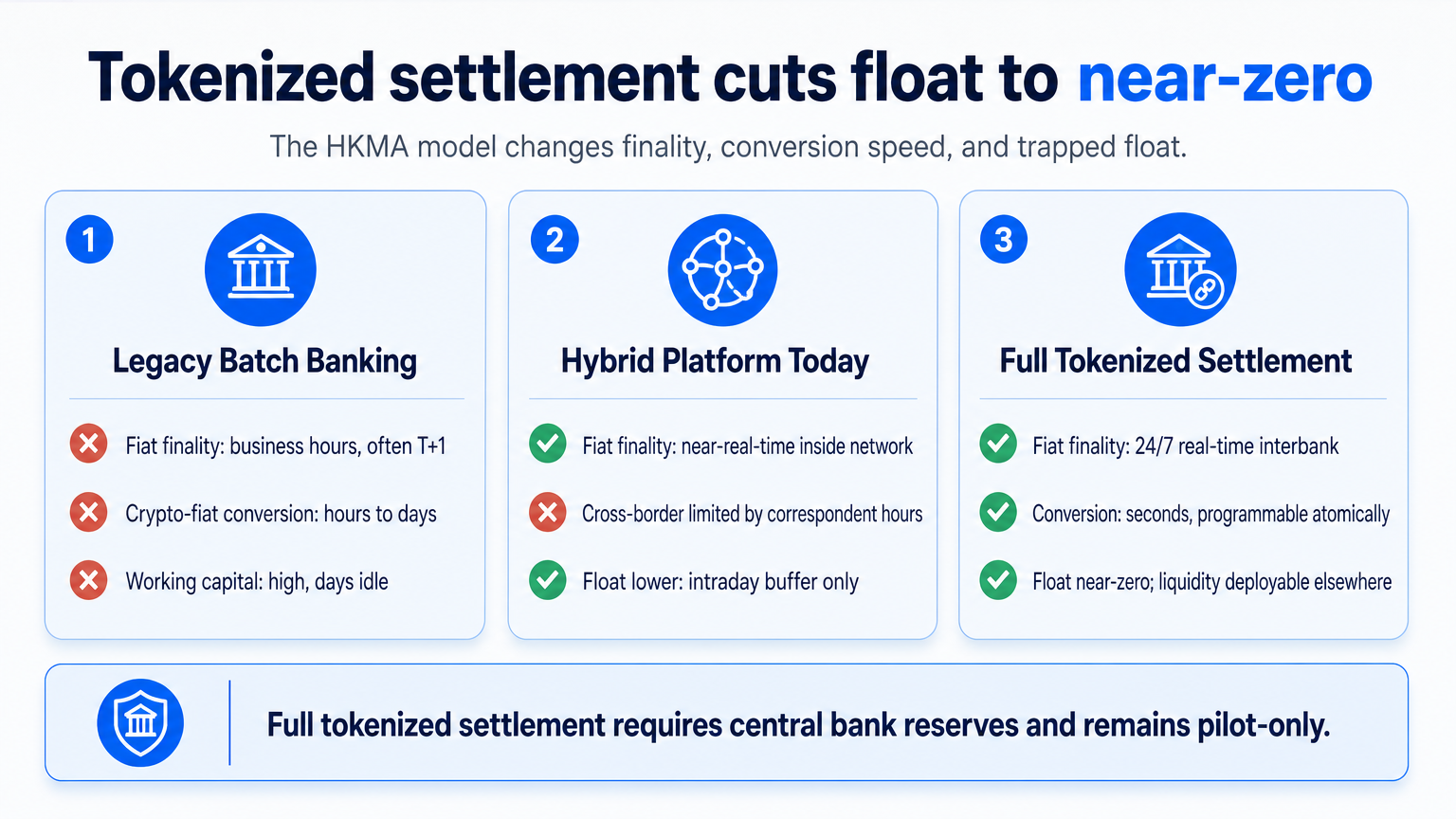
| Settlement Factor | Legacy Batch Banking | Hybrid Platform Today | Full Tokenized Settlement (HKMA Model) |
|---|---|---|---|
| Fiat finality window | Business hours only, often T+1 | Near-real-time within partner bank network, cross-border limited by correspondent banking hours | 24/7, real-time interbank via tokenized central bank money |
| Crypto-fiat conversion latency | Hours to days (manual, batch) | Minutes (automated, within platform) | Seconds (programmable atomically with fiat leg) |
| Working capital locked in float | High—days of idle balance | Lower—float reduced to intraday buffer | Near-zero—instant settlement, liquidity deployable elsewhere |
| DAO treasury management complexity | Very high—separate wallets, banks, manual signing | Reduced—unified dashboard with role-based permissions | Single programmable treasury layer across tokenized deposits and stablecoins |
| Regulatory clarity | Clear but slow | Varies by jurisdiction; platform partners with banks for compliance | Requires wholesale CBDC or tokenized central bank reserves; currently limited to pilot |
Demand Multi-Currency Accounts, Stablecoin Rails, and Role-Based Permissions
If your business relies on cross-border crypto payments, stop accepting banking products that treat crypto as an afterthought. The minimum stack for 2026 includes multi-currency accounts with transparent FX fees, stablecoin on/off-ramps with low or no fees, role-based permissions for DAOs, and secure segregated custody. These features already exist on platforms that bridge traditional banking and digital assets. Start building the treasury architecture that can plug into tokenized settlement when it arrives in your jurisdiction.
What We Don’t Know Yet — and What to Watch
Will Other Jurisdictions Follow, or Will Interoperability Stall?
The HKMA pilot is powerful within Hong Kong, but cross-border atomic settlement remains the real prize. The U.S. Office of the Comptroller of the Currency announced in September 2026 that it will enforce a 2027 deadline for stablecoin regulation (Reuters, September 12, 2026), a move that may lead to U.S. banks issuing their own tokenized deposit equivalents. Whether they’ll interoperate with Hong Kong’s model is an open question. Watch for cross-jurisdictional bridges for tokenized central bank money from the Bank for International Settlements or the Monetary Authority of Singapore.
The Open Questions on Custody, Liability, and Finality
Custody of tokenized deposits during a bank failure is untested; liability for network downtime and legal finality across chains remain gray areas. Finance leads should follow the Conference of State Bank Supervisors and Nacha Tokenized Deposits Guidance, and demand transparent risk scenarios in service-level agreements.
Is tokenized central bank money the same as a stablecoin?
No. Tokenized central bank money is a direct central bank liability on a permissioned ledger; a stablecoin is a private issuer’s liability. Tokenized deposits are commercial bank money, settled in central bank money in the HKMA model. Stablecoin settlement may be faster and cheaper for many business payments, but tokenized deposits offer a different risk profile, potentially qualifying for deposit insurance. The two instruments will coexist: tokenized deposits for institutional treasury operations, stablecoins for on-chain commerce.
Key Takeaways
- The HKMA pilot supports 24/7 settlement of tokenized deposits in central bank money, proving always-on, regulated interbank finality is feasible.
- For startups and DAOs, this cuts working capital trapped in settlement float and enables a single programmable treasury layer across fiat and crypto.
- A crypto banking platform that handles fiat and digital assets natively—with multi-currency accounts, stablecoin rails, and role-based permissions—is the immediate bridge to that future.
- Tokenized deposits and stablecoins serve complementary roles; finance leads should audit their current stack, reduce fragmentation, and run parallel hybrid operations now.
For companies that want to keep their own crypto banking content up to date without the legwork, Joyrise plans, writes and publishes illustrated SEO articles to your Webflow blog every day. Start building a treasury that works across fiat and crypto, 24/7—explore how OneSafe gives your business the unified platform you need.