The U.S. stablecoin regulation landscape shifted on October 23, 2026, when the Office of the Comptroller of the Currency (OCC) issued its final rule implementing the GENIUS Act for payment stablecoin issuers. For non-issuers—fintechs, Web3 startups, DAOs, and global firms that hold, move, or convert stablecoins—the clock starts now. The OCC’s final rule on stablecoin regulation sets a hard January 18, 2027 compliance date, and while you may never apply for stablecoin licensing, the choices you make about which stablecoins you hold and how you manage fiat-crypto flows will be shaped by this framework for years.
Table of Contents
- What just changed in US stablecoin regulation 2026?
- What exactly is the OCC final rule under the GENIUS Act, and when does it take effect?
- Who does the final rule apply to, and who is out of scope?
- How do the OCC, Fed, FDIC, and NCUA frameworks differ while the other rules are still proposals?
- What should businesses using stablecoins do before January 18, 2027?
- What does this mean for DAOs, Web3 startups, and fiat-crypto finance platforms?
- What red flags should a finance lead check when choosing a stablecoin issuer?
- What to watch next
- Key Takeaways
What just changed in US stablecoin regulation 2026?
The first federal stablecoin framework is now final
On October 23, 2026, the OCC published its final rule in the Federal Register, becoming the first federal payment stablecoin regulator to finalize its licensing and supervision framework under the GENIUS Act. The rule takes effect January 18, 2027, and covers permitted payment stablecoin issuers (PPSIs) and foreign payment stablecoin issuers within OCC jurisdiction.
Simultaneously, the OCC released application and waiver guidance and revised weekly and quarterly reporting forms. As Davis Wright Tremaine noted on November 3, 2026, the GENIUS Act final rule “rewards institutions subject to OCC jurisdiction with a flexible and easy-to-apply framework but leaves the hardest questions to be answered one application and one supervisory decision at a time.”
Who the rule covers and what it demands
The OCC stablecoin rule applies to permitted payment stablecoin issuers—national banks, federal savings associations, federal branches and agencies of foreign banks, and certain trust companies that choose the OCC as their payment stablecoin regulator. Foreign issuers seeking to operate in the U.S. under an OCC license are also covered.
Core requirements center on capital, reserve composition (high-quality liquid assets), 1:1 redemption at par, and detailed reporting. Non-issuer businesses are not required to obtain stablecoin licensing. That’s the line most explainers miss—but it’s the one that matters most for treasury operations.
What exactly is the OCC final rule under the GENIUS Act, and when does it take effect?
What the GENIUS Act actually does
The Guiding and Establishing National Innovation for U.S. Stablecoins (GENIUS) Act creates a federal licensing and supervision regime for payment stablecoin issuers. It sets uniform standards for reserves, redemption, capital, and consumer protection, replacing the previous state-by-state patchwork. The OCC’s final rule is the first installment; the Federal Reserve, FDIC, and NCUA are each drafting parallel frameworks for institutions under their jurisdictions.
The final rule takes effect on January 18, 2027—the same day the GENIUS Act itself becomes effective. Issuers under OCC supervision must be licensed or approved by that date.
Where the Fed, FDIC, and NCUA still stand
Proposed rules from the Federal Reserve, FDIC, and NCUA borrow heavily from the OCC’s approach but have not been finalized. For now, only the OCC’s framework is a known quantity. Issuers that opt for a Fed, FDIC, or NCUA license are operating under proposals that can still change. The practical consequence: if your business holds stablecoins issued by a variety of entities, the regulatory backing will be uneven for months—possibly longer. We’ll return to that asymmetry shortly.
Who does the final rule apply to, and who is out of scope?
The OCC final rule applies exclusively to entities that issue payment stablecoins and that are within the OCC’s jurisdiction. A national bank that wants to launch a stablecoin must become a permitted issuer; a trust company that chooses the OCC as its regulator must do the same. Foreign payment stablecoin issuers that maintain a U.S. presence under OCC oversight are also in scope.
Critically, the rule does not apply to:
- Businesses that merely hold, send, or convert stablecoins
- Fintech platforms that integrate stablecoin payments without issuing the tokens
- DAOs, Web3 startups, and global treasury operations that use stablecoins as a settlement asset
- Custodians, exchanges, and wallet providers that do not issue the underlying stablecoin
So if you run a fiat crypto treasury, a DAO stablecoin treasury, or a global business that holds USDC as working capital, you are out of scope for the licensing requirement. But being out of scope does not mean the rule is irrelevant—it means your counterparty, the stablecoin issuer, is now subject to enforceable prudential standards, and you need to verify that.
How do the OCC, Fed, FDIC, and NCUA frameworks differ while the other rules are still proposals?
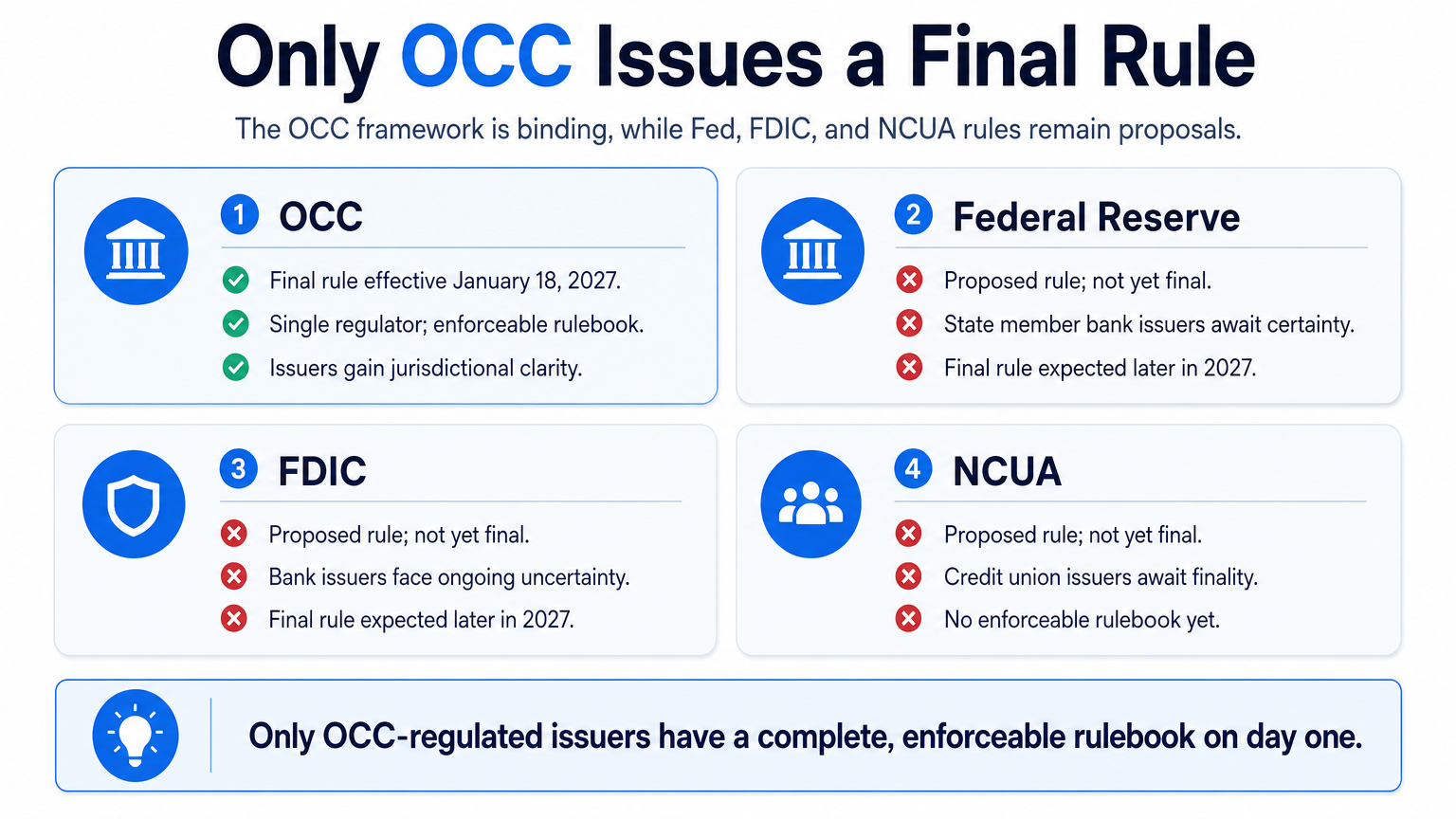
The OCC final rule is the only binding framework as of today. The Fed, FDIC, and NCUA have published proposed rules that mirror much of the OCC’s language—capital ratios, eligible reserve assets, redemption requirements—but they remain drafts. Until those are finalized, an issuer regulated by the Fed (say, a state member bank) is operating under a proposed rule that could be revised before enforcement.
From a user’s perspective, the practical differences may include:
- Jurisdictional clarity: OCC-supervised issuers have a clear, single regulator. An issuer waiting for the Fed’s final rule may be in regulatory limbo.
- Supervisory culture: The OCC has long supervised national banks and trust companies; the Fed, FDIC, and NCUA bring different priorities that can affect reserve management, reporting, and redemption enforcement.
- Timeline: Only OCC-regulated issuers will have a final operational framework by January 18, 2027. Issuers under the other agencies may not have final certainty until later in 2027.
For a non-issuer business, this means you can’t simply assume that “stablecoin = regulated.” You need to ask which regulator oversees your issuer and whether a final rule is in place yet. The GENIUS Act rulemaking tracker maintained by Chapman and Cutler is a useful resource to monitor each agency’s progress.
What should businesses using stablecoins do before January 18, 2027?

The issuer-versus-user split most explainers skip
The OCC final rule targets issuers, not users. But when an issuer fails to meet its regulatory obligations, the stablecoins you hold could become impaired, illiquid, or frozen. The deadline is your operational trigger to re-examine every stablecoin counterparty.
January 18, 2027 is an operational deadline, not a policy headline
Even if you never apply for a license, your treasury operations depend on stablecoin liquidity, 1:1 redeemability, and banking access. After that date, holding a stablecoin from an unlicensed or non-compliant issuer could introduce settlement risk, counterparty risk, or legal uncertainty in bankruptcy. A practical stablecoin compliance timeline:
| Action | Deadline | Key Question for Counterparty |
|---|---|---|
| Map all stablecoin holdings and identify each issuer | Q4 2026 | Which prudential regulator oversees this issuer, and under which framework? |
| Request documentation of reserve composition and redemption proof | By Dec 2026 | Does the issuer hold eligible high-quality liquid assets and guarantee 1:1 redemption at par? |
| Review banking and on/off-ramp providers | Q4 2026 | Will your provider’s stablecoin flows run through permitted issuers? |
| Update treasury policies and stablecoin contracts | Before Jan 18, 2027 | What triggers if the issuer loses permitted status or a regulator restricts redemptions? |
| Assess your fiat crypto treasury strategy for concentration risk | Ongoing | Are you over-reliant on a single issuer whose regulatory status may shift? |
For DAOs and Web3 startups
A DAO stablecoin treasury must be composed of stablecoins from permitted issuers to avoid friction when converting to fiat or paying contributors after January 18, 2027. Consider:
- Verify that your stablecoin of choice is issued by an OCC-licensed entity (or a future Fed/FDIC/NCUA-licensed one).
- Document the legal relationship: if you hold the stablecoin in a smart contract wallet, who has the legal claim against the issuer? That ambiguity matters if a redemption crisis hits and compliance obligations for decentralized organizations intensify.
- Platforms like OneSafe, which consolidate fiat and crypto treasury for DAOs, can help you track stablecoin flows and counterparty health as regulation tightens.
For global businesses running fiat and stablecoin flows
If you use stablecoins for cross-border settlement or working capital, your bank may ask new questions when you route stablecoin-derived funds through a fiat account. Banks will increasingly want to know that the stablecoin issuer is permitted, just as they would verify a correspondent bank. The frictions in correspondent banking for stablecoin payments are about to become more explicit. Start the conversation with your banking partners now—crypto-friendly business banking access will depend on issuer status.
What does this mean for DAOs, Web3 startups, and fiat-crypto finance platforms?
The OCC rule doesn’t force you to become a bank. But it does force you to become a thorough counterparty risk manager. For the first time, there is a clear federal line between a permissible stablecoin and one that exists in a regulatory gray zone. That clarity creates new liability vectors: if a DAO continues to use a stablecoin that later loses its permitted status, treasury management becomes a legal liability, not just a market risk.
Fiat-crypto finance platforms that offer stablecoin on/off-ramps will need to ensure they only interface with regulated issuers—or risk losing banking access. The question is no longer “is stablecoin regulation coming?” but “which permitted issuers can we trust with our flow?”
What red flags should a finance lead check when choosing a stablecoin issuer?
How to run a counterparty check before 2027
The final rule leaves several critical questions to supervisory discretion: yield on reserve assets, capital adequacy triggers, and exactly how quickly redemption must be honored in a stress scenario. You can’t just read the rule and assume compliance—you must interrogate the issuer.
Before you park treasury assets in any stablecoin, demand answers to these red-flag questions:
- Regulatory status: Is the issuer a permitted payment stablecoin issuer? Under which prudential regulator? If the answer is “applied” or “intends to apply,” treat it as unregulated until January 18, 2027.
- Reserve proof: Has the issuer published an independent attestation of reserves that maps to the eligible collateral categories in the final rule? No clear reserve attestation or proof of redemption at par is a hard pass.
- Reporting cadence: Does the issuer commit to the weekly and quarterly reporting the OCC now requires? If not, what will they disclose, and when?
- Yield promises: If the issuer advertises yield to token holders, that likely interacts with the capital and reserve rules in a way supervisors will scrutinize. Be prepared for yield structures to change or disappear as the OCC starts reviewing applications.
- Banking relationships: Does the issuer have direct access to Federal Reserve master accounts or a dependable network of banking partners? The ongoing legal battles over crypto banking access mean not every permitted issuer will have smooth fiat on/off ramps.
Yield, capital, and the questions left to supervision
Davis Wright Tremaine’s analysis highlights that the final rule “leaves the hardest questions to be answered one application and one supervisory decision at a time.” That includes whether issuers can pass through yield generated on reserve assets and how capital requirements will be calibrated for non-bank issuers. Assume that any yield or revenue-sharing model attached to a stablecoin is contingent and might be unwound under supervisory pressure. Structure your treasury contracts accordingly—don’t treat yield as a fixed feature.
What to watch next
Fed, FDIC, and NCUA final rules
The Fed’s proposed rule for state member banks and the FDIC’s and NCUA’s proposals for the institutions they supervise are expected to be finalized sometime in 2027. Once those drop, the patchwork will begin to fill in, and issuer comparisons will become easier. Until then, assume that only OCC-jurisdiction issuers have a complete, enforceable rulebook and that other stablecoins may carry latent regulatory uncertainty.
The first waiver and application decisions
The OCC’s waiver guidance will be tested quickly. Issuers will seek exemptions from certain capital or redemption requirements, and how the OCC handles those early requests will signal its true supervisory posture—more than any press release. Watch for the first public application approvals and denials; they will set precedents that affect which stablecoins survive and which disappear. The first quarter of 2027 will be a live laboratory for the future of U.S. stablecoin regulation.
For teams that need to publish these regulatory updates while managing a fiat crypto treasury, Joyrise plans, writes and publishes illustrated SEO articles to your Webflow blog every day — read your first article before you pay.
Key Takeaways
- The OCC final rule under the GENIUS Act is the first binding federal stablecoin regulation, effective January 18, 2027, and it applies only to permitted payment stablecoin issuers within OCC jurisdiction.
- Non-issuer businesses—including fintechs, Web3 startups, and DAOs—do not need a license but must verify that any stablecoin they hold comes from a permitted issuer to avoid settlement and counterparty risk.
- Before the deadline, map all stablecoin holdings, demand regulatory-status proof and reserve attestations from issuers, and update treasury policies.
- The Fed, FDIC, and NCUA frameworks remain proposals, creating an uneven landscape; only OCC-regulated issuers will have a final rulebook on day one.
- The most immediate red flags are unclear regulatory status, missing reserve proof, yield promises that may not survive supervision, and absent or unreliable redemption guarantees.
For a unified fiat-crypto treasury platform that helps you track stablecoin flows, monitor counterparty health, and keep your global operations compliant as regulation tightens, open an account with OneSafe.