
You're in month-end again, and the same mess is sitting in front of you. Vendor invoices are waiting on approval, travel receipts are half-matched, a few contractors want to know when they're getting paid, and someone just asked why one team can buy from any merchant while another needs pre-approval for every supplier. That's the purchasing cards vs credit cards decision, not a feature comparison. It's a control decision, and it starts showing up the moment finance has to reconcile spend without turning the close into a scavenger hunt.
| Dimension | Purchasing Card | Corporate Credit Card |
|---|---|---|
| Main purpose | Procurement and vendor spend | Employee travel and broader business spend |
| Control timing | Pre-purchase controls at authorization | Mostly post-purchase review and reconciliation |
| Merchant restrictions | Tight, often vendor or MCC based | Broader, more flexible |
| Data detail | More granular transaction data, often including line-item detail | Usually more expense-report style data |
| Working capital | Typically paid in full each cycle | Can allow revolving balances |
| Reconciliation load | Lower exception handling when policy is set well | More receipt matching and expense review |
| Best fit | Repeatable supplier and B2B purchases | Travel, discretionary spend, mixed employee purchases |
Table of Contents
- P-cards are procurement tools, not general spend tools
- The overlap is real, but the intent still differs
- Procurement-heavy SMB
- Distributed tech firm
- DAO or web3 treasury
- Newly incorporated entity with thin banking history
- Start with current spend, not vendor demos
- Pick a platform that matches the operating model
- Make KYB and onboarding part of the rollout
The Finance Ops Moment That Forces the Card Decision
The card choice gets real when finance ops is carrying too much weight for the process it inherited. A controller is looking at supplier spend that should have been controlled before the purchase, employee spend that got approved after the fact, and a backlog of receipts that no one wants to own. The issue isn't just speed, it's whether the company is preventing bad spend or detecting it later.
Control failures show up in the close
That distinction matters because procurement spend is still fragmented in many firms. In a 2021 survey of 361 accounting and finance professionals, 36% of companies preferred using credit cards to pay suppliers, but only 4% preferred virtual or ghost cards, and only 48% of businesses made payments by credit cards at all, while 81% used paper checks and 64% used ACH, according to the survey summary in the p-card comparison brief Stampli's p-card vs credit card overview. That mix tells you why so many teams still live with workarounds instead of a clean procurement card model.
A purchase card program is what finance reaches for when it wants the control embedded in the payment method. A corporate credit card is what finance reaches for when it needs flexibility for people who are buying across categories, cities, and business purposes. If your close breaks because suppliers, travelers, and contractors all sit in the same workflow, the card decision is really a workflow decision.
Practical rule: if you need to stop spend before it happens, you want procurement controls in the card. If you can live with reviewing it after the fact, a corporate card can be enough.
The right question is when control happens
The best operating model starts with three questions. First, who owns the data. Second, when does control happen, before purchase or after purchase. Third, where does the company spend most often, on suppliers or on employees.
That lens is stronger than a basic feature grid because it maps to finance pain. Purchase cards reduce exception handling by enforcing policy at authorization. Corporate credit cards push more of that burden into expense review and reconciliation. If you're trying to choose next quarter, don't ask which card is more modern. Ask which process your team can sustain.
What Purchasing Cards and Corporate Credit Cards Actually Are
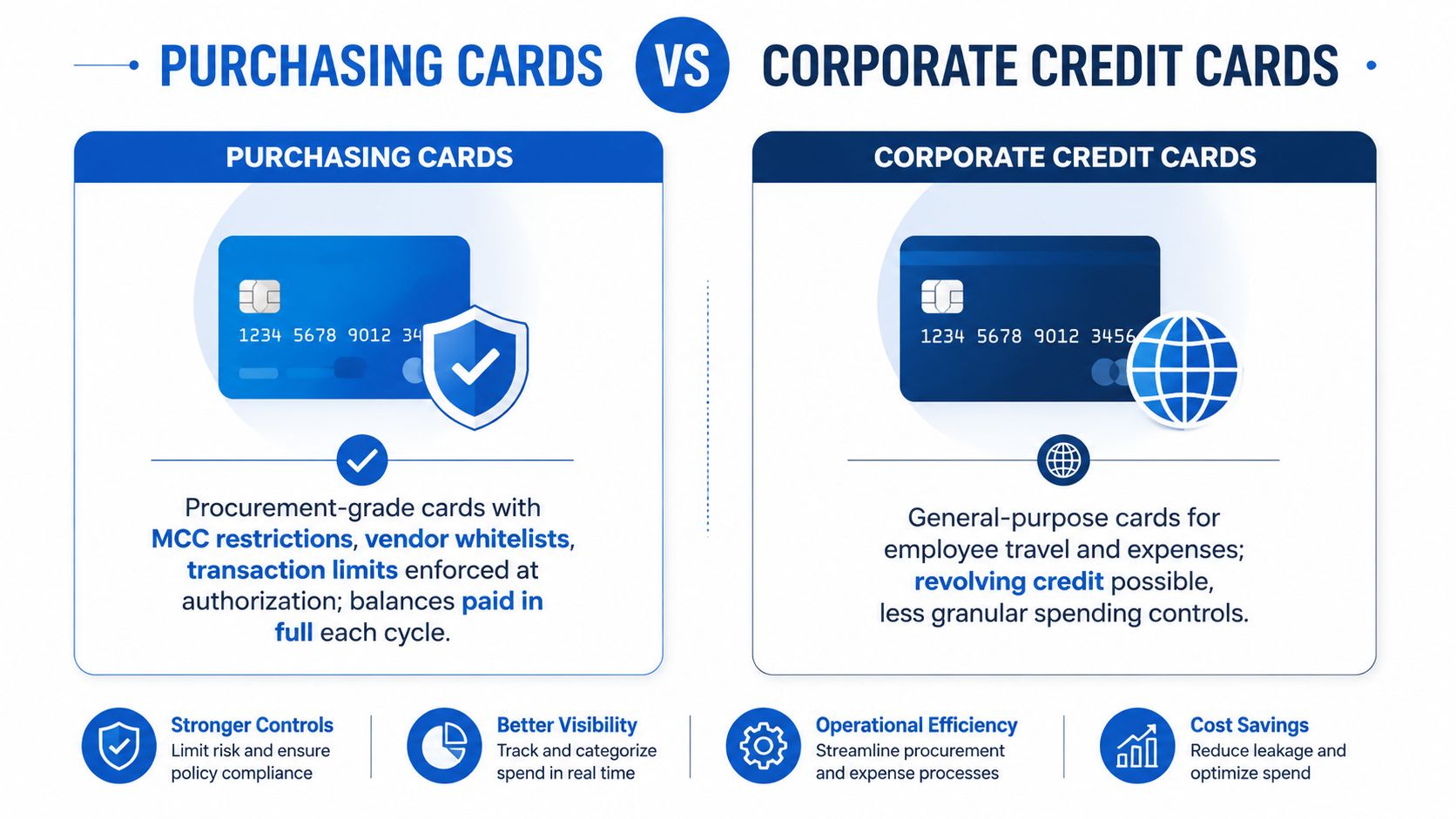
A purchasing card, or P-card, is a specialized commercial card built for procurement. It is not a generic employee spend tool with a fancy name. It's designed to encode policy into the card itself, usually through vendor restrictions, merchant category code limits, transaction caps, and pre-approval rules at the point of sale Order.co's p-card vs credit card guide.
P-cards are procurement tools, not general spend tools
In practice, p-cards work best for repeatable B2B purchases, MRO, supplier payments, and other buying patterns where the company already knows what's allowed. The control point sits at authorization, which means finance is preventing off-policy spend instead of cleaning it up later. That's why p-cards tend to cut down on post-transaction exception handling.
A corporate credit card serves a broader purpose. It's the card you give to travelers, managers, and employees who need flexibility across merchants and geographies. It's built for travel, entertainment, subscriptions, and other operational spend where a strict vendor whitelist would just create friction.
A historical detail matters here. P-cards emerged as a control-heavy middle ground between paper checks and open corporate cards, which is still why they look like procurement infrastructure rather than employee perks Stampli. They weren't invented to compete with travel cards. They were invented to replace clumsy manual purchase flows.
If your team is trying to standardize procurement approvals, the right process tool matters as much as the card. Teams that need purchase-order discipline, invoice routing, and approval traceability can also look at streamline procurement with Wistec to keep the workflow consistent before anything hits the card rail.
The overlap is real, but the intent still differs
Modern programs blur the line. Many corporate card platforms now offer tighter merchant controls, and P-cards can be issued virtually as well as physically. That's why a good provider matters. A platform like OneSafe cards can sit in that overlap, where spend limits, merchant controls, and policy-based approvals are available in one program.
The point isn't that the labels are meaningless. The point is that the design intent still is different. P-cards are procurement control mechanisms. Corporate credit cards are flexible spending lines for employees. If you treat them as interchangeable, the finance team ends up paying for that mistake in reconciliation time.
Where the Two Cards Actually Differ
The comparison isn't “which one has more features.” It's where the control lives, how much data the finance team gets, and how painful the close becomes. A p-card and a corporate credit card can both move spend, but they create very different operating models.
P-Card vs Corporate Credit Card at a Glance
| Dimension | Purchasing Card | Corporate Credit Card |
|---|---|---|
| Control timing | Enforced at authorization, before the spend happens | Usually reviewed after purchase through expense policy |
| Merchant rules | Vendor whitelists, MCC blocks, and role-based limits | Broader merchant access, more employee discretion |
| Transaction limits | Tight single-transaction and monthly caps | Often looser, especially for travel and ad hoc spend |
| Data granularity | More granular transaction data, including line-item or Level 3 detail in stronger programs First Citizens | More dependent on receipt matching and employee-entered expense detail |
| GL coding | More likely to map cleanly into procurement coding | Often depends on employee categorization and review |
| Working capital | Typically paid in full each billing cycle, so no revolving exposure First Citizens | Can carry balances and may incur APR costs |
| Reconciliation effort | Lower when controls and coding are configured well | Higher because the expense-report flow needs more human input |
| Fraud response | Prevention first | Detection first |
A p-card is a prevention tool. A corporate card is usually a detection tool.
That sentence is the core of the decision. Finance leaders who want fewer exceptions should prefer prevention. Teams that need spend latitude should accept detection and build better review processes around it.
Why data quality matters more than branding
A p-card typically produces more granular transaction data and can support automated GL-code matching, which speeds reconciliation and gives finance better visibility into spend patterns First Citizens. A corporate card can still integrate cleanly with accounting software, but it relies more on receipt collection, business-purpose notes, and employee categorization.
For a controller, that means the question isn't “Can both cards feed the ledger?” They can. The question is how much manual judgment you want the team to carry. A p-card leans toward structured procurement data. A corporate card leans toward expense reporting logic.
If you're comparing broader funding tools too, the difference between business credit and business lending works the same way. A compare line of credit vs credit card resource can help you separate revolving funding from payment controls, which is a different choice from the p-card decision but often gets bundled into the same conversation.
Use Cases by Team and Spend Pattern
The right card depends on where the spend pressure lives. Some organizations are fighting supplier chaos. Others are fighting travel friction. A few are trying to settle payments in nontraditional rails entirely. A single card type won't solve all of that.
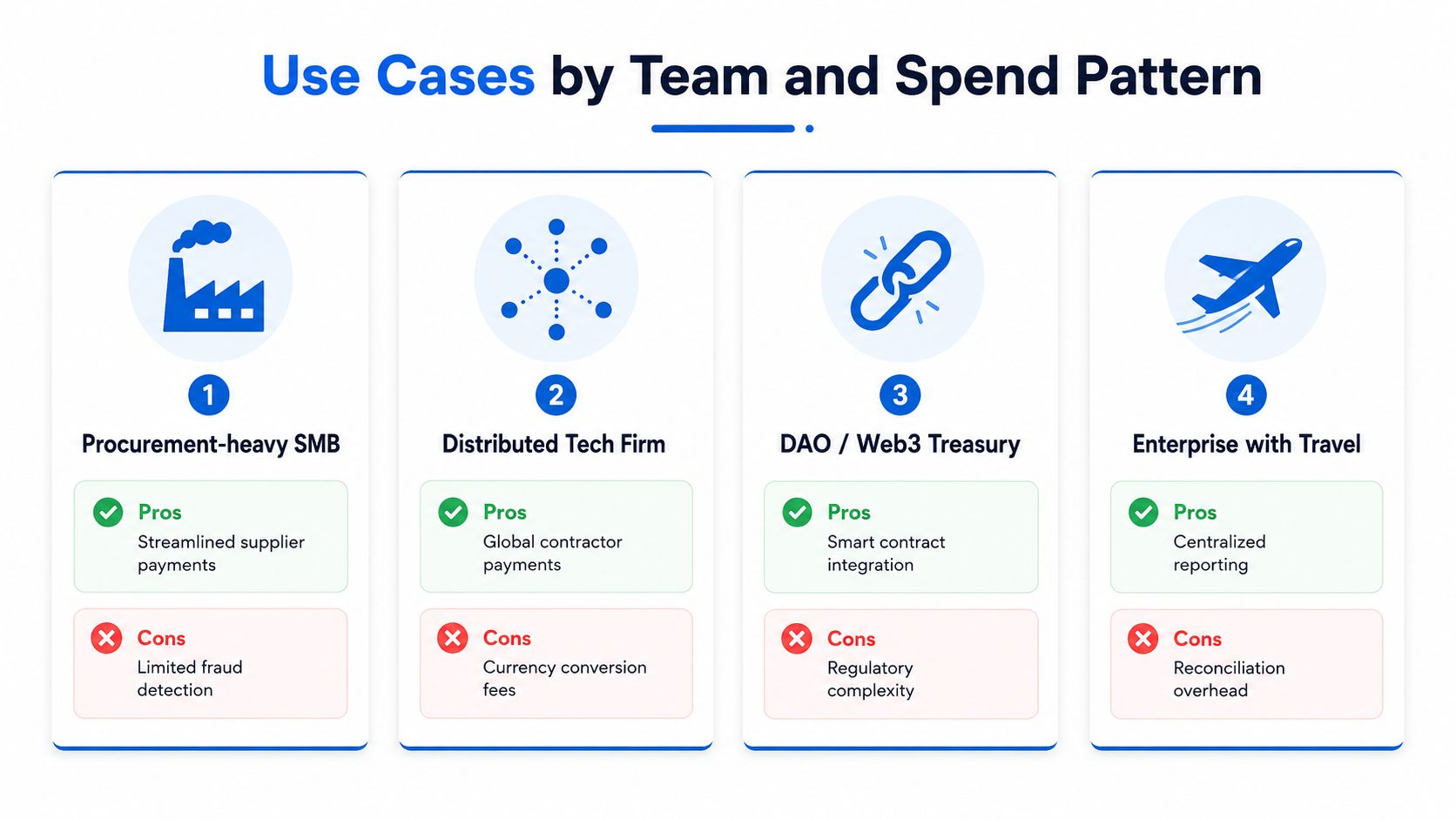
Procurement-heavy SMB
A small or mid-sized business with recurring supplier spend should lean toward p-cards if maverick spend is the problem. The benefit is straightforward, fewer off-policy purchases and less time wasted on invoice exceptions. If the company already knows its vendors and buying rules, the p-card gives finance a way to hard-code discipline.
Distributed tech firm
A distributed team with global contractors, client travel, and cross-border employee spend usually needs corporate cards first. The pain there is not procurement rigidity, it's flexibility across geographies and currencies. You want enough control to keep the spending visible, but not so much control that employees can't do their jobs.
For teams managing travel-heavy operations in Europe, fleet expense management Europe is a useful reference point because the operational problem is often the same, centralized policy with distributed execution.
DAO or web3 treasury
A DAO or web3 treasury has a different constraint entirely. If vendor payouts or operational spend need to move through stablecoins or crypto-adjacent workflows, the card decision can't be separated from settlement rails. In that world, the question is whether the platform supports the governance and payment flow you use, not whether the card is branded as a p-card.
Newly incorporated entity with thin banking history
A new entity in a jurisdiction like the Cayman Islands or BVI usually needs operational control and banking access more than it needs a long wishlist of spend features. Corporate cards with spend limits and approvals can be enough if the company's spending is still simple. If procurement becomes heavier later, the team can layer in stricter controls.
If your company has low procurement complexity but high travel volume, a p-card program may not move the needle much. You'll just create another control layer without solving the spend problem.
Cost, FX, and Liability Implications
Cost is where a lot of teams get sloppy. They compare card labels, not economics. That's a mistake, because the cost of a spend program includes fees, FX drag, fraud handling, and the labor needed to reconcile it.
Cost is not just interchange
A corporate credit card can create ongoing cost if balances revolve, because revolving balances may incur APR charges First Citizens. A p-card usually behaves more like a charge mechanism and is paid in full each cycle, so there's no revolving interest exposure. That matters if your team is tempted to use credit cards as short-term financing.
The other cost layer is administrative. If a corporate card creates more receipt chasing, more exception handling, and more manual coding, any headline rebate can get swallowed by labor. P-cards often reduce that overhead because the data structure is tighter from the start.
FX can erase the supposed advantage
Global spending changes the math fast. A card-level 3% FX fee can be painful on high-volume cross-border vendor payments, while a platform that prices FX differently, such as OneSafe's stated 0.25% or FX rate structure for foreign exchange, changes the economics for teams moving money across currencies OneSafe pricing. For distributed companies, the currency layer can matter more than the card label.
That's why global teams need to compare the card, the account, and the settlement path together. A corporate card with weak FX economics can be more expensive than a p-card used domestically. A multi-currency business account can also reduce unnecessary conversions before the card ever gets involved.
Liability follows the control model
Liability is where the risk lands. With tighter procurement controls, the company is usually on the hook for the spend because the card is designed for business purchasing. With employee-facing corporate cards, the issue becomes how much of the dispute process depends on the cardholder, the issuer, and the policy owner.
Practical rule: if the team is doing a lot of cross-border spend, compare the FX cost and the dispute burden before you compare any other feature.
If a card program leaves you with frequent chargebacks, unclear responsibility for fraud, or spend that keeps slipping outside policy, the economics are already broken. In that case, the wrong question is “Which card is cheaper?” The right one is “Which program stops waste before it lands in AP?”
Implementing the Right Program for Your Finance Team
Card programs fail when they're treated like a procurement of plastic. They succeed when they're implemented like policy infrastructure. The rollout should be sequenced, controlled, and tied to your accounting stack from day one.
Start with current spend, not vendor demos
Map the spend first. Separate supplier payments, employee travel, contractor payouts, and any global or crypto-adjacent flows. If you don't know where the money is going, you'll pick a card based on marketing copy instead of operating reality.
Then write the policy in plain language. State who gets a card, what can be bought, which merchants are blocked, what needs approval, and what happens when someone violates the rules. Policy without enforcement is just documentation.
Next, configure controls at the card level. That means MCC blocks, merchant whitelists, transaction limits, and monthly caps. The p-card mindset matters even if you choose a corporate card platform, because the controls have to live at authorization if you want prevention instead of cleanup.
After that, wire approvals into the platform. Finance shouldn't be approving spend in email threads and then pretending the software is the system of record. Finally, connect transactions to the GL with automated coding so reconciliation doesn't depend on memory and spreadsheets.
Pick a platform that matches the operating model
OneSafe offers corporate cards with spend limits, merchant controls, and policy-based approvals for vendor and team payments, alongside multi-currency business accounts and USDC deposits and withdrawals OneSafe. That kind of setup matters when finance needs one interface for controlled spend and cross-border operations.
For teams that need to audit AP behavior, the same stack can sit next to the control framework. OneSafe's audit of accounts payable guidance fits naturally if you're trying to tighten the review process around the card program instead of bolting it on later.
Make KYB and onboarding part of the rollout
New entities should think about KYB readiness and vendor onboarding early. If you're a newly incorporated company that needs banking rails quickly, the operational risk isn't just the card. It's whether the account, approvals, and payment flows are ready in time for the business to function.
The finance team that wins here doesn't start with “Which card?” It starts with “Which controls, which rails, and which reconciliation path?”
Decision Framework and Final Recommendations
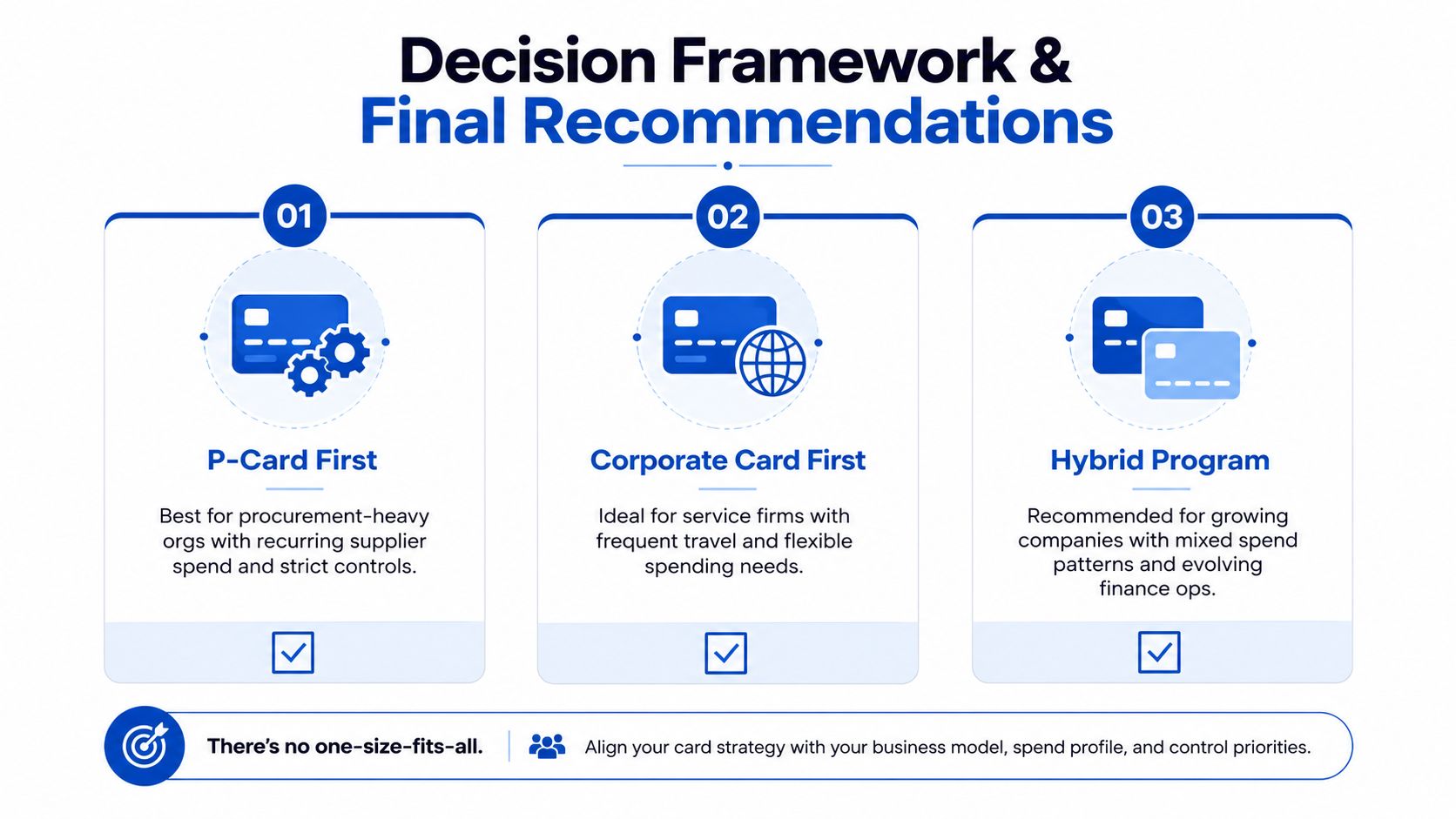
Choose a p-card first program if your company has recurring supplier spend, clear vendor lists, and a real maverick-spend problem. Choose corporate cards first if travel, entertainment, discretionary employee spend, or global flexibility are the main pressure points. Run a hybrid program if procurement and employee spend are both meaningful and you need different control models for each.
For web3 and global teams, I'd be even more direct. If settlement, multi-currency accounts, and programmable approvals matter, the card is only one piece of the stack. You need the payment rail, the controls, and the treasury layer to work together.
The purchasing cards vs credit cards decision is not about which product is better in the abstract. It's about when control should happen and how much operational judgment you want your team to carry. Pick the architecture that matches the way your company spends, not the card label that sounds simpler in a demo.
If you're deciding between p-cards, corporate cards, or a hybrid setup, OneSafe gives finance teams a way to combine spend limits, merchant controls, approvals, multi-currency accounts, and USDC rails in one workflow. Visit OneSafe to review how that structure fits your vendor payments, employee spend, and global treasury setup next quarter.


