On October 26, 2026, the Office of the Comptroller of the Currency (OCC) granted final approval for Ripple to establish a federally supervised national trust bank—a move that reshapes the crypto banking landscape and the OCC crypto banking framework for how stablecoin reserves can be managed under federal oversight. The decision, first reported by CU Today on October 28, 2026, permits Ripple National Trust Bank to hold segregated assets backing the company’s RLUSD stablecoin and to provide fiduciary custody for digital assets, though it will not accept traditional deposits or make commercial loans. For businesses already navigating the seam between fiat and crypto, the approval marks a regulatory milestone that clarifies options—but doesn’t remove all complexity.
Table of Contents
- What just happened with Ripple and the OCC?
- Why does this matter for crypto banking?
- How does a national trust bank differ from a traditional bank?
- What are the implications for stablecoin reserves and custody?
- What should startups and DAOs consider in light of this?
- How does this affect existing neo-banking platforms like OneSafe?
- What are the remaining regulatory uncertainties?
- What’s next for crypto banking regulation?
- Key Takeaways
What just happened with Ripple and the OCC?
The OCC’s final authorization on October 26, 2026, allows Ripple to launch a national trust bank—a limited‑purpose federal charter that focuses on fiduciary activities, not full‑service banking. According to the OCC’s digital‑asset licensing application page and Ripple’s press release, the trust bank will manage segregated reserves supporting RLUSD, serve as collateral trustee for stablecoin holders, and offer fiduciary custody for digital assets. It follows a conditional approval granted in December 2025, but the final go‑ahead cements the bank’s federal supervision.
RLUSD, the US‑dollar‑pegged stablecoin issued by Ripple’s New York‑regulated subsidiary, had grown to a market capitalization of approximately $2.5 billion by the time of the approval. Ripple CEO Brad Garlinghouse said, “For years, we’ve said crypto and banks work better together. Final approval for Ripple National Trust Bank is what that looks like in practice.” The trust bank does not take deposits or lend money—distinctions that separate it from a traditional credit union or commercial bank.
Why does this matter for crypto banking?
The Ripple trust bank signals that federal regulators are comfortable with a specific, supervised model that brings stablecoin reserve management and digital‑asset custody under a national charter. For the broader crypto banking space—where neobanks, fintech platforms, and state‑chartered entities have long carried the weight of bridging fiat and crypto—the approval provides a clearer, federally sanctioned on‑ramp for institutional‑grade services. This isn’t just about one company; it sets a precedent that other large crypto firms could follow, potentially creating a network of trust banks that standardize how stablecoins are backed and how digital assets are held.
While crypto banking gets a national charter has been discussed for years, this step makes federal trust charters a real option for custody‑focused crypto enterprises. It also validates the idea that regulated trust banks can coexist with, and even strengthen, the crypto‑friendly banking ecosystem without requiring every provider to become a full depository institution.
How does a national trust bank differ from a traditional bank?
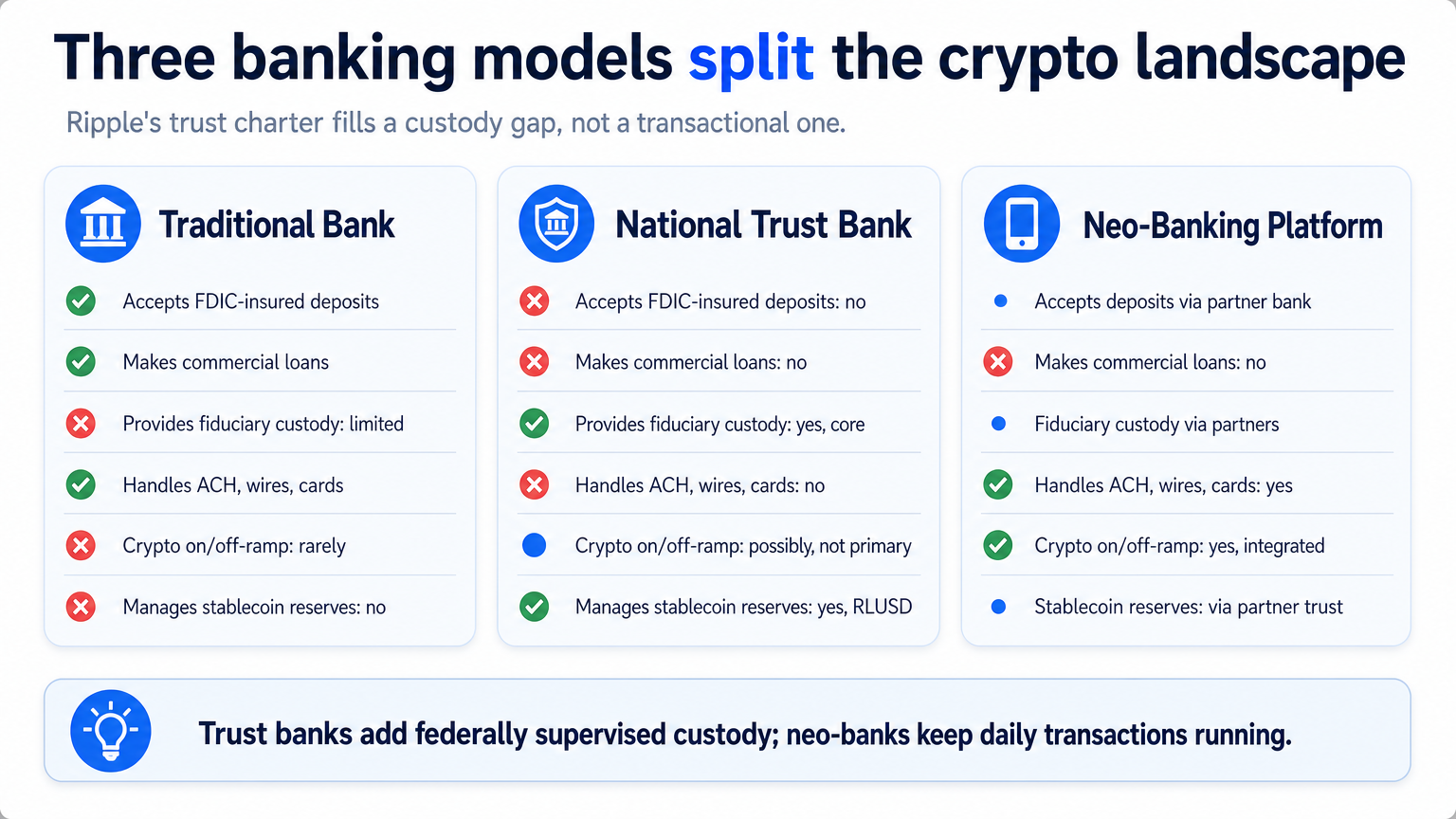
This is where the spectrum of crypto banking gets tangible. A national trust bank, unlike a commercial bank or credit union, operates under a limited federal charter. Its powers are restricted to fiduciary activities—holding assets in a custodial capacity, managing segregated accounts, and acting as a trustee. It cannot accept insured deposits, issue loans, or offer transaction accounts. The Federal Deposit Insurance Corporation (FDIC) insurance does not apply to trust banks; instead, their safety rests on strict segregation of client assets and OCC supervision.
Traditional banks offer deposit taking, lending, and payment services with FDIC backing. They generally avoid direct crypto exposure due to regulatory uncertainty, though some partner with fintechs. Neo‑banking platforms—like OneSafe—fill the gap by layering fiat and crypto services on top of traditional bank partnerships, providing multi‑currency accounts, corporate cards, ACH, wires, and crypto on/off‑ramps. Trust banks add another piece: federally supervised custody and reserve management for stablecoins that can complement, but not replace, the transactional services provided by a neo‑bank.
A table summarizing these differences helps contextualize the emerging landscape:
| Service | Traditional Bank | National Trust Bank | Neo‑Banking Platform (e.g., OneSafe) |
|---|---|---|---|
| Accepts insured deposits | Yes, FDIC‑insured | No | Through partner bank; FDIC pass‑through may apply |
| Makes commercial loans | Yes | No | No |
| Provides fiduciary custody | Limited | Yes (core function) | Via partners (e.g., Fireblocks custody) |
| Handles fiat payments (ACH, wires, cards) | Yes | No | Yes, via partner banks |
| Crypto on/off‑ramp and conversion | Rarely | Possibly, but not primary | Yes, integrated |
| Manages stablecoin reserves in segregated accounts | No | Yes (RLUSD reserves) | Not as a trust; may use partner trust infrastructure |
| Federal regulatory oversight | OCC/Fed/FDIC | OCC | State and federal BSA; partners regulated |
This differentiation underscores why the Ripple approval matters for stablecoin custody specifically, without altering the day‑to‑day transactional banking needs of a business.
What are the implications for stablecoin reserves and custody?
Ripple’s trust bank will hold segregated reserves backing RLUSD under federal oversight, directly addressing the chief concern about stablecoins: whether the assets that back them are safe and properly ring‑fenced. Under the OCC’s stablecoin‑related guidance (discussed in Stablecoin Regulation: The OCC Rule and Your Business), trust banks can provide that segregation while remaining subject to regular examination. This could become a template for other stablecoin issuers seeking U.S. regulatory legitimacy. For businesses that hold stablecoins for payroll, treasury management, or cross‑border payments, the improved transparency around reserve backing reduces counterparty risk and aligns with maturing Crypto Treasury Management strategies.
At the same time, custody services expand. The trust bank will offer fiduciary digital‑asset custody, potentially integrating with the expanded partnerships Ripple announced with BNY and Robinhood for institutional custody, payments, and stablecoin applications. For a startup or DAO, this could mean a future where part of its treasury sits in a federally chartered trust while the day‑to‑day corporate spending flows through a neo‑banking platform that handles fiat‑crypto conversions.
What should startups and DAOs consider in light of this?
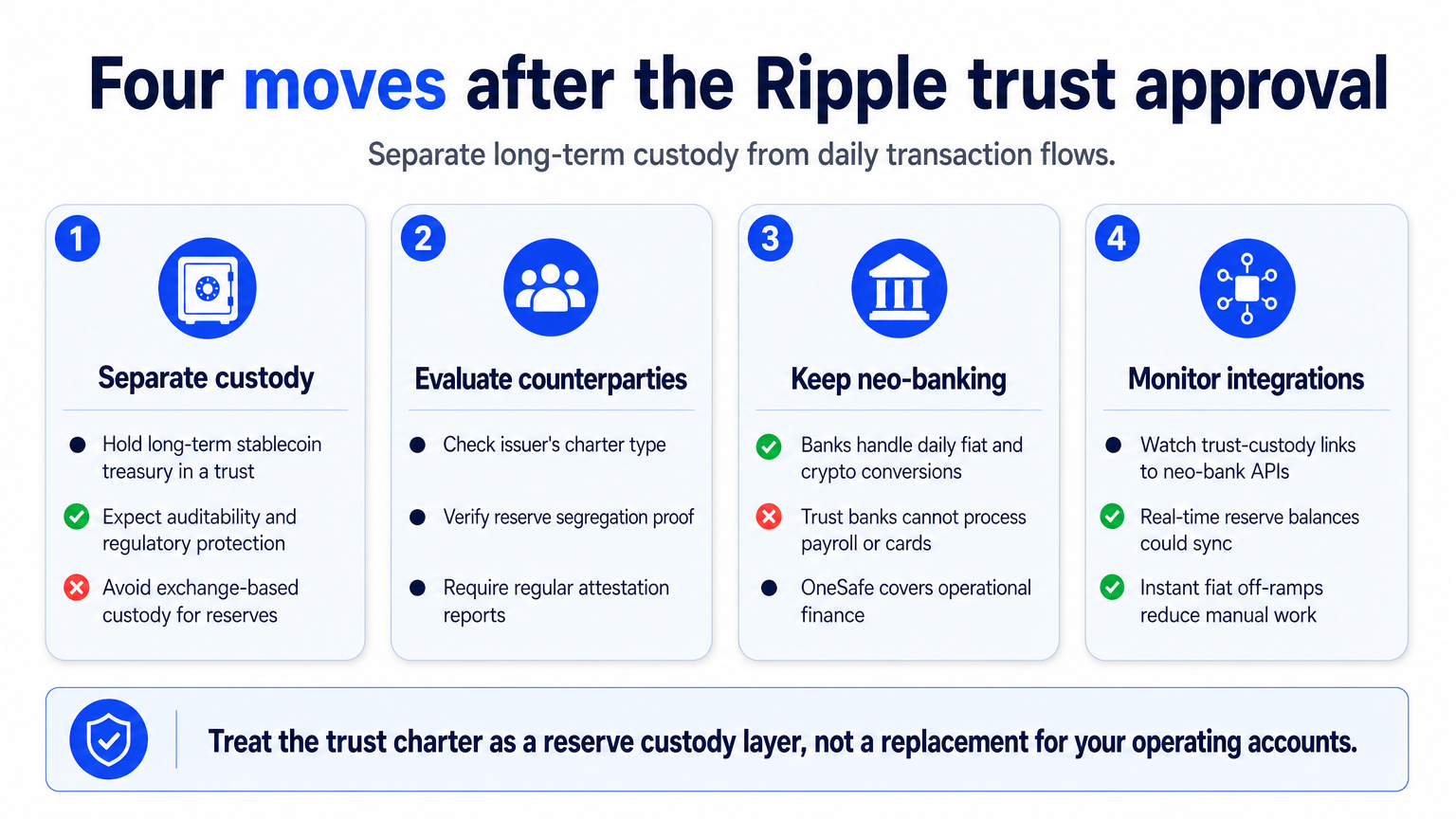
If your organization relies on crypto banking to manage both fiat and digital assets—including DAO banking workflows that span contributor payments and treasury management—the Ripple trust charter gives you a concrete signal: regulated custody and stablecoin reserve integrity are becoming table stakes. Here are practical considerations:
- Separate long‑term custody from transactional accounts. For stablecoin or crypto reserves held as treasury, a trust bank model may eventually offer superior regulatory protection and auditability compared to generic exchange‑based custody.
- Evaluate stablecoin counterparties. As more stablecoin issuers seek trust charters, you’ll be able to assess reserve backing more confidently. Start building a due‑diligence checklist that includes charter type, segregation proof, and regular attestation reports.
- Don’t abandon your neo‑banking platform. Neo‑banks like OneSafe already integrate multi‑currency accounts, corporate cards, and crypto conversions that a trust bank cannot provide. The two models are complementary: a trust bank for reserve-level custody, a neo‑bank for operational finance.
- Monitor integration partnerships. Watch for announcements where trust‑chartered custody links up with neo‑banking interfaces. For example, if your stablecoin issuer custodizes reserves at a trust bank, the neo‑bank could read those balances in real time and facilitate instant fiat off‑ramps. That would reduce manual reconciliation.
A quick‑reference checklist for a startup or DAO re‑evaluating its stablecoin reserves after October 2026:
- Identify which stablecoins you hold and the issuing entity’s regulatory status.
- Verify whether reserve assets are held in a segregated, regulated trust (federal or state).
- Assess if your current banking or neo‑banking provider offers visibility into those reserves.
- Consider splitting custody: a trust bank for long‑term stablecoin holdings, a neo‑bank for operational liquidity.
- Update internal treasury policies to require regular reserve attestation.
For web3 banking teams, the same logic applies: reserve-level custody and operational payment flows should be evaluated separately.
How does this affect existing neo-banking platforms like OneSafe?
OneSafe, a financial technology company that provides neo-banking for crypto—serving global businesses and DAOs—already bridges fiat and cryptocurrency through partner banks and Fireblocks custody. The platform handles ACH, wires, corporate cards, and crypto on/off‑ramps—services a trust bank cannot natively offer. So rather than displacing neo‑banks, the trust bank charter fills a gap that neo‑banks couldn’t (or wouldn’t) fully address on their own: federally supervised, purpose‑built custody and reserve management for large stablecoin holdings.
For a OneSafe user, the practical effect is more choice. They might continue using OneSafe for the operational checking‑like fiat services (payroll, vendor payments, FX) while opting to hold a significant portion of stablecoin treasury in a trust bank—perhaps even the same trust bank that backs the stablecoin they use heavily. The two then become interoperable endpoints within a broader Crypto Payroll After Ripple’s Bank Charter workflow. The platform’s value—seamlessly combining fiat and crypto in one interface—remains intact, and it could deepen as more trust‑chartered custodians come online and those integrations mature. For neo‑banks, the regulatory update crypto banking 2026 underscores the need for transparent asset segregation and rigorous partner bank oversight, something OneSafe already emphasizes with its Fireblocks custody and compliance protocols.
What are the remaining regulatory uncertainties?
While the OCC’s move is a landmark, it doesn’t remove all regulatory fog. Critics, including Better Markets, argue that the OCC is paving the way for crypto “banks” that undermine traditional banking without equivalent consumer protections. The trust bank model lacks FDIC insurance and clear resolution frameworks in the event of a failure. Moreover, state regulators may challenge federal pre‑emption, and the Federal Reserve’s role in access to payment systems remains unclear for trust banks.
The RLUSD stablecoin itself, while backed by segregated reserves in the trust bank, doesn’t automatically gain payment‑system status. The U.S. still lacks comprehensive stablecoin legislation, and the OCC’s approach is built on existing trust‑bank authority, not a dedicated stablecoin framework. As a result, businesses that rely on stablecoin payments may still face jurisdictional complexity, especially when operating across state lines or internationally. Further, the OCC’s approval is specific to Ripple; other applicants may face different scrutiny, and a future administration could change course.
What’s next for crypto banking regulation?
The final Ripple approval in October 2026 will likely accelerate applications from other large crypto firms seeking national trust charters. The OCC has already conditionally approved similar charters for Anchorage, Protego, and others, so we could see a small cohort of federally supervised trust banks that standardize custody and stablecoin reserve practices. That, in turn, might nudge Congress toward finally passing a stablecoin bill that codifies reserve requirements and oversight.
For business crypto bank users, the months ahead demand attention to integration announcements and regulatory signals. If trust banks can eventually gain limited access to Fed payment rails or link directly with neo‑banking platforms’ APIs, the friction between crypto treasury and fiat operations will shrink further. In the meantime, startups and DAOs should treat the Ripple trust bank as a template for what regulated custody can look like—and push their service providers to offer comparable transparency and security within the tools they already use. For teams documenting these changes on a Webflow blog, Joyrise plans, writes, and publishes illustrated SEO articles every day—read your first article before you pay.
Key Takeaways
- The OCC’s final approval on October 26, 2026, for Ripple’s national trust bank enables federally supervised stablecoin reserve management and fiduciary custody, but it does not create a full‑service crypto bank.
- The trust bank model adds a new, regulated layer to crypto banking that complements—not replaces—neo‑banking platforms like OneSafe, which handle day‑to‑day fiat and crypto transactions.
- Startups and DAOs should separate long‑term stablecoin custody (where trust banks excel) from operational cash management (where neo‑banks still lead), and update due‑diligence checklists accordingly.
- Regulatory uncertainties remain around FDIC protection, access to payments infrastructure, and the absence of federal stablecoin legislation, making vigilance essential as the landscape evolves.
- This approval signals that federal regulators are prepared to authorize more trust charters, which could make compliant stablecoin reserves the norm across the crypto banking sector.
Ready to unify your fiat and crypto operations in a single platform built for global businesses and DAOs? Sign up for OneSafe to manage multi‑currency accounts, corporate cards, and crypto payments with the transparency modern teams demand.