Meta description: Samsung’s 82-million-device USDC wallet makes stablecoin payments a distribution war. Learn how businesses can avoid platform lock-in and rising fees.
Samsung’s Stablecoin Payments Gambit: What It Means for Your Business
Samsung’s quiet rollout of a digital-dollar wallet across 82 million devices is the most consequential shift in stablecoin payments since Stripe reintroduced crypto payouts in 2024. But the real story isn’t the technology—it’s the struggle over who controls the customer relationship and captures transaction revenue. This article dissects the November 2026 launch, the profitability warning in Circle’s earnings, and the three moves businesses must make before the distribution wars foreclose their options.
Table of Contents
- What Just Happened: Samsung’s 82-Million-Device Stablecoin Wallet
- Why This Matters Now for Business Payments
- The Stablecoin Payments Landscape in 2026
- What Founders and Finance Leads Should Do Now
- What to Watch Next
- Key Takeaways
What Just Happened: Samsung’s 82-Million-Device Stablecoin Wallet
On November 5, 2026, Samsung embedded a USDC-based digital dollar wallet into the native experience of 82 million devices, as reported by PYMNTS (November 6, 2026). Stripe handles merchant acceptance, Coinbase provides on/off-ramp liquidity, and Circle supplies the USDC. The user pays by scanning a QR code; the merchant receives funds via Stripe’s stablecoin processing API. It’s a mass-market payment flow, not a crypto experiment.
But this is more than a product launch: Samsung now sits between customer and merchant, controlling the payment interface. In payments, whoever controls the interface sets the economics. The launch signals that stablecoin payments have moved from infrastructure building to owning the checkout moment—a grab reminiscent of the 2010s mobile wallet wars, but with stablecoins at the core.
Why This Matters Now for Business Payments
For years, the business case for stablecoin payments rested on lower costs and near-instant settlement. But the industry’s orientation has shifted. Builders of the underlying pipes are no longer the primary value capturers. Platforms that aggregate consumer attention now position themselves to levy new fees, collect transaction data, and dictate treasury rules. If Samsung becomes the primary consumer-facing stablecoin wallet, your processor might route through its interface, adding a layer of fees you cannot bypass, eroding the cheap cross-border promise.
Circle’s latest earnings underscore the urgency. USDC transaction volume jumped 49%, yet reserve income fell 8%, as PYMNTS reported on November 6, 2026. That means stablecoin issuance alone isn’t reliably profitable; the profit motive shifts to distribution—transaction fees, spreads, premium services. For businesses, the low, transparent fees early adopters enjoyed will come under pressure.
Stablecoin payments become a default option inside consumer tech ecosystems, lowering adoption barriers but forcing merchants into the platform’s fee structure. When a single wallet controls the default, it can dictate the merchant discount rate, add FX margins, and require settlement into proprietary accounts—raising costs as the platform entrenches.
The Stablecoin Payments Landscape in 2026

How stablecoins became a legitimate payment rail
Stablecoin cross-border payments have matured: settlement in minutes, cost a fraction of a percent. Regulatory clarity—the GENIUS Act in the US and MiCA in Europe—gave banks and fintechs confidence to integrate. Stripe extended USDC payouts, Visa piloted stablecoin settlement, and banks started offering custody. The bottleneck was never the pipes; it was the consumer endpoint. Stripe’s Stablecoin Payments Explained details how businesses can integrate this rail.
The crowded field
Now that endpoint is crowded. Banks launch corporate stablecoin services, fintechs offer APIs, card networks test settlement, and Samsung embeds a wallet at the OS level—82 million devices strong. Circle’s Stablecoin Payments: The Next Phase of Digital Commerce predicts exactly this distribution shift. This fragmentation could create walled gardens akin to mobile payment apps, forcing merchants to support multiple wallets with different fee schedules.
What Founders and Finance Leads Should Do Now
Control your payment interface
The strategic imperative is clear: own your payment infrastructure, not the channel. Treat Samsung’s wallet—and any future wallet from Apple or Google—as one acceptance channel among several. Maintain a central, neutral treasury that integrates all of them on your terms.
Why a unified fiat–crypto platform keeps you in charge
A crypto-friendly business account that natively handles both fiat and stablecoins gives you that independence. OneSafe is an example—it combines multi-currency fiat accounts with USDC custody, free crypto deposits and withdrawals, and transparent FX fees (0.25% or the prevailing rate). By consolidating your stablecoin treasury into a platform-agnostic hub, you can accept from any consumer wallet, convert when you choose, and pay suppliers or employees across borders without routing through a proprietary wallet’s fee stack. This separates how customers pay from how you manage money once it arrives.
Relying on a single platform risks lock-in: rising fees, lost customer data, and interoperability costs if switching. To keep control, maintain a platform-agnostic central treasury that receives stablecoins from any front-end wallet and converts through competitive marketplaces, not a single wallet’s bundled exchange. When evaluating a partner, demand native fiat and stablecoin accounts, transparent FX fees, free on/off-ramps, programmatic flows, and institutional-grade custody. OneSafe provides segregated global accounts, Fireblocks-level security, and compliance with relevant stablecoin regulation frameworks.
3 concrete steps
- Audit your payment stack for stablecoin touchpoints. Map every incoming and outgoing stablecoin flow, document the cost per transaction (including hidden FX spreads), and list the platforms intermediating each flow.
- Evaluate your on/off-ramp providers. Compare speed, cost, and reliability. Ask vendors about free USDC deposits and withdrawals, the all-in FX cost for a $50,000 stablecoin wire, and how quickly converted fiat lands in a bank account.
- Renegotiate settlement terms. Use increased competition to lower fiat withdrawal fees, stablecoin conversion rates, and card-network cross-border markups. Many providers will reduce fees for committed volumes.
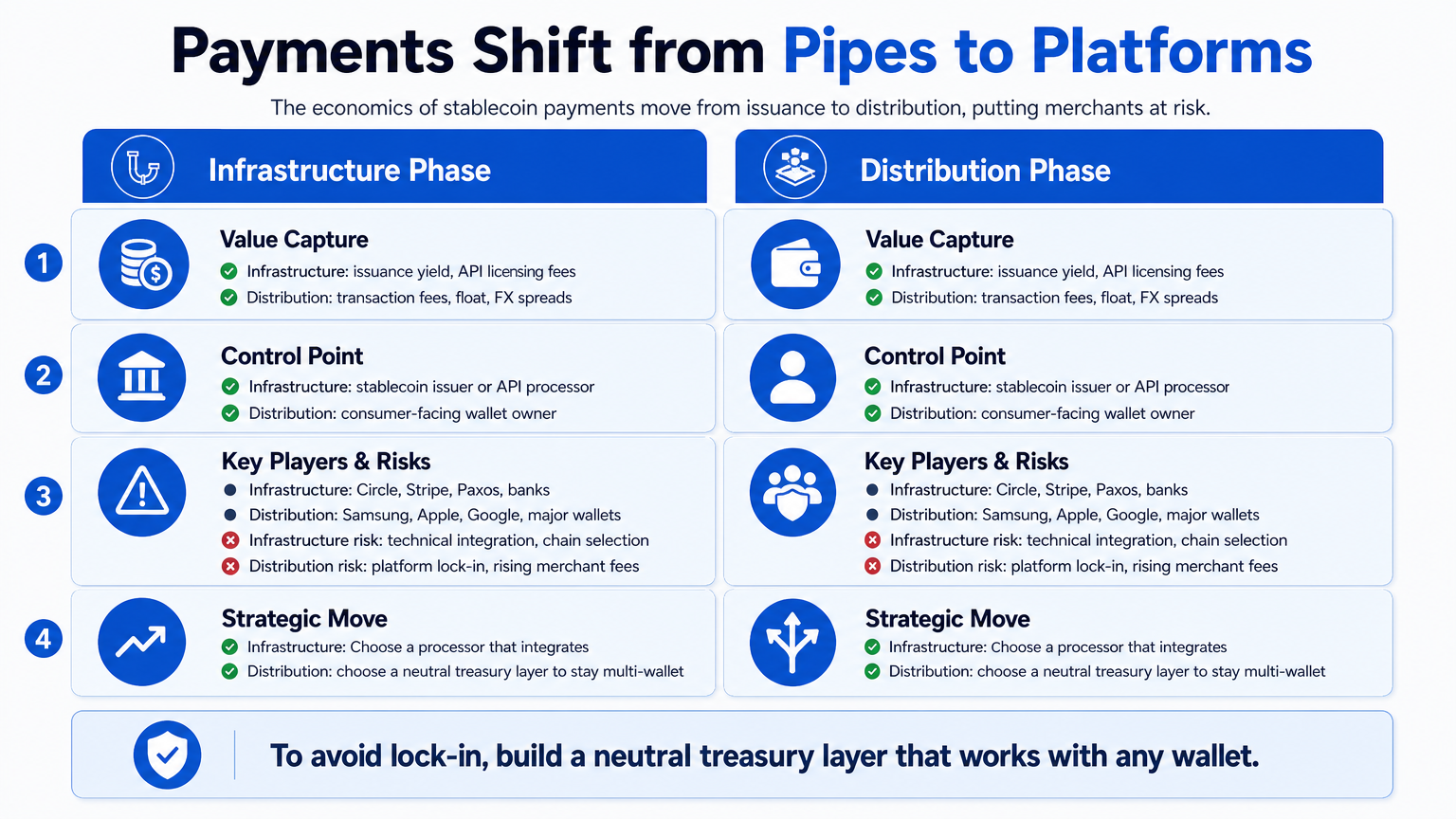
| Infrastructure Phase (2024–2025) | Distribution Phase (2026 onward) | |
|---|---|---|
| Value capture | Issuance yield, API licensing fees | Transaction fees, float, FX spreads |
| Control point | Stablecoin issuer or API processor | Consumer-facing wallet owner |
| Key players | Circle, Stripe, Paxos, banks | Samsung, Apple, Google, major wallets |
| Business risk | Technical integration, chain selection | Platform lock-in, rising merchant fees |
| Strategic move | Choose a processor that integrates | Choose a neutral treasury layer to stay multi-wallet |
What to Watch Next
Regulatory aftermath: Current stablecoin frameworks (GENIUS Act, MiCA) focus on issuers, not the distribution layer. Expect lawmakers to examine whether consumer tech companies embedding wallets should meet interoperability and anti-trust requirements. The answer will determine whether Samsung’s wallet must open to competing stablecoins and third-party settlement providers.
Will Apple or Google follow? Samsung’s move is unlikely to remain solitary. If Apple and Google integrate stablecoins at OS scale, the interface market could consolidate around three or four wallets globally—making a neutral treasury partner even more urgent.
Profitability in the next earnings cycle: Circle’s volume-versus-income gap is not a one-quarter anomaly. With rate trajectories uncertain and competition intensifying, the issuance-only model faces pressure. The next earnings cycle will reveal whether stablecoin payment processing revenue shifts largely to distribution players. For businesses, that timeline is the window to lock in favorable fee structures.
Keeping your own stakeholders informed is equally tactical. Tools like Joyrise—a service that plans, writes and publishes illustrated SEO articles to your Webflow blog every day—can help businesses maintain a steady thought-leadership presence as the payments landscape reorders.
Key Takeaways
- Samsung’s 82-million-device USDC wallet turns stablecoin payments into a distribution war where the interface owner captures the economics.
- Circle’s 49% volume growth paired with an 8% decline in reserve income proves stablecoin volume alone doesn’t equal profit; businesses should brace for platform-driven fees.
- To avoid lock-in, finance leads should immediately audit their payment stack, evaluate on/off-ramp providers, and renegotiate settlement terms.
- A unified, crypto-friendly business account that handles fiat and stablecoins natively—like OneSafe—keeps customer and treasury flows under your control, independent of any consumer wallet.
- Regulatory scrutiny will soon focus on the distribution layer, making it critical to choose compliant financial partners that offer transparent, multi-platform settlement.
For a platform that bridges fiat and stablecoin payments within a single, secure interface, explore OneSafe.