Table of Contents
- description: "On November 6, 2026, Samsung launched a USDC wallet for 82M devices, making stablecoin payments mainstream. Here’s what that means for your business."
- The Samsung News That Changes Stablecoin Payments
- Why This Matters for Your Business Right Now
- Stablecoin Payments 101: The New Rail for Money
- What a Unified Fiat-Crypto Platform Brings to the Table
- Three Steps to Turn This News into Action
- What to Watch in Q1 2027 and Beyond
- Key Takeaways
description: "On November 6, 2026, Samsung launched a USDC wallet for 82M devices, making stablecoin payments mainstream. Here’s what that means for your business."
Samsung’s Stablecoin Payments Bet: A Wake-Up for Business
On November 6, 2026, Samsung launched a USDC wallet for 82M devices, making stablecoin payments mainstream. Here’s what that means for your business.
The Samsung News That Changes Stablecoin Payments
What did Samsung announce about stablecoin payments on November 6, 2026?
According to PYMNTS, Samsung launched a USDC wallet inside its Samsung Wallet, making USDC spendable for over 80 million consumers. The integration combines Stripe’s payment infrastructure, Coinbase’s exchange rails, and Circle’s USDC under a single interface.
The players involved: Stripe, Coinbase, Circle — and Samsung as the interface
Samsung controls the interface; Stripe handles merchant acceptance and on/off-ramps; Coinbase provides custodial and exchange infrastructure; Circle issues USDC. Samsung could capture fee revenue from the interface, while infrastructure players compete for transaction margins.
Why This Matters for Your Business Right Now
Why is Samsung’s stablecoin wallet important for global businesses?
With 82 million devices supporting USDC, the addressable market for stablecoin-accepting businesses expands instantly. Instead of convincing users to download a separate wallet, companies can rely on a pre-installed, trusted interface (see Samsung Wallet Adds USDC: Stablecoin Payments Go Mainstream). This reduces adoption barriers and accelerates demand for stablecoin invoices and cross-border commerce. CFOs should prepare to handle stablecoin inflows efficiently.
The distribution war: when 82 million devices become a payment rail
Samsung’s move highlights a distribution battle. PYMNTS notes that stablecoins are a distribution business before a profitable payments business. Banks and platforms vie for stablecoin revenue; Samsung’s interface ownership leaps ahead. Mid-sized businesses may face shifting costs as intermediaries extract margins. A consolidated provider can guard against fee creep.
Stablecoin volume surges, but margins tighten — what Circle’s earnings reveal
USDC volume jumped 49% in Circle’s most recent quarter, while reserve income fell 8% (PYMNTS, Nov. 6, 2026). Usage soars but issuance profits weaken. Providers will likely shift to transaction fees or premium services, altering the cost-benefit equation. Lock in favorable pricing now. (Stablecoin Payments Boom: Circle’s $865M Quarter)
The window for regulation-driven market access is opening right now
Clarity from the GENIUS Act and the OCC’s final rules gives players like Samsung confidence. Regulators are defining the market, not picking winners — businesses have a narrow window to adopt stablecoin payments under today’s open conditions. Early movers with compliant workflows will face fewer disruptions. For additional context, Stablecoins explained: what US business owners need to know offers insights.
Stablecoin Payments 101: The New Rail for Money

How stablecoin payments actually work (and why they’re faster and cheaper)
A stablecoin is a digital token pegged 1:1 to fiat, issued by a regulated entity. When a customer sends USDC, the blockchain verifies and settles the transaction in minutes without correspondent banks. Businesses typically convert received stablecoins to fiat for operational needs. Efficiency comes from skipping SWIFT and using 24/7 blockchains. (Stablecoin Payments Surge, But Business Use Stalls) For a deeper look, see Stablecoin Payments Explained: A Guide for Businesses.
What are the costs and speed of stablecoin payments compared to traditional wires?
| Aspect | Traditional Wire Transfer | Stablecoin Payment (USDC) |
|---|---|---|
| Speed | 1–5 business days | Near-instant (seconds to minutes) |
| Base cost | Domestic: $15–$50; International: $25–$65 | Network fee: Solana < $0.01; Ethereum $5–$50 (varies) |
| FX markup | 2–5% over mid-market | Conversion fee: 0.15%–0.5% (e.g., OneSafe 0.15% for fiat deposits, 0.25% for FX) |
| Intermediaries | Correspondent banks, SWIFT | Blockchain validators, optional bridge provider |
| Disputes | Reversible (within limits) | Immutable; chargebacks require explicit provider mechanism |
| Operating hours | Business days only | 24/7/365 |
While on-chain transfers are cheap, the full round-trip cost — fiat to stablecoin, transfer, stablecoin back to fiat — can add up. A unified fiat-crypto platform that nets internal liquidity can keep total costs low.
The business case: cross-border settlement, instant payouts, reduced FX spread
A U.S. software company can pay European contractors in USDC, settling in seconds, then convert to EUR at roughly 0.25% instead of a 3% bank spread. Supply-chain invoices, ad-platform settlements, and DAO distributions benefit from faster settlement and lower FX costs. Businesses exploring cross-border stablecoin payments can refer to Stablecoin Payments: The Complete B2B Guide.
What a Unified Fiat-Crypto Platform Brings to the Table
How does a platform like OneSafe fit into the stablecoin payments ecosystem?
A crypto-friendly business banking platform like OneSafe bridges fiat and on-chain money. It offers multi-currency fiat accounts, instant USDC conversion, stablecoin payments, and a corporate card — all from one dashboard. Onboarding is digital, typically within a week.
Case in point: OneSafe’s approach — global accounts, crypto on/off-ramp, corporate cards
OneSafe has processed over $800 million in transaction volume for 1,000+ businesses across 30+ countries. Its fiat-crypto platform offers free USDC deposits and withdrawals, fiat conversion at 0.15% (0.25% for FX), and corporate cards with spend limits. For DAOs, customizable roles streamline treasury management.
Is it safe to hold USDC or other stablecoins for daily business use?
USDC isn’t FDIC-insured, but it’s regulated and backed by liquid assets (Treasury bills and cash equivalents), mitigating — though not eliminating — counterparty risk. Custodial risk is the greater threat: funds on an exchange without proper security are vulnerable. Fireblocks custody is a competitive necessity.
Security and custody: Fireblocks, MFA, and what your business needs to know
Fireblocks provides institutional-grade custody via MPC wallets. OneSafe integrates Fireblocks and requires Multi-Factor Authentication. When choosing a provider, confirm asset segregation and tested custody. Limit stablecoin holdings to operational needs and sweep excess to fiat regularly.
Three Steps to Turn This News into Action
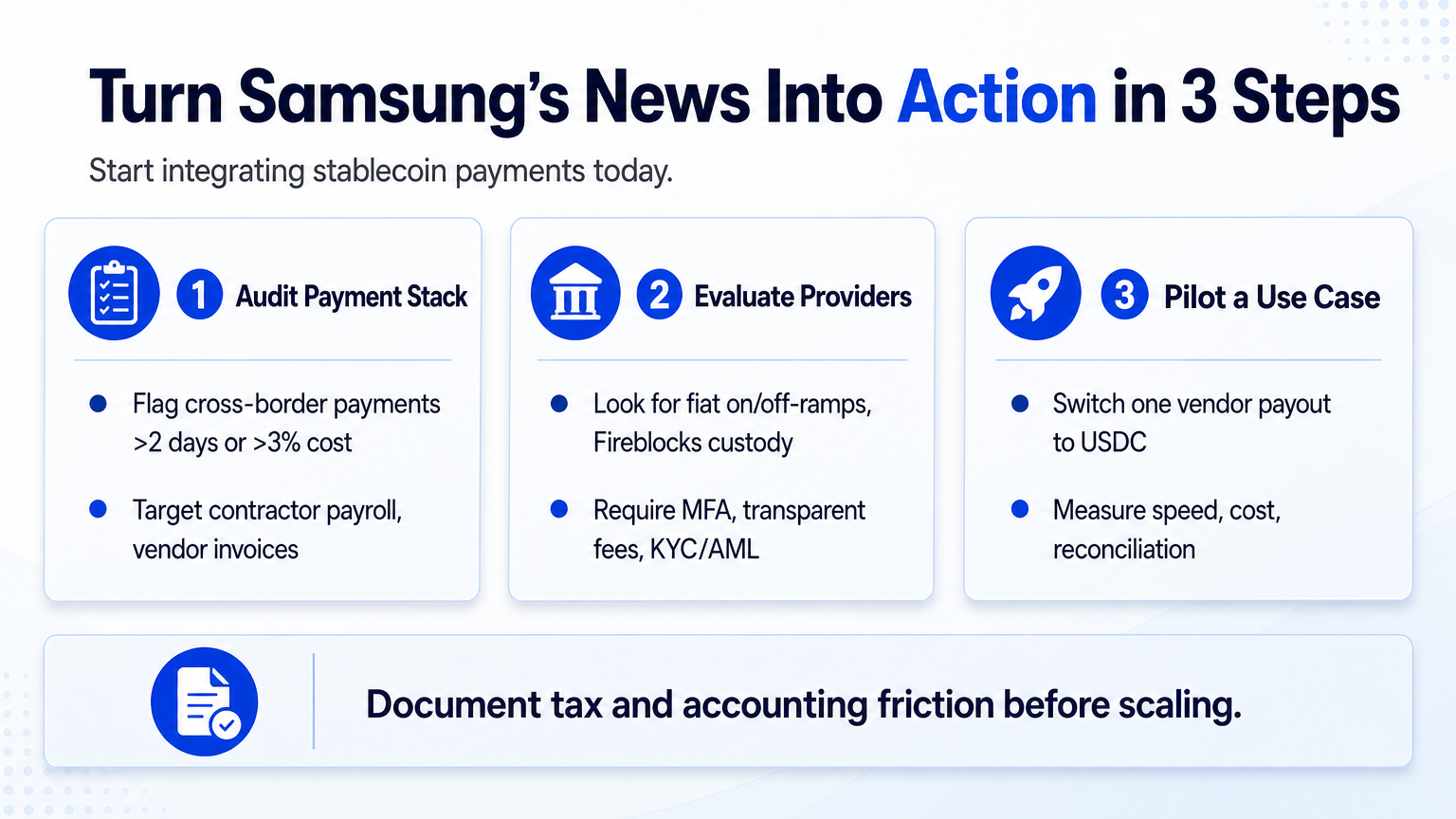
How can my company start using stablecoin payments today?
1. Audit your payment stack.
2. Evaluate providers for banking-grade security and compliance.
3. Pilot a single high-friction use case.
Audit your payment stack: where could stablecoins replace wires or FX marks?
List recurring cross-border payments; flag any that take more than two business days or cost more than 3%. International contractor payroll, vendor invoices in emerging markets, and DAO grant distributions are prime candidates for stablecoin savings.
Evaluate providers not just for crypto support but for banking-grade security and compliance
A business-ready solution needs direct fiat on/off-ramps, multi-currency accounts, corporate cards, Fireblocks custody, mandatory MFA, transparent fees, and KYC/AML compliance. It should operate like a financial services company, not a crypto exchange with a business label.
Pilot with a small, high-friction use case
Pick one vendor payout or contractor payment, switch it to USDC, measure speed, cost, and reconciliation. Document any tax or accounting friction before scaling.
What to Watch in Q1 2027 and Beyond
What are the risks of stablecoin payments for business operations?
Three risks: regulatory (reclassification, new reserve requirements), technology (blockchain outage, smart-contract exploit), counterparty (issuer default). Mitigate by diversifying stablecoin providers, keeping working capital in fiat, and monitoring regulations.
Will Samsung’s move force banks to accelerate stablecoin services?
Pressure mounts: 82 million devices spending USDC threatens bank payment revenue. Several global banks have filed stablecoin patents; Samsung’s move may accelerate launches by mid-2027. More options could lower fees for businesses.
The profitability question: can stablecoin distribution become a sustainable business?
Circle’s numbers show volume up but reserve income down. The distribution model must shift to service-based offerings — custody, cash management, cross-border FX, compliance. Businesses should avoid long-term contracts with high per-transaction fees until pricing settles.
Regulatory clarity: what the SEC, Fed, and global regulators might do next
The GENIUS Act sets a U.S. framework; the SEC may opine on yield-bearing stablecoins, and the Fed could require bank charters for issuers. MiCA’s EU implementation creates a benchmark. Q1 2027 enforcement actions will define compliance. Having a partner with embedded regulatory awareness is an advantage.
Key Takeaways
- Samsung’s 82-million-device stablecoin wallet, powered by Stripe, Coinbase, and Circle, makes stablecoin payments mainstream, pressuring businesses to integrate them.
- Circle’s surging volume but shrinking reserve income reveals a profitability gap; expect pricing shifts and negotiate favorable terms now.
- The fastest adoption path is a unified fiat-crypto platform with banking-grade security and compliance — Fireblocks custody, MFA, free USDC on/off-ramps, and segregated accounts.
- Start by auditing high-friction international payments, pilot a single use case, and stay agile on regulation.
- Early stablecoin integration locks in lower costs and faster settlement before the regulatory window tightens.
If you need regular content to support your stablecoin payments knowledge, Joyrise plans, writes and publishes illustrated SEO articles to your Webflow blog every day. Read your first article before you pay.
Ready to unify fiat and crypto in a single platform? Open a OneSafe account and start streamlining your stablecoin payments today.