Table of Contents
- description: "A September 2026 Cleveland Fed survey reveals that despite soaring stablecoin supply, business adoption lags with only 1 of 148 firms using them. Explore barriers and solutions."
- What Just Happened: The Fed Survey on Stablecoin Adoption Reveals Supply Boom, But Business Usage Barely Registers
- Why This Matters Now for Global Businesses and DAOs
- The Background: Stablecoin Payments from Concept to Corporate Treasury
- What’s Really Holding Back Stablecoin Payments in Business Transactions
- Bridging the Gap: How Early Adopters Are Making Stablecoin Payments Work Today
- What to Watch Next: Regulation, Adoption Metrics, and the Fight for Real Business Demand
- Key Takeaways
description: "A September 2026 Cleveland Fed survey reveals that despite soaring stablecoin supply, business adoption lags with only 1 of 148 firms using them. Explore barriers and solutions."
Stablecoin Payments Surge, But Business Use Stalls
A September 2026 survey by the Federal Reserve Bank of Cleveland threw cold water on the industry’s narrative that stablecoin payments are entering mainstream business. While stablecoin circulating supply has soared past $200 billion and payment infrastructure providers like Visa and Circle promote enterprise-grade readiness, the survey of 148 businesses found that only one currently uses stablecoins and just seven plan to adopt them. The findings underscore a stubborn reality: supply-side expansion doesn’t automatically create business demand. This analysis digs into the real-world hurdles—integration burden, hidden costs, trust gaps—and reveals how all-in-one fiat+crypto platforms are quietly solving the adoption puzzle for the first generation of B2B stablecoin users.
What Just Happened: The Fed Survey on Stablecoin Adoption Reveals Supply Boom, But Business Usage Barely Registers
The Cleveland Fed Survey That Caught the Industry Off Guard (September 2026 data)
On November 4, 2026, an article in 아시아경제 covered the Cleveland Fed’s survey—released a month earlier—that exposed the chasm between infrastructure hype and actual business usage. The Fed survey stablecoin results showed that of the 148 participating companies, only a single respondent was using stablecoins for payments; seven more said they might adopt them, but even that combined figure remained under 6% (AsiaE, Nov 4, 2026). The survey’s methodology, while not nationally representative, provides a rare, real-world snapshot of mainstream corporate behavior. It makes plain that excitement about circulating supply stablecoin growth has little correlation with B2B stablecoin adoption on the ground.
Why the Disconnect? System Integration, Unclear Economic Benefits, and Legacy Payment Inertia
The survey’s respondents cited unclear economic benefits compared to existing payment methods and the burden of system integration as the top reasons for holding back. Adding a stablecoin rail means connecting to new wallets, handling private key management, reconciling on-chain transactions, and retraining staff—all while keeping legacy SWIFT and ACH workflows running. Unless the cost savings are dramatic and the process seamless, inertia wins.
Why This Matters Now for Global Businesses and DAOs
Stablecoin Payments Promise Speed and Lower Costs, But the “Last Mile” Is Still Missing
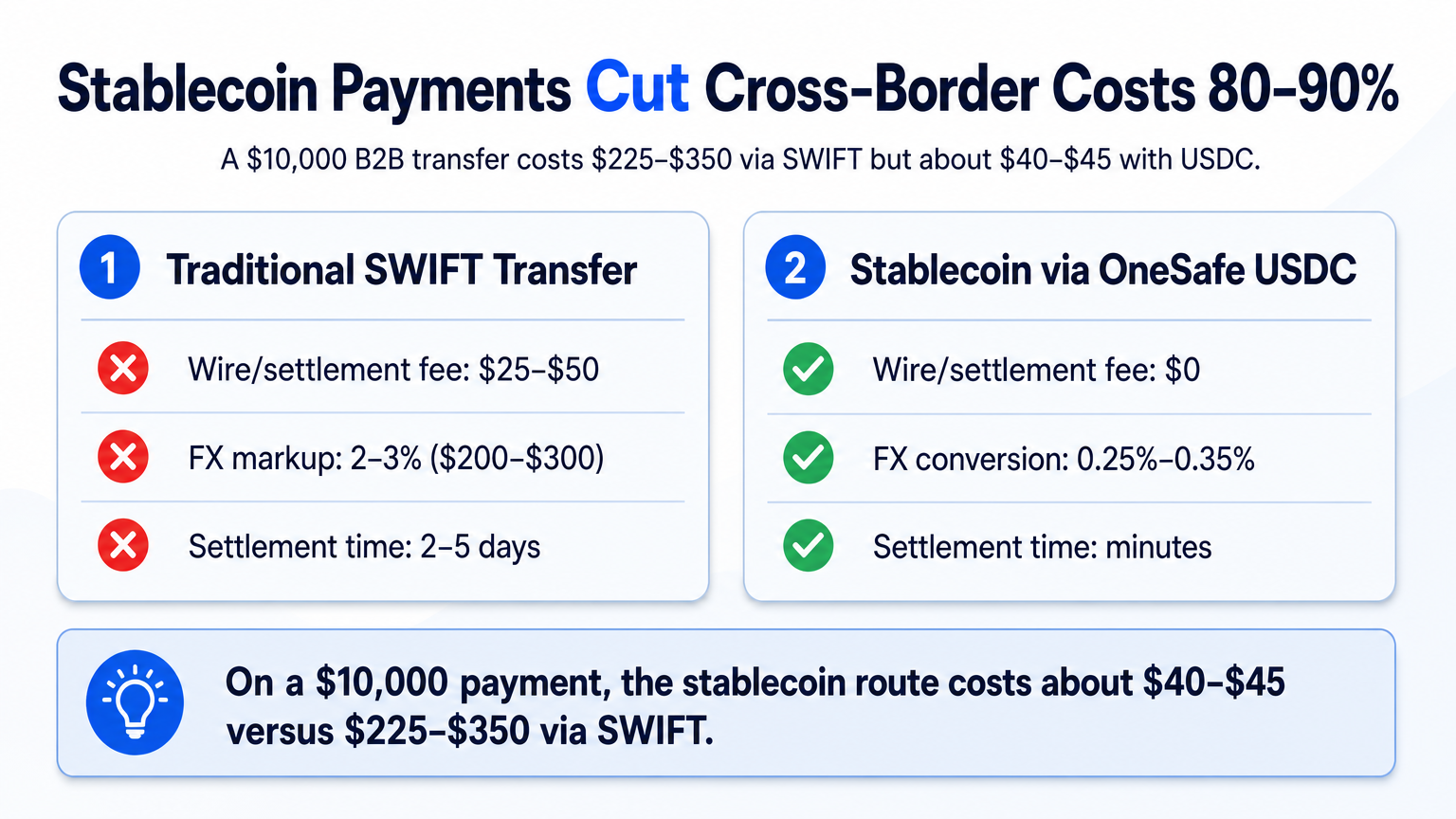
On paper, stablecoin payments can settle in seconds and cost a fraction of a traditional wire. A cross-border B2B transaction sent via SWIFT might take 2–5 days and rack up $25–$50 in wire fees, plus a 2–3% foreign exchange markup. In contrast, a USDC transaction on a modern blockchain costs less than a cent and clears in minutes. The problem is the last mile: the recipient’s ability to convert stablecoins into local fiat cheaply and without manual intervention, and the sender’s ability to route the payment through existing accounting and compliance systems. Without an integrated fiat and crypto management layer, those theoretical savings vanish.
The Real Cost of International Payments Today vs. Stablecoin Cross-Border Payments (with a glance at OneSafe’s fee structure for context)
Here’s a concrete comparison using typical B2B cross-border payments of $10,000.
| Cost Component | Traditional SWIFT Transfer | Stablecoin via Platforms Like OneSafe (USDC) |
|---|---|---|
| Wire/Settlement Fee | $25–$50 | $0 |
| FX Markup (major to minor currency) | 2–3% ($200–$300) | 0.25% – 0.35% (platform conversion fee) |
| On/Off-Ramp Fee | N/A | 0.15% (fiat deposit/withdrawal) |
| Crypto Deposit/Withdrawal | N/A | Free (USDC) |
| Total Estimated Cost | $225–$350 | ~$40–$45 |
| Settlement Time | 2–5 days | Minutes |
Note: OneSafe is a financial technology platform, not a bank. Fees shown are as published: fiat deposit/withdrawal 0.15%, SWIFT 0.35%+$50, FX 0.25% or the prevailing rate. USDC crypto transactions are free. This side-by-side illustrates that stablecoin cross-border payments can cut costs by 80–90%—but only if the business can access those rates through a unified, compliant interface.
The Background: Stablecoin Payments from Concept to Corporate Treasury
How Payment Stablecoins Work and Their Rapid Supply Growth
Payment stablecoins are blockchain-based tokens pegged to a fiat currency, typically the U.S. dollar. They combine the programmability of crypto with price stability. The top two—USDC and Tether (USDT)—now boast a combined circulating supply of over $200 billion. That supply surge has been fueled by crypto-native trading, DeFi lending, and a wave of institutional interest. Yet, as the Cleveland Fed data shows, B2B stablecoin adoption remains negligible.
Regulatory Milestones: Stablecoin Regulation 2026, the GENIUS Act, and the Fed’s Exploration
The U.S. regulatory landscape is beginning to provide the legal clarity that businesses require. The GENIUS Act stablecoin regulation, a cornerstone of stablecoin regulation 2026, moved through Congress in 2025–2026 and sets prudential standards for stablecoin issuers. The OCC opened a path for national bank custody and payment use of stablecoins (OCC Opens Stablecoin Path), and the Fed itself continues to study implications. Meanwhile, real-world trials like NEC’s Avalanche settlement in Colombia in mid-2026 (NEC’s Avalanche Move) show that retail and enterprise use cases are being actively prototyped. However, regulation alone doesn’t fix the last-mile adoption gap.
Where Stablecoins Are Gaining Traction: Remittances, Crypto-Native Commerce, and DAOs
Outside of mainstream businesses, stablecoins are already a workhorse. Remittance corridors to Latin America and Southeast Asia see millions in monthly volume. Crypto-native organizations like DAOs use stablecoins for payroll, vendor payments, and treasury management because they natively operate on-chain. But these niches don’t represent the broad corporate adoption that the supply-side narrative suggests.
What’s Really Holding Back Stablecoin Payments in Business Transactions
Why aren't more businesses using stablecoins for B2B payments despite the supply surge?
The core answer is that stablecoin payments still demand a parallel financial operations stack. A CFO doesn’t see “a faster payment rail”; she sees another wallet to secure, another reconciliation process, another potential compliance headache. As a McKinsey analysis on stablecoin payments infrastructure notes, “the challenge is not the technology but the integration with existing treasury systems” (McKinsey, 2024). Without a unified banking and crypto interface, the marginal benefit of a cheaper settlement gets swamped by operational complexity.
What are the practical barriers to stablecoin payment adoption for businesses?
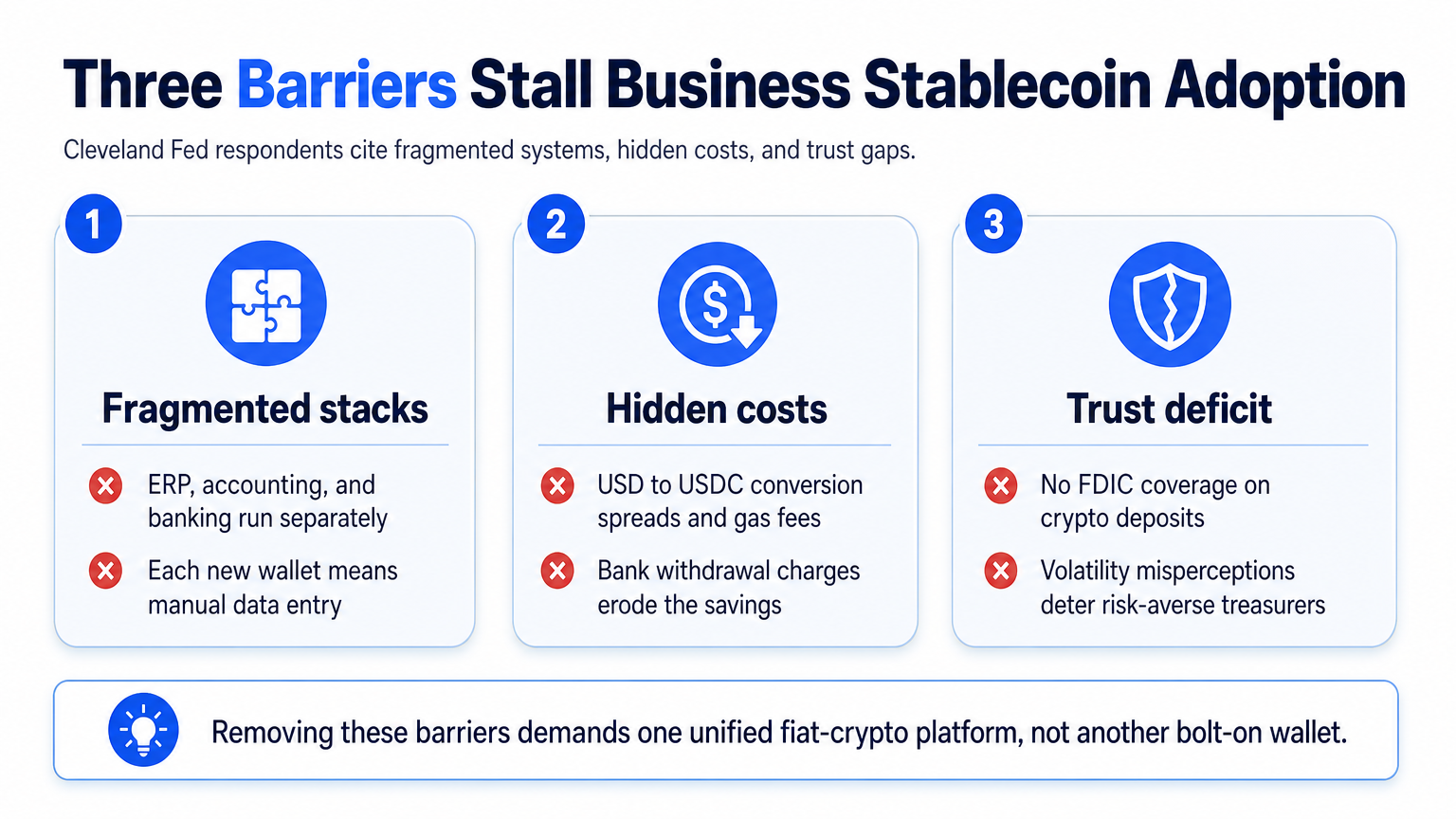
Three barriers dominate:
- Fragmented financial stacks: Most businesses run ERP, accounting, and banking independently. Adding a crypto wallet means manual data entry and extra record-keeping.
- Hidden costs of on/off-ramping: Converting USD to USDC and back involves exchange spread, gas fees, and bank withdrawal charges. Unless those are bundled transparently, the savings evaporate.
- Trust deficit: The lack of FDIC coverage on crypto deposits and misconceptions about volatility deter risk-averse treasurers, even though stablecoins are pegged.
What did the Cleveland Fed survey find about stablecoin adoption in 2026?
The Fed survey stablecoin results found only one current user and seven potential adopters among 148 businesses. It also captured the rationale: unclear cost advantages and integration headaches. The data underlines that business stablecoin integration is the critical missing link, not a lack of payment rails.
Bridging the Gap: How Early Adopters Are Making Stablecoin Payments Work Today
The All-in-One Platform Approach: A Single Dashboard for Fiat and Crypto
The most practical path is to use an all-in-one platform that treats stablecoins as just another account within a unified dashboard. Instead of bolting on a crypto wallet, you open a multi-currency account that natively supports fiat and USDC. You can receive stablecoins from a client, convert to USD instantly, and pay a supplier via wire or ACH—all from the same interface. Such platforms also provide corporate cards, invoicing, and automated reconciliation, removing the double-entry work that traditionally kills adoption. Stripe’s own guide on B2B stablecoin payments similarly acknowledges that businesses need “a single API that abstracts away the complexity of blockchains” (Stripe, 2025).
A checklist for evaluating a stablecoin payment platform should include:
- Unified fiat and crypto accounts for USD, EUR, USDC, etc.
- Transparent on/off-ramp fees without hidden exchange margins.
- Built-in compliance (KYB/KYC, OFAC screening, audit-ready reporting).
- Corporate card support with spending limits.
- Security infrastructure such as Fireblocks-grade custody and multi-factor authentication.
- Global reach with multi-currency support (not in sanctioned jurisdictions).
- Fractional FX rates that don’t eat the savings from using stablecoins.
How OneSafe Addresses Integration, Cost, and Trust Challenges
OneSafe—a fintech platform for global businesses and DAOs—provides segregated fiat and crypto accounts, free USDC deposits/withdrawals, and transparent fees (0.15% fiat on/off-ramp, competitive FX). Businesses using the platform report processing cross-border vendor payments in minutes instead of days, with an 80%+ reduction in FX costs. The platform has processed over $800 million in transaction volume from more than 1,000 businesses across 30+ countries. For DAOs, customizable role-based permissions and Fireblocks-grade custody add the governance layer decentralized treasuries need.
OneSafe addresses the three critical barriers directly:
- Integration: A single account for ACH, wires, crypto payments, and invoicing replaces multiple bank and exchange logins.
- Hidden costs: Transparent fees (free USDC transactions, 0.15% fiat on/off-ramp, 0.25% FX) prevent expense leaks, and corporate cards allow stablecoin-funded vendor payments without requiring the recipient to accept crypto.
- Trust: Partnerships with regulated banking institutions and Fireblocks-based digital asset custody, plus mandatory MFA, provide an enterprise-grade security posture, even though stablecoin balances are not FDIC-insured.
What to Watch Next: Regulation, Adoption Metrics, and the Fight for Real Business Demand
Is stablecoin payment adoption inevitable, and what regulatory milestones are needed for it to reach critical mass?
Adoption is not inevitable; it requires a distinct shift in business behavior. The necessary milestones include:
- Final passage of the GENIUS Act or equivalent to give stablecoin issuers a clear federal charter, reducing counterparty risk for corporates.
- OCC and Fed guidance that explicitly permits banks to hold and transact stablecoins for their customers without punitive capital treatment.
- Development of industry-standard, compliant on/off-ramp APIs that connect stablecoin rails to legacy payment networks, closing the last mile.
- Practical, demonstrable cost-benefit cases backed by third-party audits, not just vendor marketing.
The Cleveland Fed survey already suggests the next wave of research will track whether business sentiment shifts once those milestones are hit. For now, the industry finds itself at a stablecoin plateau: infrastructure has raced ahead, but genuine B2B demand still needs cultivation.
The Fed’s Ongoing Studies and Potential CBDC Interplay
The Federal Reserve’s interest in stablecoin payments isn’t accidental. Its ongoing explorations, including potential CBDC pilots, may eventually provide a government-backed digital dollar. But that could be a decade away. In the interim, privately issued stablecoins that conform to U.S. regulatory standards will likely serve as the bridge.
Will Stablecoin Payments Follow the Credit Card Model for Mainstream Adoption?
Credit cards took decades to become a ubiquitous B2B tool—and that was after merchant networks, consumer habits, and regulatory acceptance aligned. Stablecoin payments may follow a similar path: early adopters will be crypto-native firms and DAOs, then subsidiaries of large enterprises with controlled tests, and finally mid-market companies once the platform layer matures. A Bancoli guide notes that “the move from experiment to norm will depend on solving the reconciliation and compliance problem at scale” (Bancoli, 2026). That’s exactly what all-in-one platforms are designed to do.
The Critical Milestones: When Will B2B Stablecoin Usage Cross from Experiment to Norm?
The tipping point will come when a mid-market company can onboard and pay a supplier in stablecoins with the same ease as initiating an ACH transfer—and document the audit trail automatically. The industry has perhaps two to three regulatory cycles before that’s widely available. In the meantime, the businesses that move early on an integrated fiat+crypto platform will lock in lower payment costs and faster settlement, while the rest wait for the infrastructure to become “enterprise grade” in their eyes.
As the landscape evolves daily, keeping stakeholders informed may require robust content strategies; platforms like Joyrise can automate this process for corporate blogs.
Key Takeaways
- The Cleveland Fed’s September 2026 survey of 148 businesses found only one stablecoin user, proving that circulating supply growth does not equal B2B demand.
- Practical barriers—fragmented systems, hidden on/off-ramp costs, and risk misperceptions—are the real culprits, not a lack of payment rails.
- Businesses can start using stablecoin payments today by adopting a unified neo-banking platform that handles fiat and crypto in a single, compliant interface, cutting cross-border costs by up to 90%.
- Regulatory clarity (stablecoin regulation 2026 milestones like the GENIUS Act, OCC rules) is essential but not sufficient; the market needs seamless last-mile integration before mainstream companies switch.
- Early adopter results from platforms processing hundreds of millions in stablecoin volume show that when integration is removed, speed and cost advantages materialize immediately.
Start exploring a secure, integrated fiat and crypto account for your global business at OneSafe.