The landscape of stablecoin regulation in the U.S. shifted decisively on October 21, 2026, when the OCC released its final rule implementing the GENIUS Act for payment stablecoin issuers and custodians. For crypto-native businesses—startups, DAOs, and global platforms that rely on stablecoins for treasury, payroll, and remittances—the rule removes months of uncertainty and lays out a clear compliance roadmap. This analysis demystifies what the rule actually requires, how it exposes gaps in traditional banking, and how a platform like OneSafe can function as a practical compliance layer.
Table of Contents
- What Just Happened: OCC Drops Final Stablecoin Rules
- Why This Matters Now for Crypto-Native Businesses
- Stablecoin Regulation 101: The GENIUS Act Backbone
- Concrete Implications: What Your Business Must Do
- Where Traditional Banking Stumbles—and How OneSafe Bridges the Gap
- Practical Steps for DAOs
- What to Watch Next
- Key Takeaways
- Further reading
What Just Happened: OCC Drops Final Stablecoin Rules
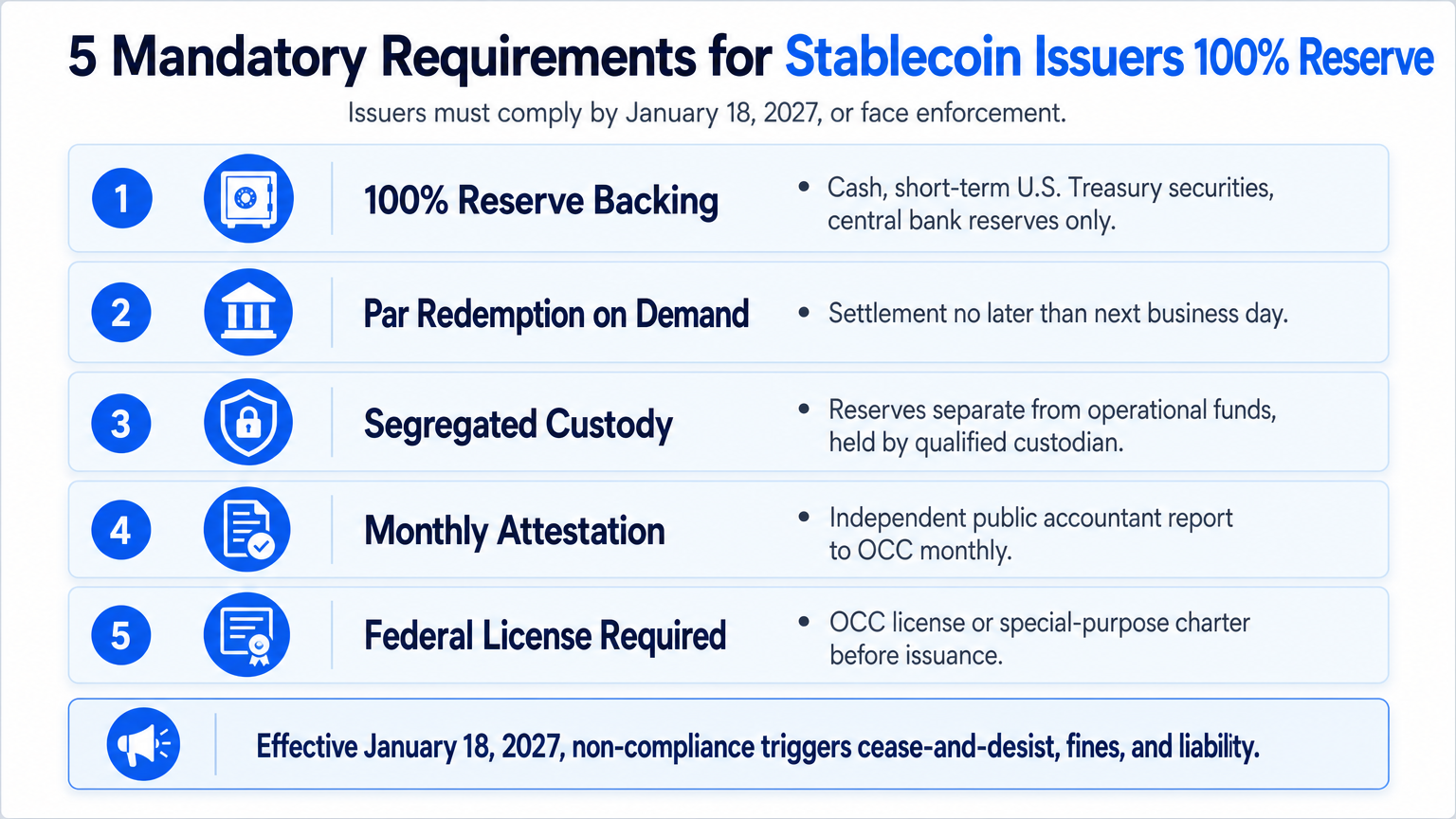
On October 21, 2026, the OCC issued its final rule implementing the Guiding and Establishing National Innovation for U.S. Stablecoins Act (GENIUS Act), as detailed in a JD Supra analysis. The rule takes effect January 18, 2027—the same day the GENIUS Act itself becomes operative. The OCC is the first federal agency to publish comprehensive final rules under the statute, and its standards are already being referenced by other agencies, effectively turning the OCC’s framework into the national template.
The rule requires payment stablecoin issuers to:
- Maintain 100% reserve backing in cash, short-term U.S. Treasury securities, and central bank reserves.
- Guarantee par redemption on demand, with settlement no later than the next business day.
- Hold reserves in segregated accounts with a qualified custodian, separate from operational funds.
- Submit to monthly attestation by an independent public accountant and ongoing reporting to the OCC.
- Obtain a federal license or special-purpose charter from the OCC before issuing any payment stablecoin.
The OCC’s implementation page now serves as the central source for filing guidance.
Why This Matters Now for Crypto-Native Businesses
Businesses that issue stablecoins, hold customer reserves, or provide related custody services must be fully compliant by January 18, 2027. The lead time is roughly 14 months. Non-compliance after that date can trigger cease-and-desist orders, civil money penalties, and potential criminal liability for willful violations.
Crucially, the rule draws a bright line. Holding stablecoin reserves for others, controlling the minting and redemption process, or offering a payment stablecoin to the public triggers issuer obligations. A business that simply holds USDC in its own treasury—without controlling the underlying trust—remains a user, not an issuer. This distinction defines who needs a federal license and who can lean on regulated third parties.
Stablecoin Regulation 101: The GENIUS Act Backbone
The GENIUS Act (signed into law July 10, 2025, per the White House) created the first comprehensive federal framework for payment stablecoin issuance. It defines a “payment stablecoin” as a digital representation of fiat currency used for payments and redeemable at par, and directs the OCC, Federal Reserve, and FDIC to issue implementing rules. The statute mandates 100% liquid backing, par redemption, federal licensing, qualified custody, and regular attestation.
Concrete Implications: What Your Business Must Do
For startups navigating stablecoin licensing and broader crypto compliance, the OCC’s framework sets the bar.
Reserve Composition and Redemption
Reserves must be limited to cash, U.S. Treasury bills with maturities under 90 days, and deposits at Federal Reserve Banks. Yield-generating structures using corporate bonds or commercial paper are excluded. Redemption must be at par, on demand, with settlement within one business day.
Licensing Pathways
The OCC offers two paths: an existing national bank can seek approval to issue stablecoins directly; a non-bank fintech can apply for a special-purpose national bank charter or a new federal license the OCC is developing. Applications will require a detailed business plan, robust BSA/AML compliance, and proof of operational capability. For DAOs without a legal entity, forming a U.S. entity first is a prerequisite.
Custody and Reporting
Reserves must be held by a qualified custodian—a regulated financial institution—not by the issuer itself. The custodian must segregate the reserve assets, and the issuer must produce real-time reserve records. Reporting includes monthly public attestation by a PCAOB-registered auditor and quarterly and annual filings with the OCC.
Non-issuer businesses that hold large stablecoin balances can still benefit from segregated custody. Using a platform that offers digital asset custody via a qualified custodian—like OneSafe’s integration with Fireblocks—can preemptively demonstrate compliance-like controls.
State-Level Overlap
A federal OCC license does not automatically preempt state money transmitter laws. Non-bank issuers will still need to satisfy state-level licensing regimes until federal law explicitly preempts them—something left for future rulemaking. As noted in a previous analysis, the dual federal-state regime means many non-bank issuers will find the most efficient route is to work with a federally chartered bank partner that already satisfies both state and federal requirements.
Where Traditional Banking Stumbles—and How OneSafe Bridges the Gap
Traditional banks were not built for crypto-native businesses. Opening an account as a DAO or Web3 startup often triggers months of enhanced due diligence, account freezes, or outright denial. The new regulation demands segregated accounts, qualified custody, real-time reporting, and the ability to handle fiat and crypto in one workflow—capabilities legacy banks rarely offer together.
OneSafe (a financial technology company, not a bank; banking services are provided through its partner banks) delivers this unified infrastructure. The platform provides fiat accounts in multiple currencies, international wires, and instant crypto-to-fiat conversion, all with built-in audit trails. The same segregation the OCC requires for reserves is reflected in the platform’s ability to maintain distinct accounts for operational funds and stablecoin backing, reducing commingling risk.
Custody and Audit Trails
OneSafe offers digital asset custody anchored by Fireblocks, a qualified custodian infrastructure used by institutional clients. Crypto assets are secured under Fireblocks’ multi-layer security and MPC technology, while fiat reserves sit in segregated partner-bank accounts. This architecture lets a DAO or startup produce clean audit trails and demonstrate a professional compliance posture without building the infrastructure from scratch.
DAO-Specific Tools
DAOs face unique governance challenges. OneSafe provides role-based access controls that can mirror a DAO’s voting structure, enabling segregated vaults for treasury, grants, and payroll with distinct permissions. Every stablecoin movement is logged and attributable, helping DAOs show responsible stewardship—a factor examiners will weigh when assessing whether a DAO is an unlicensed issuer.
Practical Steps for DAOs
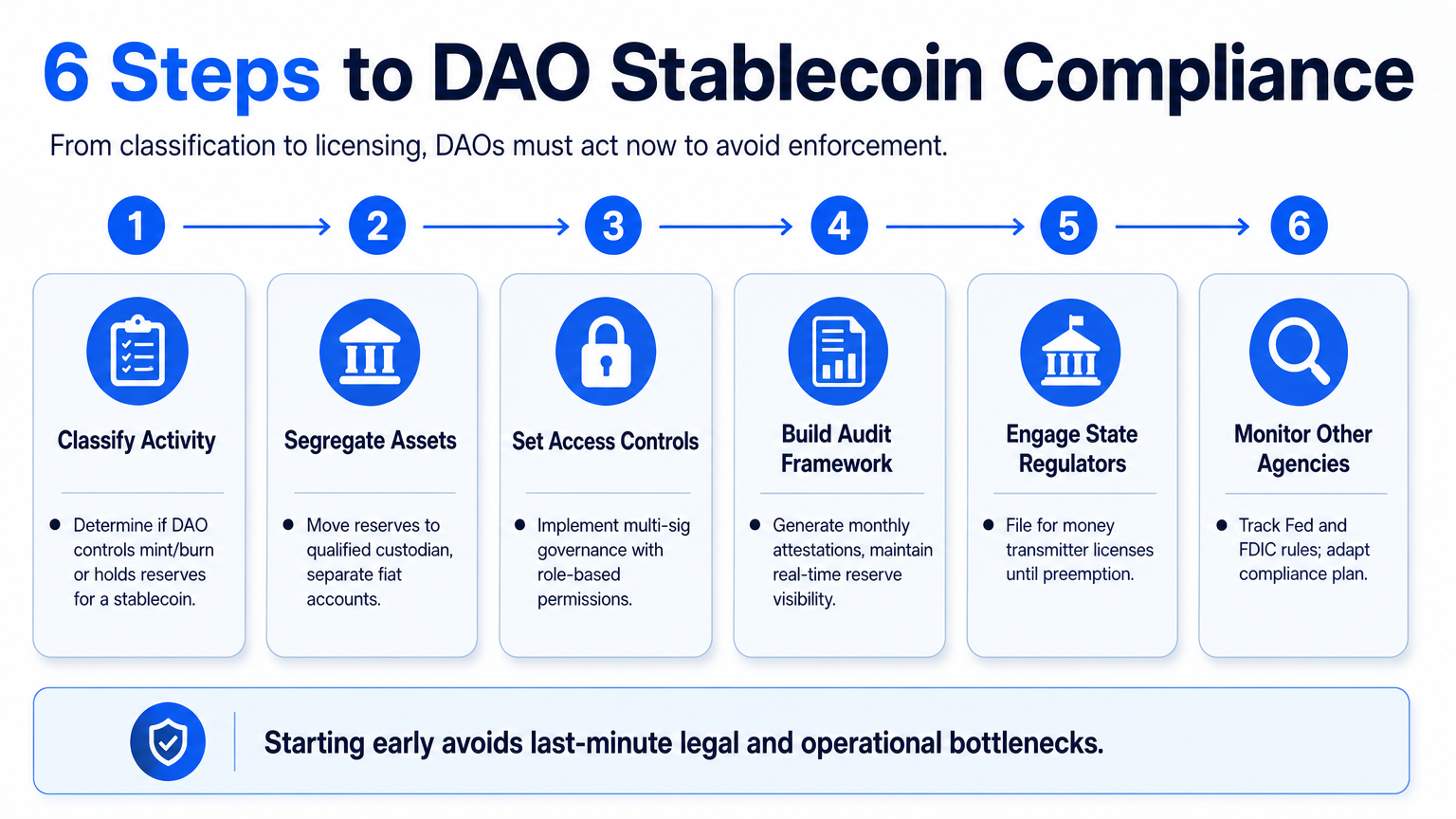
- Classify your activity. If the DAO controls mint/burn or holds reserves for a stablecoin it issued, incorporation is urgent. Form a U.S. entity and begin the OCC license process.
- Segregate assets. Move stablecoin reserves to a qualified custodian and separate fiat accounts.
- Implement access controls. Configure multi-signature governance with role-based permissions.
- Build an audit framework. Start generating monthly balance attestations and maintain real-time reserve visibility. A platform like OneSafe can automate much of the record-keeping.
- Engage state regulators. File for money transmitter licenses in relevant states; dual compliance will be necessary until preemption.
- Monitor other agencies. The Fed and FDIC rules may add requirements; keep flexibility in your compliance plan.
A practical worked example: a DAO that mints a small stablecoin for internal payments and holds the reserves in a DeFi lending protocol must move those funds out of any yield-bearing protocol, into a dedicated, Fireblocks-secured vault, form a legal entity, and pursue federal and state licenses. That transition demands months of legal and operational work.
What to Watch Next
The Federal Reserve and FDIC are expected to issue their own final rules soon, likely mirroring the OCC’s reserve and custody standards but with additional requirements on systemic risk and deposit insurance eligibility. Internationally, the EU’s MiCA regulation is already live for stablecoin issuers, and the UK is consulting on a similar framework—creating a path toward mutual recognition and smoother cross-border operations.
Keeping up with daily regulatory shifts is critical. Joyrise plans, writes and publishes illustrated SEO articles to your Webflow blog every day, helping teams stay informed without added effort. Combined with a platform that unifies fiat and crypto operations under one compliance-aligned roof, businesses can turn regulatory complexity into operational simplicity—explore how OneSafe helps.
Key Takeaways
- The OCC’s final stablecoin rule, effective January 18, 2027, mandates 100% liquid reserve backing, par redemption, qualified custody, and monthly attestation for payment stablecoin issuers.
- Crypto startups and DAOs that merely use stablecoins (without controlling minting or reserves) do not need a federal license, but should still segregate operational funds and maintain transparent records.
- A federal OCC license does not eliminate state money transmitter requirements; non-bank issuers must prepare for a dual compliance regime.
- DAOs face particular urgency: without a legal entity and segregated custody, they risk enforcement action and should begin incorporating, licensing, and implementing multi-sig treasury controls immediately.
- Neo-banking platforms like OneSafe can help non-issuer businesses achieve compliant reserve segregation, provide Fireblocks-qualified digital asset custody, and automate audit-ready reporting—bridging the gap between legacy banking and crypto-native operations.
Further reading