
Stablecoin Payments: Distribution Battle Heats Up
The quiet infrastructure layer behind digital money is being rebuilt. On October 13, 2026, SAP and Samsung each made moves that recast the stablecoin payments race from a contest over who mints the tokens to one over who puts them in front of users—embedding settlement inside software and wallets millions of people already use. The announcement, reported by Payments Industry Intelligence, shows the next phase of adoption won’t be won on blockchains but inside the applications where money actually moves.
Table of Contents
- The News: SAP and Samsung Embed Stablecoins into the Enterprise
- Why Distribution Now Outweighs Issuance for Stablecoin Payments
- Background: How Stablecoin Payments Work Today
- Implications of SAP and Samsung’s Move for Your Business
- Are Stablecoin Payments Legal for Businesses?
- Which Stablecoin Should a Business Accept?
- How Can Businesses Implement Stablecoin Payments Now
- What Role Do Platforms Like OneSafe Play in Embedded Stablecoin Payments?
- Recommended Actions for Finance Teams
- What to Watch Next
- Key Takeaways
The News: SAP and Samsung Embed Stablecoins into the Enterprise
SAP is integrating stablecoin settlement directly into its ERP systems, while Samsung is rolling out support inside its native consumer wallet, the Samsung stablecoin wallet. The effect is a shift from standalone crypto wallets to embedded stablecoin payments that require no blockchain expertise.
SAP’s move targets B2B commerce: automated invoicing, treasury reconciliation, and cross-border supplier payments that settle in stablecoins without leaving the SAP interface. Samsung’s stablecoin wallet puts balances inside the same application that handles loyalty points, transit cards, and digital IDs, enabling retail payments and P2P transfers with the feel of fiat mobile payments.
Both developments were covered by Payments Industry Intelligence. They signal that stablecoin distribution is overtaking issuance as the determinant of business adoption.
Why Distribution Now Outweighs Issuance for Stablecoin Payments
A well-capitalized, compliant stablecoin is only useful if it reaches where invoices are generated, payroll is run, and consumer purchases happen. SAP and Samsung are building distribution channels at a scale that bypasses the crypto-native ecosystem. Until now, paying a supplier in stablecoins meant managing a separate wallet and manually reconciling inside the ERP. With pre-integrated rails, the payment becomes a dropdown option alongside ACH, wire, and card—turning a technical integration project into a configuration toggle.
This matters for global businesses moving money across currencies, startups that raise in crypto but pay vendors in fiat, and DAOs that need fiat payments from on-chain treasuries. Stablecoin business payments will scale because they appear inside systems already in use, not because companies learn to run nodes.
Background: How Stablecoin Payments Work Today
Stablecoins are blockchain-based tokens pegged to fiat currencies, most commonly the U.S. dollar. Payments settle in seconds to minutes on modern chains, versus days for international wires.
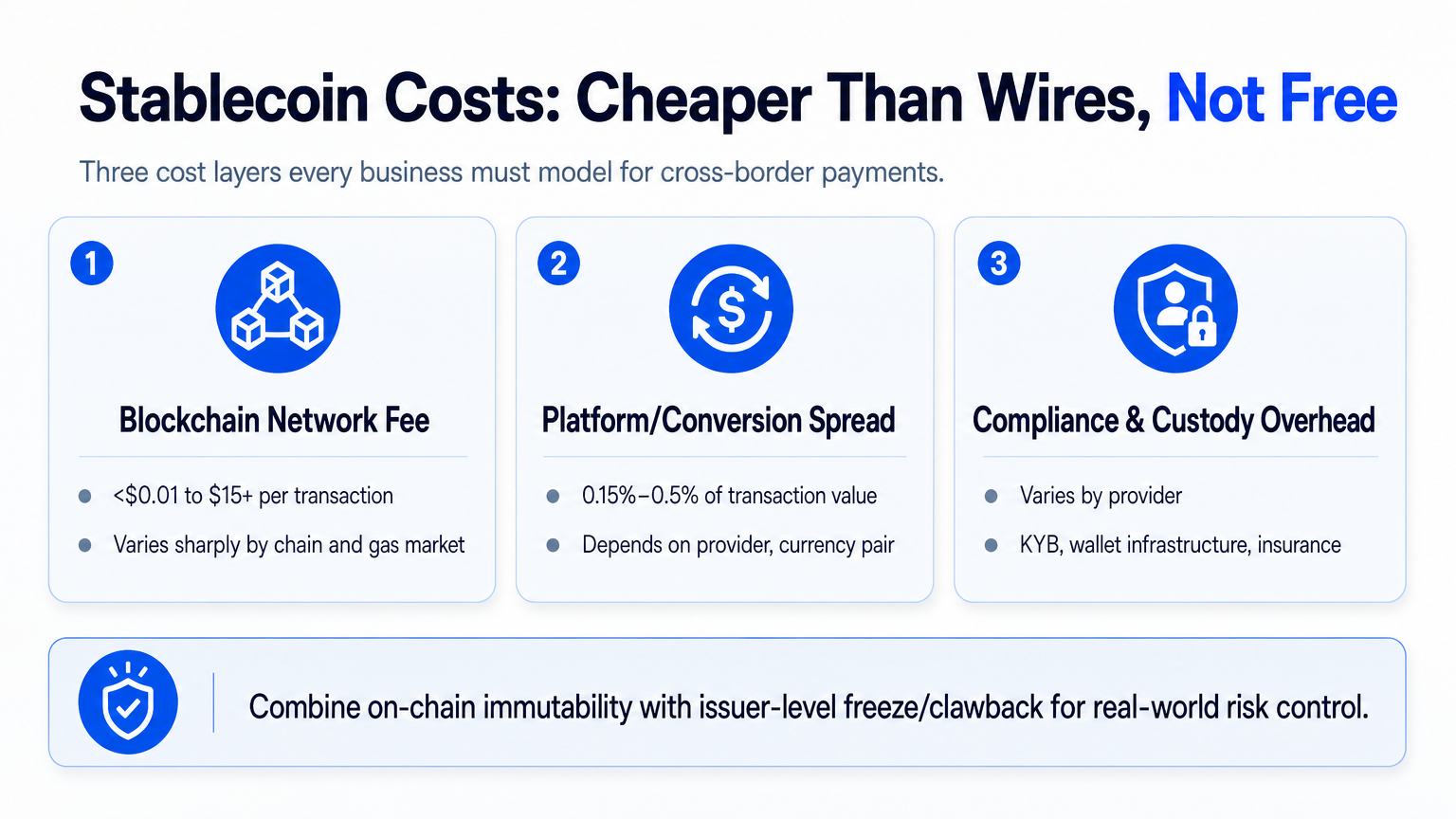
The all-in cost is more nuanced than “near-zero.” Network fees on Polygon or Solana may be sub-cent, but businesses must account for conversion spreads (0.1–0.5%), platform fees, and occasional high gas on Ethereum mainnet (above $10). Source disagreement exists: some marketing claims fees are free, while enterprise guides like Fipto and Nium emphasize total cost varies sharply with chosen network and providers. For a $50,000 cross-border payment through a regulated platform, all-in cost might be 0.15–0.5%—much cheaper than a SWIFT wire (1–3%), but not zero.
A practical cost framework:
| Cost Layer | Typical Range | Depends On |
|---|---|---|
| Blockchain network fee | <$0.01 to $15+ | Chain used, gas market |
| Platform/conversion spread | 0.15%–0.5% | Provider, currency pair, liquidity |
| Compliance & custody overhead | Varies by provider | KYB, wallet infrastructure, insurance |
Existing infrastructure from Visa’s B2B settlement and Stripe’s USDC payouts already offers speed, but required adopting a specific gateway. The missing piece was integration into ERPs and corporate banking portals.
Can stablecoin payments be reversed?
On-chain transfers are immutable. Once confirmed, a transaction cannot be reversed by the sender alone. However, centralized issuers like Circle (USDC) retain the ability to freeze an address and claw back funds via smart-contract controls in cases of fraud or legal order. For businesses, the practical reality is a hybrid: day-to-day immutability with a clawback safety net for regulated stablecoins when judicial intervention occurs. Treat stablecoin payments as not universally irreversible; understand issuer-level controls and build them into risk policies.
Implications of SAP and Samsung’s Move for Your Business
With SAP embedding stablecoin settlement inside ERP modules, finance teams can automate cross-border invoice payment without a separate crypto wallet. A supplier in Nigeria could receive instant USDC, reconciled against an open payable, while corporate treasury holds fiat and pushes stablecoin through an integrated neo-banking crypto payments platform.
For the Samsung stablecoin wallet, consumer-facing businesses gain an acceptance channel that needs only a wallet address at checkout, not a card terminal. The impact on cross-border stablecoin transactions is immediate: remote-worker payroll settled in stablecoins with fiat held on the corporate side until transfer; idle stablecoin balances swept into fiat via off-ramps; and on-chain records aligning with ERP entries for simplified reconciliation.
Platforms bridging fiat and stablecoin rails—such as OneSafe—become the connective layer. They provide the multi-currency accounts, FX conversion, and compliance workflows that let a business trigger a stablecoin payment from within its ERP or banking dashboard without managing private keys. The value shifts from custody to financial orchestration. OneSafe stablecoin integration illustrates how stablecoin payment integration no longer means hiring a smart-contract developer; it means connecting your stack to a compliant orchestration layer (more).
Are Stablecoin Payments Legal for Businesses?
Stablecoin payments are legal in most major jurisdictions, but the regulatory patchwork includes the EU’s MiCA framework governing issuance and payment services, while the U.S. is still moving toward comprehensive rules with proposals like the FASB’s cash-equivalent treatment. Key obligations remain KYB/KYC, transaction monitoring, and sanctions screening. Businesses must ensure the stablecoin and facilitating platform hold required licenses in relevant jurisdictions; regulated custodians and neo-banking platforms absorb much of this burden, but finance teams still need documented internal policies.
Which Stablecoin Should a Business Accept?
The market is coalescing around a two-tier model:
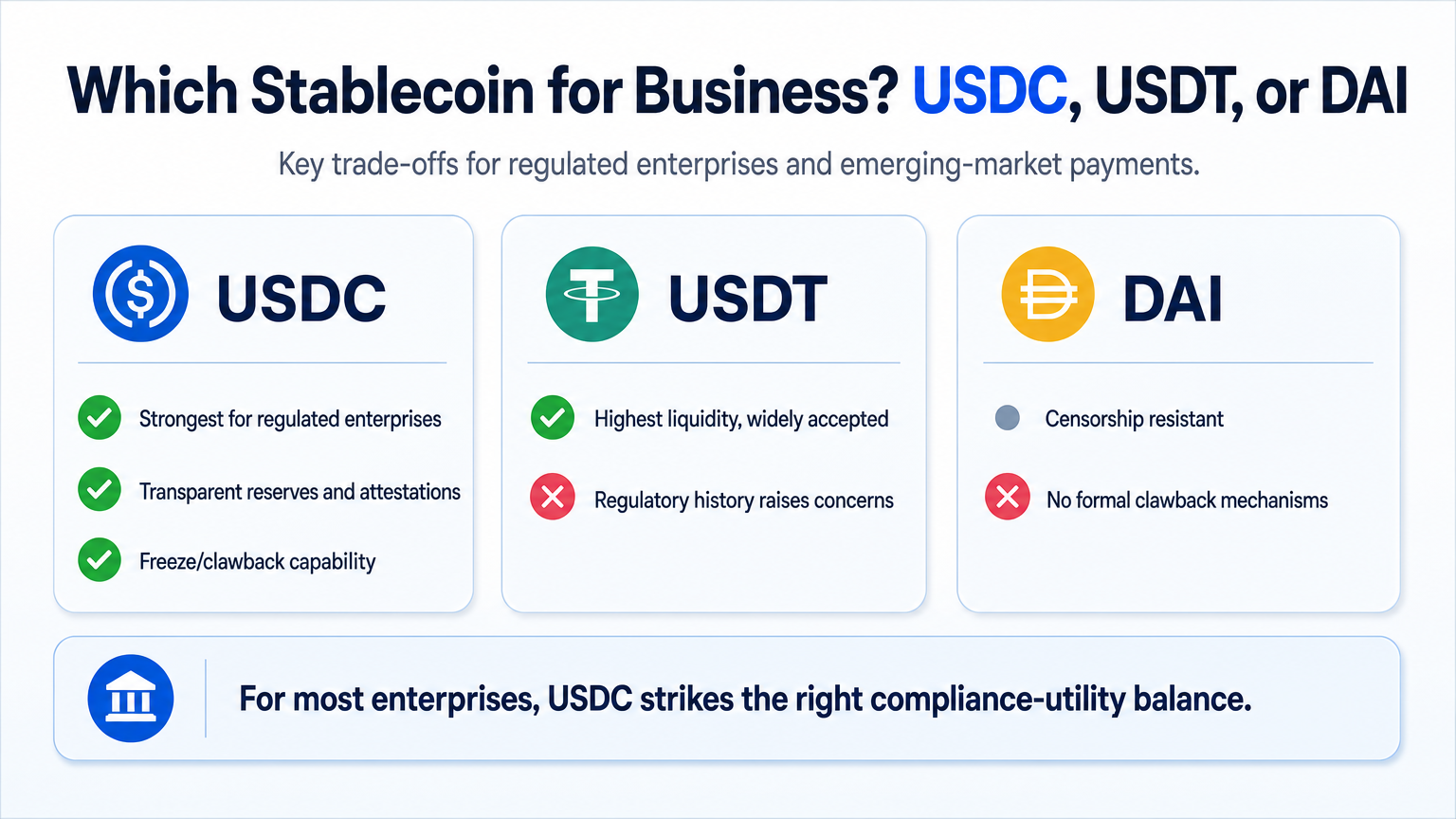
- USDC is the strongest choice for regulated enterprises due to transparent reserves, attestations, and issuer-level freeze/clawback capability aligned with audit requirements.
- USDT remains the most liquid, especially in emerging markets, but its regulatory history gives some finance teams pause.
Decentralized options like DAI offer censorship resistance but lack formal clawback mechanisms. Enterprise adoption leans toward regulated tokens, especially when payments route through ERP systems demanding counterparty visibility.
How Can Businesses Implement Stablecoin Payments Now
A five-step checklist:
- Audit your payment stack for stablecoin compatibility—check if your ERP or accounting system has an API for stablecoin settlement (SAP users will soon have native options).
- Select a neo-banking crypto payments platform that handles fiat and stablecoin rails with a single interface, automated on/off-ramps, and real-time FX at competitive conversion costs (0.15–0.25%).
- Onboard a regulated digital-asset custodian supporting the stablecoins you’ll use, with segregated institutional-grade security.
- Integrate compliance workflows: automated KYB for new suppliers, transaction monitoring, and a clear policy for frozen or clawed-back funds.
- Pilot a single cross-border corridor before full rollout. Measure settlement time, total cost, and reconciliation effort against current wire or card flows.
With SAP stablecoin embedded payments ahead, building the fiat-to-stablecoin connective layer now positions you when the toggle appears in your ERP.
What Role Do Platforms Like OneSafe Play in Embedded Stablecoin Payments?
Neo-banking platforms that unify fiat and crypto accounts are the hidden distribution layer behind embedded stablecoin payments. They act as the translation engine: a business initiates a payment in its ERP or banking dashboard, a stablecoin settles on-chain, and in between the platform handles fiat-to-stablecoin conversion, compliance screening, and wallet management without exposing private-key complexity. For example, a global startup can use OneSafe to hold multi-currency fiat balances, pay a European supplier via SEPA, and settle a freelancer in USDC—all from one dashboard. As distribution moves inside enterprise software, platforms bridging both worlds are the primary integration point, not the blockchain itself. OneSafe stablecoin integration exemplifies this shift.
Recommended Actions for Finance Teams
- Map counterparty acceptance: confirm which stablecoins key suppliers can receive.
- Model total cost (platform fees, FX, gas) for top corridors—speed unlocks working capital savings.
- Engage ERP implementation partners to understand SAP’s stablecoin module timeline; early access can give a head start.
- Draft an internal stablecoin policy covering accepted tokens, issuer-control risks, and procedures for frozen funds, alongside treasury protocols.
What to Watch Next
- Whether other enterprise vendors (Oracle, Microsoft Dynamics) follow SAP’s lead, making embedded stablecoin payments an expected ERP feature.
- How regulators treat stablecoins inside ERP systems—when settlement looks like a standard financial application line item, the conversation may shift to stablecoin regulation 2026 as payments regulation.
- Emergence of standardized stablecoin payment APIs that let any system plug into stablecoin rails, accelerating enterprise stablecoin adoption.
Key Takeaways
- Distribution now outweighs issuance: SAP and Samsung’s October 13 moves embed settlement inside software and the Samsung stablecoin wallet, lowering the blockchain expertise barrier.
- Cost is not zero, but using efficient on/off-ramps can undercut wires by 50–80%; model your corridors.
- Reversibility is hybrid: on-chain transfers are immutable, but regulated stablecoins like USDC allow issuer-level freezes—critical for corporate risk controls.
- Neo-banking crypto payments platforms are the integration point connecting ERP and consumer wallets to stablecoin rails.
- Audit your stack and pilot a cross-border flow before the SAP toggle arrives.
For global businesses looking to unify fiat and stablecoin payment operations, explore how OneSafe can streamline your financial infrastructure.



