Stablecoin payments are fundamentally altering the relationship between Ethereum and the U.S. dollar. An October 12, 2026 analysis from Racine County Eye shows that the surge in stablecoin activity on Ethereum could rewire the ETH‑to‑USD economy, turning ether into a utility token powering the world’s most active dollar‑denominated payment network. This shift arrives as U.S. policymakers debate the ground rules for payment stablecoins via the GENIUS Act and businesses scramble to modernize.
Table of Contents
- What just happened: The ETH‑USD economy is being rewired
- Why it matters now for global businesses and DAOs
- The background: How stablecoins on Ethereum came to dominate payments
- Concrete implications and recommended actions
- What to watch next
- Key Takeaways
What just happened: The ETH‑USD economy is being rewired

The news: Stablecoin payments on Ethereum change the game (Racine County Eye, Oct 12, 2026)
On October 12, 2026, Racine County Eye reported that stablecoin payments on Ethereum are reshaping the ETH‑USD dynamic. Because dollar‑backed stablecoins—USDC, USDT, and others—largely settle on Ethereum, every cross‑border stablecoin payment, payroll run, and treasury transfer consumes ETH as gas. This makes ether a necessary utility, not simply a speculative asset. As stablecoins penetrate global commerce, the ETH‑USD relationship becomes one of operational dependency.
Why this story now: Policy debates and soaring volumes
Regulatory attention is at a peak. The GENIUS Act framework, debated through 2026, aims to define “payment stablecoins” and set issuer rules. Meanwhile, stablecoin adoption in 2026 has ballooned: Arkham Research’s payment‑rails guide notes that stablecoin settlement now rivals daily card‑network volumes. This combination of scale and regulatory urgency makes the ETH‑USD rewiring a live issue for any organization moving money across borders.
Why it matters now for global businesses and DAOs
How are stablecoin payments changing the ETH‑to‑USD economy?
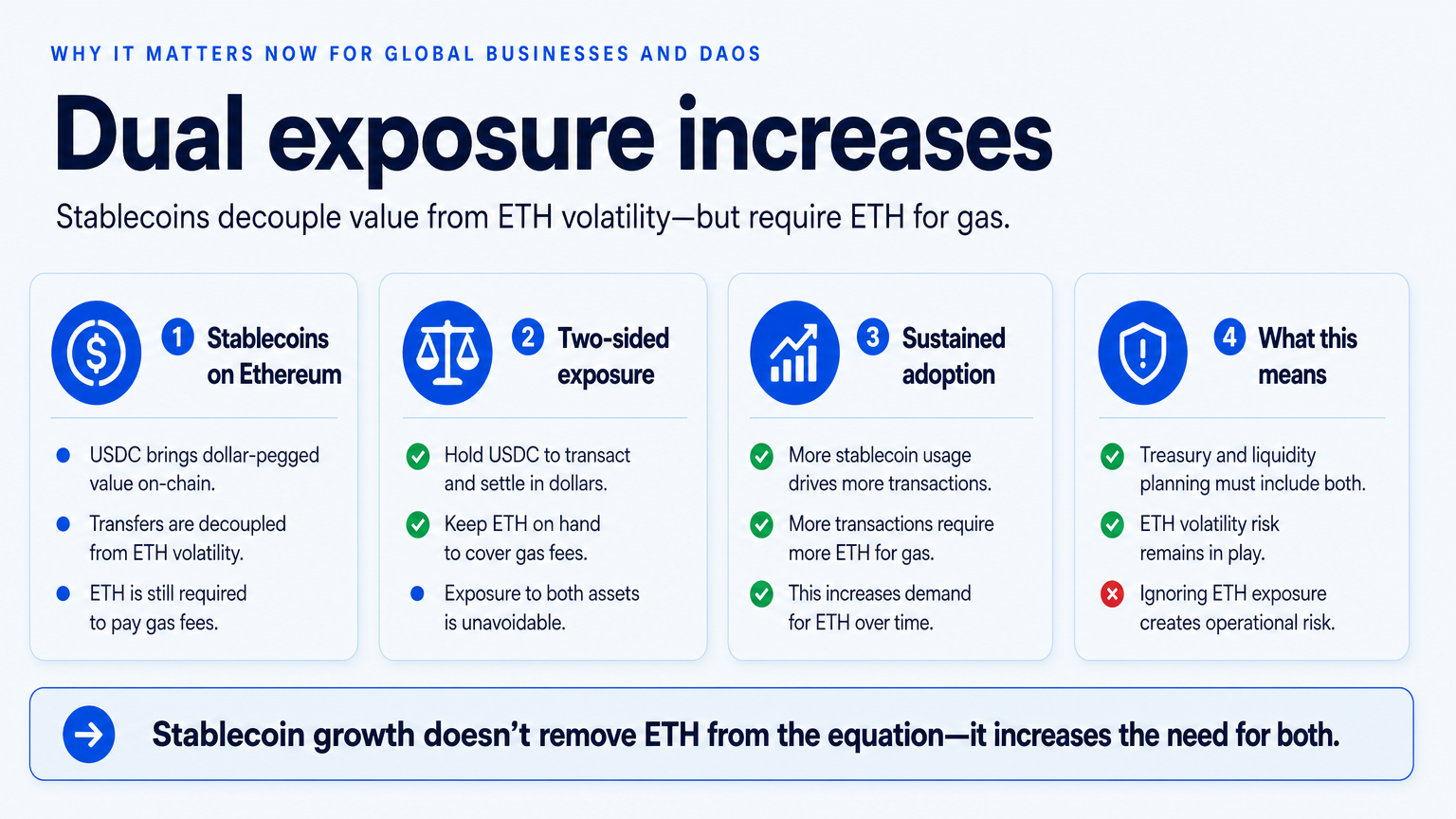
Stablecoin payments inject dollar‑pegged value onto Ethereum, decoupling transfers from ETH volatility while still requiring ETH for gas. This creates a two‑sided exposure: businesses hold USDC for payments but must keep ETH for fees. Sustained stablecoin adoption thus increases structural demand for ETH as a network commodity—a shift that turns the ETH‑USD pair from a purely speculative market into one driven by real‑world payment throughput.
What do the Racine County Eye findings mean for my business?
The findings surface a risk and an opportunity. As stablecoin traffic grows, Ethereum gas fees can spike during congestion, making routine payments unpredictably expensive. The upside: businesses that adopt stablecoin rails cut cross‑border settlement costs dramatically and integrate directly with Web3‑native platforms—provided they also manage ETH‑fee exposure. Ignoring the ETH‑USD link means underestimating the total cost of running stablecoin operations.
The pain of running separate fiat and crypto stacks
Most internationally active companies still rely on fragmented setups: a bank for fiat, a wallet for crypto, a third‑party on‑ramp, and manual reconciliation. This patchwork slows close cycles and duplicates compliance checks—exactly the opposite of what treasury automation promises.
Stablecoin payments are graduating to core infrastructure
Enterprise providers like Stripe and Circle, along with research from BVNK, show stablecoin payment rails being embedded into institutional treasury flows. Combined with the 2026 FASB proposal that could let companies treat stablecoins as cash equivalents—a change covered in OneSafe’s accounting overhaul analysis—stablecoins are moving from experimental tools to core infrastructure.
The background: How stablecoins on Ethereum came to dominate payments
Ethereum as the settlement layer: from volatile gas to utility token
Early Ethereum gas swings scared off payment use cases. But as issuers chose Ethereum for its security, wallet ecosystem, and composability, the network evolved into a general‑purpose settlement layer for dollar value. Today, over 80% of USDC’s supply sits on Ethereum, turning it into a de facto ACH‑like system for programmable dollars.
The rise of USD‑backed stablecoins and the GENIUS Act
The spread of fully reserved, regulated stablecoins like USDC and the push for the GENIUS Act payment stablecoins framework have given businesses confidence to hold and pay in dollar‑pegged tokens without fearing issuer insolvency. As Alacriti noted in its overview of stablecoin programmability, embedding payment logic directly into token transfers is a step‑change over ACH and wires.
Why businesses turn to neobanks that unify fiat and crypto
To escape the complexity of managing fiat, stablecoins, and ETH gas, businesses are adopting crypto‑friendly business accounts that combine multi‑currency fiat wallets, on‑chain addresses, corporate cards, and automated off‑ramps under one login. As OneSafe’s neobank crypto guide explains, the value lies in collapsing three separate financial relationships into one dashboard.
Concrete implications and recommended actions
Assess platform consolidation
If you’re using one bank for fiat, one exchange for on‑ramps, and a multisig for DAO funds, you are leaking time and fees on every transaction. Consolidating into a single fiat‑and‑crypto payment platform that offers ACH, wires, and stablecoin transfers is now a competitive necessity.
How a global business or DAO can start using stablecoins for payments
Onboarding takes less than a week with proper documentation. A platform like OneSafe illustrates the workflow:
- Complete digital KYB.
- Receive a multi‑currency account and on‑chain wallet.
- Fund via wire, ACH, or crypto deposit.
- Convert fiat to USDC instantly at low fees.
- Pay vendors and contributors in stablecoins, cutting settlement from days to minutes.
| Payment Method | Speed (Cross‑Border) | Cost for $10,000 Example | Key Friction |
|---|---|---|---|
| SWIFT Wire | 2–5 days | ~$50 – $100 (0.35% + $50) | Intermediary fees, hidden FX margins |
| Domestic ACH (US) | 1 day | ~$0.15 | Not available internationally |
| Stablecoin (USDC on Ethereum) | < 1 minute | Gas fee only (~$5 – $50) + 0% deposit/withdrawal fee | Must hold minimal ETH for gas |
| Stablecoin (USDC on L2) | Seconds | Gas fee < $0.05 | Requires L2 bridge; many platforms already support |
Gas fees are network‑driven; L2 averages from Arbitrum/Optimism as of October 2026.
Case in point: How OneSafe bridges the gap
OneSafe is a neobank for Web3 startups that provides multi‑currency fiat accounts, corporate cards, automated stablecoin payouts, and on/off‑ramps from a single interface. For a DAO, that could mean paying a freelancer in USDC from the treasury, issuing virtual cards for subscriptions, and sweeping idle fiat into yield—all without leaving the dashboard. More on DAO treasury management can be found in this crypto treasury guide.
What is a neobank that handles both fiat and stablecoins?
It’s a financial technology platform—not a bank—that partners with institutions to offer fiat accounts alongside native crypto wallets and payment rails. It replaces the dance of sending fiat to an exchange, swapping, and then moving on‑chain. Onboarding is digital; assets are custodied with institutional‑grade security, and all users are protected by multi‑factor authentication. These platforms typically integrate with accounting software, simplifying reconciliation.
Managing Ethereum gas fees for stablecoins
Ethereum gas fees are the largest variable cost in stablecoin operations. While stablecoin payments themselves are free of FX volatility, gas costs can spike during congestion. Mitigation strategies:
- Batch low‑priority transfers during off‑peak periods.
- Keep a small ETH reserve purchased at low price windows.
- Migrate recurring payments to Layer‑2 networks where fees are negligible. Many enterprise stablecoin payment rails now support L2s natively.
The reality is: stablecoins don’t expose you to ETH price volatility for the value transferred, but they force you to hold and spend ETH as gas, creating a structural tie between the two ecosystems.
DAOs: programmatic payments meet real‑world obligations
Using multisig wallets tied to a fiat and crypto payment platform, DAOs can automate contributor payments in USDC, pay SaaS providers with virtual cards, and manage grant distributions—with on‑chain transparency and role‑based permissions. This transforms treasury management into a programmable financial stack.
What to watch next
Will the GENIUS Act define payment stablecoins and change the rules?
If passed, the GENIUS Act would create a federal framework for payment stablecoin issuers, possibly imposing reserve and licensing requirements. This would give businesses legal clarity but might also raise issuer costs. The definition of “payment stablecoin” will determine which tokens qualify and whether activity remains concentrated on Ethereum.
Ethereum scalability: will L2s decouple stablecoin activity from ETH price?
If stablecoin transactions move overwhelmingly to L2s, the ETH‑demand linkage could weaken. Yet L2s still settle on Ethereum, and sequencer fees may still require ETH at some layer. The open question is whether residual demand is enough to sustain ETH’s utility value.
Can traditional banks catch up, or will neobanks eat their cross‑border lunch?
Banks have been slow to integrate stablecoin rails. Meanwhile, stablecoin adoption in 2026 is accelerating, and neobanks that fuse fiat banking with crypto services are capturing SME business. Without unified dashboards, banks risk losing entire client relationships.
What to watch in stablecoin regulation this year
Beyond the GENIUS Act, the FASB’s proposal on stablecoins as cash equivalents (detailed in this regulatory update) and the Financial Stability Board’s run‑risk warnings could shape capital and accounting rules through 2027. Any business holding material stablecoin balances should track these developments.
Key Takeaways
- Stablecoin payments on Ethereum are turning the ETH‑USD pair into a demand‑driven utility relationship, with ETH consumed as gas for dollar transfers.
- The Racine County Eye analysis highlights that businesses now manage both stablecoin balances and ETH reserves—a double exposure that unifies the two economies.
- Platforms like OneSafe eliminate the need for multiple bank and wallet relationships, cutting cross‑border stablecoin payment settlement to minutes and slashing costs.
- Layer‑2 adoption is the fastest lever to neutralize Ethereum gas fees for stablecoins, while the GENIUS Act payment stablecoins framework could solidify corporate‑grade stablecoins.
- The window for traditional banks is closing; consolidating financial operations onto a single fiat‑and‑stablecoin platform today positions businesses for tomorrow’s programmable money economy.
Start receiving and sending stablecoin payments through a crypto‑friendly business account built for global operations.