Stablecoin Payments: OCC Final Rule Explained
On October 21, 2026, the Office of the Comptroller of the Currency (OCC) issued a final rule implementing the Guiding and Establishing National Innovation for U.S. Stablecoins Act — the GENIUS Act — for OCC-supervised entities. As detailed in an Arnold & Porter Advisory dated October 30, 2026, the rule introduces principles‑based standards for reserve backing, redemption, and risk management, while BSA/AML and sanctions requirements are reserved for a separate Treasury-coordinated rulemaking. For businesses that use stablecoin payments every day, this is not an abstract regulatory milestone: it is the moment the rails you route money over begin to standardize, and the compliance ground rules get written down, with an effective date of January 18, 2027.
Table of Contents
- What Just Happened: The OCC's Stablecoin Payment Framework
- Why This Rule Matters for Stablecoin Payment Users
- Understanding the GENIUS Act: A Backgrounder for Operators
- What to Do Now: Practical Steps for Businesses
- Looking Ahead: Open Questions After the OCC Rule
- What does the OCC’s final rule mean for stablecoin payments?
- How will the rule impact businesses that use stablecoins day‑to‑day?
- When does the new stablecoin framework take effect?
- What concrete steps should my team take before January 2027?
- What parts of stablecoin compliance are still unresolved?
- Could this rule change how cross‑border stablecoin payments work for my company?
- Key Takeaways
What Just Happened: The OCC's Stablecoin Payment Framework
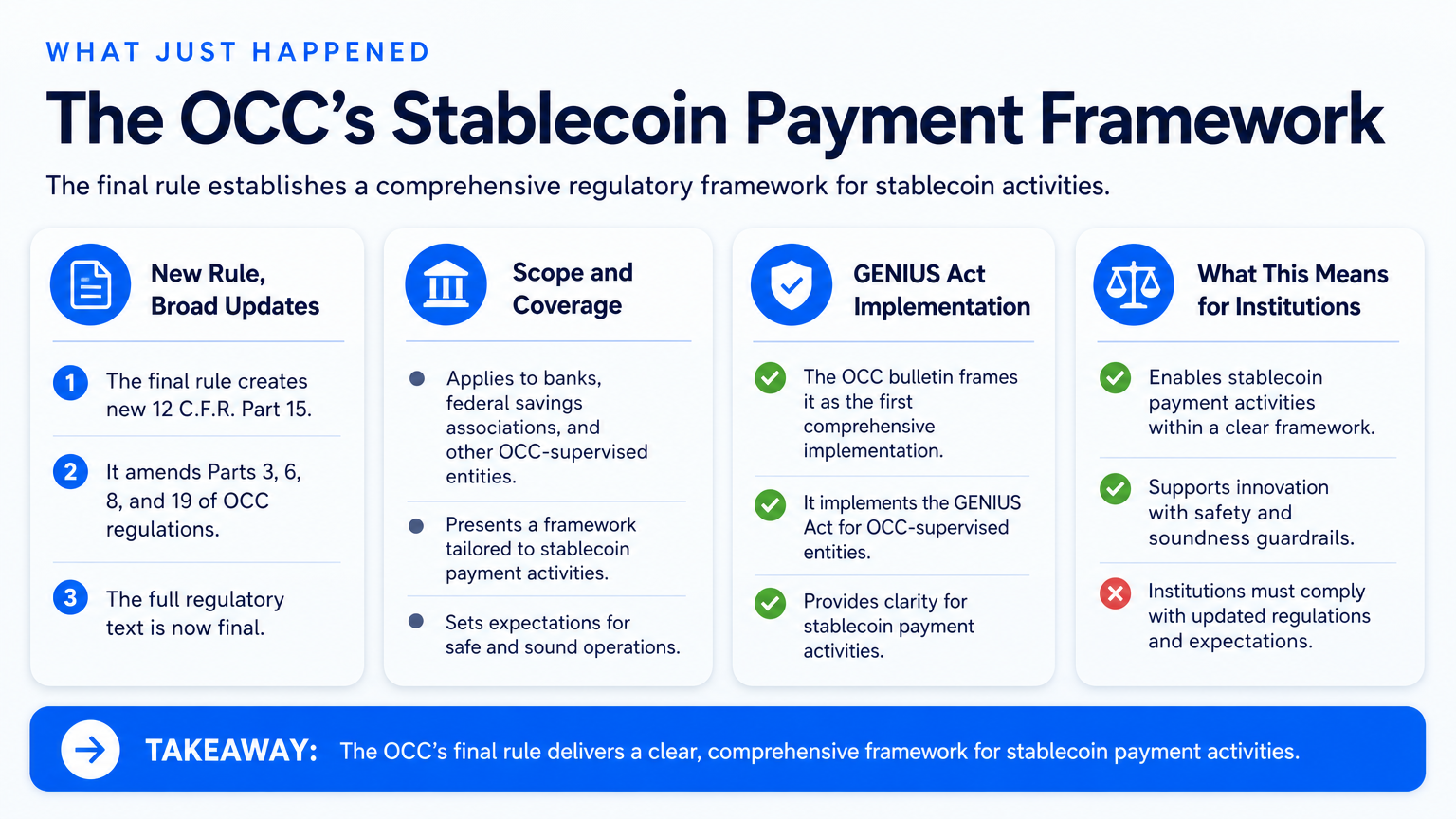
The final rule creates new 12 C.F.R. Part 15 and amends Parts 3, 6, 8, and 19 of OCC regulations. The OCC bulletin frames it as the first comprehensive implementation of the GENIUS Act for banks, federal savings associations, and other OCC‑supervised entities. The full regulatory text appears in the Federal Register under “Implementing the Guiding and Establishing National Innovation for U.S. Stablecoins Act.”
Comptroller Gould called the rule “a clear, practical framework for payment stablecoin innovation, with strong standards for reserve backing, redemption, and risk management,” according to the October 30, 2026 Arnold & Porter advisory.
Key Requirements: Reserves, Redemption, and Risk Management
The rule is principles‑based, not prescriptive. OCC‑supervised issuers must hold reserve assets fully backing outstanding stablecoins, maintain enforceable redemption rights at par, and implement risk management frameworks scaled to their operations. That’s reserves, redemption, and the controls in between. The final rule’s more flexible posture — noted in Arnold & Porter’s October 30 analysis — means fewer rigid checkboxes and more interpretive latitude, but also more responsibility to get the judgment calls right.
Why This Rule Matters for Stablecoin Payment Users
Stablecoin payments have lived in a regulatory gray zone. The GENIUS Act final rule changes that for OCC‑supervised issuers: reserves, redemption, and risk management are now regulatory prerequisites, not voluntary best practices. When your company sends or receives stablecoins, a growing share of the issuers will operate under the same supervisory umbrella as the banks you already rely on. That makes the OCC final rule effective date of January 18, 2027 a milestone to build workflows around.
For cross‑border stablecoin transactions, the counterparty risk picture sharpens. If the issuer is OCC‑supervised, the reserve and redemption standards are statutory, not promotional. Stablecoin payments have already shifted toward clearer instruments as RLUSD surged 88% while XRP fell — a rebalancing this rule accelerates. As issuer standards consolidate, due‑diligence costs per transaction fall, and the rationale for staying on the sidelines weakens.
Understanding the GENIUS Act: A Backgrounder for Operators
The GENIUS Act established a federal framework for payment stablecoin issuers, creating a path for both bank and non‑bank issuers under federal or state charters with standardized reserve, redemption, and consumer protection obligations. The Congressional Research Service’s overview provides a legislative baseline. Before this, the closest thing to federal clarity was a patchwork of OCC interpretive letters and state money‑transmission regimes — which is why Ripple’s earlier OCC approval was treated as a stablecoin regulation turning point. The final rule now codifies that openness into a durable stablecoin payment legal framework.
What’s Not Covered Yet: BSA/AML and Sanctions Compliance
The biggest gap is deliberate. BSA/AML and sanctions requirements are reserved for a separate Treasury‑coordinated rulemaking, with no published timeline. Arnold & Porter’s October 30 advisory notes the OCC will “closely monitor the industry as the statute and Final Rule take effect, signaling the possibility of future interpretive guidance.”
That’s a problem for payment operations teams, not a reprieve. If you use stablecoins for cross‑border settlement, BSA/AML obligations apply to your business today, regardless of the OCC rule. Freeze‑and‑seizure dynamics remain live under existing frameworks. Sanctions screening and transaction monitoring obligations continue to rest on each intermediary — including your own treasury function. A rule silent on BSA/AML doesn’t remove those duties; it leaves them scattered, for now.
What to Do Now: Practical Steps for Businesses

The January 18, 2027 effective date may feel distant, but operational lead time is not. Treasury changes, bank negotiations, and documentation reviews all move slowly.
| Action | Why It Matters | Priority |
|---|---|---|
| Map every stablecoin flow: which issuer, chain, and custodial partner | Counterparty risk is invisible until you know who holds the tokens behind each payment | High |
| Confirm whether each issuer is OCC‑supervised or state‑regulated under GENIUS | The final rule applies only to OCC‑supervised entities; others fall under parallel state regimes | High |
| Document redemption terms and reserve attestations from each stablecoin provider | Redemption at par and reserve backing are now enforceable standards, not marketing claims | Medium |
| Review sanctions and AML controls at every step of the payment chain | Pending BSA/AML rulemaking doesn’t pause your obligations today | High |
| Test a fallback rail for critical treasury flows | Even a regulated issuer can fail; redundancy is essential | Medium |
Evaluate Your Stablecoin Payment Providers
Ask every issuer you hold or transact with whether they are OCC‑supervised, state‑supervised under the GENIUS Act, or still operating under legacy state money‑transmission frameworks. The answer determines which stablecoin issuer standards apply — and which protections you can rely on.
For businesses managing multi‑currency treasury through a fintech platform, the platform’s bank partners become part of this diligence. OneSafe, for example, is a financial technology company — not a bank — that delivers banking services through partner banks, so its stablecoin payment infrastructure sits on top of its partners’ regulated rails. When you move USDC through such a platform, you inherit both the platform’s controls and the underlying bank’s supervisory obligations. That layering is increasingly the norm.
Review Settlement and Treasury Workflows
Cross‑border stablecoin transactions often touch multiple intermediaries: a sender’s bank, an exchange or OTC desk, a stablecoin issuer, and a receiving platform. Map the chain and ask: does every leg have a defined redemption path and a sanctions‑compliant counterparty?
Prepare Documentation for Future Compliance Requests
When the Treasury‑coordinated BSA/AML rulemaking arrives, businesses will need to document source of funds, purpose, and counterparties far more rigorously than most do today. Preparing that documentation now, in a consistent, auditable format, is a competitive advantage. For teams that publish internal updates or client‑facing compliance guidance, tools like Joyrise, which plans, writes, and publishes illustrated SEO articles to your Webflow blog every day, can help keep documentation pipelines current without adding editorial overhead.
Looking Ahead: Open Questions After the OCC Rule
How Will Banks and Tech Platforms Respond?
Most OCC‑supervised banks don’t issue stablecoins today. The final rule lowers the barrier to entry with a clear, flexible framework. Whether banks respond by issuing their own payment stablecoins, partnering with existing issuers, or building acceptance rails will shape how quickly stablecoin payment infrastructure consolidates — or fragments.
The International Regulatory Ripple Effect
The EU’s MiCA framework and the GENIUS Act now create two large regulated blocs for stablecoin payments. Jurisdictions in Asia and Latin America will watch how the U.S. stablecoin compliance 2027 timeline plays out. The open question is whether other jurisdictions converge on the OCC’s principles‑based model or diverge toward stricter mandates.
What does the OCC’s final rule mean for stablecoin payments?
It moves stablecoin payments out of a regulatory gray zone and onto supervised infrastructure. For the first time, OCC‑supervised issuers have a legally binding framework covering reserve backing, redemption rights, and risk management — replacing voluntary attestations with enforceable standards.
How will the rule impact businesses that use stablecoins day‑to‑day?
In the near term, payments settle as they do today. What changes is diligence: you now know which standards your issuer must meet. Over time, as banks and fintech platforms adopt the framework, business stablecoin payments will likely become cheaper to integrate because the compliance stack — bank accounts, reserve reporting, redemption guarantees — standardizes.
When does the new stablecoin framework take effect?
The final rule takes effect January 18, 2027. It was issued October 21, 2026, and applies to all OCC‑supervised stablecoin issuers. BSA/AML and sanctions requirements have no date yet — they remain reserved for separate Treasury‑coordinated rulemaking.
What concrete steps should my team take before January 2027?
Prioritize three things. First, map every stablecoin issuer and custodial partner in your payment chain and verify their supervisory status. Second, document redemption terms and reserve attestations for each. Third, test redundancy: what happens if a single issuer freezes, de‑pegs, or loses its standing? The $1.8B freeze and $5.6B breach analyzed in our Web3 payments breakdown show that operational resilience is not theoretical. Secure custody practices, as discussed in our post‑Bybit analysis, matter every bit as much as the legal framework.
What parts of stablecoin compliance are still unresolved?
The biggest unresolved piece is BSA/AML and sanctions compliance, explicitly reserved for a future Treasury‑coordinated rulemaking with no published timeline. Also open: how OCC interpretive guidance will evolve, and whether state regulators align with or diverge from the federal framework.
Could this rule change how cross‑border stablecoin payments work for my company?
It could, but not overnight. The most likely near‑term change is settlement certainty: when cross‑border transactions run through OCC‑supervised issuers, redemption and reserve standards carry bank‑regulation‑grade obligations. That reduces the due‑diligence burden and may eventually lower the cost of cross‑border treasury management. For multi‑currency operations, the rule creates a consistent reference point for what “regulated” means — even if speed, FX economics, and network fees remain largely unchanged.
Key Takeaways
- The OCC’s final GENIUS Act rule takes effect January 18, 2027 — a date to treat as a workflow milestone, not a headline.
- It imposes enforceable standards on reserve backing, redemption, and risk management for OCC‑supervised issuers. BSA/AML and sanctions compliance remain unresolved pending Treasury‑coordinated rulemaking.
- Day‑to‑day stablecoin payments won’t change immediately, but counterparty risk is now much clearer for OCC‑supervised issuers.
- The pragmatic priorities before January 2027: map every issuer, verify supervisory status, document redemption terms, and test redundancy.
- Cross‑border stablecoin payments gain settlement certainty, but the biggest operational variable — AML/CFT enforcement — is still an open question.
Ready to manage fiat and stablecoin payments under one roof with a compliance‑first platform? Open your OneSafe account and run your treasury on infrastructure built for the new regulatory era.