Meta description: Canada’s new stablecoin rules permit activity-based rewards for business payments and DAO treasury management, reshaping global stablecoin regulation.
Stablecoin Regulation: Canada’s New Yield Rules
On October 23, 2026, Canada’s Department of Finance published draft stablecoin regulation that permits issuers to distribute rewards tied to transaction activity—not passive deposits. This deliberate shift away from an outright yield ban could reshape stablecoin for business use cases, including DAO treasury management, without triggering securities classification.
Table of Contents
- What just happened with Canada stablecoin rules?
- Stablecoin for business: operational currency and treasury management
- Risks and benefits of earning yield on stablecoins
- How stablecoins are regulated in the US and other major markets
- Compliance steps for businesses
- What’s next for stablecoin yield regulation globally?
- Key Takeaways
What just happened with Canada stablecoin rules?

The draft allows activity-based rewards—compensation linked to payments, conversions, or other on-chain actions—rather than rewarding mere balance holding. Rewards must be “directly linked to the volume, nature, or frequency of transactions,” deliberately separating them from securities. Public feedback runs until January 2026, final rules by mid-year.
Previously, OSFI banned any stablecoin yield, fearing blurring with deposits and securities. The new draft distinguishes loyalty-style rewards (like cashback) from passive interest:
| Yield Type | Regulatory Treatment | Example | Key Requirement |
|---|---|---|---|
| Passive Yield (interest on deposits, staking rewards from lending) | Blanket ban under previous policy, still prohibited under the new draft | Holding USDC in a “savings” pool that grows 4% APY regardless of usage | Rewards accrue solely with time; securities laws likely triggered |
| Activity-Based Rewards (cashback, usage-linked rebates) | Permitted for the first time under the draft | Earning 0.5% back in stablecoin each time a business pays a supplier or converts to fiat | Reward must be tied to a specific, verifiable transaction |
Stablecoin for business: operational currency and treasury management
18% of surveyed enterprises now use stablecoins in at least one payment flow (Stablecoin Payments Data). Canada’s activity-based rewards let businesses earn on funds while they move, lowering net costs. A DAO can layer a transaction rebate onto contributor payments, avoiding DeFi staking risks.
For DAO treasury management and Web3 firms, the choice is often between non-yielding wallets and risky lending pools. Canada’s draft offers a third path: yield as a byproduct of essential business activity. A startup using a platform like OneSafe converts fiat to USDC for supplier payments, triggering an activity-based reward—a compliant treasury yield that avoids securities reclassification. Cross-border context: Crypto Treasury Management: South Africa Revises Rules.
Risks and benefits of earning yield on stablecoins
The benefit: businesses recapture value on working capital via payment-linked rewards, improving cash flow without lending risk.
Risks:
- Regulatory reclassification. Poorly designed rewards could be deemed disguised interest, triggering securities laws—Canada’s draft draws a bright line, but global regulators have not converged.
- Gaming and compliance overhead. Artificial transaction volume to harvest rewards invites scrutiny; anti-fraud thresholds may raise complexity.
- Tax implications. Rewards likely taxable as income or rebates, cross-border treatment murky.
- Securities law tension. The US SEC views yield-bearing stablecoins as potential securities; Canada’s usage-linked model mirrors loyalty program jurisprudence.
The Congressional Research Service notes stablecoin yield remains a gray zone; Canada’s draft is the most concrete boundary yet.
How stablecoins are regulated in the US and other major markets
US: The OCC’s GENIUS Act final rule bans interest on stablecoin balances, but a May 2026 Senate deal could authorize activity-based rewards. The SEC’s posture keeps most issuers yield-free. The OCC’s stablecoin rulebook leaves room for supervisory agreements, but implementation is stalled.
EU: MiCA doesn’t explicitly permit yield; rewards resembling interest may clash with e-money rules. The 2027 review could address this. Singapore and UAE handle activity-based rewards case-by-case.
A crypto-friendly bank like OneSafe that natively links fiat and stablecoin flows helps companies navigate fragmented regimes.
Compliance steps for businesses
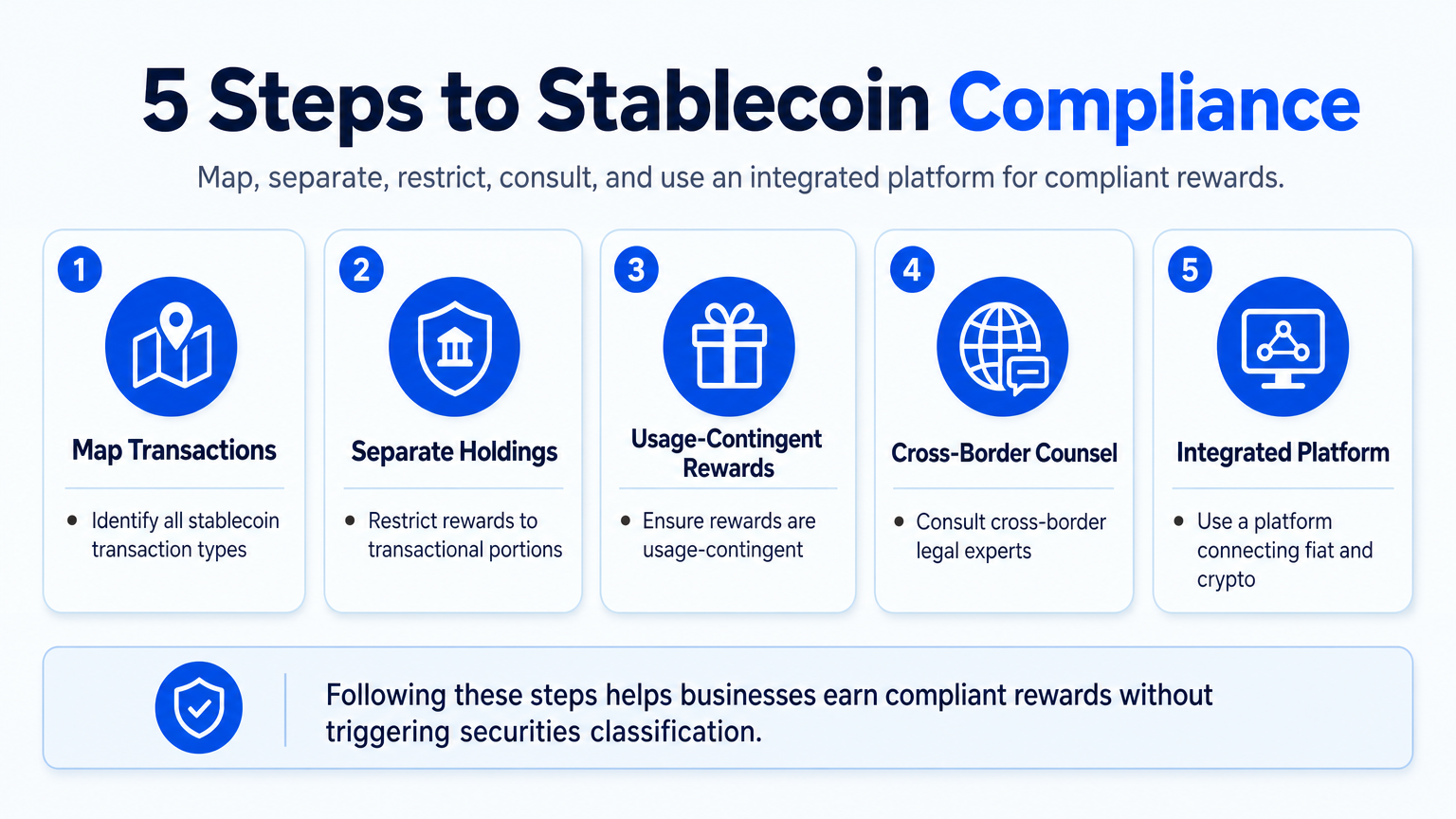
- Map all stablecoin transaction types.
- Separate passive holding from active usage – restrict rewards to transactional portions with clean audit trails.
- Ensure rewards are usage-contingent, not time-based.
- Consult cross-border legal counsel.
- Use a platform that natively connects fiat and crypto for automated reward tracking and compliance records.
OneSafe provides segregated multi-currency accounts, corporate cards, and instant conversions—tagging payments for rewards and generating audit-ready ledgers. Over $800M processed from 1,000+ businesses across 30 countries demonstrates viability at scale.
What’s next for stablecoin yield regulation globally?
Canada’s activity-based model offers a middle ground—payment utility without deposit products—influencing US GENIUS Act markups and the EU MiCA review. Watch for SEC no-action letters on activity-based rewards.
Open questions:
- What constitutes “activity”? Layer-2 transactions, swaps, governance votes?
- Anti-gaming thresholds – volume or velocity floors not yet proposed.
- Tax harmonization – rebate vs. income treatment remains unsettled.
- Cross-border enforcement – which rules apply when a Canadian‑compliant reward reaches a US user?
- Interplay with securities laws – activity triggers may still attract aggressive regulators.
Canada’s draft is the most concrete blueprint yet for resolving the yield dilemma without stifling innovation.
Key Takeaways
- Canada’s October 23, 2026 draft permits activity-based stablecoin rewards, prohibiting passive yield—creating a compliant path for businesses to earn on payments.
- DAO treasury management and operational treasuries can generate modest yield as a byproduct of real transactions, reducing opportunity cost without lending risks.
- The activity-based model avoids securities classification when rewards are genuinely tied to usage; poor implementation risks regulatory action, especially in the US.
- Global businesses should audit stablecoin workflows, separate passive balances, and use integrated fiat-crypto platforms for compliance and reward tracking.
- Canada’s approach influences US and EU debates, though significant jurisdictional differences remain.
To manage fiat and stablecoin treasuries across fragmented rules, explore a unified neo-banking platform at OneSafe.